
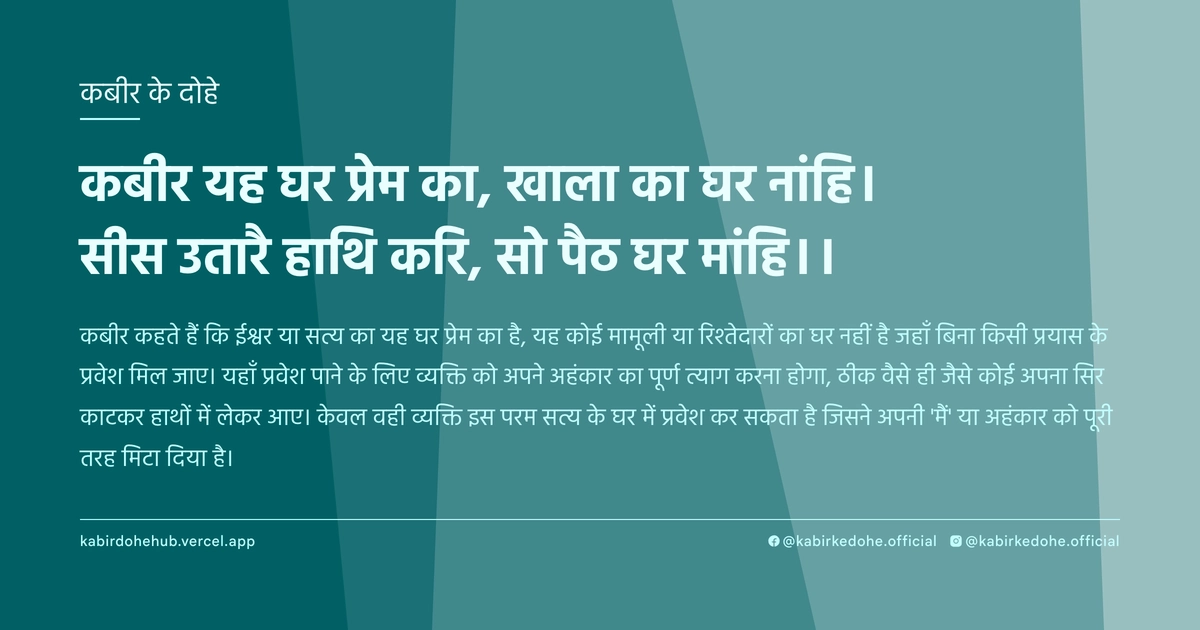
कबीर यह घर प्रेम का, खाला का घर नांहि।
सीस उतारै हाथि करि, सो पैठ घर मांहि।।
Kabir yeh ghar prem ka, khala ka ghar nahi. Sees utarai haathi kari, so paith ghar maahi.
इस पृष्ठ पर इस कबीर दोहे का अर्थ (meaning), हिंदी व्याख्या और अंग्रेज़ी अनुवाद, दार्शनिक विश्लेषण और व्यावहारिक जीवन सीख दी गई है। यह दोहा भक्ति (Bhakti) विषय से जुड़ा है — Kabir doha meaning and explanation in Hindi and English.
अर्थ (Meaning):
कबीर कहते हैं कि ईश्वर या सत्य का यह घर प्रेम का है, यह कोई मामूली या रिश्तेदारों का घर नहीं है जहाँ बिना किसी प्रयास के प्रवेश मिल जाए। यहाँ प्रवेश पाने के लिए व्यक्ति को अपने अहंकार का पूर्ण त्याग करना होगा, ठीक वैसे ही जैसे कोई अपना सिर काटकर हाथों में लेकर आए। केवल वही व्यक्ति इस परम सत्य के घर में प्रवेश कर सकता है जिसने अपनी 'मैं' या अहंकार को पूरी तरह मिटा दिया है।
Kabir asserts that the abode of Divine Love is not a casual dwelling or a relative's house where one can enter with entitlement or ease. It is a sanctuary of absolute surrender. To enter this house, one must be prepared to sever the head of the ego and carry it in one's hands. Only the seeker who has completely annihilated their sense of 'I-ness' and pride can truly step into the presence of the Ultimate Truth.
व्याख्या (Interpretation):
इस दोहे में 'घर' आत्मा और परमात्मा के मिलन का प्रतीक है। 'खाला का घर' एक मुहावरा है जो लापरवाही और अधिकार भाव को दर्शाता है, जिसे कबीर यहाँ नकारते हैं। 'सीस उतारना' का अर्थ शारीरिक मृत्यु नहीं, बल्कि मानसिक और आध्यात्मिक मृत्यु है—अहंकार का विसर्जन। यह निरगुण भक्ति का सार है जहाँ भक्त को यह समझना होता है कि जब तक 'मैं' मौजूद है, तब तक 'वह' (परमात्मा) नहीं मिल सकता। यह अद्वैत वेदांत के उस सिद्धांत से जुड़ा है जहाँ ज्ञाता और ज्ञेय का भेद मिट जाता है। माया हमें विश्वास दिलाती है कि हम अलग हैं, लेकिन प्रेम का मार्ग इस भ्रम को तोड़ता है। यह एक विरोधाभास है: स्वयं को पूरी तरह खोकर ही स्वयं को वास्तव में पाया जा सकता है।
In this couplet, the 'house' symbolizes the union of the Atman (individual soul) and Brahman (universal consciousness). The reference to a 'relative's house' serves as a metaphor for the casual, entitled approach many take toward spirituality, which Kabir sternly rejects. 'Severing the head' is not a literal act of violence but a profound metaphor for the psychological death of the ego. This aligns with Nirgun Bhakti, where the formless Divine is accessible only after the dissolution of the individual identity. It echoes Advaita Vedanta's non-duality: as long as the 'I' (ego) persists, the 'Thou' (Divine) remains distant. Maya creates the illusion of separation, but the path of Love demands the total annihilation of this boundary. It presents the central spiritual paradox: only by completely losing oneself can one truly be found.
दार्शनिक विश्लेषण (Philosophical Analysis):
कबीर का यह दृष्टिकोण उनके युग के धार्मिक पाखंड और कर्मकांडीय आडंबरों के विरुद्ध एक सशक्त प्रहार था। उस समय धर्म को बाहरी रीति-रिवाजों, जातिगत श्रेष्ठता और कठिन तपस्याओं के माध्यम से प्राप्त करने का प्रयास किया जाता था। कबीर ने स्पष्ट किया कि परमात्मा किसी मंदिर, मस्जिद या विशेष जाति के अधिकार क्षेत्र में नहीं है, बल्कि वह 'प्रेम' के घर में रहता है। यह प्रेम कामुक या सांसारिक नहीं, बल्कि 'इश्क-ए-हकीकी' (दिव्य प्रेम) है, जैसा कि सूफी मत में वर्णित है।
दार्शनिक स्तर पर, यह दोहा 'अहं ब्रह्मास्मि' की प्राप्ति के लिए 'अहंकार' के विलोपन की बात करता है। जब तक मनुष्य अपनी सामाजिक पहचान, ज्ञान का गर्व या नैतिक श्रेष्ठता को पकड़े रहता है, वह सत्य के द्वार पर खड़ा रहता है, भीतर प्रवेश नहीं कर पाता। कबीर यहाँ चेतावनी देते हैं कि आध्यात्मिक मार्ग कोई सैर-सपाटा नहीं है, बल्कि यह एक अग्नि-परीक्षा है जिसमें व्यक्ति को अपनी पूरी पहचान की आहुति देनी पड़ती है।
यह विचार सूफीवाद के 'फना' (annihilation) के सिद्धांत के अत्यंत निकट है, जहाँ साधक ईश्वर में विलीन होने के लिए अपने अस्तित्व को मिटा देता है। कबीर का 'सीस उतारना' वास्तव में उसी 'फना' की स्थिति है। वे समझाते हैं कि ज्ञान (Knowledge) यदि अहंकार पैदा करे, तो वह बंधन बन जाता है; केवल वह ज्ञान जो विनम्रता और समर्पण में बदल जाए, वही मुक्ति का मार्ग है।
सांस्कृतिक रूप से, कबीर ने जाति और वर्ण के भेदभाव को नकारते हुए यह स्थापित किया कि प्रेम ही एकमात्र योग्यता है। एक उच्च कुल का व्यक्ति यदि अहंकारी है, तो वह इस घर से बाहर है, जबकि एक निम्न कुल का व्यक्ति यदि समर्पित है, तो वह भीतर है। यह सामाजिक संरचना के प्रति एक क्रांतिकारी चुनौती थी।
अंततः, यह विश्लेषण हमें यह समझने पर मजबूर करता है कि आध्यात्मिक प्रगति बाहरी क्रियाओं से नहीं, बल्कि आंतरिक रूपांतरण से होती है। अहंकार का त्याग केवल एक विचार नहीं, बल्कि एक अनुभव है। जब 'मैं' मरता है, तभी 'सत्य' का जन्म होता है। यह मनोवैज्ञानिक रूपांतरण ही मनुष्य को पशुता से देवत्व की ओर ले जाता है।
Kabir's perspective serves as a powerful critique of the religious hypocrisy and ritualistic pomposity of his era. During his time, spirituality was often reduced to external rites, caste superiority, and grueling asceticism. Kabir dismantled these notions by asserting that the Divine does not reside in temples, mosques, or the exclusive domains of a particular caste, but in the 'House of Love.' This love is not mundane or erotic, but 'Ishq-e-Haqiqi' (Divine Love), as conceptualized in Sufism.
Philosophically, this doha addresses the necessity of eradicating the ego to realize the state of 'Aham Brahmasmi' (I am Brahman). As long as a person clings to their social identity, intellectual pride, or moral superiority, they remain at the threshold of Truth, unable to enter. Kabir warns that the spiritual path is not a casual stroll but a rigorous trial by fire where one must sacrifice their entire perceived identity.
This concept closely mirrors the Sufi doctrine of 'Fana' (annihilation), where the seeker dissolves their existence to merge with the Divine. Kabir's 'severing of the head' is a poetic representation of this state of Fana. He argues that knowledge, if it breeds ego, becomes a shackle; only knowledge that transforms into humility and surrender leads to liberation.
Culturally, by prioritizing love over lineage, Kabir challenged the rigid caste hierarchies of medieval India. He established that love is the only valid credential for spiritual entry. A person of high birth who is arrogant remains an outsider, while a marginalized person who is surrendered is welcomed inside. This was a revolutionary strike against the social structures of the time.
Ultimately, this analysis reveals that spiritual progress is not achieved through external actions but through internal transmutation. The surrender of the ego is not a mere intellectual exercise but a lived experience. When the 'I' dies, the 'Truth' is born. This psychological transformation is what elevates a human being from animalistic instinct to divine consciousness.
मूल संदेश (Core Message):
- अहंकार वह दीवार है जो आत्मा को परमात्मा से अलग करती है।
- प्रेम का मार्ग समर्पण से शुरू होता है, अधिकार से नहीं।
- सच्ची भक्ति बाहरी दिखावे में नहीं, आंतरिक विलोपन में है।
- जब 'मैं' मिटता है, तभी 'सत्य' का साक्षात्कार होता है।
- विनम्रता ही वह एकमात्र कुंजी है जो दिव्य द्वार खोलती है।
- The ego is the wall that separates the soul from the Divine.
- The path of love begins with surrender, not entitlement.
- True devotion lies in internal dissolution, not external display.
- Only when the 'I' vanishes does the 'Truth' manifest.
- Humility is the only key that unlocks the divine door.
व्यावहारिक उदाहरण (Practical Example):
वाराणसी के एक पुराने मोहल्ले में माधव नाम का एक अत्यंत विद्वान पंडित रहता था। माधव ने चारों वेदों का अध्ययन किया था और शहर भर में अपनी बौद्धिक श्रेष्ठता के लिए प्रसिद्ध था। वह अक्सर अन्य साधकों को उनकी कमियाँ बताता और उन्हें उपदेश देता कि ईश्वर तक पहुँचने का सही मार्ग क्या है। उसके लिए धर्म का अर्थ था—शुद्धता, शास्त्र और नियमों का पालन।
उसी शहर के एक कोने में एक वृद्ध विधवा, जानकी रहती थी, जो दूसरों के घरों में छोटे-मोटे काम करती थी। जानकी अनपढ़ थी, लेकिन उसका हृदय करुणा से भरा था। वह हर सुबह मंदिर की सीढ़ियों पर बैठकर बस मौन प्रार्थना करती और जो भी उसके पास आता, उसे प्रेम से पानी पिलाती। माधव उसे अक्सर 'अज्ञानी' कहकर उपहास करता था।
एक दिन शहर में एक रहस्यमयी फकीर आया। उसने घोषणा की कि वह केवल उसी व्यक्ति से बात करेगा जो अपना 'सब कुछ' त्याग कर उसके पास आए। माधव अपनी पोथियों और ज्ञान के अहंकार के साथ फकीर के पास पहुँचा। उसने फकीर को शास्त्रार्थ के लिए चुनौती दी और अपनी विद्वत्ता का प्रदर्शन करने लगा। फकीर ने उसकी ओर देखा भी नहीं और बस एक शब्द कहा—"अपना सिर यहाँ रख कर आओ।"
माधव क्रोधित हो गया। उसने कहा, "यह कैसी मूर्खता है? मैं एक महान विद्वान हूँ, आप मुझसे इस तरह बात कैसे कर सकते हैं?" माधव का अहंकार उसके ज्ञान की ढाल बनकर खड़ा था। वह यह नहीं समझ पाया कि फकीर 'अहंकार की मृत्यु' की बात कर रहा था। वह अपमानित महसूस कर वहाँ से चला गया।
तभी जानकी वहाँ पहुँची। उसके पास न तो शास्त्र थे, न ही कोई पद। उसने फकीर के चरणों में अपना सिर झुकाया और रोते हुए कहा, "प्रभु, मैं तो कुछ भी नहीं हूँ। मेरी कोई पहचान नहीं है, कोई ज्ञान नहीं है। मैं बस आपकी शरण में हूँ।"
फकीर ने मुस्कुराते हुए जानकी को गले लगाया और कहा, "तुमने अपना सिर (अहंकार) पहले ही उतार दिया था, इसलिए तुम इस प्रेम के घर में प्रवेश कर गई।"
माधव ने यह दृश्य दूर से देखा। उसे पहली बार महसूस हुआ कि उसकी सारी पोथियाँ और ज्ञान उसके और ईश्वर के बीच एक दीवार बन गए थे। उसे समझ आया कि वह 'खाला के घर' की तरह धर्म को एक अधिकार समझ रहा था, जबकि जानकी ने उसे एक समर्पण बना लिया था।
उस रात माधव घंटों तक रोया। उसने अपनी सारी पोथियों को एक तरफ रखा और पहली बार अपने भीतर की उस 'मैं' को देखने की कोशिश की जो उसे श्रेष्ठ बनाती थी। उसने महसूस किया कि जब तक वह 'विद्वान माधव' बना रहेगा, वह उस परम प्रेम को कभी नहीं पा सकेगा।
अगली सुबह, माधव अपनी सारी श्रेष्ठता का त्याग कर जानकी के पास गया और उससे पूछा कि वह इतनी शांति कैसे पाती है। उसने सीखा कि ईश्वर को पाने के लिए ज्ञान की नहीं, बल्कि उस ज्ञान के मिट जाने की आवश्यकता है। माधव का जीवन बदल गया; अब वह उपदेश नहीं देता था, बल्कि सेवा करता था।
In an old neighborhood of Varanasi lived a highly learned priest named Madhav. Madhav had studied the four Vedas and was renowned throughout the city for his intellectual superiority. He often pointed out the flaws of other seekers and lectured them on the 'correct' path to God. For him, religion meant purity, scriptures, and strict adherence to rules.
In a corner of the same city lived an elderly widow named Janaki, who did odd jobs in other people's homes. Janaki was illiterate, but her heart overflowed with compassion. Every morning, she would sit on the temple steps in silent prayer, offering water with love to anyone who passed by. Madhav often mocked her, calling her 'ignorant.'
One day, a mysterious fakir arrived in the city. He announced that he would only speak to someone who came to him having renounced 'everything.' Madhav approached the fakir with his scrolls and the pride of his learning. He challenged the fakir to a scholarly debate, showcasing his vast knowledge. The fakir didn't even look at him and simply said, "Place your head here first."
Madhav became enraged. He exclaimed, "What absurdity is this? I am a great scholar; how dare you speak to me in such a manner?" Madhav's ego stood as a shield of his knowledge. He failed to realize that the fakir was speaking of the 'death of the ego.' Feeling insulted, he stormed away.
Just then, Janaki arrived. She had neither scriptures nor status. She bowed her head at the fakir's feet and wept, saying, "Lord, I am nothing. I have no identity, no knowledge. I am simply in your refuge."
The fakir smiled and embraced Janaki, saying, "You had already severed your head (ego), and thus you have entered this house of love."
Madhav witnessed this scene from a distance. For the first time, he realized that all his books and knowledge had become a wall between him and the Divine. He understood that he was treating religion like a 'relative's house'—as a matter of entitlement—whereas Janaki had made it a matter of surrender.
That night, Madhav wept for hours. He set aside his scrolls and tried for the first time to observe the 'I' within him that made him feel superior. He realized that as long as he remained the 'Scholar Madhav,' he could never attain that ultimate love.
The next morning, Madhav renounced all his pretensions and went to Janaki, asking how she found such peace. He learned that to find God, one does not need knowledge, but rather the dissolution of that very knowledge. Madhav's life transformed; he stopped lecturing and began serving.
अभ्यास मार्गदर्शन (Practice Guidance):
- दैनिक आत्म-निरीक्षण: प्रतिदिन 15 मिनट मौन बैठें और उन क्षणों को याद करें जब आपने अपनी श्रेष्ठता सिद्ध करने के लिए दूसरों को छोटा महसूस कराया।
- अहंकार का विसर्जन अभ्यास: दिन में कम से कम एक बार ऐसा कार्य करें जहाँ आप अपनी पहचान या पद को पूरी तरह भुलाकर किसी की निस्वार्थ सेवा करें।
- जर्नलिंग प्रॉम्प्ट: लिखें—"यदि मेरी सारी उपाधियाँ, उपलब्धियाँ और सामाजिक पहचान छीन ली जाएँ, तो वास्तव में मैं कौन हूँ?"
- डायग्नोस्टिक चेकलिस्ट: क्या मैं दूसरों की सलाह सुनकर क्रोधित होता हूँ? क्या मैं अपनी सही होने की जिद पकड़ कर रखता हूँ? क्या मैं दूसरों में अपनी कमियाँ देखता हूँ? यदि हाँ, तो 'सीस' अभी भी शरीर पर है।
- Daily Self-Observation: Sit in silence for 15 minutes daily and recall moments where you made others feel inferior to prove your own superiority.
- Ego Dissolution Practice: At least once a day, perform an act of selfless service where you completely forget your identity or status.
- Journaling Prompt: Write—"If all my titles, achievements, and social identities were stripped away, who would I actually be?"
- Diagnostic Checklist: Do I get angry when receiving advice? Do I cling stubbornly to being 'right'? Do I project my flaws onto others? If yes, the 'head' is still attached.
चिंतन प्रश्न (Reflection Questions):
- मेरा वह कौन सा 'मुखौटा' है जिसे मैं दुनिया के सामने सबसे ज्यादा गर्व से पहनता हूँ?
- क्या मेरी आध्यात्मिकता वास्तव में मुझे विनम्र बना रही है, या यह मेरे अहंकार को एक नया 'धार्मिक' रूप दे रही है?
- मैं अपनी गलतियों को स्वीकार करने में इतना संकोच क्यों करता हूँ? क्या यह मेरी आत्मा का डर है या मेरी छवि का?
- यदि मुझे आज पता चले कि मेरा सबसे बड़ा गर्व वास्तव में मेरी सबसे बड़ी कमजोरी है, तो मेरी प्रतिक्रिया क्या होगी?
- क्या मैं प्रेम करना चाहता हूँ, या मैं केवल प्रेम पाना चाहता हूँ?
- Which 'mask' do I wear with the most pride in front of the world?
- Is my spirituality actually making me humble, or is it giving my ego a new 'religious' form?
- Why do I hesitate so much to admit my mistakes? Is it a fear of the soul or a fear for my image?
- If I discovered today that my greatest pride is actually my greatest weakness, what would be my reaction?
- Do I truly want to love, or do I only want to be loved?