
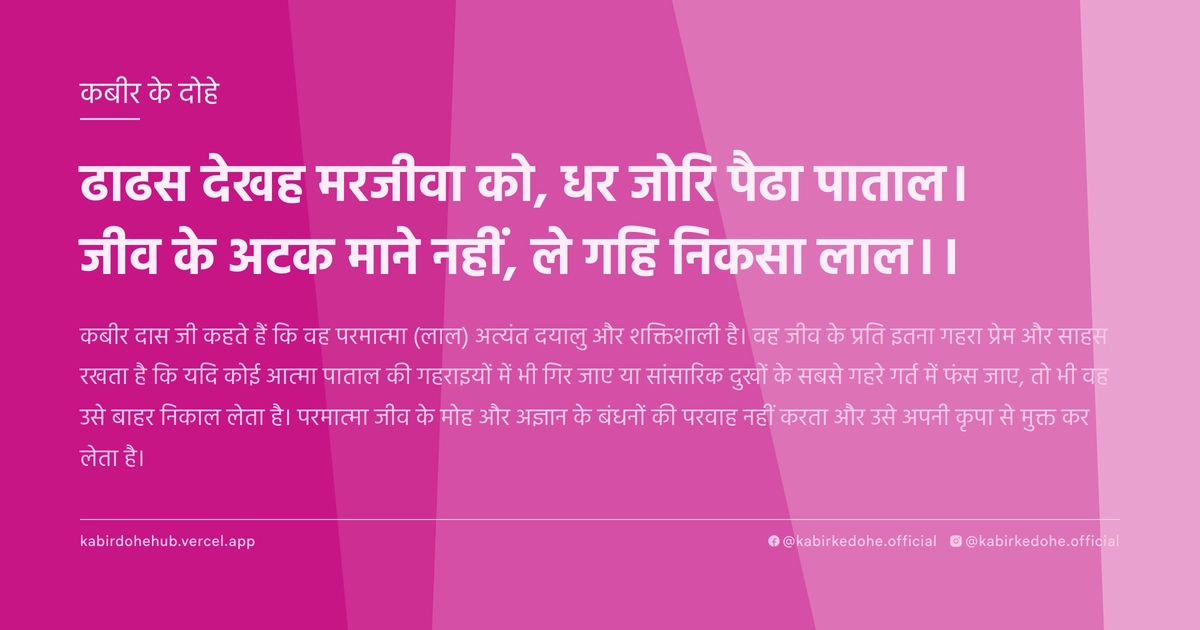
ढाढस देखह मरजीवा को, धर जोरि पैढा पाताल।
जीव के अटक माने नहीं, ले गहि निकसा लाल।।
Dhaadhas dekha marjeeva ko, dhar jori paidha paataal. Jeev ke atak maane nahi, le gahi niksa laal.
इस पृष्ठ पर इस कबीर दोहे का अर्थ (meaning), हिंदी व्याख्या और अंग्रेज़ी अनुवाद, दार्शनिक विश्लेषण और व्यावहारिक जीवन सीख दी गई है। यह दोहा मुक्ति (Liberation) विषय से जुड़ा है — Kabir doha meaning and explanation in Hindi and English.
अर्थ (Meaning):
कबीर दास जी कहते हैं कि वह परमात्मा (लाल) अत्यंत दयालु और शक्तिशाली है। वह जीव के प्रति इतना गहरा प्रेम और साहस रखता है कि यदि कोई आत्मा पाताल की गहराइयों में भी गिर जाए या सांसारिक दुखों के सबसे गहरे गर्त में फंस जाए, तो भी वह उसे बाहर निकाल लेता है। परमात्मा जीव के मोह और अज्ञान के बंधनों की परवाह नहीं करता और उसे अपनी कृपा से मुक्त कर लेता है।
Kabir asserts that the Divine (the Beloved/Laal) possesses an infinite capacity for compassion and courage. Even if a soul descends into the deepest abyss of 'Paatal'—the lowest spiritual depths or the most profound suffering—the Divine does not hesitate. Regardless of the complexities or the 'stuckness' of the soul's egoic attachments, the Divine reaches down to seize the soul and pull it back into the light of liberation.
व्याख्या (Interpretation):
इस दोहे का शाब्दिक अर्थ है कि ईश्वर जीव को पाताल से भी खींच लाता है। रूपक के स्तर पर, 'पाताल' वह गहन अज्ञान और अवसाद है जहाँ मनुष्य अपनी पहचान खो देता है। यह निर्गुण भक्ति का सार है, जहाँ ईश्वर किसी मंदिर या मस्जिद में नहीं, बल्कि उस अदम्य इच्छाशक्ति में है जो जीव को अंधकार से मुक्त करती है। यहाँ 'लाल' शब्द प्रेम और ऊर्जा का प्रतीक है। यह अद्वैत वेदांत की उस स्थिति को दर्शाता है जहाँ आत्मा और ब्रह्म अलग नहीं हैं; जब जीव अपनी सीमित पहचान (माया) को छोड़ता है, तो वह पाता है कि वह स्वयं उस शक्ति का हिस्सा है जो उसे बचा रही थी। यह विरोधाभास है कि जीव खुद को अलग मानकर डरता है, जबकि उसकी मुक्ति का कारण वही एक तत्व है।
Literally, the verse describes the Divine pulling a soul from the underworld. Metaphorically, 'Paatal' represents the nadir of human consciousness—the depths of ignorance, depression, and karmic entanglement. In the context of Nirgun Bhakti, the Divine is not a distant judge but an immanent force of liberation. The term 'Laal' signifies the passionate, loving aspect of the formless Absolute. This aligns with Advaita Vedanta, suggesting that the perceived separation between the suffering soul and the liberating Divine is the ultimate illusion (Maya). The paradox lies in the soul's struggle against its own chains, unaware that the hand reaching down from the abyss is its own true nature (Atman) awakening. The 'stuckness' (atak) is the ego's resistance, which the Divine love effortlessly overrides.
दार्शनिक विश्लेषण (Philosophical Analysis):
कबीर का यह दोहा उस युग की उपज है जब धर्म केवल कर्मकांडों और जातिगत श्रेष्ठता तक सीमित था। कबीर ने इन बाहरी ढांचों को नकारते हुए 'सहज' मार्ग पर जोर दिया। यहाँ पाताल का उल्लेख केवल एक स्थान नहीं, बल्कि उस मानसिक स्थिति का प्रतीक है जहाँ मनुष्य अपनी जाति, धर्म या पापों के बोझ तले दबा महसूस करता है। कबीर यह संदेश देते हैं कि ईश्वर की कृपा किसी सामाजिक श्रेणी या नैतिक पूर्णता की मोहताज नहीं है।
दार्शनिक रूप से, यह सूफी मत के 'इश्क-ए-हकीकी' (ईश्वरीय प्रेम) से मेल खाता है, जहाँ प्रेमी (ईश्वर) अपने प्रिय (आत्मा) को खोजने के लिए किसी भी हद तक जा सकता है। यह विचार कि परमात्मा जीव के 'अटक' (रुकावटों) की परवाह नहीं करता, यह दर्शाता है कि दैवीय अनुग्रह (Grace) मानवीय त्रुटियों से कहीं अधिक शक्तिशाली है।
अद्वैत वेदांत के परिप्रेक्ष्य में, यह आत्मा का परमात्मा में विलीनीकरण है। जब तक हम स्वयं को 'पापी' या 'पतित' मानते हैं, हम द्वैत में जीते हैं। कबीर हमें उस स्थिति से ऊपर उठाकर यह बताते हैं कि मुक्ति का मार्ग बाहरी अनुष्ठानों से नहीं, बल्कि उस आंतरिक पुकार से खुलता है जिसे परमात्मा सुनता है।
मनोवैज्ञानिक स्तर पर, यह दोहा अवसाद और आत्म-घृणा के विरुद्ध एक शक्तिशाली उपकरण है। यह सिखाता है कि कोई भी व्यक्ति इतना बुरा या इतना गिरा हुआ नहीं है कि वह सुधार या मोक्ष के योग्य न रहे। अहंकार का विनाश ही वह बिंदु है जहाँ 'लाल' का हाथ जीव को पकड़ता है।
अंततः, कबीर ritualism (कर्मकांड) का विरोध करते हुए यह स्पष्ट करते हैं कि मोक्ष किसी विशेष विधि से नहीं, बल्कि पूर्ण समर्पण और प्रेम से प्राप्त होता है। यह उस सार्वभौमिक सत्य की पुष्टि है कि चेतना का उच्चतम स्तर सभी के लिए सुलभ है, चाहे वे जीवन के किसी भी स्तर पर हों।
Kabir’s poetry emerged during a period of rigid religious orthodoxy and caste stratification. By invoking 'Paatal' (the underworld), Kabir transcends the physical geography of heaven and hell, transforming them into psychological states of alienation and ignorance. He rejects the notion that salvation is reserved for the 'pure' or the high-born, asserting that the Divine Grace is radically inclusive and subversive to social hierarchies.
Philosophically, this mirrors the Sufi concept of 'Ishq-e-Haqiqi' (Divine Love), where the Beloved is an relentless seeker of the soul. The assertion that the Divine ignores the 'stuckness' (atak) of the soul suggests that Divine Grace operates on a plane superior to human morality or karmic debt. It is an unconditional pull toward the center of existence.
From the lens of Advaita Vedanta, the struggle in the abyss is the experience of the 'Jiva' (individual soul) caught in the web of Maya. The act of being 'pulled out' is the realization of non-duality. The 'Laal' is not an external deity but the awakened consciousness within, which recognizes that the separation was always an illusion.
Psychologically, this verse addresses the phenomenon of spiritual despair. It posits that no matter how deep the descent into self-loathing or failure, the potential for transcendence remains intact. The annihilation of the ego is not a violent act but a surrender to a love that is stronger than the gravity of one's mistakes.
Ultimately, Kabir dismantles ritualism by suggesting that no amount of pilgrimage or chanting can replace the raw, authentic connection between the soul and the Absolute. He replaces the fear of divine punishment with the certainty of divine rescue, shifting the spiritual paradigm from fear to love.
मूल संदेश (Core Message):
- अंधकार कितना भी गहरा हो, दैवीय प्रेम उससे अधिक शक्तिशाली है।
- मुक्ति के लिए बाहरी शुद्धता नहीं, आंतरिक समर्पण आवश्यक है।
- अहंकार और ग्लानि ही वे जंजीरें हैं जो हमें पाताल में रखती हैं।
- ईश्वर किसी सामाजिक श्रेणी या पाप के बोझ को नहीं देखता।
- आत्मा का वास्तविक स्वरूप सदैव मुक्त और शुद्ध रहता है।
- समर्पण वह पुल है जो जीव को शून्य से अनंत तक ले जाता है।
- No matter how deep the darkness, Divine Love is more powerful.
- Liberation requires inner surrender, not external ritual purity.
- Ego and guilt are the only chains that keep us in the abyss.
- The Divine ignores social hierarchies and the burden of sin.
- The true nature of the soul remains eternally free and pure.
- Surrender is the bridge from the void to the Infinite.
व्यावहारिक उदाहरण (Practical Example):
वाराणसी के एक पुराने घाट पर रहने वाली एक वृद्ध विधवा, जानकी, का जीवन अकेलेपन और समाज द्वारा थोपे गए 'अपवित्रता' के बोध से भरा था। वह खुद को आध्यात्मिक रूप से मृत मान चुकी थी, जैसे वह किसी गहरे पाताल में गिर गई हो।
वह प्रतिदिन गंगा किनारे बैठती, लेकिन उसके मन में यह विश्वास था कि उसके पाप और उसकी सामाजिक स्थिति उसे ईश्वर से दूर रखती है। वह खुद को एक ऐसे गर्त में देखती थी जहाँ से निकलना असंभव था।
एक दिन, उसने एक छोटे बच्चे को देखा जो कीचड़ में फंसी अपनी बिल्ली को बचाने के लिए बिना सोचे-समझे गंदे नाले में कूद गया। बच्चा गंदा हो गया, लेकिन उसने बिल्ली को सुरक्षित बाहर निकाल लिया।
जानकी इस दृश्य को देखकर स्तब्ध रह गई। उसने महसूस किया कि यदि एक छोटा बच्चा एक जानवर के लिए इतना साहस दिखा सकता है, तो वह परमात्मा, जो प्रेम का सागर है, उसके लिए ऐसा क्यों नहीं करेगा?
उस क्षण, उसके मन का 'अटक' (अहंकार और ग्लानि का बंधन) टूट गया। उसने महसूस किया कि उसकी 'अपवित्रता' केवल एक सामाजिक भ्रम था, जबकि उसकी आत्मा शुद्ध थी।
उसने अपनी ग्लानि को त्याग दिया और पहली बार बिना किसी डर के, केवल प्रेम के भाव से ईश्वर को पुकारा। उसे महसूस हुआ कि वह अब तक खुद को पाताल में कैद किए हुए थी, जबकि द्वार हमेशा खुले थे।
उसका व्यवहार बदल गया; वह अब अन्य उपेक्षित महिलाओं की मदद करने लगी और उन्हें यह सिखाने लगी कि ईश्वर किसी की जाति या स्थिति नहीं देखता।
उसकी आंतरिक शांति उसके चेहरे पर झलकने लगी। वह अब विधवा की पहचान से ऊपर उठकर एक 'मुक्त आत्मा' बन गई थी।
यह 'कबीर ट्विस्ट' था—एक साधारण घटना ने उसे यह अहसास कराया कि दैवीय प्रेम किसी भी सामाजिक या मानसिक गहराई से अधिक शक्तिशाली है।
जानकी का जीवन अब पाताल के अंधकार से निकलकर प्रेम के प्रकाश में आ गया था, ठीक वैसे ही जैसे कबीर के दोहे में 'लाल' जीव को निकाल लाता है।
Janaki, an elderly widow living on an ancient ghat in Varanasi, spent her days enveloped in loneliness and the social stigma of 'impurity.' She felt spiritually dead, as if she had fallen into a profound 'Paatal' of despair and social exclusion.
Every day she sat by the Ganges, but her mind was convinced that her perceived sins and her social status created an impassable barrier between her and the Divine. She saw herself as trapped in a pit from which there was no escape.
One afternoon, she witnessed a small child jump headlong into a muddy, foul-smelling drain to rescue a kitten that had become stuck in the sludge. The child was covered in filth, but he successfully pulled the kitten to safety.
Janaki was stunned by this sight. A sudden realization struck her: if a small child could show such courage and disregard for filth to save a tiny animal, why would the Divine, the ocean of love, not do the same for her?
In that moment, the 'atak'—the knot of guilt and social conditioning—snapped. She realized that her 'impurity' was merely a social construct, while her essence remained untouched and pure.
She abandoned her self-loathing and, for the first time, called out to the Divine not with fear or a request for forgiveness, but with raw, trusting love.
She felt an immediate shift, as if a hand had reached into her darkness and pulled her upward. She realized she had been the one keeping herself imprisoned in the abyss.
Her behavior transformed; she began reaching out to other marginalized women, teaching them that the Divine recognizes no caste, gender, or social standing.
Her face, once etched with sorrow, now radiated a serene peace. She had ceased to be 'the widow' and had become a 'liberated soul.'
This was the 'Kabir Twist'—a mundane event triggered a metaphysical awakening, proving that Divine Love is more powerful than any depth of human suffering.
Janaki's life moved from the darkness of Paatal to the light of liberation, mirroring the action of the 'Laal' in Kabir's verse.
अभ्यास मार्गदर्शन (Practice Guidance):
- प्रतिदिन 15 मिनट 'शून्य ध्यान' का अभ्यास करें, जहाँ आप अपनी सभी पहचानों (नाम, पद, संबंध) को त्याग कर केवल एक साक्षी के रूप में स्वयं को देखें।
- एक 'ग्लानि पत्रिका' (Guilt Journal) लिखें: उन सभी बातों को लिखें जिनसे आप खुद को 'अपवित्र' या 'अयोग्य' महसूस करते हैं, और फिर उनके सामने लिखें—'यह केवल माया है, मैं शुद्ध आत्मा हूँ'।
- व्यवहार परिवर्तन: दिन में कम से कम एक बार किसी ऐसे व्यक्ति की निस्वार्थ मदद करें जिसे समाज ने 'अछूत' या 'अयोग्य' मान लिया हो, ताकि आप अपने भीतर के द्वैत को मिटा सकें।
- डायग्नोस्टिक चेकलिस्ट: क्या आप अभी भी अपनी गलतियों के लिए खुद को कोस रहे हैं? क्या आप मानते हैं कि कुछ लोग मोक्ष के योग्य नहीं हैं? यदि हाँ, तो आप अभी भी 'पाताल' के भ्रम में हैं।
- Practice 15 minutes of 'Shunya Meditation' daily, stripping away all identities (name, role, status) to observe yourself purely as a witness.
- Maintain a 'Guilt Journal': List all the things that make you feel 'impure' or 'unworthy,' and next to each, write—'This is merely Maya; I am the pure Atman.'
- Behavioral Shift: Once a day, perform a selfless act of service for someone whom society deems 'unworthy' or 'outcast,' effectively dissolving the duality within yourself.
- Diagnostic Checklist: Do you still punish yourself for past mistakes? Do you believe some people are beyond redemption? If yes, you are still operating under the illusion of 'Paatal'.
चिंतन प्रश्न (Reflection Questions):
- मेरे जीवन का वह 'पाताल' क्या है जहाँ मैं खुद को कैद महसूस करता हूँ?
- क्या मेरी 'नैतिकता' वास्तव में करुणा है, या यह दूसरों को छोटा दिखाने का एक तरीका है?
- यदि मैं अपनी सभी सामाजिक पहचान खो दूँ, तो मेरे भीतर क्या बचेगा?
- मैं किन पूर्वाग्रहों के कारण कुछ लोगों को 'अपात्र' मान लेता हूँ?
- क्या मैं वास्तव में मुक्त होना चाहता हूँ, या मुझे अपने दुखों की पहचान से लगाव हो गया है?
- मेरे भीतर का 'लाल' (प्रेम) कब जागता है और कब सो जाता है?
- What is the 'Paatal' in my own life where I feel most imprisoned?
- Is my sense of 'morality' actually compassion, or is it a tool to feel superior to others?
- If I stripped away all my social identities, what would remain of me?
- Which biases lead me to believe that certain people are 'unworthy' of grace?
- Do I truly desire liberation, or have I become attached to the identity of my suffering?
- When does the 'Laal' (Divine Love) awaken within me, and when does it fall asleep?