
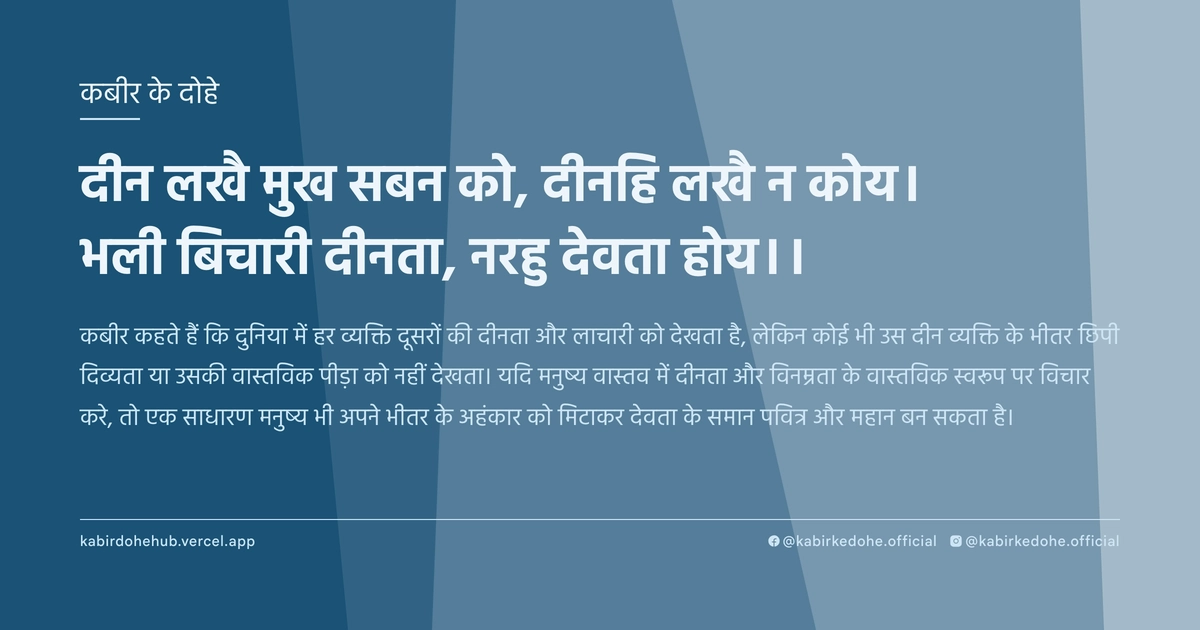
दीन लखै मुख सबन को, दीनहि लखै न कोय।
भली बिचारी दीनता, नरहु देवता होय।।
Deen lakhai mukh saban ko, deenhi lakhai na koy. Bhali bichaari deenta, narahu devta hoye.
इस पृष्ठ पर इस कबीर दोहे का अर्थ (meaning), हिंदी व्याख्या और अंग्रेज़ी अनुवाद, दार्शनिक विश्लेषण और व्यावहारिक जीवन सीख दी गई है। यह दोहा करुणा (Compassion) विषय से जुड़ा है — Kabir doha meaning and explanation in Hindi and English.
अर्थ (Meaning):
कबीर कहते हैं कि दुनिया में हर व्यक्ति दूसरों की दीनता और लाचारी को देखता है, लेकिन कोई भी उस दीन व्यक्ति के भीतर छिपी दिव्यता या उसकी वास्तविक पीड़ा को नहीं देखता। यदि मनुष्य वास्तव में दीनता और विनम्रता के वास्तविक स्वरूप पर विचार करे, तो एक साधारण मनुष्य भी अपने भीतर के अहंकार को मिटाकर देवता के समान पवित्र और महान बन सकता है।
Kabir observes that while everyone acknowledges the outward poverty or helplessness of others, no one truly 'sees' or empathizes with the soul of the downtrodden. He suggests that if one deeply contemplates the essence of humility and the shared vulnerability of existence, a mere mortal can transcend their ego and attain a divine state of being, effectively becoming a deity through compassion.
व्याख्या (Interpretation):
इस दोहे का शाब्दिक अर्थ है कि लोग गरीबों को देखते तो हैं, पर उन्हें समझते नहीं। रूपकात्मक स्तर पर, 'दीनता' यहाँ केवल आर्थिक गरीबी नहीं, बल्कि आत्मा की उस विनम्रता का प्रतीक है जो अहंकार के विसर्जन से आती है। यह निर्गुण भक्ति का सार है, जहाँ ईश्वर किसी मंदिर में नहीं, बल्कि सबसे उपेक्षित व्यक्ति की सेवा में मिलता है। जब हम दूसरे की दीनता में अपनी ही आत्मा का प्रतिबिंब देखते हैं, तो द्वैत (Duality) समाप्त हो जाता है और अद्वैत वेदांत की स्थिति प्राप्त होती है। माया हमें यह विश्वास दिलाती है कि हम दूसरों से श्रेष्ठ हैं, लेकिन दीनता का बोध इस भ्रम को तोड़ता है। इस प्रकार, विनम्रता वह कीमिया है जो साधारण मनुष्य को देवत्व में बदल देती है। यह विरोधाभास है कि जो स्वयं को सबसे छोटा मानता है, वही वास्तव में सबसे महान बन जाता है।
Literally, the verse notes that the world observes the poor but ignores their inner essence. Metaphorically, 'Deenta' (humility/poverty) represents the spiritual state of surrender and the shedding of the 'I-consciousness'. In the context of Nirgun Bhakti, the formless Divine is found not in rituals, but in the heart of the marginalized. When a seeker recognizes their own vulnerability in the suffering of another, the veil of Maya—the illusion of separation—is lifted, aligning with the Advaita Vedanta principle of non-duality (Atman-Brahman). The central paradox presented is that the annihilation of the ego through humility is the only path to true exaltation. By embracing the 'lowliest' state, the practitioner transcends the human condition to achieve a god-like state of unconditional love and equanimity.
दार्शनिक विश्लेषण (Philosophical Analysis):
कबीर का यह दोहा उस सामाजिक और धार्मिक परिवेश की प्रतिक्रिया है जहाँ जाति और वर्ण के आधार पर मनुष्य का मूल्य तय किया जाता था। कबीर ने स्पष्ट रूप से कर्मकांडों और बाहरी आडंबरों को नकारते हुए 'मानवता' को ही सर्वोच्च धर्म माना। उनका दर्शन सूफीवाद के 'फना' (अहंकार का विनाश) और वेदांत के 'अहं ब्रह्मास्मि' का एक अनूठा संगम है। वे तर्क देते हैं कि जब तक मनुष्य स्वयं को दूसरों से ऊपर समझता है, वह ईश्वर से दूर है।
यहाँ 'दीनता' का अर्थ लाचारी नहीं, बल्कि 'शून्यता' है। जब मनुष्य अपने भीतर के गर्व को शून्य कर देता है, तब वह उस अनंत परमात्मा के लिए पात्र हो जाता है। यह मनोवैज्ञानिक रूपांतरण की प्रक्रिया है जहाँ 'स्व' का विस्तार होकर 'सर्व' हो जाता है। कबीर के अनुसार, देवता वह नहीं जो स्वर्ग में रहता है, बल्कि वह है जिसने करुणा को अपना स्वभाव बना लिया है।
यह विचार तत्कालीन समाज के लिए क्रांतिकारी था क्योंकि यह ब्राह्मणवादी श्रेष्ठता और सूफी संतों के कुछ कट्टरपंथी पहलुओं, दोनों को चुनौती देता था। कबीर का जोर इस बात पर है कि सत्य किसी शास्त्र में नहीं, बल्कि जीव के प्रति जीव के व्यवहार में है। वे सिखाते हैं कि सेवा ही वास्तविक साधना है।
दार्शनिक रूप से, यह दोहा यह स्थापित करता है कि दिव्यता कोई बाहरी उपलब्धि नहीं है, बल्कि एक आंतरिक गुण है जो अहंकार की परतों के हटने पर स्वतः प्रकट होता है। जो व्यक्ति दूसरों के दुख को अपना दुख समझने की क्षमता विकसित कर लेता है, वह वास्तव में माया के बंधन से मुक्त हो जाता है।
अंततः, कबीर यह संदेश देते हैं कि सामाजिक पदानुक्रम केवल एक मानसिक रोग है। जब हम इस रोग से मुक्त होकर दीनता को गरिमा के साथ स्वीकार करते हैं, तब हम उस परम सत्य का अनुभव करते हैं जहाँ न कोई छोटा है, न कोई बड़ा, केवल एक ही चेतना व्याप्त है।
This Doha emerges as a visceral response to the rigid caste hierarchies and ritualistic blindness of Kabir's era. By centering the 'Deen' (the downtrodden), Kabir dismantles the notion that spiritual proximity to God is reserved for the priestly class or the wealthy. His philosophy synthesizes the Sufi concept of 'Fana' (annihilation of the self) with the Advaita Vedantic realization of oneness. He posits that the ego is the primary barrier between the individual and the Absolute.
In this context, 'humility' is not a sign of weakness but a spiritual technology for transcendence. By consciously identifying with the lowest, the seeker bypasses the traps of spiritual pride. This is a psychological shift from 'I-ness' to 'We-ness', where the boundaries of the individual identity dissolve into a universal consciousness. Kabir redefines 'divinity' not as a celestial status, but as a state of profound empathy and selfless service.
Historically, this was a subversive act. Kabir challenged the religious orthodoxy by suggesting that a leather-worker or a weaver could be more 'divine' than a scholar if they possessed true compassion. He argues that ritual purity is a myth; the only true purity is the purity of a heart that beats for another.
From a metaphysical perspective, the verse addresses the nature of Maya. The illusion is not that the world doesn't exist, but that we are separate from one another. By recognizing the shared vulnerability of all sentient beings, the practitioner breaks the cycle of judgment and hatred, moving toward a state of 'Samatva' (equanimity).
Ultimately, Kabir suggests that the path to the Divine is paved with the dust of the earth. The 'Kabir Twist' here is that the very thing the world despises—poverty and humility—is actually the golden gate to liberation. To be 'Deen' is to be open, empty, and therefore capable of being filled with the Infinite.
मूल संदेश (Core Message):
- अहंकार ही आत्मा और परमात्मा के बीच की सबसे बड़ी दीवार है।
- सच्ची विनम्रता कमजोरी नहीं, बल्कि सर्वोच्च आध्यात्मिक शक्ति है।
- दूसरों की पीड़ा में अपनी पीड़ा देखना ही अद्वैत का वास्तविक अनुभव है।
- बाहरी गरीबी एक स्थिति है, लेकिन आंतरिक दीनता एक उपलब्धि है।
- जब 'मैं' मिटता है, तब 'वह' (ईश्वर) प्रकट होता है।
- सेवा ही एकमात्र ऐसा मार्ग है जो मनुष्य को देवता बनाता है।
- The ego is the primary wall separating the individual soul from the Universal Divine.
- True humility is not a sign of weakness, but the highest form of spiritual power.
- Recognizing one's own suffering in the pain of others is the lived experience of Non-duality.
- External poverty is a circumstance, but internal humility is a spiritual achievement.
- When the 'I' is annihilated, the 'Infinite' manifests within.
- Selfless service is the only alchemy that transforms a human into a divine being.
व्यावहारिक उदाहरण (Practical Example):
वाराणसी के एक पुराने घाट पर माधव नाम का एक वृद्ध नाविक रहता था। वह जीवन भर नाव चलाकर लोगों को पार लगाता रहा, लेकिन उसका अपना जीवन अभावों और उपेक्षा से भरा था। लोग उसे केवल एक 'नाव चलाने वाला' समझते थे और अक्सर उसे तुच्छ नजर से देखते थे। माधव शांत रहता और हर किसी की सेवा करता, चाहे वह उसे अपमानित ही क्यों न करे।
एक दिन शहर का एक बहुत बड़ा विद्वान पंडित, जो अपनी शास्त्रार्थ क्षमता के लिए प्रसिद्ध था, उसी घाट पर आया। वह अपने ज्ञान के अहंकार में चूर था और हर किसी को नीचा दिखाता था। उसने माधव को देखा और उसकी फटी हुई धोती और मैले हाथों का मजाक उड़ाया, उसे 'अज्ञानी और दीन' कहकर पुकारा।
माधव ने मुस्कुराकर जवाब दिया, 'महाराज, मेरी दीनता ही मेरा सबसे बड़ा धन है, क्योंकि इसने मुझे वह देखना सिखाया है जो आपकी पुस्तकें नहीं सिखा पाईं।' पंडित को यह बात चुभी और उसने माधव को चुनौती दी कि वह अपनी 'दीनता' का लाभ बताए।
उसी शाम, घाट पर एक भयानक दुर्घटना हुई। एक छोटा बच्चा नदी में गिर गया और लहरें उसे बहा ले गईं। पंडित किनारे पर खड़े होकर मंत्र पढ़ने लगा और यह सोचने लगा कि कौन सा शास्त्र इस स्थिति में सही मार्गदर्शन देगा। लेकिन माधव ने एक क्षण भी नहीं सोचा। उसने अपनी जान की परवाह किए बिना ठंडे पानी में छलांग लगा दी।
माधव ने बच्चे को बचा लिया, लेकिन इस प्रक्रिया में वह खुद बुरी तरह घायल हो गया। जब वह किनारे पर आया, तो उसकी आँखों में कोई गर्व नहीं था, केवल बच्चे को सुरक्षित देखने की शांति थी। पंडित यह देखकर स्तब्ध रह गया कि जिस 'दीनता' का उसने मजाक उड़ाया था, उसी ने माधव को निडर और निस्वार्थ बना दिया था।
पंडित को एहसास हुआ कि उसका ज्ञान केवल शब्दों का ढेर था, जबकि माधव की विनम्रता वास्तविक जीवन का सत्य थी। उसने देखा कि माधव के भीतर एक ऐसी करुणा थी जो उसे किसी भी देवता से बड़ा बनाती थी।
उस दिन पंडित का अहंकार टूट गया। उसने माधव के चरणों में सिर झुकाया और पूछा कि यह बदलाव कैसे आया। माधव ने बस इतना कहा, 'जब आप खुद को सबसे छोटा मान लेते हैं, तो आपको किसी से डर नहीं लगता और न ही किसी से घृणा होती है।'
पंडित ने अपनी पूरी जीवनशैली बदल ली। उसने शास्त्रों को केवल पढ़ने के बजाय, उन्हें दीन-दुखियों की सेवा में लागू करना शुरू किया। वह अब एक विद्वान पंडित नहीं, बल्कि एक विनम्र सेवक बन गया था।
माधव की उस सरल दीनता ने एक अहंकारी मस्तिष्क को आध्यात्मिक जागृति प्रदान की। यह इस बात का प्रमाण था कि विनम्रता ही वह मार्ग है जो मनुष्य को देवत्व की ओर ले जाता है।
अंत में, पूरा घाट अब माधव और उस पंडित को एक साथ देखता था—एक जिसने जन्म से विनम्रता सीखी थी और दूसरे ने अनुभव से।
On an ancient ghat in Varanasi lived an elderly boatman named Madhav. For decades, he ferried pilgrims across the river, yet his own life was marked by scarcity and social neglect. To the world, he was merely a 'boatman,' a low-caste laborer often viewed with indifference or disdain. Madhav remained serene, serving everyone with a smile, regardless of how he was treated.
One day, a renowned scholar-priest arrived at the ghat. He was famous for his mastery of scriptures but was consumed by an immense ego, frequently belittling others to assert his superiority. Seeing Madhav’s tattered clothes and weathered skin, the priest mocked him, calling him 'pitifully ignorant and wretched.'
Madhav replied with a gentle smile, 'Honored sir, my wretchedness is my greatest wealth, for it has taught me to see what your books could never reveal.' Stung by this, the priest challenged Madhav to prove how such 'lowliness' could possibly be an advantage.
That evening, a tragedy struck. A small child slipped into the churning currents of the Ganges. The priest stood on the bank, frantically recalling scriptures and mantras to find a theoretical solution to the crisis, paralyzed by the suddenness of the event.
Without a second thought, Madhav dove into the freezing, turbulent water. He didn't calculate the risk or consider his social standing; he acted purely on the impulse of compassion. He fought the current and managed to pull the child to safety, though he himself was severely bruised and exhausted.
As Madhav collapsed on the shore, there was no pride in his eyes, only the quiet peace of seeing the child safe. The priest was stunned. He realized that the 'lowliness' he had mocked was actually the source of Madhav's fearlessness and selflessness.
In that moment, the priest's intellectual arrogance shattered. He saw that his knowledge was a sterile collection of words, while Madhav's humility was a living, breathing truth. He realized that Madhav possessed a divinity that no amount of scholarship could purchase.
Overwhelmed, the priest bowed at Madhav's feet and asked how he had attained such a state. Madhav simply said, 'When you accept yourself as the smallest of all, you no longer fear anything, nor do you feel hatred for anyone.'
This encounter transformed the priest's life. He stopped using his knowledge to dominate and started using it to serve the marginalized. He transitioned from being a proud scholar to a humble servant of humanity.
Madhav's simple humility had triggered a profound spiritual awakening in a man who thought he already knew everything. It proved that the path to the divine is not through the ascent of power, but through the descent into humility.
Eventually, the people of the ghat saw the two of them—the boatman and the priest—as equals, one who was born into humility and one who had earned it through a shattering of the ego.
अभ्यास मार्गदर्शन (Practice Guidance):
- दैनिक अभ्यास: प्रतिदिन कम से कम एक बार किसी ऐसे व्यक्ति की मदद करें जिससे समाज उपेक्षित रहता है, और इस प्रक्रिया में स्वयं को 'दाता' नहीं बल्कि 'सेवक' महसूस करें।
- आत्म-चिंतन जर्नल: हर रात लिखें कि आज आपने कहाँ अपने अहंकार को महसूस किया और कैसे उस क्षण में आप 'दीन' या विनम्र बन सकते थे।
- व्यवहार परिवर्तन: जब भी कोई आपकी आलोचना करे, तो प्रतिक्रिया देने के बजाय यह सोचें कि उनके दृष्टिकोण में कौन सा सत्य छिपा है जो आपके अहंकार को चुनौती दे रहा है।
- निदान चेकलिस्ट: क्या आप दूसरों की मदद करते समय श्रेष्ठता महसूस करते हैं? क्या आप अपनी उपलब्धियों का श्रेय स्वयं लेते हैं? यदि हाँ, तो आप अभी भी 'माया' के प्रभाव में हैं और विनम्रता के मार्ग से दूर हैं।
- Daily Practice: Once a day, perform a selfless act for someone marginalized by society, consciously shifting your identity from a 'benefactor' to a 'servant'.
- Self-Inquiry Journaling: Each night, record instances where your ego flared up and reflect on how you could have responded with 'Deenta' (humility) instead.
- Behavioral Shift: When criticized, instead of defending your image, ask yourself: 'What part of my ego is being threatened, and what truth can I learn from this discomfort?'
- Diagnostic Checklist: Do you feel a sense of superiority while helping others? Do you instinctively take credit for your successes? If yes, you are still operating under the illusion of the 'I' and have not yet embraced true humility.
चिंतन प्रश्न (Reflection Questions):
- क्या मेरी दयालुता वास्तव में करुणा है, या यह मेरे भीतर के 'श्रेष्ठ' होने के अहसास को पुष्ट करने का एक तरीका है?
- यदि समाज में मेरी सारी पहचान (पद, पैसा, प्रतिष्ठा) छीन ली जाए, तो मेरे भीतर क्या बचेगा?
- मैं उन लोगों के प्रति कैसा व्यवहार करता हूँ जिनसे मुझे जीवन में कुछ भी मिलने की उम्मीद नहीं है?
- क्या मैं अपनी कमजोरियों को स्वीकार करने का साहस रखता हूँ, या मैं उन्हें अपनी 'छवि' के पीछे छिपाता हूँ?
- मेरे जीवन का वह कौन सा हिस्सा है जहाँ मैं अभी भी खुद को दूसरों से बेहतर समझने की कोशिश कर रहा हूँ?
- क्या मैं वास्तव में दूसरों के दुख को महसूस करता हूँ, या मैं केवल उनके प्रति सहानुभूति का प्रदर्शन करता हूँ?
- Is my kindness truly compassion, or is it a subconscious tool to reinforce my sense of superiority?
- If all my social identifiers—status, wealth, and reputation—were stripped away, what would remain of my essence?
- How do I treat those from whom I have absolutely nothing to gain in this lifetime?
- Do I have the courage to be vulnerable and admit my flaws, or do I curate a 'perfect' image to hide them?
- In which specific areas of my life am I still desperately trying to prove that I am 'better' than others?
- Do I actually feel the suffering of another, or am I merely performing the social ritual of empathy?