
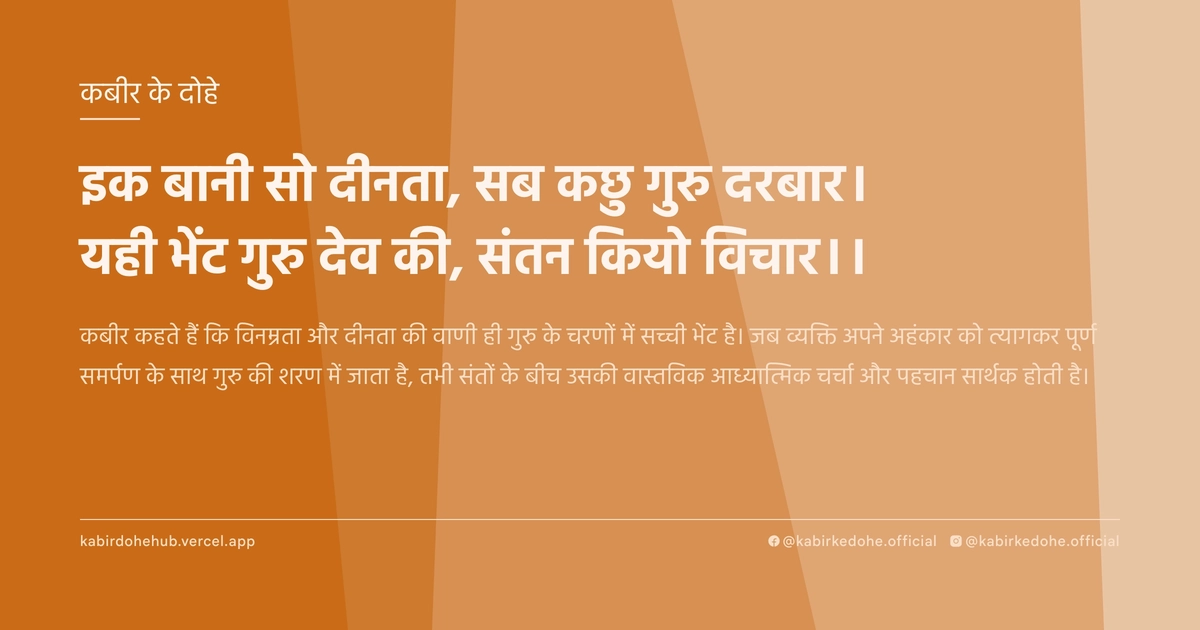
इक बानी सो दीनता, सब कछु गुरु दरबार।
यही भेंट गुरु देव की, संतन कियो विचार।।
Ik baani so deenta, sab kachhu guru darbaar. Yahi bhent guru dev ki, santan kiyo vichaar.
इस पृष्ठ पर इस कबीर दोहे का अर्थ (meaning), हिंदी व्याख्या और अंग्रेज़ी अनुवाद, दार्शनिक विश्लेषण और व्यावहारिक जीवन सीख दी गई है। यह दोहा गुरु महत्व (The Guru's Importance) विषय से जुड़ा है — Kabir doha meaning and explanation in Hindi and English.
अर्थ (Meaning):
कबीर कहते हैं कि विनम्रता और दीनता की वाणी ही गुरु के चरणों में सच्ची भेंट है। जब व्यक्ति अपने अहंकार को त्यागकर पूर्ण समर्पण के साथ गुरु की शरण में जाता है, तभी संतों के बीच उसकी वास्तविक आध्यात्मिक चर्चा और पहचान सार्थक होती है।
Kabir asserts that the only true offering one can bring to the threshold of the Guru is a voice steeped in humility and absolute surrender. When an individual relinquishes the ego and approaches the spiritual master with genuine lowliness, they truly enter the sacred discourse of the enlightened saints.
व्याख्या (Interpretation):
इसका शाब्दिक अर्थ है कि गुरु को भौतिक वस्तुओं की आवश्यकता नहीं है, बल्कि वे शिष्य की विनम्रता चाहते हैं। रूपक के स्तर पर, 'दीनता' का अर्थ गरीबी नहीं, बल्कि अहंकार का विसर्जन है। यह निर्गुण भक्ति का सार है जहाँ 'मैं' का मिटना ही 'वह' का मिलना है। अद्वैत वेदांत के अनुसार, जब तक पृथक अहंकार (माया) जीवित है, तब तक ब्रह्म का ज्ञान असंभव है। यहाँ गुरु केवल एक व्यक्ति नहीं, बल्कि वह चेतना है जो शिष्य के भीतर के अंधकार को मिटाती है। यह विरोधाभास है कि सबसे शक्तिशाली स्थिति वह है जब व्यक्ति स्वयं को सबसे छोटा महसूस करता है। अंततः, यह समर्पण ही आत्मा और परमात्मा के मिलन का एकमात्र द्वार है।
Literally, this suggests that the Guru requires no material gifts, only the humility of the seeker. Metaphorically, 'deenta' (lowliness) does not signify poverty but the systematic dissolution of the ego. This is the essence of Nirgun Bhakti, where the annihilation of the 'I' is the only prerequisite for the realization of the 'One'. In the framework of Advaita Vedanta, as long as the illusion of separation (Maya) persists, the realization of Brahman remains elusive. Here, the Guru is not merely a human teacher but the awakening consciousness that dissolves the seeker's darkness. It presents a spiritual paradox: the state of maximum power is achieved only when one attains maximum humility. Ultimately, this surrender is the sole gateway to the non-dual union of Atman and Brahman.
दार्शनिक विश्लेषण (Philosophical Analysis):
कबीर का यह दोहा उस युग की प्रतिक्रिया है जहाँ धर्म केवल कर्मकांडों और बाहरी दिखावे तक सीमित था। उन्होंने देखा कि लोग मंदिरों और मस्जिदों में महंगे चढ़ावे चढ़ाते थे, लेकिन उनके भीतर का अहंकार और जातिगत श्रेष्ठता का भाव यथावत था। कबीर ने इस पाखंड को चुनौती देते हुए 'दीनता' को सर्वोच्च आध्यात्मिक मुद्रा घोषित किया।
दार्शनिक रूप से, यह सूफीवाद के 'फना' (अहंकार का विनाश) के सिद्धांत से मेल खाता है। सूफी मत में जब तक साधक अपनी हस्ती को मिटाता नहीं, तब तक वह ईश्वर की उपस्थिति का अनुभव नहीं कर सकता। कबीर इसी मार्ग को अपनाते हुए कहते हैं कि ज्ञान की प्राप्ति बौद्धिक विमर्श से नहीं, बल्कि हृदय के समर्पण से होती है।
अद्वैत वेदांत के परिप्रेक्ष्य में, अहंकार वह पर्दा है जो जीव को ब्रह्म से अलग करता है। जब शिष्य 'दीनता' अपनाता है, तो वह वास्तव में उस पर्दे को हटा रहा होता है। यह प्रक्रिया मनोवैज्ञानिक रूपांतरण की है, जहाँ व्यक्ति अपनी सामाजिक पहचान, पद और प्रतिष्ठा को शून्य मानकर सत्य की खोज करता है।
कबीर ने जाति और वर्ग के भेदभाव को पूरी तरह खारिज किया। उनके लिए 'गुरु दरबार' वह स्थान है जहाँ राजा और रंक, ब्राह्मण और चर्मकार, सभी समान हैं क्योंकि वहाँ केवल विनम्रता की भाषा चलती है। यह सामाजिक समानता का एक गहरा आध्यात्मिक आधार प्रदान करता है।
अक्सर लोग इस दोहे को केवल गुरु की आज्ञा मानने के रूप में देखते हैं, जो एक संकुचित व्याख्या है। वास्तव में, यह 'स्व' के विसर्जन की प्रक्रिया है। जब तक 'मैं' मौजूद है, तब तक गुरु का ज्ञान केवल सूचना बनकर रह जाता है; जब 'मैं' मिट जाता है, तब वह ज्ञान अनुभव बन जाता है।
This couplet is a direct response to an era where religion had devolved into mere ritualism and external ostentation. Kabir observed people offering lavish gifts at temples and mosques while clinging stubbornly to their ego and caste-based superiority. He challenged this hypocrisy by declaring 'humility' as the only valid spiritual currency.
Philosophically, this aligns with the Sufi concept of 'Fana' (the annihilation of the self). In Sufism, the seeker cannot experience the Divine Presence until their individual identity is completely extinguished. Kabir adopts this path, suggesting that enlightenment is not a product of intellectual discourse but of heartfelt surrender.
From the lens of Advaita Vedanta, the ego is the veil that separates the Jiva (individual soul) from Brahman (the Absolute). When a disciple embraces 'deenta', they are effectively tearing down this veil. This is a process of psychological transmutation, where the seeker renders their social identity, rank, and prestige void to seek the Truth.
Kabir fundamentally rejected caste and class hierarchies. For him, the 'Guru's Court' is a space where the king and the pauper, the priest and the untouchable, are equal because only the language of humility is spoken there. This provides a profound spiritual foundation for social egalitarianism.
Common literalist interpretations often mistake this for blind obedience to a teacher. However, the deeper meaning is the dissolution of the 'self'. As long as the 'I' exists, the Guru's teachings remain mere information; once the 'I' vanishes, that information transforms into direct experience.
मूल संदेश (Core Message):
- अहंकार वह दीवार है जो सत्य के मार्ग को अवरुद्ध करती है।
- विनम्रता केवल व्यवहार नहीं, बल्कि आत्मा की उच्चतम अवस्था है।
- सच्ची भक्ति बाहरी आडंबरों में नहीं, आंतरिक समर्पण में है।
- जब 'मैं' मिटता है, तभी 'परमात्मा' का उदय होता है।
- गुरु की कृपा केवल खाली पात्र (विनम्र हृदय) में ही समाती है।
- श्रेष्ठता का भ्रम ही आध्यात्मिक प्रगति की सबसे बड़ी बाधा है।
- Ego is the wall that obstructs the path to Truth.
- Humility is not just a behavior, but the highest state of the soul.
- True devotion lies in internal surrender, not external rituals.
- Only when the 'I' vanishes does the 'Divine' emerge.
- The Guru's grace fills only the empty vessel of a humble heart.
- The illusion of superiority is the greatest hurdle to spiritual growth.
व्यावहारिक उदाहरण (Practical Example):
वाराणसी के एक पुराने घाट पर माधव नाम का एक वृद्ध बुनकर रहता था। वह अपने काम में निपुण था और पूरे शहर में उसकी साड़ियों की मांग थी। अपनी कला के कारण माधव के भीतर एक सूक्ष्म अहंकार आ गया था; वह मानता था कि उसकी कुशलता उसे अन्य बुनकरों से श्रेष्ठ बनाती है।
एक दिन शहर में एक मौन संत आए। माधव उनके पास गया और अपनी सबसे महंगी रेशमी साड़ी भेंट की, यह उम्मीद करते हुए कि संत उसकी कला की प्रशंसा करेंगे। संत ने साड़ी को देखा तक नहीं और चुपचाप एक कोने में बैठे रहे।
माधव को यह अपमानजनक लगा। उसने सोचा कि उसकी इतनी मूल्यवान भेंट को अनदेखा कैसे किया जा सकता है। वह क्रोध और जिज्ञासा के साथ संत के पास दोबारा गया और पूछा, 'आपको मेरी कला में क्या कमी लगी?'
संत ने पहली बार अपनी आँखें खोलीं और केवल इतना कहा, 'तुम्हारी साड़ी सुंदर है, लेकिन तुम्हारा अहंकार उससे भी अधिक भारी है। यहाँ कपड़े नहीं, केवल समर्पण स्वीकार्य है।'
माधव स्तब्ध रह गया। उसे एहसास हुआ कि वह साड़ी भेंट नहीं कर रहा था, बल्कि अपनी श्रेष्ठता का प्रदर्शन कर रहा था। वह वहीं जमीन पर बैठ गया और उसकी आँखों से आँसू बहने लगे।
उसने महसूस किया कि जिस 'मास्टर' होने के गर्व में वह जी रहा था, उसने उसे वास्तव में अकेला कर दिया था। उसने अपनी सारी उपलब्धियों को उस क्षण शून्य मान लिया।
उसने संत के चरणों में सिर झुकाया और पहली बार बिना किसी वस्तु के, केवल एक टूटे हुए हृदय और विनम्र वाणी के साथ प्रार्थना की।
उस दिन माधव ने सीखा कि सच्ची भेंट वह नहीं जो हाथ से दी जाए, बल्कि वह है जो हृदय से समर्पित हो। उसके व्यवहार में बदलाव आया; वह अब अन्य बुनकरों की मदद करने लगा और अपनी कला को सेवा मान लिया।
उसका जीवन अब प्रदर्शन से हटकर शांति की ओर मुड़ गया था। वह अब केवल रेशम नहीं बुनता था, बल्कि विनम्रता के धागों से मानवीय संबंधों को जोड़ रहा था।
यह 'कबीर ट्विस्ट' था—जहाँ एक भौतिक वस्तु का तिरस्कार एक आध्यात्मिक जागृति का कारण बना और अहंकार का विसर्जन वास्तविक शांति में बदल गया।
On an ancient ghat in Varanasi lived an elderly weaver named Madhav. He was a master of his craft, and his sarees were coveted throughout the city. Because of this skill, a subtle ego had crept into Madhav; he believed his expertise made him superior to all other weavers.
One day, a silent saint arrived in the city. Madhav approached him and offered his most expensive silk saree, expecting the saint to praise his artistry.
The saint did not even glance at the fabric and remained silently seated in a corner. Madhav found this insulting. He wondered how such a valuable gift could be ignored.
Driven by a mix of anger and curiosity, Madhav approached the saint again and asked, 'What deficiency did you find in my art?'
The saint opened his eyes for the first time and simply said, 'Your saree is beautiful, but your ego is even heavier. Here, fabrics are not accepted; only surrender is.'
Madhav was stunned. He realized that he wasn't offering a gift, but rather showcasing his superiority. He collapsed to the ground, and tears began to flow from his eyes.
He felt that the pride of being a 'master' had actually left him profoundly alone. In that moment, he rendered all his achievements as zero.
He bowed his head at the saint's feet and, for the first time, without any material object, prayed with a broken heart and a humble voice.
Madhav learned that a true offering is not something given by the hand, but something surrendered by the heart.
His behavior transformed; he began helping other weavers and viewed his art as a form of service rather than a source of status.
His life shifted from performance to peace. He no longer just wove silk; he began weaving human connections with the threads of humility.
This was the 'Kabir Twist'—where the rejection of a material object triggered a spiritual awakening, and the dissolution of ego led to genuine tranquility.
अभ्यास मार्गदर्शन (Practice Guidance):
- प्रतिदिन 15 मिनट 'शून्य ध्यान' का अभ्यास करें, जहाँ आप अपनी सभी उपलब्धियों, पद और पहचान को मानसिक रूप से त्याग दें।
- एक 'अहंकार डायरी' लिखें: दिन भर में जब भी आपको लगे कि आप किसी से श्रेष्ठ हैं या किसी को नीचा दिखा रहे हैं, उसे लिखें और फिर उस विचार को विनम्रता में बदलने का प्रयास करें।
- व्यवहार परिवर्तन: प्रतिदिन किसी ऐसे व्यक्ति की निस्वार्थ सेवा करें जिससे आप सामाजिक या मानसिक रूप से खुद को ऊपर समझते हैं।
- निदान चेकलिस्ट: क्या मैं दूसरों की आलोचना करते समय खुद को सही मानता हूँ? क्या मैं प्रशंसा मिलने पर गर्व महसूस करता हूँ? क्या मैं बिना किसी अपेक्षा के झुक सकता हूँ? (यदि उत्तर 'हाँ' है, तो अहंकार अभी भी सक्रिय है)।
- Practice 15 minutes of 'Zero Meditation' daily, where you mentally relinquish all your achievements, titles, and identities.
- Maintain an 'Ego Diary': Record moments throughout the day when you felt superior to others or looked down upon them, then consciously reframe those thoughts into humility.
- Behavioral Shift: Perform a selfless act of service daily for someone whom you socially or mentally perceive as 'below' you.
- Diagnostic Checklist: Do I believe I am right while criticizing others? Do I feel a surge of pride upon receiving praise? Can I bow to another without any expectation of return? (If 'Yes', the ego is still active).
चिंतन प्रश्न (Reflection Questions):
- मेरी वह कौन सी 'उपलब्धि' है जिसे मैं अपनी पहचान मानता हूँ और जिसके खोने के डर से मैं असुरक्षित महसूस करता हूँ?
- क्या मेरा विनम्रता का मुखौटा वास्तव में आंतरिक दीनता है, या यह दूसरों से प्रशंसा पाने की एक रणनीति है?
- जब मैं किसी की मदद करता हूँ, तो क्या मैं वास्तव में सेवा कर रहा होता हूँ या अपनी 'दाता' वाली छवि को पुष्ट कर रहा होता हूँ?
- मेरे जीवन में वह कौन सा व्यक्ति है जिसे मैं कभी क्षमा नहीं कर पाया, और क्या मेरा वह क्रोध मेरे अहंकार की रक्षा कर रहा है?
- यदि आज मेरी सारी सामाजिक प्रतिष्ठा छीन ली जाए, तो मेरे भीतर क्या शेष बचेगा?
- Which 'achievement' do I consider my core identity, and why does the fear of losing it make me feel insecure?
- Is my mask of humility true internal lowliness, or is it a calculated strategy to gain admiration from others?
- When I help someone, am I truly serving, or am I reinforcing my image as a 'benefactor'?
- Who is the person I cannot forgive, and is my anger merely a mechanism to protect my ego?
- If all my social prestige were stripped away today, what would actually remain within me?