
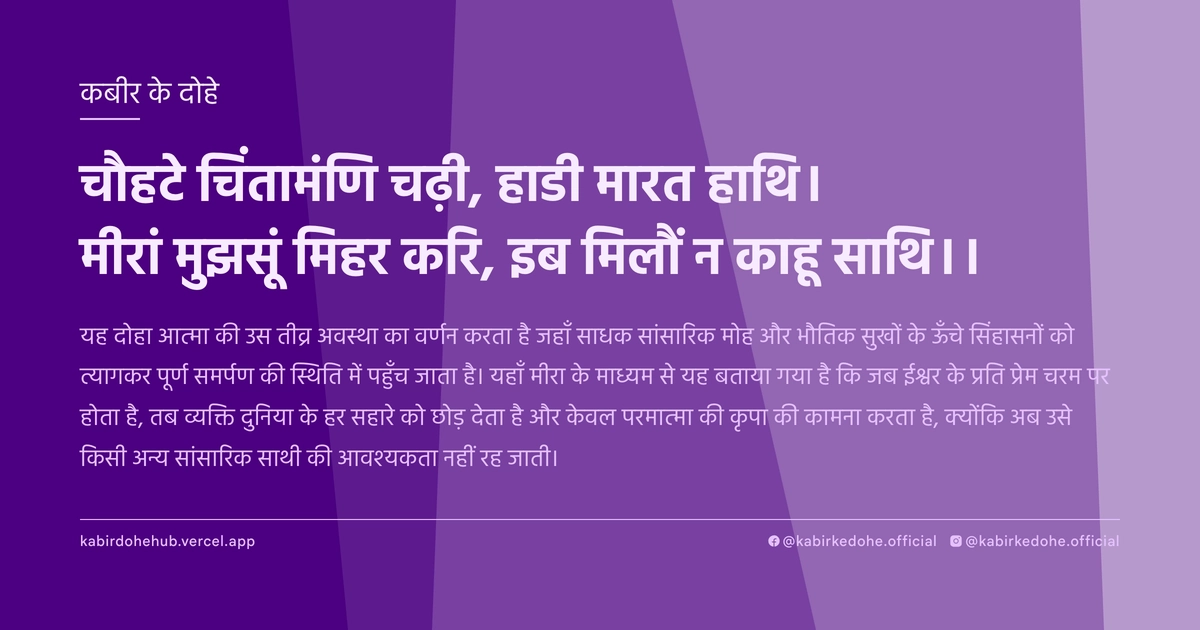
चौहटे चिंतामंणि चढ़ी, हाडी मारत हाथि।
मीरां मुझसूं मिहर करि, इब मिलौं न काहू साथि।।
Chauhate chintamani chadhi, haadi marat haathi. Meera mujhasun mihar kari, ib milaun na kahu sathi.
इस पृष्ठ पर इस कबीर दोहे का अर्थ (meaning), हिंदी व्याख्या और अंग्रेज़ी अनुवाद, दार्शनिक विश्लेषण और व्यावहारिक जीवन सीख दी गई है। यह दोहा प्रपत्ति (Surrender) विषय से जुड़ा है — Kabir doha meaning and explanation in Hindi and English.
अर्थ (Meaning):
यह दोहा आत्मा की उस तीव्र अवस्था का वर्णन करता है जहाँ साधक सांसारिक मोह और भौतिक सुखों के ऊँचे सिंहासनों को त्यागकर पूर्ण समर्पण की स्थिति में पहुँच जाता है। यहाँ मीरा के माध्यम से यह बताया गया है कि जब ईश्वर के प्रति प्रेम चरम पर होता है, तब व्यक्ति दुनिया के हर सहारे को छोड़ देता है और केवल परमात्मा की कृपा की कामना करता है, क्योंकि अब उसे किसी अन्य सांसारिक साथी की आवश्यकता नहीं रह जाती।
This couplet describes the intense state of the soul where the seeker transcends the high pedestals of worldly attachments and material pleasures to reach a state of total surrender. Through the figure of Meera, it conveys that when love for the Divine reaches its zenith, the individual relinquishes all earthly supports and seeks only the grace of the Almighty, for they no longer require the companionship of any mortal being.
व्याख्या (Interpretation):
शाब्दिक अर्थ में यह मीरा की विरह वेदना और उनके ईश्वर के प्रति अनन्य प्रेम को दर्शाता है। रूपकात्मक रूप से, 'चौहटा' और 'चिंतामणि' सांसारिक वैभव और मानसिक इच्छाओं के प्रतीक हैं, जिन्हें साधक अब तुच्छ मानता है। यह 'निर्गुण भक्ति' की उस अवस्था को इंगित करता है जहाँ भक्त और भगवान के बीच का द्वैत समाप्त हो जाता है। यहाँ 'हाडी मारत' का संकेत उस आंतरिक संघर्ष से है जो अहंकार के विनाश के समय होता है। यह अद्वैत वेदांत के उस सिद्धांत से जुड़ा है जहाँ आत्मा (Atman) यह जान लेती है कि वह स्वयं ब्रह्म (Brahman) है, और इस बोध के बाद बाहरी दुनिया का अकेलापन वास्तव में पूर्णता बन जाता है। माया का पर्दा गिरते ही, साधक को यह अहसास होता है कि जिसे वह अकेलापन समझ रहा था, वह वास्तव में परमात्मा के साथ एकाकार होना है।
Literally, this depicts the agony of separation and the exclusive devotion of Meera toward the Divine. Metaphorically, the 'Chauhata' and 'Chintamani' symbolize worldly opulence and the jewel of mental desires, which the seeker now deems trivial. It points toward that stage of 'Nirgun Bhakti' where the duality between the devotee and the Divine dissolves. The phrase 'haadi maarat' suggests the internal struggle that occurs during the annihilation of the ego. This aligns with the Advaita Vedanta principle where the soul (Atman) realizes its identity as Brahman; upon this realization, the loneliness of the external world transforms into absolute wholeness. As the veil of Maya falls, the seeker perceives that what was mistaken for isolation is, in truth, a merging with the Infinite.
दार्शनिक विश्लेषण (Philosophical Analysis):
कबीर और मीरा की परंपरा में यह दोहा उस क्रांतिकारी मोड़ को दर्शाता है जहाँ भक्ति केवल पूजा नहीं, बल्कि एक विद्रोह बन जाती है। यह विद्रोह है सामाजिक मर्यादाओं, जातिगत बंधनों और धार्मिक कर्मकांडों के विरुद्ध। उस युग में, एक स्त्री का घर त्यागकर ईश्वर की शरण में जाना सबसे बड़ा सामाजिक विद्रोह था। कबीर ने हमेशा बाहरी आडंबरों का विरोध किया और आंतरिक अनुभव पर जोर दिया, जो यहाँ मीरा के समर्पण में झलकता है।
दार्शनिक रूप से, यह सूफीवाद के 'फना' (Fana) के सिद्धांत के समान है, जहाँ प्रेमी अपने अस्तित्व को मिटाकर केवल प्रिय (ईश्वर) में जीवित रहता है। जब 'मैं' मिटता है, तभी 'वह' प्रकट होता है। यह अहंकार का पूर्ण विलोपन है। यहाँ 'चिंतामणि' का त्याग यह बताता है कि जब तक मनुष्य अपनी इच्छाओं के केंद्र में रहता है, वह सत्य को नहीं पा सकता।
अद्वैत वेदांत के अनुसार, संसार एक भ्रम है। जब साधक को यह अनुभव होता है कि वह स्वयं उस परम तत्व का हिस्सा है, तो उसे किसी बाहरी साथी की आवश्यकता नहीं रहती। यह अकेलापन 'विषाद' नहीं, बल्कि 'परमानंद' है। यह वह स्थिति है जहाँ आत्मा अपनी मूल प्रकृति को पहचान लेती है।
यह दोहा इस बात पर प्रहार करता है कि हम अक्सर ईश्वर को पाने के लिए बाहरी माध्यमों या गुरुओं के सहारे चलते हैं, लेकिन अंततः यात्रा एकांत की होती है। यह कर्मकांडीय धर्म के विपरीत 'अनुभवजन्य धर्म' की वकालत करता है।
मनोवैज्ञानिक स्तर पर, यह 'अटैचमेंट' (मोह) से 'डिटैचमेंट' (वैराग्य) की ओर संक्रमण है। जब व्यक्ति यह समझ जाता है कि संसार की कोई भी वस्तु उसे स्थायी शांति नहीं दे सकती, तब वह उस शाश्वत सत्य की ओर मुड़ता है। यह मानसिक रूपांतरण ही वास्तविक मुक्ति है।
In the tradition of Kabir and Meera, this couplet represents a revolutionary turning point where devotion ceases to be mere worship and becomes an act of rebellion. It is a rebellion against social norms, caste hierarchies, and rigid religious rituals. In that era, a woman abandoning her domestic sphere to seek refuge in the Divine was the ultimate defiance of societal expectations.
Philosophically, this mirrors the Sufi concept of 'Fana' (annihilation), where the lover erases their own existence to live solely within the Beloved (God). Only when the 'I' is extinguished does the 'He' manifest. This is the total dissolution of the ego. The renunciation of the 'Chintamani' signifies that as long as a human remains centered in their own desires, they cannot attain the Truth.
According to Advaita Vedanta, the world is an illusion (Maya). When the seeker experiences that they are an integral part of the Supreme Element, the need for any external companion vanishes. This solitude is not 'depression' but 'supreme bliss' (Ananda). It is the state where the soul recognizes its original nature.
The couplet critiques the tendency to rely on external mediums or intermediaries to find God, asserting that the final journey is always one of solitude. It advocates for an 'experiential religion' over a 'ritualistic religion.'
On a psychological level, this is the transition from 'attachment' (Moha) to 'detachment' (Vairagya). When an individual realizes that no worldly object can provide permanent peace, they turn toward the Eternal Truth. This mental transformation is the essence of true liberation.
मूल संदेश (Core Message):
- बाहरी सहारे केवल भ्रम हैं, वास्तविक शक्ति आंतरिक मौन में है।
- अहंकार का विसर्जन ही परमात्मा से मिलन का एकमात्र द्वार है।
- सच्चा वैराग्य वस्तुओं का त्याग नहीं, बल्कि वस्तुओं के प्रति मोह का अंत है।
- जब आप दुनिया के लिए अकेले होते हैं, तब आप ईश्वर के सबसे करीब होते हैं।
- प्रेम जब चरम पर होता है, तो वह व्यक्ति से ऊपर उठकर निराकार हो जाता है।
- External supports are mere illusions; true power resides in internal silence.
- The dissolution of ego is the only gateway to union with the Divine.
- True renunciation is not the abandonment of objects, but the end of attachment to them.
- When you are alone to the world, you are closest to the Divine.
- When love reaches its zenith, it transcends the individual and becomes formless.
व्यावहारिक उदाहरण (Practical Example):
एक समय की बात है, बनारस के एक पुराने मोहल्ले में रामदीन नाम का एक वृद्ध बुनकर रहता था। रामदीन ने अपना पूरा जीवन रेशमी साड़ियाँ बुनने में बिता दिया था। उसके पास धन की कोई कमी नहीं थी और समाज में उसका बड़ा सम्मान था। वह अपने काम को ही अपनी 'चिंतामणि' मानता था और अपनी कुशलता पर बहुत गर्व करता था।
रामदीन का मानना था कि उसकी सफलता उसकी मेहनत और उसकी जाति की श्रेष्ठता के कारण है। वह अक्सर अपने आसपास के गरीब बुनकरों को नीची नजर से देखता था। उसका जीवन बाहरी तौर पर समृद्ध था, लेकिन भीतर एक गहरी बेचैनी थी। उसे लगता था कि कुछ छूट रहा है, जिसे वह धन या प्रसिद्धि से नहीं भर सकता।
एक दिन उसके घर के पास एक फकीर आया, जिसने कोई उपदेश नहीं दिया, बस रामदीन के करघे को देखा और मुस्कुराकर कहा, "धागे तो सुंदर हैं, पर बुनने वाला अभी भी धागों में उलझा है।"
यह बात रामदीन के दिल में चुभ गई। उसने महसूस किया कि वह जिस सम्मान और संपत्ति को अपना आधार मान रहा था, वह वास्तव में उसके अहंकार की बेड़ियाँ थीं। वह जिस 'साथ' की तलाश करता था—चाहे वह परिवार का हो या समाज का—वह सब उसे केवल एक मुखौटा दे रहे थे।
अगले कुछ महीनों तक रामदीन गहरे आत्म-मंथन में रहा। उसने अपनी सारी संपत्ति का एक बड़ा हिस्सा उन बुनकरों की मदद में लगा दिया जिन्हें वह कभी तुच्छ समझता था। उसने महसूस किया कि जब वह दूसरों के दुख में अपना दुख देखता है, तो उसका अहंकार पिघलने लगता है।
धीरे-धीरे उसने अपनी सामाजिक प्रतिष्ठा की परवाह करना छोड़ दिया। लोग उसे पागल कहने लगे क्योंकि वह अब घंटों चुपचाप बैठा रहता या बिना किसी स्वार्थ के दूसरों की सेवा करता था। लेकिन रामदीन को अब उस 'अकेलेपन' में एक अद्भुत संगीत सुनाई देने लगा था।
एक शाम, जब वह गंगा के घाट पर बैठा था, उसे अहसास हुआ कि उसे अब किसी की प्रशंसा, किसी के साथ या किसी सांसारिक सहारे की जरूरत नहीं है। वह उस शून्य में पूर्ण महसूस कर रहा था।
उसका रूपांतरण तब पूरा हुआ जब उसने अपने करघे को केवल जीविका का साधन नहीं, बल्कि ईश्वर की आराधना का माध्यम बना लिया। अब वह साड़ियाँ इसलिए नहीं बुनता था कि वह प्रसिद्ध हो, बल्कि इसलिए कि वह हर धागे में उस निराकार परमात्मा को देख सके।
रामदीन अब वह अहंकारी बुनकर नहीं था; वह एक ऐसा साधक बन चुका था जिसने अपनी 'चिंतामणि' को ईश्वर के चरणों में समर्पित कर दिया था। उसने पाया कि वास्तविक साथी वह है जो हमारे भीतर ही निवास करता है।
उसकी कहानी यह सिखाती है कि जब हम बाहरी सहारे और अहंकार को छोड़ते हैं, तभी हम उस परम सत्य से मिलते हैं जो हमें कभी अकेला नहीं होने देता।
Once, in an old neighborhood of Varanasi, lived an elderly weaver named Ramdeen. Ramdeen had spent his entire life weaving exquisite silk sarees. He lacked for nothing in terms of wealth and enjoyed great respect in society. He viewed his craft as his 'Chintamani' (wish-fulfilling jewel) and took immense pride in his skill.
Ramdeen believed his success was due to his hard work and the perceived superiority of his caste. He often looked down upon the poorer weavers around him. While his life was outwardly prosperous, there was a deep restlessness within him. He felt something was missing, a void that neither money nor fame could fill.
One day, a wandering ascetic arrived near his home. The ascetic didn't preach; he simply looked at Ramdeen's loom, smiled, and said, "The threads are beautiful, but the weaver is still entangled in the threads."
These words pierced Ramdeen's heart. He realized that the respect and wealth he considered his foundation were, in reality, the shackles of his ego. The 'companionship' he sought—whether from family or society—was merely providing him with a mask.
For the next few months, Ramdeen entered a period of deep introspection. He donated a significant portion of his wealth to help the weavers he had once despised. He discovered that when he saw his own suffering in others, his ego began to melt.
Gradually, he stopped caring for his social standing. People began calling him mad because he would spend hours in silence or serve others without any expectation. Yet, in that 'solitude,' Ramdeen began to hear a divine melody.
One evening, while sitting on the banks of the Ganges, he realized he no longer needed anyone's praise, companionship, or worldly support. He felt complete within that void.
His transformation was complete when he stopped viewing his loom as a mere means of livelihood and started seeing it as a medium of worship. He no longer wove sarees for fame, but to see the Formless Divine in every single thread.
Ramdeen was no longer the arrogant weaver; he had become a seeker who had surrendered his 'Chintamani' at the feet of the Divine. He found that the only true companion is the one who resides within.
His story teaches us that only when we let go of external crutches and ego do we encounter the Supreme Truth, which ensures we are never truly alone.
अभ्यास मार्गदर्शन (Practice Guidance):
- प्रतिदिन 20 मिनट मौन अभ्यास करें, जहाँ आप किसी भी बाहरी विचार या व्यक्ति से जुड़ने की इच्छा का त्याग करें और केवल अपनी श्वास के प्रति जागरूक रहें।
- एक 'अहंकार पत्रिका' (Ego Journal) बनाएँ। प्रतिदिन लिखें कि आज आपने कहाँ अपनी श्रेष्ठता सिद्ध करने की कोशिश की और उस भावना को साक्षी भाव से देखें।
- सप्ताह में एक बार किसी ऐसे व्यक्ति की निस्वार्थ सेवा करें जिसे समाज 'तुच्छ' मानता है, ताकि आपके भीतर की श्रेणीबद्ध सोच समाप्त हो सके।
- निदान चेकलिस्ट: क्या आप अकेले होने पर बेचैन होते हैं? क्या आप अपनी पहचान अपनी उपलब्धियों से जोड़ते हैं? यदि हाँ, तो आप अभी भी 'चिंतामणि' के मोह में हैं।
- स्व-पूछताछ: 'यदि मेरी सारी उपलब्धियाँ और रिश्ते छीन लिए जाएँ, तो मैं वास्तव में कौन हूँ?' इस प्रश्न पर गहन चिंतन करें।
- Practice 20 minutes of daily silence, relinquishing the desire to connect with any external thought or person, focusing solely on the awareness of your breath.
- Maintain an 'Ego Journal.' Record instances where you attempted to prove your superiority today and observe that feeling with detached awareness.
- Once a week, perform selfless service for someone whom society deems 'insignificant' to dismantle your internal hierarchical biases.
- Diagnostic Checklist: Do you feel restless when alone? Do you tie your identity to your achievements? If yes, you are still clinging to the 'Chintamani' of ego.
- Self-Inquiry: Contemplate deeply on the question: 'If all my achievements and relationships were stripped away, who would I truly be?'
चिंतन प्रश्न (Reflection Questions):
- आपकी वह कौन सी 'चिंतामणि' (उपलब्धि या पहचान) है जिसे खोने के डर से आप अपनी आत्मा को कैद करके रखे हुए हैं?
- क्या आपका 'अकेलापन' वास्तव में शांति है, या यह केवल दूसरों की अनुपस्थिति का डर है?
- आप समाज के सामने जो आदर्श छवि प्रस्तुत करते हैं, उसके पीछे कौन सा अंधेरा या डर छिपा है?
- यदि आपको पता चले कि आपकी सारी धार्मिक मान्यताएँ गलत हैं, तो क्या आप फिर भी सत्य की खोज जारी रखेंगे?
- क्या आप वास्तव में ईश्वर को चाहते हैं, या आप केवल उस सुरक्षा और सांत्वना को चाहते हैं जो ईश्वर के नाम से मिलती है?
- What is that 'Chintamani' (achievement or identity) which you fear losing so much that you keep your soul imprisoned?
- Is your 'solitude' truly peace, or is it merely the fear of the absence of others?
- What darkness or fear is hidden behind the ideal image you project to society?
- If you discovered that all your religious beliefs were wrong, would you still continue the quest for Truth?
- Do you truly desire the Divine, or do you only seek the security and solace that comes with the name of God?