
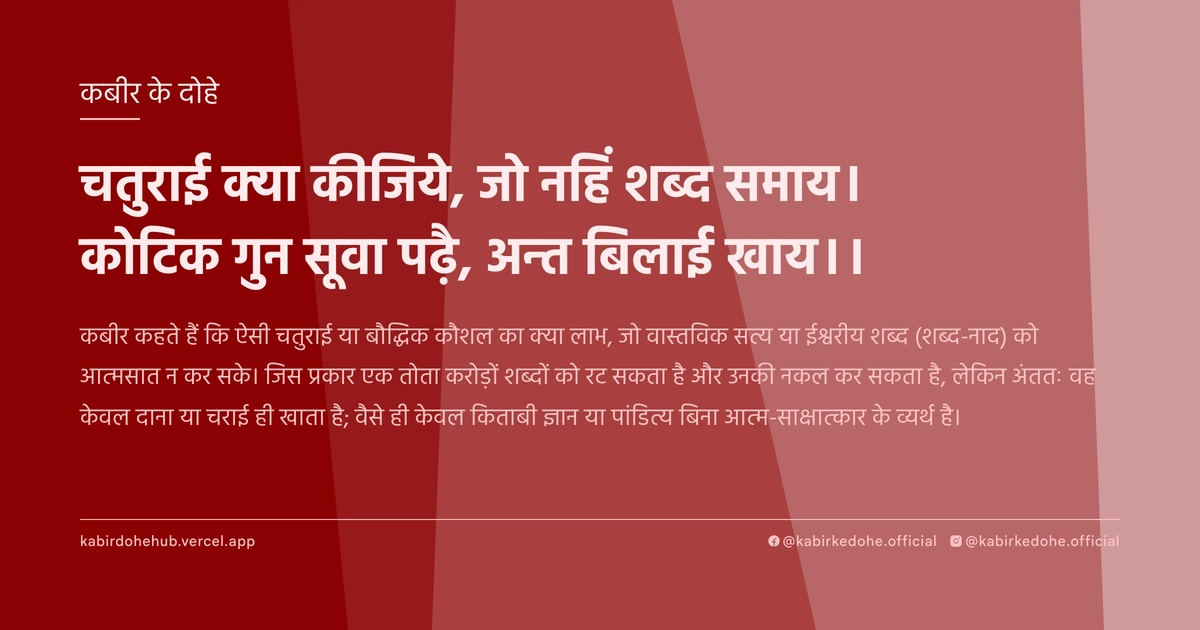
चतुराई क्या कीजिये, जो नहिं शब्द समाय।
कोटिक गुन सूवा पढ़ै, अन्त बिलाई खाय।।
Chaturai kya kariye, jo nahin shabd samaye. Kotik gun suva padhai, ant bilai khaye.
इस पृष्ठ पर इस कबीर दोहे का अर्थ (meaning), हिंदी व्याख्या और अंग्रेज़ी अनुवाद, दार्शनिक विश्लेषण और व्यावहारिक जीवन सीख दी गई है। यह दोहा सहज योग (Sahaja Yoga) विषय से जुड़ा है — Kabir doha meaning and explanation in Hindi and English.
अर्थ (Meaning):
कबीर कहते हैं कि ऐसी चतुराई या बौद्धिक कौशल का क्या लाभ, जो वास्तविक सत्य या ईश्वरीय शब्द (शब्द-नाद) को आत्मसात न कर सके। जिस प्रकार एक तोता करोड़ों शब्दों को रट सकता है और उनकी नकल कर सकता है, लेकिन अंततः वह केवल दाना या चराई ही खाता है; वैसे ही केवल किताबी ज्ञान या पांडित्य बिना आत्म-साक्षात्कार के व्यर्थ है।
Kabir questions the utility of intellectual cleverness or scholarly prowess if it fails to internalize the 'Shabd' (the divine sound or ultimate truth). He illustrates this with the metaphor of a parrot that may mimic millions of words with precision, yet in the end, it remains a bird driven by basic instinct, eating only grain, possessing no true understanding of the words it utters.
व्याख्या (Interpretation):
यह दोहा बौद्धिक अहंकार और वास्तविक आध्यात्मिक अनुभूति के बीच के अंतर को स्पष्ट करता है। 'शब्द' यहाँ केवल भाषा नहीं, बल्कि उस अनाहत नाद या ब्रह्मांडीय चेतना का प्रतीक है जो आत्मा को परमात्मा से जोड़ता है। कबीर संकेत देते हैं कि जब तक ज्ञान केवल मस्तिष्क का खेल है, वह 'माया' का एक सूक्ष्म रूप है। तोते का उदाहरण यह दर्शाता है कि नकल और रटने से ज्ञान नहीं मिलता; ज्ञान वह है जो व्यवहार और अस्तित्व को बदल दे। यह निर्गुण भक्ति का सार है, जहाँ बाहरी आडंबरों और शास्त्रार्थ के बजाय आंतरिक मौन और समर्पण को प्राथमिकता दी जाती है। यहाँ विरोधाभास यह है कि सबसे 'चतुर' व्यक्ति अक्सर अपनी ही चतुराई के जाल में फंसकर सत्य से दूर हो जाता है।
This couplet elucidates the chasm between intellectual vanity and genuine spiritual realization. The 'Shabd' here does not refer to mere linguistic vocabulary, but to the 'Anahata Nada' or the cosmic vibration that bridges the individual soul (Atman) with the Absolute (Brahman). Kabir suggests that as long as knowledge remains a cerebral exercise, it is merely a subtle manifestation of 'Maya' (illusion). The metaphor of the parrot demonstrates that mimicry and rote memorization do not constitute wisdom; true wisdom is that which transforms one's very existence. This is the essence of Nirgun Bhakti, prioritizing internal silence and surrender over external rituals and scholastic debates. The central paradox lies in the fact that the most 'clever' individual is often the one most trapped by their own intellect, thereby distancing themselves from the Truth.
दार्शनिक विश्लेषण (Philosophical Analysis):
कबीर का यह विचार उनके समय के उस सामाजिक-धार्मिक परिवेश की प्रतिक्रिया है जहाँ पंडित और मौलवी केवल शास्त्रों की व्याख्याओं में उलझे थे। वे 'पांडित्य' को एक बाधा मानते थे यदि वह अहंकार को जन्म दे। यह दृष्टिकोण अद्वैत वेदांत के उस सिद्धांत से मेल खाता है जहाँ 'चित्त' की शुद्धि को ज्ञान से अधिक महत्वपूर्ण माना गया है। कबीर का तर्क है कि सत्य तर्क का विषय नहीं, बल्कि अनुभव का विषय है।
सूफीवाद के प्रभाव में, कबीर 'इश्क' (प्रेम) और 'हाल' (आध्यात्मिक अवस्था) पर जोर देते हैं। उनके लिए, शब्दों का ढेर लगाना केवल एक मानसिक व्यायाम है। जब तक व्यक्ति अपने 'अहं' (Ego) का विसर्जन नहीं करता, वह केवल एक 'शिक्षित तोता' बना रहता है। यह विश्लेषण हमें बताता है कि बौद्धिक क्षमता एक उपकरण हो सकती है, लेकिन वह गंतव्य नहीं है।
ritualism (कर्मकांड) के प्रति उनकी घृणा यहाँ स्पष्ट है। वे कहते हैं कि यदि आपका ज्ञान आपको विनम्र नहीं बनाता या आपको जीव मात्र के प्रति करुणा से नहीं भरता, तो वह ज्ञान केवल एक बोझ है। वे शास्त्र-ज्ञान के बजाय 'सहज' मार्ग की वकालत करते हैं।
मनोवैज्ञानिक स्तर पर, यह दोहा 'संज्ञानात्मक विसंगति' की बात करता है। हम अक्सर वह जानते हैं जो सही है, लेकिन हम उसे जीते नहीं हैं। तोता शब्दों को जानता है पर उनका अर्थ नहीं। इसी तरह, मनुष्य धर्मग्रंथों को जानता है पर धर्म को जीता नहीं है।
अंततः, कबीर का संदेश यह है कि सत्य 'शब्दों' के पार है। जब शब्द शांत हो जाते हैं और केवल अनुभव शेष रहता है, तब वास्तविक 'चतुराई' या प्रज्ञा का उदय होता है। यह अहंकार के पूर्ण विनाश और शून्य में विलीन होने की प्रक्रिया है।
Kabir's insight is a direct reaction to the socio-religious climate of his era, where pundits and mullahs were entangled in endless exegetical debates. He viewed 'scholasticism' as a barrier if it fueled the ego. This perspective aligns with the Advaita Vedanta principle that the purification of the 'Chitta' (mind-stuff) is more critical than the accumulation of theoretical knowledge. Kabir argues that Truth is not a subject of logic, but an object of experience.
Influenced by Sufism, Kabir emphasizes 'Ishq' (divine love) and 'Haal' (spiritual state). To him, piling up words is merely a mental exercise. Until an individual undergoes the annihilation of the 'Ana' (Ego), they remain nothing more than an 'educated parrot.' This analysis reveals that while intellectual capacity can be a tool, it is never the destination.
His disdain for ritualism is evident here. He asserts that if knowledge does not cultivate humility or a profound compassion for all living beings, it is merely a burden. He advocates for the 'Sahaja' (natural/spontaneous) path over the rigid adherence to scriptures.
On a psychological level, this couplet addresses the gap between cognitive knowledge and embodied wisdom. We often know what is right, yet we do not live it. The parrot knows the words but not the meaning; similarly, the human knows the scripture but not the Spirit.
Ultimately, Kabir's message is that Truth lies beyond words. When the noise of language ceases and only pure experience remains, true 'cleverness' or Prajna (transcendental wisdom) awakens. This is the process of the total dissolution of the ego into the Void.
मूल संदेश (Core Message):
- बौद्धिक चालाकी आध्यात्मिक प्रगति की सबसे बड़ी बाधा है।
- सत्य शब्दों में नहीं, बल्कि उनके पीछे के मौन में है।
- रटा हुआ ज्ञान केवल एक मुखौटा है, वास्तविक अनुभव ही सत्य है।
- अहंकार का विसर्जन ही वास्तविक प्रज्ञा का उदय है।
- जीवन को जीना, उसके बारे में पढ़ने से कहीं अधिक श्रेष्ठ है।
- Intellectual cleverness is the greatest obstacle to spiritual progress.
- Truth resides not in words, but in the silence behind them.
- Rote knowledge is a mere mask; only lived experience is real.
- The dissolution of ego is the only way to awaken true wisdom.
- Living the truth is infinitely superior to reading about it.
व्यावहारिक उदाहरण (Practical Example):
एक समय की बात है, वाराणसी के घाटों पर एक वृद्ध विधवा रहती थी, जिसका नाम जानकी था। जानकी ने अपना पूरा जीवन धर्मग्रंथों को पढ़ने और सुनने में बिता दिया था। वह शहर की सबसे विद्वान महिला मानी जाती थी, जो कठिन से कठिन श्लोकों की व्याख्या कर सकती थी। लोग उसे सम्मान देते थे, और वह भी इस सम्मान को अपनी पहचान मान बैठी थी।
जानकी का दिन शास्त्रों के विश्लेषण और दूसरों को उनकी गलतियाँ बताने में बीतता था। वह अक्सर युवा साधुओं को टोकती कि उनका उच्चारण गलत है या उनका तरीका शास्त्र-सम्मत नहीं है। उसकी 'चतुराई' उसके अहंकार का कवच बन गई थी।
एक दिन, घाट की सीढ़ियों पर एक साधारण सा मल्लाह बैठा था, जो अनपढ़ था लेकिन उसकी आँखों में एक अजीब सी शांति थी। वह बस चुपचाप गंगा की लहरों को देख रहा था। जानकी उसके पास गई और उसे उपदेश देने लगी कि कैसे जीवन का लक्ष्य मोक्ष है और इसके लिए शास्त्रों का अध्ययन अनिवार्य है।
मल्लाह ने मुस्कुराकर बस इतना कहा, "माँ, आप लहरों के बारे में पढ़ रही हैं, और मैं लहरों में बह रहा हूँ। क्या पढ़ना बहने से बड़ा है?"
जानकी को यह बात चुभी। उसने उसे शास्त्र-तर्क से हराने की कोशिश की। लेकिन मल्लाह ने शांति से पूछा, "यदि आप इतनी विद्वान हैं, तो क्या आपका मन इस समय शांत है? या वह अभी भी शब्दों की लड़ाई लड़ रहा है?"
जानकी अचानक मौन हो गई। उसे एहसास हुआ कि वह पिछले चालीस वर्षों से केवल शब्दों को इकट्ठा कर रही थी, ठीक उसी तोते की तरह जिसका जिक्र कबीर ने किया था। उसके पास ज्ञान तो था, पर शांति नहीं थी।
उस रात जानकी सो नहीं सकी। उसने महसूस किया कि उसकी सारी 'चतुराई' उसे सत्य से दूर ले गई थी। उसने अपनी किताबों को एक कोने में रखा और पहली बार बिना किसी श्लोक के, केवल मौन रहकर गंगा को देखा।
अगले कुछ महीनों में, जानकी का व्यवहार बदल गया। उसने दूसरों की गलतियाँ निकालना बंद कर दिया। अब वह विद्वान नहीं, बल्कि एक दयालु स्त्री बन गई थी।
उसने सीखा कि असली ज्ञान वह नहीं जो जीभ पर हो, बल्कि वह है जो हृदय में उतरकर व्यवहार बन जाए।
उसकी चतुराई अब शब्दों में नहीं, बल्कि उसकी करुणा और मौन में झलकती थी।
Once, on the ghats of Varanasi, lived an elderly widow named Janaki. Janaki had spent her entire life reading and listening to religious scriptures. She was considered the most learned woman in the city, capable of interpreting the most complex shlokas. People revered her, and she, in turn, adopted this reverence as her primary identity.
Janaki's days were spent analyzing texts and pointing out the flaws in others' understanding. She frequently corrected young monks, telling them their pronunciation was wrong or their methods were not scripturally sound. Her 'cleverness' had become the armor of her ego.
One day, a simple boatman sat on the steps of the ghat. He was illiterate, yet his eyes held a strange, profound peace. He was simply watching the ripples of the Ganges in silence. Janaki approached him and began preaching about the goal of liberation and the necessity of scriptural study.
The boatman smiled and said, "Mother, you are reading about the waves, while I am flowing with them. Is reading greater than flowing?"
Janaki felt stung by this. She attempted to defeat him with scriptural logic. But the boatman calmly asked, "If you are so learned, is your mind peaceful at this moment? Or is it still fighting a war of words?"
Janaki suddenly fell silent. She realized that for the past forty years, she had merely been collecting words, exactly like the parrot mentioned by Kabir. She possessed knowledge, but not peace.
That night, Janaki could not sleep. She felt that all her 'cleverness' had actually distanced her from the Truth. She set her books aside in a corner and, for the first time, watched the Ganges in absolute silence, without any shlokas running through her mind.
Over the next few months, Janaki's behavior transformed. She stopped correcting others. She was no longer the 'scholar,' but a compassionate woman.
She learned that real knowledge is not that which resides on the tongue, but that which descends into the heart and manifests as conduct.
Her cleverness was no longer found in her vocabulary, but in her silence and her kindness.
अभ्यास मार्गदर्शन (Practice Guidance):
- दैनिक मौन अभ्यास: प्रतिदिन 20 मिनट के लिए पूर्ण मौन रहें। शब्दों के बिना केवल अपनी श्वास और अस्तित्व को महसूस करें।
- आत्म-पूछताछ जर्नल: लिखें कि आज आपने कितनी बार अपनी बौद्धिक श्रेष्ठता का उपयोग दूसरों को छोटा महसूस कराने के लिए किया।
- व्यवहार परिवर्तन: जब भी आप किसी को 'सही' साबित करने की इच्छा महसूस करें, तो रुकें और स्वयं से पूछें, 'क्या यह सत्य की खोज है या अहंकार की तुष्टि?'
- निदान चेकलिस्ट: क्या आप अभी भी केवल किताबों के माध्यम से सत्य खोज रहे हैं? क्या आपका ज्ञान आपके क्रोध और अहंकार को बढ़ा रहा है? यदि हाँ, तो आप 'तोता' बन रहे हैं।
- Daily Silence Practice: Spend 20 minutes in absolute silence. Feel your breath and existence without the mediation of words.
- Self-Inquiry Journaling: Record instances where you used your intellectual superiority to make others feel inferior.
- Behavioral Shift: Whenever you feel the urge to prove someone 'wrong' or yourself 'right,' pause and ask, 'Is this a quest for Truth or a feeding of the ego?'
- Diagnostic Checklist: Are you still seeking Truth exclusively through books? Is your knowledge increasing your anger or pride? If yes, you are becoming the 'parrot'.
चिंतन प्रश्न (Reflection Questions):
- क्या मेरी शिक्षा ने मुझे अधिक विनम्र बनाया है, या इसने मुझे दूसरों को आंकने का एक नया पैमाना दे दिया है?
- मेरे व्यक्तित्व का वह कौन सा हिस्सा है जो केवल 'दिखावे' के लिए ज्ञान का प्रदर्शन करता है?
- यदि मुझसे मेरी सारी डिग्रियां और बौद्धिक उपलब्धियां छीन ली जाएं, तो क्या मेरे पास कोई आंतरिक शांति बचेगी?
- मैं कितनी बार सत्य को 'जानने' के भ्रम में सत्य को 'जीना' भूल जाता हूँ?
- क्या मेरा डिजिटल व्यक्तित्व (Social Media) मेरी वास्तविक आध्यात्मिक स्थिति का प्रतिबिंब है या केवल एक 'शिक्षित तोते' की नकल?
- Has my education made me more humble, or has it simply given me a new scale to judge others?
- Which part of my personality performs knowledge merely for the sake of appearance?
- If all my degrees and intellectual achievements were stripped away, would any inner peace remain?
- How often do I forget to 'live' the truth because I am under the illusion of 'knowing' it?
- Is my digital persona a reflection of my actual spiritual state, or merely the mimicry of an 'educated parrot'?