
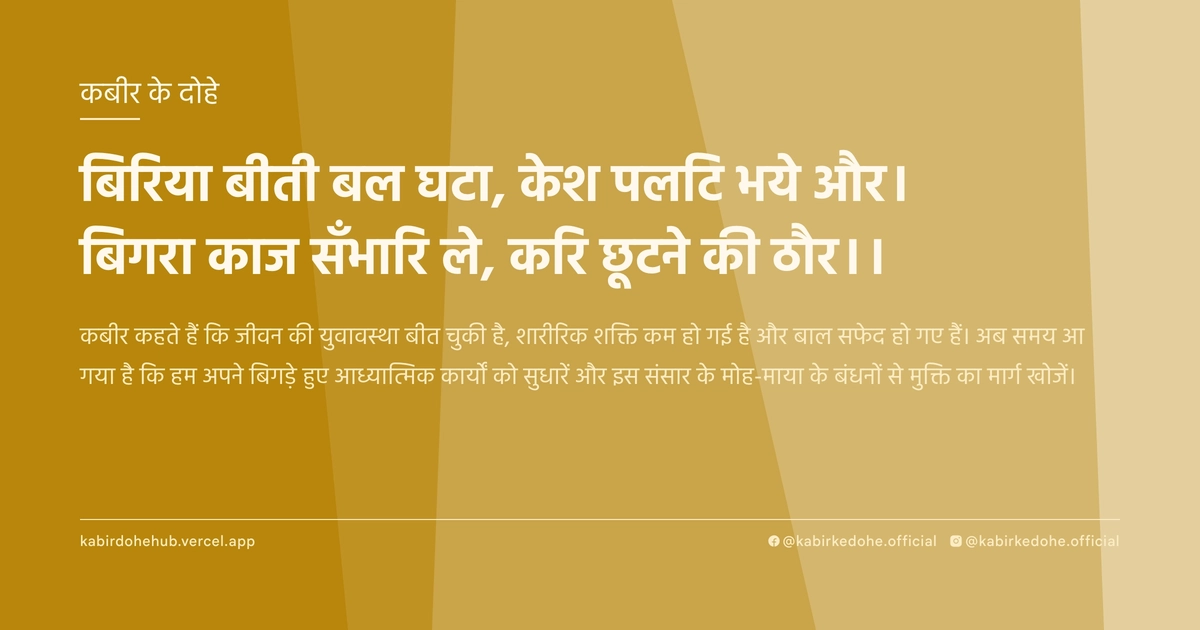
बिरिया बीती बल घटा, केश पलटि भये और।
बिगरा काज सँभारि ले, करि छूटने की ठौर।।
Biriya beeti bal ghata, kesh palati bhaye aur. Bigra kaaj sambhari le, kari chhootne ki thaur.
इस पृष्ठ पर इस कबीर दोहे का अर्थ (meaning), हिंदी व्याख्या और अंग्रेज़ी अनुवाद, दार्शनिक विश्लेषण और व्यावहारिक जीवन सीख दी गई है। यह दोहा यौवन की नश्वरता (Transience of Youth) विषय से जुड़ा है — Kabir doha meaning and explanation in Hindi and English.
अर्थ (Meaning):
कबीर कहते हैं कि जीवन की युवावस्था बीत चुकी है, शारीरिक शक्ति कम हो गई है और बाल सफेद हो गए हैं। अब समय आ गया है कि हम अपने बिगड़े हुए आध्यात्मिक कार्यों को सुधारें और इस संसार के मोह-माया के बंधनों से मुक्ति का मार्ग खोजें।
Kabir observes that the prime of youth has passed, physical strength has waned, and hair has turned grey. He urges the soul to rectify its neglected spiritual endeavors and seek a definitive way to liberate itself from the entanglements of worldly existence before time expires.
व्याख्या (Interpretation):
यह दोहा समय की नश्वरता और जीवन की क्षणभंगुरता का एक शक्तिशाली चित्रण है। 'बिरिया' और 'केश' का बदलना केवल शारीरिक बुढ़ापे का संकेत नहीं है, बल्कि यह आत्मा के लिए एक चेतावनी है कि भौतिक शरीर एक सीमित समय के लिए मिला है। यहाँ 'बिगरा काज' का अर्थ है वह आध्यात्मिक लक्ष्य जिसे हमने सांसारिक इच्छाओं के कारण अनदेखा कर दिया। यह निरगुण भक्ति का आह्वान है, जहाँ साधक को यह समझना होता है कि माया का पर्दा केवल तब गिरता है जब व्यक्ति को अपनी मृत्यु और समय की सीमितता का आभास होता है। यह द्वैत से अद्वैत की ओर संक्रमण की पुकार है, जहाँ व्यक्ति अपनी पहचान शरीर से हटाकर उस अविनाशी ब्रह्म से जोड़ता है।
This couplet serves as a poignant meditation on the transience of time and the fragility of human existence. The whitening of hair and loss of vigor are not merely biological markers of aging, but spiritual alarms signaling that the physical vessel is decaying. 'Bigra kaaj' (spoiled work) refers to the neglected cultivation of the soul, sacrificed at the altar of worldly desires. It aligns with Nirgun Bhakti, urging the seeker to pierce through the veil of Maya (illusion) by recognizing the inevitability of death. The central paradox lies in the fact that only when the body weakens does the spirit often awaken to the non-duality of Atman and Brahman, realizing that the true self is timeless and unbound by the physical decay described.
दार्शनिक विश्लेषण (Philosophical Analysis):
कबीर का यह दृष्टिकोण उनके युग के कर्मकांडीय आडंबरों के विरुद्ध एक प्रहार है। जहाँ तत्कालीन समाज बाहरी पूजा-पाठ और तीर्थयात्राओं में समय व्यतीत कर रहा था, कबीर ने आंतरिक रूपांतरण और 'सहज' मार्ग पर बल दिया। वे बताते हैं कि मोक्ष किसी बाहरी अनुष्ठान से नहीं, बल्कि अहंकार के विसर्जन से मिलता है।
अद्वैत वेदांत के परिप्रेक्ष्य में, यह दोहा जीव को उसकी वास्तविक प्रकृति की याद दिलाता है। जब तक मनुष्य स्वयं को शरीर मानता है, वह समय के चक्र में फंसा रहता है। जैसे ही वह यह अनुभव करता है कि वह शरीर नहीं बल्कि शुद्ध चेतना है, वह 'छूटने की ठौर' यानी मुक्ति का द्वार पा लेता है।
सूफी मत के 'फना' के सिद्धांत के समान, कबीर यहाँ स्वयं के सीमित अस्तित्व को मिटाने की बात कर रहे हैं। उनके लिए 'बिगड़ा काज' वह अलगाव है जो मनुष्य ने ईश्वर (परमात्मा) और स्वयं के बीच पैदा कर लिया है। इस अलगाव को मिटाना ही वास्तविक साधना है।
ऐतिहासिक रूप से, कबीर ने जाति और धर्म की सीमाओं को तोड़कर एक सार्वभौमिक सत्य की स्थापना की। उन्होंने चेतावनी दी कि समय किसी की प्रतीक्षा नहीं करता, चाहे वह पंडित हो या मुल्ला। आध्यात्मिक जागृति के लिए पात्रता केवल एक ही है—अपनी अज्ञानता को स्वीकार करना और सत्य की खोज में तत्पर होना।
मनोवैज्ञानिक स्तर पर, यह दोहा 'मृत्यु-चेतना' (Memento Mori) का उपयोग करता है ताकि व्यक्ति को वर्तमान क्षण की महत्ता का बोध हो। जब हम यह स्वीकार करते हैं कि हमारा समय सीमित है, तो हम अनावश्यक विवादों, ईर्ष्या और भौतिक संग्रह की प्रवृत्ति को त्याग कर आत्म-साक्षात्कार की ओर बढ़ते हैं।
Kabir’s perspective here is a sharp critique of the ritualistic pomposity of his era. While the society of his time was preoccupied with external piety, pilgrimage, and rigid caste hierarchies, Kabir emphasized internal transformation and the 'Sahaj' (natural) path. He asserts that liberation is not achieved through external rites but through the annihilation of the ego.
From the lens of Advaita Vedanta, this doha reminds the Jiva (individual soul) of its true nature. As long as one identifies with the physical body, they remain trapped in the cycle of Samsara. The moment one realizes they are not the decaying flesh but the eternal consciousness, they find the 'thaur' (place) of liberation, bridging the gap between Atman and Brahman.
Parallel to the Sufi concept of 'Fana' (annihilation of the self), Kabir speaks of erasing the limited identity. To him, the 'spoiled work' is the perceived separation between the Creator and the created. The spiritual journey is not about adding something new to the self, but stripping away the layers of illusion that hide the innate divinity.
Historically, Kabir dismantled the barriers of caste and creed to establish a universal truth. He warned that time is an impartial devourer, indifferent to whether one is a priest or a peasant. The only prerequisite for spiritual awakening is the courage to acknowledge one's ignorance and the urgency to seek the Truth.
Psychologically, this verse employs the concept of 'Memento Mori' to trigger an existential shift. By confronting the reality of aging and death, the individual is forced to abandon trivial conflicts, greed, and the digital or social ego, shifting focus toward a meaningful, transcendental existence.
मूल संदेश (Core Message):
- समय की रेत तेजी से फिसल रही है, जागृत हो जाओ।
- शारीरिक क्षय आत्मा के जागरण का संकेत हो सकता है।
- सांसारिक उपलब्धियां आध्यात्मिक शून्यता को नहीं भर सकतीं।
- अहंकार का त्याग ही मुक्ति का एकमात्र द्वार है।
- सत्य की खोज में देरी करना स्वयं के साथ विश्वासघात है।
- अंततः केवल वह बचेगा जो निस्वार्थ और शुद्ध है।
- The sands of time are slipping; awaken from the slumber of ignorance.
- Physical decay can be the catalyst for spiritual awakening.
- Worldly achievements cannot fill the void of a neglected soul.
- The surrender of the ego is the only gateway to liberation.
- Delaying the search for Truth is a betrayal of one's own existence.
- In the end, only that which is selfless and pure shall remain.
व्यावहारिक उदाहरण (Practical Example):
वाराणसी के एक पुराने घाट पर रहने वाले एक वृद्ध बुनकर, माधव, का जीवन केवल कपड़ों की बुनाई और धन संचय में बीता।
माधव ने अपनी पूरी जवानी केवल इस बात में लगा दी कि वह शहर का सबसे अमीर बुनकर बने।
उसने अपने परिवार को नजरअंदाज किया और अपने मन की शांति को केवल मुनाफे के तराजू पर तोला।
एक दिन, आईने में देखते हुए उसने पाया कि उसके बाल पूरी तरह सफेद हो चुके हैं और हाथ अब कांपने लगे हैं।
उसे अचानक याद आया कि उसने कभी उस शांति की खोज नहीं की जिसका वादा उसके पूर्वजों ने किया था।
उसे महसूस हुआ कि उसने जीवन भर केवल 'कपड़ा' बुना, लेकिन अपनी 'आत्मा' के धागों को उलझा हुआ छोड़ दिया।
उसने अपनी सारी संपत्ति का एक बड़ा हिस्सा अनाथ बच्चों की शिक्षा के लिए दान कर दिया और सादगी अपना ली।
अब वह केवल कपड़े नहीं बुनता था, बल्कि हर धागे के साथ ईश्वर के नाम का स्मरण करता था।
उसका क्रोध शांत हो गया और वह दूसरों की सेवा में आनंद खोजने लगा।
माधव ने अंततः समझ लिया कि असली 'काम' धन कमाना नहीं, बल्कि स्वयं को जानना और दूसरों के काम आना था।
In the ancient ghats of Varanasi lived an elderly weaver named Madhav, whose entire existence was woven into the pursuit of wealth.
Madhav spent his youth obsessively striving to become the most prosperous weaver in the city.
He neglected his emotional bonds and measured the success of his soul only by the weight of his profits.
One morning, gazing into a mirror, he realized his hair had turned completely silver and his hands had begun to tremble.
Suddenly, he was struck by the realization that he had never sought the inner peace his ancestors had spoken of.
He felt that while he had spent a lifetime weaving exquisite fabrics, he had left the threads of his own soul tangled and frayed.
In a sudden shift of consciousness, he donated a vast portion of his wealth to educate orphaned children and embraced a life of minimalism.
He no longer wove cloth merely for commerce; with every pass of the shuttle, he chanted the name of the Divine.
His chronic anger vanished, replaced by a profound joy found in selfless service to others.
Madhav finally understood that the true 'work' was not the accumulation of gold, but the realization of the Self and the service of humanity.
अभ्यास मार्गदर्शन (Practice Guidance):
- प्रतिदिन 20 मिनट मौन रहकर अपने शरीर की नश्वरता और आत्मा की अमरता पर चिंतन करें।
- एक डायरी लिखें जिसमें उन 'बिगड़े हुए कार्यों' (अधूरे आध्यात्मिक लक्ष्यों) की सूची बनाएं जिन्हें आप अब सुधारना चाहते हैं।
- साप्ताहिक रूप से किसी ऐसे व्यक्ति की निस्वार्थ सेवा करें जिससे आपका कोई व्यक्तिगत लाभ न जुड़ा हो।
- निदान चेकलिस्ट: क्या आप अभी भी बाहरी प्रशंसा के लिए जी रहे हैं? क्या मृत्यु का विचार आपको डराता है या प्रेरित करता है? क्या आप वर्तमान क्षण में उपस्थित हैं?
- Spend 20 minutes daily in absolute silence, contemplating the decay of the physical body versus the eternity of the soul.
- Maintain a journal listing the 'spoiled works' (neglected spiritual goals) you wish to rectify in the remaining time.
- Engage in selfless service (Seva) weekly for someone from whom you can gain no material or social advantage.
- Diagnostic Checklist: Are you still living for external validation? Does the thought of death evoke fear or a sense of urgency for growth? Are you truly present in the 'now'?
चिंतन प्रश्न (Reflection Questions):
- यदि आज आपका अंतिम दिन हो, तो क्या आप अपनी उपलब्धियों से संतुष्ट होंगे या अपनी आंतरिक शून्यता से भयभीत?
- आपकी 'डिजिटल पहचान' और सामाजिक छवि आपके वास्तविक स्वरूप को कितना ढक रही है?
- वह कौन सा 'बिगड़ा हुआ कार्य' है जिसे आप अपनी ईगो के कारण सुधारने से डर रहे हैं?
- क्या आप वास्तव में स्वतंत्र हैं, या आप अपनी इच्छाओं और आदतों के गुलाम हैं?
- आपकी आत्मा का वह कौन सा हिस्सा है जो समय और मृत्यु से परे है?
- If today were your final day, would you be satisfied with your achievements or terrified by your inner void?
- To what extent does your digital persona and social image obscure your authentic self?
- What is the 'spoiled work' in your life that you are afraid to rectify due to your ego?
- Are you truly free, or are you merely a slave to your desires and conditioned habits?
- Which part of your being exists beyond the reach of time and the inevitability of death?