
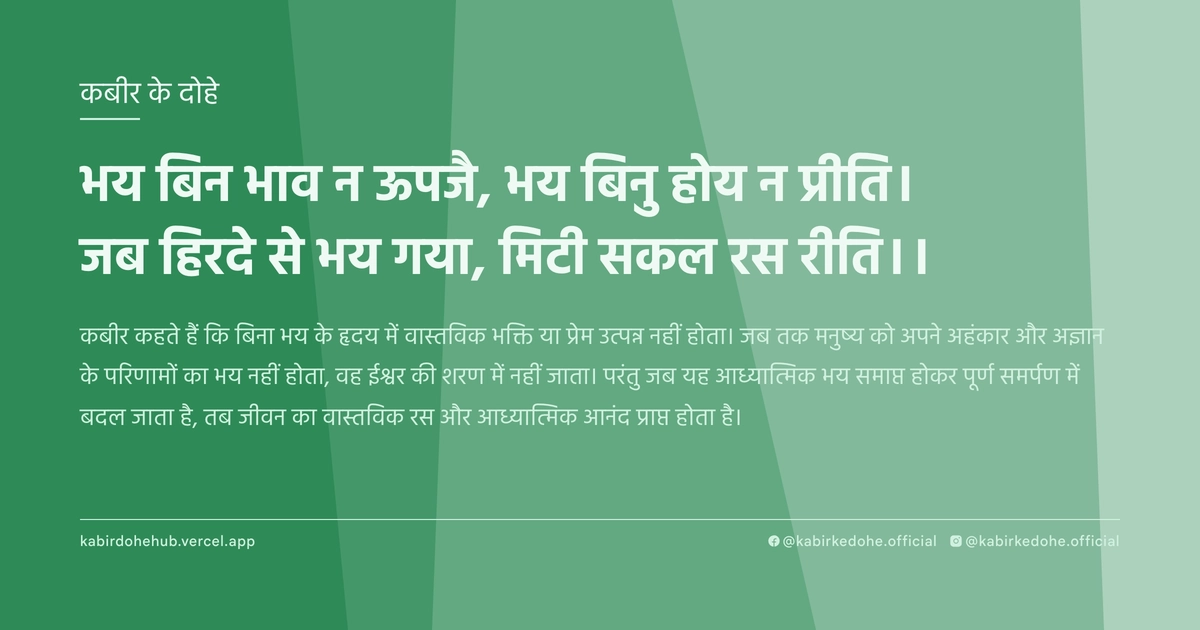
भय बिन भाव न ऊपजै, भय बिनु होय न प्रीति।
जब हिरदे से भय गया, मिटी सकल रस रीति।।
Bhay bin bhaav na upjai, bhay binu hoye na preeti. Jab hirde se bhay gaya, miti sakal ras reeti.
इस पृष्ठ पर इस कबीर दोहे का अर्थ (meaning), हिंदी व्याख्या और अंग्रेज़ी अनुवाद, दार्शनिक विश्लेषण और व्यावहारिक जीवन सीख दी गई है। यह दोहा भय (Fear) विषय से जुड़ा है — Kabir doha meaning and explanation in Hindi and English.
अर्थ (Meaning):
कबीर कहते हैं कि बिना भय के हृदय में वास्तविक भक्ति या प्रेम उत्पन्न नहीं होता। जब तक मनुष्य को अपने अहंकार और अज्ञान के परिणामों का भय नहीं होता, वह ईश्वर की शरण में नहीं जाता। परंतु जब यह आध्यात्मिक भय समाप्त होकर पूर्ण समर्पण में बदल जाता है, तब जीवन का वास्तविक रस और आध्यात्मिक आनंद प्राप्त होता है।
Kabir asserts that without a sense of awe or spiritual fear, true devotion and love cannot blossom. Until one recognizes the peril of their own ego and ignorance, they remain distant from the Divine. However, once this fear is transmuted through surrender, the superficial rituals vanish, and the true essence of spiritual bliss is realized.
व्याख्या (Interpretation):
इस दोहे का शाब्दिक अर्थ है कि अनुशासन और भय के बिना प्रेम संभव नहीं है। लेकिन आध्यात्मिक स्तर पर, 'भय' यहाँ शारीरिक डर नहीं, बल्कि 'दिव्य विस्मय' (Divine Awe) है। यह वह क्षण है जब साधक को अपनी लघुता और माया के जाल का आभास होता है। यह भय अहंकार को तोड़ता है, जिससे निर्गुण भक्ति का मार्ग प्रशस्त होता है। जब यह भय 'भक्ति' में बदल जाता है, तो द्वैत समाप्त हो जाता है और आत्मा का ब्रह्म से मिलन होता है। यह विरोधाभास है कि विनाश का भय ही वास्तव में शाश्वत जीवन की ओर ले जाता है।
Literally, the verse suggests that love cannot exist without fear. Metaphorically, 'fear' here refers to 'Divine Awe'—the profound realization of one's own insignificance in the face of the Infinite. This is not a fear of punishment, but a fear of remaining separated from the Truth due to the veil of Maya. In Nirgun Bhakti, this fear acts as the catalyst that shatters the ego, allowing the Atman to recognize its non-duality with Brahman. The paradox lies in the fact that only by fearing the illusion of the 'I' can one enter the state of 'Soham' (I am That), where all fear dissolves into pure, unconditional love.
दार्शनिक विश्लेषण (Philosophical Analysis):
कबीर का यह दृष्टिकोण उनके युग के सामाजिक और धार्मिक पाखंडों पर एक प्रहार है। उन्होंने देखा कि लोग केवल कर्मकांडों के माध्यम से मोक्ष चाहते थे, जिसमें कोई आंतरिक रूपांतरण नहीं था। यहाँ 'भय' का अर्थ है आत्म-साक्षात्कार की वह तीव्रता जो व्यक्ति को उसकी वास्तविक स्थिति से अवगत कराती है। यह सूफी मत के 'खौफ' (Khauf) के समान है, जहाँ ईश्वर की महानता के सामने अपनी तुच्छता का बोध ही प्रेम की पहली सीढ़ी है।
अद्वैत वेदांत के संदर्भ में, यह भय 'अविद्या' (अज्ञान) के प्रति भय है। जब साधक को यह समझ आता है कि उसका पूरा अस्तित्व एक भ्रम है, तो वह भयभीत होता है, और यही भय उसे सत्य की खोज के लिए प्रेरित करता है। कबीर यहाँ यह स्पष्ट कर रहे हैं कि बिना अनुशासन और गंभीरता के आध्यात्मिक प्रगति असंभव है।
यह दोहा अहंकार के विलोपन (Annihilation of Ego) की प्रक्रिया को दर्शाता है। जब तक 'मैं' जीवित है, तब तक प्रेम नहीं हो सकता क्योंकि प्रेम में 'दो' का होना आवश्यक है, लेकिन सर्वोच्च प्रेम में 'दो' मिलकर 'एक' हो जाते हैं। भय वह कुल्हाड़ी है जो अहंकार की जड़ काटती है।
कबीर ने जाति और धर्म के बाहरी ढांचों को नकारते हुए आंतरिक अनुभव पर बल दिया। उनके लिए, मंदिर या मस्जिद जाना व्यर्थ है यदि हृदय में वह तड़प या भय नहीं है जो उसे सत्य की ओर धकेले। यह एक मनोवैज्ञानिक रूपांतरण है जहाँ भय, श्रद्धा में बदल जाता है।
अंततः, यह विश्लेषण हमें बताता है कि आध्यात्मिक यात्रा का आरंभ अक्सर एक संकट या गहरे बोध से होता है। यह 'रस रीति' का मिटना वास्तव में सांसारिक मोह-माया के अंत और दिव्य आनंद के उदय का संकेत है।
Kabir’s perspective is a sharp critique of the ritualistic complacency of his era. He observed that people sought salvation through mechanical rites without any internal transformation. Here, 'fear' is not terror, but a profound existential urgency—a realization of the precariousness of the ego. This mirrors the Sufi concept of 'Khauf,' where the awe of the Divine's majesty is the necessary precursor to 'Ishq' (Divine Love).
In the context of Advaita Vedanta, this fear is the apprehension of 'Avidya' (ignorance). When the seeker realizes that their perceived identity is a mere construct of Maya, a spiritual crisis ensues. This crisis is the 'fear' Kabir speaks of; it is the catalyst that drives the soul toward the Absolute. Without this initial shock, the mind remains dormant in its delusions.
The verse details the process of 'Fana' or the annihilation of the ego. True love cannot exist as long as the 'I' persists, for the ego is the primary barrier to union. Fear acts as the surgical instrument that removes the tumor of pride, clearing the path for the Atman to merge with Brahman.
By rejecting caste and creed, Kabir emphasizes that spiritual evolution is an internal alchemy. He posits that visiting shrines is futile if the heart lacks the intensity of longing. The transition from fear to love is a psychological shift from external coercion to internal conviction.
Ultimately, this analysis reveals that the spiritual journey often begins with a breakdown. The 'erasing of the ways of essence' (ras reeti) refers to the dissolution of worldly attachments and the superficial pleasures of the ego, making room for the singular, all-encompassing joy of the Formless One.
मूल संदेश (Core Message):
- अहंकार का अंत ही प्रेम का प्रारंभ है।
- दिव्य विस्मय हमें हमारी वास्तविक लघुता से परिचित कराता है।
- बिना अनुशासन और गंभीरता के भक्ति केवल एक दिखावा है।
- जब 'मैं' मिटता है, तब केवल 'वह' (ब्रह्म) शेष रहता है।
- भय से प्रेम की यात्रा ही वास्तविक आध्यात्मिक विकास है।
- सांसारिक आसक्तियों का अंत ही दिव्य रस की प्राप्ति है।
- The end of ego is the beginning of true love.
- Divine awe introduces us to our authentic insignificance.
- Devotion without discipline and urgency is mere performance.
- When the 'I' dissolves, only the 'Infinite' remains.
- The journey from fear to love is the essence of spiritual growth.
- The dissolution of worldly attachment unlocks divine bliss.
व्यावहारिक उदाहरण (Practical Example):
एक समय की बात है, वाराणसी के घाटों पर माधव नाम का एक वृद्ध कुम्हार रहता था। वह अपनी कला में निपुण था, लेकिन अत्यंत अभिमानी था। उसे लगता था कि उसके बनाए मिट्टी के बर्तनों जैसा कोई दूसरा नहीं बना सकता। वह अन्य कुम्हारों को तुच्छ समझता था और स्वयं को सर्वश्रेष्ठ मानता था।
एक दिन, शहर में एक भीषण बाढ़ आई। गंगा का जलस्तर इतनी तेजी से बढ़ा कि माधव की पूरी कार्यशाला, उसके सारे तैयार बर्तन और उसका घर पानी में डूब गए। एक ही पल में उसकी सारी संपत्ति और उसका अहंकार मिट्टी में मिल गया।
जब वह अपनी छत पर खड़ा होकर सब कुछ नष्ट होते देख रहा था, तो उसके मन में एक गहरा भय व्याप्त हो गया। उसे एहसास हुआ कि जिस मिट्टी पर उसे इतना गर्व था, वह कितनी क्षणभंगुर है। वह सोचने लगा, 'मैं कौन हूँ? मेरा अस्तित्व क्या है जब प्रकृति एक पल में सब कुछ मिटा सकती है?'
यह भय उसे रात भर जगाए रखा। उसने महसूस किया कि उसने जीवन भर केवल मिट्टी के बर्तनों से प्रेम किया, लेकिन उस कुम्हार (ईश्वर) को कभी नहीं जाना जिसने इस सृष्टि को गढ़ा है। उसके भीतर का अहंकार टूट गया और उसकी आँखों में आँसू आ गए।
अगले दिन, जब पानी उतरा, माधव ने फिर से मिट्टी उठाई। लेकिन अब उसके काम में एक अलग ही चमक थी। वह अब श्रेष्ठता के लिए नहीं, बल्कि समर्पण के लिए बर्तन बनाने लगा।
वह अब हर बर्तन को ईश्वर की एक भेंट मानने लगा। उसने अपने साथ काम करने वाले अन्य कुम्हारों की मदद करना शुरू किया, जिन्हें वह पहले नीचा दिखाता था।
उसने पाया कि जब तक वह अपनी श्रेष्ठता के भ्रम में था, वह अकेला था। लेकिन जब उसने अपनी लघुता का भय स्वीकार किया, तो उसे सबके प्रति प्रेम महसूस होने लगा।
उसका जीवन अब एक उत्सव बन गया था। उसने सीखा कि जब तक उसे अपनी नश्वरता का भय नहीं हुआ, तब तक वह वास्तव में प्रेम करना नहीं सीख पाया था।
माधव अब केवल एक कुम्हार नहीं था, वह एक साधक बन गया था। उसकी कला अब केवल जीविका नहीं, बल्कि उसकी प्रार्थना बन गई थी।
यह 'कबीर ट्विस्ट' था: विनाश के भय ने उसे सृजन के वास्तविक आनंद से मिला दिया।
Once, on the ghats of Varanasi, lived an elderly potter named Madhav. He was a master of his craft but consumed by immense pride. He believed his clay vessels were peerless and looked down upon other potters, convinced of his own superiority.
One year, a devastating flood struck the city. The waters of the Ganges rose with such fury that Madhav's entire workshop, his finished wares, and his home were swept away in an instant. His wealth and his ego were dissolved into the mud.
Standing on his roof, watching everything vanish, a profound fear gripped him. He realized the fragility of the clay he had worshipped. He questioned, 'Who am I? What is my existence when nature can erase everything in a heartbeat?'
This fear kept him awake all night. He realized he had spent his life loving the pots but had ignored the Divine Potter who shaped the universe. The shell of his ego shattered, and he wept for his blindness.
When the waters receded, Madhav returned to the clay. But his work had changed. He no longer crafted for prestige; he crafted in surrender.
He began to view every vessel as an offering to the Divine. He reached out to the other potters he had once belittled, offering them support and kinship.
He discovered that while his pride had kept him isolated, the acceptance of his own insignificance had opened his heart to universal love.
His life became a celebration of simplicity. He understood that until he feared his own transience, he could never truly love.
Madhav was no longer just a craftsman; he had become a seeker. His art was no longer a means of livelihood, but a form of prayer.
This was the 'Kabir Twist': the fear of total loss became the gateway to an eternal gain.
अभ्यास मार्गदर्शन (Practice Guidance):
- प्रतिदिन 20 मिनट मौन रहकर इस विचार पर मनन करें कि यदि आज आपका अहंकार और पहचान छीन ली जाए, तो आप क्या बचेंगे।
- एक 'अहंकार डायरी' लिखें: दिन भर में उन क्षणों को दर्ज करें जब आपने स्वयं को दूसरों से श्रेष्ठ या निम्न महसूस किया और विश्लेषण करें कि वह भय या असुरक्षा कहाँ से आई।
- सेवा का अभ्यास: सप्ताह में एक बार किसी ऐसे व्यक्ति की निस्वार्थ मदद करें जिससे आप घृणा करते हैं या जिसे आप तुच्छ समझते हैं, ताकि आपके भीतर का 'मैं' मिट सके।
- निदान चेकलिस्ट: क्या आप अभी भी अपनी उपलब्धियों का श्रेय स्वयं लेते हैं? क्या आप दूसरों की आलोचना करते समय श्रेष्ठता महसूस करते हैं? यदि हाँ, तो आप अभी भी 'भय' (दिव्य विस्मय) से दूर हैं।
- Spend 20 minutes daily in silence, contemplating: 'If my identity and ego were stripped away today, what would remain of me?'
- Maintain an 'Ego Journal': Record moments during the day when you felt superior or inferior to others, and analyze the underlying fear or insecurity.
- Practice selfless service: Once a week, help someone you dislike or deem insignificant, specifically to dismantle the barrier of the 'I'.
- Diagnostic Checklist: Do you still take sole credit for your achievements? Do you feel a sense of superiority while criticizing others? If yes, you are still distant from 'Divine Awe'.
चिंतन प्रश्न (Reflection Questions):
- वह कौन सा डर है जो आपको वास्तव में बदलने के लिए मजबूर कर सकता है?
- क्या आपका 'आध्यात्मिक व्यक्तित्व' केवल आपके सामाजिक अहंकार का एक विस्तार है?
- यदि आपकी सारी उपाधियाँ और उपलब्धियाँ छीन ली जाएँ, तो क्या आप स्वयं को प्रेम कर पाएंगे?
- आपकी कौन सी छिपी हुई पूर्वाग्रह (biases) आपको दूसरों के साथ एक होने से रोकती हैं?
- क्या आप ईश्वर से प्रेम करते हैं, या उस सुरक्षा की भावना से जो ईश्वर का नाम लेने से मिलती है?
- आपके जीवन में 'भय' ने कब आपको सत्य के करीब पहुँचाया है?
- What is the specific fear that could actually compel you to transform?
- Is your 'spiritual persona' merely an extension of your social ego?
- If all your titles and achievements were stripped away, would you still be able to love yourself?
- Which hidden biases prevent you from experiencing oneness with others?
- Do you love the Divine, or do you love the feeling of security that comes from claiming to be a devotee?
- When has 'fear' in your life actually acted as a bridge to the Truth?