
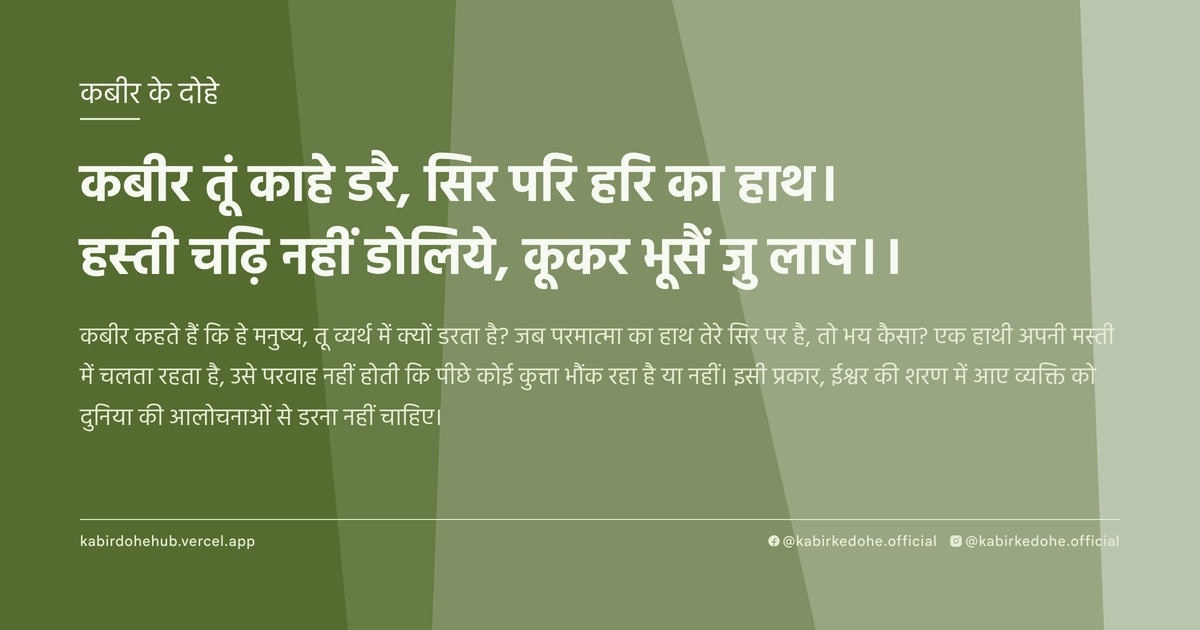
कबीर तूं काहे डरै, सिर परि हरि का हाथ।
हस्ती चढ़ि नहीं डोलिये, कूकर भूसैं जु लाष।।
Kabir tun kaahe darai, sir pari hari ka haath. Hasti chadhi nahi doliye, kookar bhusain ju laash.
इस पृष्ठ पर इस कबीर दोहे का अर्थ (meaning), हिंदी व्याख्या और अंग्रेज़ी अनुवाद, दार्शनिक विश्लेषण और व्यावहारिक जीवन सीख दी गई है। यह दोहा भय (Fear) विषय से जुड़ा है — Kabir doha meaning and explanation in Hindi and English.
अर्थ (Meaning):
कबीर कहते हैं कि हे मनुष्य, तू व्यर्थ में क्यों डरता है? जब परमात्मा का हाथ तेरे सिर पर है, तो भय कैसा? एक हाथी अपनी मस्ती में चलता रहता है, उसे परवाह नहीं होती कि पीछे कोई कुत्ता भौंक रहा है या नहीं। इसी प्रकार, ईश्वर की शरण में आए व्यक्ति को दुनिया की आलोचनाओं से डरना नहीं चाहिए।
Kabir asks, 'Why do you fear, O human, when the hand of the Divine rests upon your head?' He illustrates this with a metaphor: an elephant, riding in its own majestic strength, remains unmoved by the frantic barking of dogs. Similarly, one who is anchored in God's grace should remain indifferent to the petty criticisms and noise of the world.
व्याख्या (Interpretation):
इस दोहे का शाब्दिक अर्थ है कि ईश्वर की सुरक्षा में रहने वाला व्यक्ति निर्भय होता है। रूपकात्मक रूप से, 'हाथी' उस जागृत आत्मा का प्रतीक है जिसने अपनी आंतरिक शक्ति और परमात्मा के साथ एकाकारता को पहचान लिया है। 'कुत्ता' उन सांसारिक बाधाओं, ईर्ष्यालु लोगों और सामाजिक दबावों का प्रतीक है जो हमें हमारे मार्ग से भटकाने का प्रयास करते हैं। यह निर्गुण भक्ति का सार है, जहाँ भक्त किसी बाहरी मूर्ति के बजाय अपने भीतर के उस निराकार सत्य (Brahman) पर भरोसा करता है। यहाँ 'हरि का हाथ' केवल एक बाहरी सुरक्षा नहीं, बल्कि आत्म-साक्षात्कार की वह अवस्था है जहाँ द्वैत समाप्त हो जाता है और केवल एक अखंड चेतना शेष रहती है। यह माया के भ्रम को तोड़कर सत्य में स्थित होने की प्रेरणा है।
Literally, the verse suggests that divine protection grants fearlessness. Metaphorically, the 'elephant' represents the awakened soul who has realized their inherent strength and union with the Divine. The 'barking dog' symbolizes the mundane obstacles, envious critics, and societal pressures that attempt to derail the spiritual seeker. This embodies the essence of Nirgun Bhakti, where the devotee relies not on external idols but on the formless Truth (Brahman) within. 'Hari's hand' is not merely external protection, but the state of self-realization where duality vanishes, leaving only a singular, unbroken consciousness. It is a call to pierce through the veil of Maya and stand firm in the absolute reality of the Atman.
दार्शनिक विश्लेषण (Philosophical Analysis):
कबीर का यह दोहा उस समय के सामाजिक परिवेश की प्रतिक्रिया है जहाँ धर्म के नाम पर डर और पाखंड का बोलबाला था। कबीर ने पुरोहितवाद और कर्मकांडों को नकारते हुए सीधे ईश्वर से संबंध स्थापित करने पर जोर दिया। यह दृष्टिकोण अद्वैत वेदांत के करीब है, जो मानता है कि आत्मा और परमात्मा एक ही हैं; यदि हम इस एकता को जान लें, तो भय का कोई अस्तित्व नहीं रहता।
सूफीवाद के प्रभाव में, कबीर 'इश्क-ए-हकीकी' (ईश्वरीय प्रेम) की बात करते हैं, जहाँ प्रेमी अपने महबूब (ईश्वर) के प्रति इतना समर्पित होता है कि दुनिया की कोई भी ताकत उसे विचलित नहीं कर सकती। यहाँ 'अहंकार' का विसर्जन अनिवार्य है। जब तक व्यक्ति 'मैं' और 'मेरा' के भ्रम में रहता है, वह डरता है, लेकिन जब वह स्वयं को परमात्मा की इच्छा में विलीन कर देता है, तो वह 'हाथी' की तरह अडिग हो जाता है।
कबीर जाति और वर्ग के भेदभाव को पूरी तरह खारिज करते हैं। उनके लिए आध्यात्मिक पात्रता किसी विशेष कुल या शास्त्र ज्ञान से नहीं, बल्कि हृदय की सरलता और साहस से आती है। वे सिखाते हैं कि वास्तविक धर्म बाहरी दिखावे में नहीं, बल्कि आंतरिक स्थिरता में है।
मनोवैज्ञानिक स्तर पर, यह दोहा 'बाहरी सत्यापन' (External Validation) की भूख को समाप्त करने का मार्ग है। मनुष्य अक्सर दूसरों की राय के आधार पर अपनी खुशी और शांति तय करता है। कबीर इस निर्भरता को तोड़कर व्यक्ति को उसकी अपनी आंतरिक गरिमा और दैवीय स्रोत से जोड़ते हैं।
अंततः, यह दोहा हमें सिखाता है कि सत्य का मार्ग अक्सर अकेला होता है और उस पर चलने वालों को उपहास का सामना करना पड़ता है। लेकिन जो व्यक्ति सत्य के साथ संरेखित है, उसके लिए यह उपहास केवल शोर है, जो उसकी यात्रा की गति को कम नहीं कर सकता।
This couplet is a direct response to the socio-religious climate of Kabir's era, dominated by fear-based theology and ritualistic hypocrisy. By rejecting the mediation of priests, Kabir emphasizes a direct, unmediated relationship with the Divine. This aligns closely with Advaita Vedanta, which posits that the Atman (individual soul) and Brahman (universal soul) are identical; once this non-duality is realized, fear ceases to exist.
Influenced by Sufism, Kabir speaks of 'Ishq-e-Haqiqi' (Divine Love), where the seeker's devotion is so absolute that no worldly force can shake their resolve. The annihilation of the ego (Fana) is central here. As long as one clings to the illusion of 'I' and 'mine,' fear persists; however, by merging one's will with the Divine, one attains the stability of the elephant.
Kabir radically rejects caste and class hierarchies. For him, spiritual eligibility is not derived from lineage or scriptural erudition but from purity of heart and courage. He asserts that true religion resides not in outward displays of piety but in inner steadfastness.
Psychologically, this verse addresses the trap of 'External Validation.' Humans often tether their peace of mind to the opinions of others. Kabir breaks this dependency, urging the individual to anchor their identity in their own divine source rather than in the fluctuating judgments of society.
Ultimately, the poem teaches that the path of Truth is often solitary and fraught with ridicule. Yet, for the one aligned with Truth, such mockery is mere noise—insignificant and incapable of altering the trajectory of their spiritual ascent.
मूल संदेश (Core Message):
- बाहरी शोर केवल एक भ्रम है, आंतरिक शांति ही एकमात्र सत्य है।
- ईश्वरीय समर्पण डर की जड़ों को पूरी तरह नष्ट कर देता है।
- सत्य का मार्ग अकेले चलने का साहस माँगता है।
- जब आप स्वयं को परमात्मा में विलीन करते हैं, तो आलोचनाएँ अर्थहीन हो जाती हैं।
- आत्म-विश्वास नहीं, बल्कि 'ईश्वर-विश्वास' ही वास्तविक निर्भयता है।
- दुनिया की प्रतिक्रियाएँ आपकी आंतरिक कीमत तय नहीं करतीं।
- External noise is a mere illusion; inner stillness is the only reality.
- Absolute surrender to the Divine eradicates the very roots of fear.
- The path of Truth demands the courage to walk alone.
- When you merge with the Divine, all criticisms become meaningless.
- Not self-confidence, but 'Divine-confidence' is the source of true fearlessness.
- The reactions of the world do not determine your intrinsic value.
व्यावहारिक उदाहरण (Practical Example):
राजस्थान के एक छोटे से गाँव में रामदीन नाम का एक वृद्ध कुम्हार रहता था। वह अपनी कला के प्रति समर्पित था, लेकिन गाँव के कुछ प्रभावशाली लोग उसे नीचा दिखाते थे क्योंकि वह उनके द्वारा थोपे गए पुराने रीति-रिवाजों को नहीं मानता था।
रामदीन का मानना था कि मिट्टी की सेवा ही ईश्वर की सेवा है। वह घंटों चाक पर मिट्टी को आकार देता और गाता रहता। गाँव के लोग उसका मजाक उड़ाते और कहते कि वह पाखंडी है क्योंकि वह मंदिर के बाहरी आडंबरों में विश्वास नहीं करता था।
एक समय ऐसा आया जब गाँव में एक बड़ा उत्सव था। सभी कुम्हारों को राजा के लिए विशेष बर्तन बनाने का आदेश दिया गया। अन्य कुम्हार डर के मारे और लालच में आकर केवल वही बना रहे थे जो राजा को पसंद आता, चाहे वह कलात्मक रूप से गलत ही क्यों न हो।
रामदीन ने अपनी अंतरात्मा की सुनी। उसने ऐसे बर्तन बनाए जिनमें उसकी अपनी मौलिकता और ईश्वर के प्रति प्रेम झलकता था। उसने किसी की परवाह नहीं की, चाहे लोग उसे 'मूर्ख' कहें या 'विद्रोही'।
जब राजा ने बर्तनों का निरीक्षण किया, तो वह रामदीन की कृतियों की सादगी और गहराई देखकर दंग रह गया। उसने देखा कि अन्य बर्तनों में केवल दिखावा था, जबकि रामदीन के बर्तनों में एक रूहानी सुकून था।
गाँव के वही लोग जो रामदीन को ताने देते थे, अब उसकी चापलूसी करने लगे। लेकिन रामदीन के चेहरे पर न तो अहंकार था और न ही कोई बदलाव। वह अभी भी उसी शांत भाव से अपना काम कर रहा था।
उसे याद आया कि कैसे वह वर्षों तक लोगों की बातों से परेशान हुआ था। अब उसे समझ आया कि जब आप अपने सत्य और परमात्मा के साथ जुड़े होते हैं, तो दुनिया का शोर केवल एक पृष्ठभूमि संगीत बन जाता है।
रामदीन ने महसूस किया कि उसकी शांति बाहरी प्रशंसा में नहीं, बल्कि इस बात में थी कि उसने कभी अपने सत्य से समझौता नहीं किया। वह अब वास्तव में उस 'हाथी' की तरह था जिसे कुत्तों के भौंकने से कोई फर्क नहीं पड़ता।
उसने गाँव के युवाओं को सिखाया कि डर को जीतना ही वास्तविक स्वतंत्रता है। उसने उन्हें बताया कि जब आप सही रास्ते पर होते हैं, तो पूरी कायनात आपकी ढाल बन जाती है।
इस प्रकार, रामदीन का जीवन एक उदाहरण बन गया कि कैसे आंतरिक विश्वास और ईश्वरीय समर्पण मनुष्य को सामाजिक दबावों से ऊपर उठा देता है।
In a small village in Rajasthan lived an elderly potter named Ramdeen. He was deeply devoted to his craft, but some influential villagers looked down upon him because he refused to follow the rigid, outdated rituals they imposed.
Ramdeen believed that serving the clay was equivalent to serving God. He would spend hours at his wheel, shaping earth and singing hymns. The villagers mocked him, calling him a heretic because he ignored the outward pomps of the temple.
Once, during a grand festival, all the potters were ordered to create special vessels for the King. Driven by fear and greed, the other potters made pieces that they thought the King would like, even if they were artistically hollow.
Ramdeen listened to his inner voice. He crafted vessels that reflected his original spirit and his love for the Divine. He remained indifferent to whether people called him a 'fool' or a 'rebel.'
When the King inspected the works, he was stunned by the simplicity and depth of Ramdeen's creations. He noticed that while others offered mere decoration, Ramdeen's pots possessed a spiritual serenity.
The same villagers who had spent years taunting Ramdeen now began to flatter him. However, there was neither arrogance nor change in Ramdeen's demeanor. He continued his work with the same quiet grace.
He recalled the years he had spent troubled by the words of others. He realized that when one is aligned with their truth and the Divine, the noise of the world becomes nothing more than background music.
Ramdeen understood that his peace did not lie in external praise, but in the fact that he had never compromised his integrity. He had truly become the 'elephant' who is unmoved by the barking of dogs.
He began teaching the village youth that conquering fear is the only true freedom. He told them that when you walk the path of truth, the entire universe becomes your shield.
Thus, Ramdeen's life became a testament to how inner faith and divine surrender elevate a human being above the crushing weight of societal pressure.
अभ्यास मार्गदर्शन (Practice Guidance):
- प्रतिदिन 15 मिनट मौन ध्यान करें और कल्पना करें कि एक दैवीय प्रकाश आपके सिर पर सुरक्षा कवच की तरह स्थित है।
- एक 'भय-डायरी' लिखें: उन स्थितियों को दर्ज करें जहाँ आप दूसरों की राय से डरते हैं, और फिर लिखें कि यदि आप केवल ईश्वर/सत्य के प्रति जवाबदेह होते, तो आपका निर्णय क्या होता।
- जब भी कोई आपकी आलोचना करे, मन में कहें: 'मैं वह हाथी हूँ जो अपने सत्य में स्थिर है', और प्रतिक्रिया देने के बजाय केवल मुस्कुराएं।
- निदान चेकलिस्ट: क्या आप निर्णय लेने से पहले यह सोचते हैं कि 'लोग क्या कहेंगे'? क्या आप अपनी मान्यताओं को केवल इसलिए बदलते हैं ताकि आप फिट हो सकें? यदि हाँ, तो आप अभी भी 'कुत्तों के भौंकने' से विचलित हैं।
- Practice 15 minutes of silent meditation daily, visualizing a divine light resting upon your head like a protective shield of grace.
- Maintain a 'Fear Journal': Record instances where you felt intimidated by others' opinions, then write how your decision would change if you were accountable only to the Divine Truth.
- Whenever you face criticism, mentally recite: 'I am the elephant, steady in my truth,' and choose a smile over a defensive reaction.
- Diagnostic Checklist: Do you prioritize 'what people will say' over your inner conviction? Do you alter your beliefs just to fit in? If yes, you are still being swayed by the 'barking dogs' of society.
चिंतन प्रश्न (Reflection Questions):
- मेरे जीवन का वह कौन सा हिस्सा है जहाँ मैं 'कुत्तों के भौंकने' (दूसरों की राय) के कारण अपना रास्ता बदल लेता हूँ?
- यदि आज मेरी सामाजिक पहचान (पद, प्रतिष्ठा, जाति) छीन ली जाए, तो क्या मेरे पास इतना साहस होगा कि मैं स्वयं को पर्याप्त मानूँ?
- क्या मेरा 'भक्ति' भाव वास्तव में समर्पण है, या यह केवल डर से बचने का एक माध्यम है?
- मैं अपनी डिजिटल पहचान (Social Media) को बनाए रखने के लिए अपने वास्तविक सत्य का कितना त्याग करता हूँ?
- वह कौन सा डर है जो मुझे मेरे उच्चतम स्वरूप (Higher Self) से मिलने से रोक रहा है?
- क्या मैं वास्तव में निर्भय हूँ, या मैंने केवल अपनी डरपोक प्रकृति को 'विनम्रता' का नाम दे दिया है?
- In which area of my life do I alter my path simply because of the 'barking dogs' (the opinions of others)?
- If my social identity (status, prestige, caste) were stripped away today, would I have the courage to feel sufficient in my own being?
- Is my 'devotion' a genuine surrender, or is it merely a psychological mechanism to escape fear?
- How much of my authentic truth do I sacrifice to maintain my digital persona on social media?
- What is the specific fear that prevents me from aligning with my Higher Self?
- Am I truly fearless, or have I simply labeled my cowardice as 'humility'?