
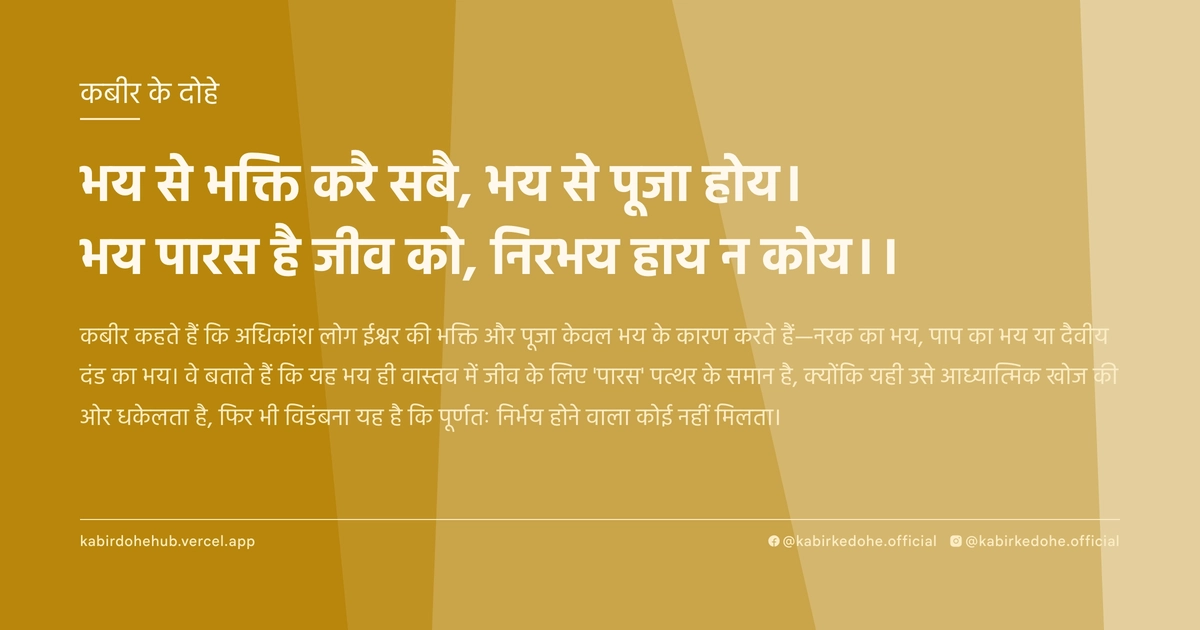
भय से भक्ति करै सबै, भय से पूजा होय।
भय पारस है जीव को, निरभय हाय न कोय।।
Bhay se bhakti karai sabai, bhay se puja hoye. Bhay paras hai jeev ko, nirbhay haay na koye.
इस पृष्ठ पर इस कबीर दोहे का अर्थ (meaning), हिंदी व्याख्या और अंग्रेज़ी अनुवाद, दार्शनिक विश्लेषण और व्यावहारिक जीवन सीख दी गई है। यह दोहा भय (Fear) विषय से जुड़ा है — Kabir doha meaning and explanation in Hindi and English.
अर्थ (Meaning):
कबीर कहते हैं कि अधिकांश लोग ईश्वर की भक्ति और पूजा केवल भय के कारण करते हैं—नरक का भय, पाप का भय या दैवीय दंड का भय। वे बताते हैं कि यह भय ही वास्तव में जीव के लिए 'पारस' पत्थर के समान है, क्योंकि यही उसे आध्यात्मिक खोज की ओर धकेलता है, फिर भी विडंबना यह है कि पूर्णतः निर्भय होने वाला कोई नहीं मिलता।
Kabir observes that most people engage in devotion and worship driven solely by fear—fear of hell, fear of sin, or fear of divine retribution. He suggests that while this fear acts as a 'Philosopher's Stone' (Paras) for the soul by initiating the spiritual quest, the ultimate tragedy is that almost no one ever transcends this fear to reach a state of absolute fearlessness.
व्याख्या (Interpretation):
शाब्दिक अर्थ यह है कि मनुष्य डर के कारण प्रार्थना करता है। लेकिन रूपक स्तर पर, कबीर 'भय' को एक उत्प्रेरक के रूप में देखते हैं। निर्गुण भक्ति में, भय वह प्रारंभिक धक्का है जो अहंकार को हिलाता है। माया का पर्दा तब हटता है जब जीव को अपनी नश्वरता का बोध होता है। यहाँ 'पारस' का प्रयोग यह दर्शाने के लिए किया गया है कि जैसे पारस लोहे को सोना बना देता है, वैसे ही सही दिशा में निर्देशित भय जीव को भौतिकता से आध्यात्मिकता की ओर ले जाता है। अंततः, यह द्वैत (भय और अभय) के बीच का संघर्ष है, जहाँ अद्वैत वेदांत के अनुसार जब 'मैं' (अहंकार) मिट जाता है, तब भय स्वतः समाप्त हो जाता है क्योंकि डरने वाला कोई बचता ही नहीं।
Literally, the verse describes prayer born of terror. Metaphorically, Kabir views 'fear' as a catalyst. In Nirgun Bhakti, fear is the initial jolt that destabilizes the ego. The veil of Maya lifts when the soul realizes its own mortality. The use of 'Paras' (the mythical touchstone) implies that just as the stone turns iron to gold, fear—if channeled correctly—transforms a mundane existence into a spiritual quest. This highlights the central paradox: fear is the gateway, yet the destination is 'Nirbhaya' (fearlessness). According to Advaita Vedanta, fear exists only where there is a perceived duality; once the Atman realizes its non-duality with Brahman, the entity that feared ceases to exist, leading to liberation.
दार्शनिक विश्लेषण (Philosophical Analysis):
कबीर का यह दोहा उनके युग के धार्मिक पाखंड और कर्मकांडीय भय पर एक तीखा प्रहार है। उस समय धर्म का उपयोग नियंत्रण के साधन के रूप में किया जाता था, जहाँ स्वर्ग और नरक के डर से लोगों को अनुशासित किया जाता था। कबीर इस 'भय-आधारित भक्ति' को निम्न स्तर की साधना मानते हैं। वे तर्क देते हैं कि जो भक्ति डर से पैदा होती है, वह वास्तव में ईश्वर से प्रेम नहीं, बल्कि स्वयं के बचाव का प्रयास है।
दार्शनिक रूप से, यह सूफीवाद के 'खौफ' (divine awe) और 'इश्क' (divine love) के बीच के संक्रमण जैसा है। सूफी मत में, ईश्वर की महानता का अहसास पहले भय पैदा करता है, जो बाद में प्रेम में बदल जाता है। कबीर यहाँ इसी मनोवैज्ञानिक परिवर्तन की बात कर रहे हैं। वे चाहते हैं कि साधक भय की सीढ़ी चढ़कर प्रेम के शिखर तक पहुँचे, न कि केवल सीढ़ी पर ही अटका रहे।
अद्वैत वेदांत के परिप्रेक्ष्य में, भय का मूल कारण 'अविद्या' (अज्ञान) है। जब तक हम स्वयं को शरीर या मन मानते हैं, हम विनाश से डरते हैं। कबीर यह संकेत दे रहे हैं कि जब तक जीव 'जीव' बना रहता है, वह भयभीत रहेगा। मुक्ति केवल तभी संभव है जब व्यक्ति यह जान ले कि वह अविनाशी चेतना है।
कबीर जाति और कर्मकांड के विरोध में यह बात इसलिए कहते हैं क्योंकि मंदिर-मस्जिद के बाहरी आडंबर अक्सर भय और सामाजिक दबाव पर टिके होते हैं। वे आंतरिक रूपांतरण पर जोर देते हैं। उनके लिए, वास्तविक पूजा वह है जो भयमुक्त हृदय से की जाए, जहाँ भक्त और भगवान के बीच कोई दूरी न हो।
अंततः, यह विश्लेषण हमें बताता है कि भय एक उपयोगी उपकरण हो सकता है यदि वह हमें आत्म-निरीक्षण की ओर ले जाए, लेकिन यदि वह स्थायी बन जाए, तो वह बंधन बन जाता है। कबीर का उद्देश्य मनुष्य को 'भय' से 'निर्भय' की यात्रा पर ले जाना है, जो अहंकार के पूर्ण विसर्जन के बिना असंभव है।
This couplet is a sharp critique of the religious hypocrisy and ritualistic fear prevalent during Kabir's era. Religion was often used as a tool for control, where the threat of hell and the promise of heaven were used to enforce discipline. Kabir views this 'fear-based devotion' as a lower stage of spiritual evolution. He argues that devotion born of fear is not love for the Divine, but rather a desperate attempt at self-preservation.
Philosophically, this mirrors the transition in Sufism from 'Khauf' (divine awe/fear) to 'Ishq' (divine love). In the Sufi path, the overwhelming realization of God's majesty initially creates a sense of dread, which eventually matures into an intimate, longing love. Kabir is addressing this psychological shift, urging the seeker to use fear as a ladder to reach the peak of love, rather than remaining trapped on the ladder itself.
From the lens of Advaita Vedanta, the root of fear is 'Avidya' (ignorance). As long as we identify with the perishable body or the fluctuating mind, we fear annihilation. Kabir suggests that as long as the soul perceives itself as a separate 'Jeeva' (individual entity), fear is inevitable. Liberation occurs only when one realizes their identity as the eternal, indivisible Consciousness (Brahman).
Kabir's rejection of caste and ritualism is intertwined here; the external pomps of temples and mosques are often sustained by social pressure and fear of excommunication. He emphasizes internal transformation over external compliance. For him, true worship is that which emanates from a heart free of terror, where the duality between the devotee and the Divine dissolves.
Ultimately, this analysis reveals that fear can be a useful instrument if it prompts self-inquiry, but if it becomes the permanent state, it becomes a shackle. Kabir's objective is to guide the human spirit from 'Bhay' (fear) to 'Nirbhaya' (fearlessness), a transition that is impossible without the total annihilation of the ego.
मूल संदेश (Core Message):
- भय केवल अज्ञान का प्रतिबिंब है, सत्य का नहीं।
- डर से की गई पूजा एक सौदा है, समर्पण नहीं।
- भय एक प्रारंभिक सीढ़ी है, लेकिन यह गंतव्य नहीं हो सकता।
- जब 'मैं' का भ्रम मिटता है, तब डरने वाला कोई नहीं बचता।
- वास्तविक भक्ति केवल निर्भय हृदय में ही जन्म ले सकती है।
- अद्वैत का बोध ही समस्त भयों का अंतिम उपचार है।
- Fear is merely a reflection of ignorance, not of Truth.
- Worship born of fear is a transaction, not a surrender.
- Fear is a starting ladder, but it cannot be the destination.
- When the illusion of 'I' vanishes, there is no one left to fear.
- True devotion can only be born in a fearless heart.
- The realization of non-duality is the ultimate cure for all fears.
व्यावहारिक उदाहरण (Practical Example):
एक समय की बात है, वाराणसी के घाटों पर रहने वाला एक वृद्ध विधवा, जानकी, अपना पूरा दिन भगवान शिव की पूजा में बिताती थी। वह घंटों मंत्र पढ़ती, उपवास रखती और कठोर नियमों का पालन करती। लेकिन उसकी भक्ति का मूल आधार प्रेम नहीं, बल्कि एक गहरा डर था। उसे डर था कि यदि उसने एक भी नियम तोड़ा, तो उसे अगले जन्म में और अधिक कष्ट सहने पड़ेंगे या उसे नरक की यातनाएं झेलनी पड़ेंगी। उसकी प्रार्थनाएं एक सौदेबाजी की तरह थीं: 'हे प्रभु, मैं आपकी सेवा कर रही हूँ, कृपया मुझे दंड से बचाएं।'
एक दिन, घाट पर एक फकीर आया जिसने जानकी की व्याकुलता को देखा। फकीर ने उससे पूछा, 'माँ, तुम किसे पूज रही हो? उस ईश्वर को जो तुम्हें दंड देने के लिए बैठा है, या उस चेतना को जो तुम्हें प्रेम करती है?' जानकी चौंक गई। उसने कभी इस तरह नहीं सोचा था। उसने उत्तर दिया, 'ईश्वर न्यायप्रिय हैं, वे पापों का दंड देते हैं।'
फकीर मुस्कुराया और बोला, 'जो डरकर झुकता है, वह केवल अपनी गर्दन बचा रहा होता है, अपना हृदय नहीं। क्या तुम उस पिता से डरती हो जिसने तुम्हें जन्म दिया? भय केवल वहां होता है जहां तुम खुद को ईश्वर से अलग मानती हो। जिस दिन तुम जान जाओगी कि तुम और वह एक ही हो, तुम्हारा डर गायब हो जाएगा।'
जानकी को यह बात रास नहीं आई, लेकिन वह विचार उसके मन में घर कर गया। अगले कुछ हफ्तों तक, वह जब भी पूजा करती, उसे महसूस होता कि वह डर के कारण कर रही है। उसने महसूस किया कि उसका पूरा आध्यात्मिक जीवन एक 'सुरक्षा कवच' बनाने की कोशिश थी, न कि सत्य की खोज।
एक शाम, जब वह गंगा आरती देख रही थी, उसने अचानक अपनी आंखें बंद कीं और प्रार्थना करना छोड़ दिया। उसने बस यह महसूस करने की कोशिश की कि वह जीवित है और वह ब्रह्मांड का हिस्सा है। उसने पहली बार यह सोचा, 'अगर मैं मिट भी जाऊं, तो भी मैं उसी अनंत में मिलूंगा जिससे मैं आया हूं। फिर डर कैसा?'
उस क्षण, उसके भीतर एक गहरा सन्नाटा छा गया। वह डर, जिसने दशकों से उसे जकड़ा हुआ था, अचानक पिघल गया। उसने महसूस किया कि वह अब तक एक ऐसे जेलर की पूजा कर रही थी जिसे उसने खुद अपने मन में बनाया था।
उस दिन के बाद, जानकी की पूजा बदल गई। अब वह घंटों मंत्र नहीं पढ़ती थी, बल्कि मौन में बैठती थी। उसकी आंखों में अब भय नहीं, बल्कि एक असीम शांति थी। वह अब नियमों का पालन इसलिए नहीं करती थी कि उसे दंड का डर था, बल्कि इसलिए क्योंकि वह उन नियमों में आनंद महसूस करती थी।
उसने अपने आस-पास की अन्य महिलाओं को भी यह समझाना शुरू किया कि ईश्वर डराने वाला कोई न्यायाधीश नहीं, बल्कि वह प्रेम है जो हमारे भीतर ही है। उसकी जीवनशैली अब 'बचाव' की नहीं, बल्कि 'समर्पण' की थी।
जानकी ने पाया कि जब भय गया, तब जाकर वास्तविक भक्ति शुरू हुई। वह अब केवल एक भक्त नहीं थी, वह स्वयं उस शांति का अनुभव कर रही थी जिसे वह बाहर खोज रही थी।
यह 'कबीर ट्विस्ट' था—भय को पहचानना और फिर उसे अद्वैत के बोध से मिटा देना। जानकी अब वास्तव में 'निर्भय' हो गई थी, और यही उसकी वास्तविक मुक्ति थी।
Once, in the ghats of Varanasi, lived an elderly widow named Janaki. She spent her entire day in the worship of Lord Shiva, reciting mantras for hours, fasting, and adhering to rigorous rituals. However, the foundation of her devotion was not love, but a deep-seated fear. She feared that if she missed a single rule, she would suffer more hardships in her next life or face the agonies of hell. Her prayers were like a bargain: 'O Lord, I am serving You; please save me from punishment.'
One day, a wandering fakir arrived at the ghats and noticed Janaki's anxiety. He asked her, 'Mother, whom are you worshipping? The God who sits waiting to punish you, or the Consciousness that loves you?' Janaki was startled; she had never thought of it this way. She replied, 'God is just; He punishes sins.'
The fakir smiled and said, 'He who bows out of fear is only saving his neck, not his heart. Do you fear the father who gave you birth? Fear only exists where you perceive yourself as separate from the Divine. The day you realize that you and He are one, your fear will vanish.'
Janaki didn't initially accept this, but the thought took root in her mind. For the next few weeks, whenever she prayed, she became aware that she was doing so out of fear. She realized her entire spiritual life had been an attempt to build a 'safety shield' rather than a quest for truth.
One evening, while watching the Ganga Aarti, she suddenly closed her eyes and stopped praying. She simply tried to feel that she was alive and a part of the universe. For the first time, she thought, 'Even if I perish, I will merge back into the infinite from which I came. Then why fear?'
In that moment, a profound silence descended upon her. The fear that had gripped her for decades suddenly melted away. She realized she had been worshipping a jailer she had created in her own mind.
After that day, Janaki's worship changed. She no longer spent hours reciting mantras but sat in silence. There was no longer fear in her eyes, only an infinite peace. She followed the rituals not because she feared punishment, but because she found joy in them.
She began to teach other women around her that God is not a judging entity to be feared, but the love that resides within us. Her life was no longer about 'survival' but about 'surrender.'
Janaki discovered that only when fear departed did true devotion begin. She was no longer just a devotee; she was experiencing the very peace she had been searching for externally.
This was the 'Kabir Twist'—recognizing fear and then dissolving it through the realization of non-duality. Janaki had finally become 'Nirbhaya' (fearless), and that was her true liberation.
अभ्यास मार्गदर्शन (Practice Guidance):
- दैनिक आत्म-निरीक्षण: दिन के अंत में यह विश्लेषण करें कि आपके आज के कौन से कार्य 'डर' (सामाजिक छवि खोने का डर, असफलता का डर) से प्रेरित थे और कौन से 'प्रेम' से।
- भय-विसर्जन ध्यान: 15 मिनट के लिए शांत बैठें। अपने भीतर के सबसे गहरे डर को महसूस करें और उसे एक बाहरी वस्तु की तरह देखें। स्वयं से पूछें, 'यदि यह डर हट जाए, तो मैं कौन हूँ?'
- जर्नलिंग प्रॉम्प्ट: 'मैं ईश्वर/ब्रह्मांड से क्या चाहता हूँ और मैं उससे क्यों डरता हूँ?' इस प्रश्न पर ईमानदारी से लिखें कि क्या आपकी आध्यात्मिकता केवल एक सुरक्षा तंत्र (Safety Mechanism) है।
- व्यवहारिक परिवर्तन: एक ऐसा कार्य करें जिससे आपको थोड़ा डर लगता हो (जैसे किसी से क्षमा मांगना या अपनी गलती स्वीकार करना), और अनुभव करें कि अहंकार के टूटने पर भय कैसे कम होता है।
- डायग्नोस्टिक चेकलिस्ट: यदि आप अभी भी 'पाप-पुण्य' के डर से निर्णय ले रहे हैं, तो आप 'भय' के स्तर पर हैं। यदि आप 'करुणा और आनंद' से निर्णय ले रहे हैं, तो आप 'निर्भय' की ओर बढ़ रहे हैं।
- Daily Self-Audit: At the end of the day, analyze which of your actions were driven by 'fear' (fear of losing social image, fear of failure) and which were driven by 'love'.
- Fear-Dissolution Meditation: Sit in silence for 15 minutes. Feel your deepest fear and observe it as an external object. Ask yourself, 'If this fear were gone, who would I be?'
- Journaling Prompt: 'What do I want from the Divine/Universe, and why am I afraid of It?' Write honestly about whether your spirituality is merely a safety mechanism.
- Behavioral Shift: Perform one act that scares you (such as asking for forgiveness or admitting a mistake) and observe how fear diminishes as the ego breaks.
- Diagnostic Checklist: If you are still making decisions based on the fear of 'sin and merit,' you are at the level of 'Bhay'. If you decide based on 'compassion and joy,' you are moving toward 'Nirbhaya'.
चिंतन प्रश्न (Reflection Questions):
- क्या मेरी धार्मिक मान्यताएं मुझे वास्तव में मुक्त कर रही हैं, या वे मुझे नए प्रकार के मानसिक डर में बांध रही हैं?
- यदि दुनिया से 'नरक' और 'दंड' की अवधारणा हटा दी जाए, तो क्या मैं अभी भी उसी निष्ठा से प्रार्थना करूँगा?
- मेरा 'डिजिटल ईगो' (सोशल मीडिया पर मेरी छवि) किस डर से संचालित है, और यह मेरी आंतरिक शांति को कैसे बाधित करता है?
- मैं किन लोगों से डरता हूँ और वह डर वास्तव में उनके बारे में है या मेरी अपनी कमियों के बारे में?
- क्या मैं वास्तव में ईश्वर से प्रेम करता हूँ, या मैं केवल उस सुरक्षा की तलाश में हूँ जो ईश्वर का नाम लेने से मिलती है?
- मेरे जीवन का वह कौन सा हिस्सा है जहाँ मैं 'निर्भय' होने का नाटक करता हूँ, जबकि भीतर डर व्याप्त है?
- Are my religious beliefs truly liberating me, or are they binding me to new forms of mental fear?
- If the concepts of 'hell' and 'punishment' were removed from the world, would I still pray with the same sincerity?
- What fear drives my 'digital ego' (my social media image), and how does it disrupt my inner peace?
- Whom do I fear, and is that fear actually about them or about my own perceived inadequacies?
- Do I truly love the Divine, or am I merely seeking the security that comes from invoking the Divine's name?
- In which part of my life do I pretend to be 'fearless' while fear actually permeates my interior?