
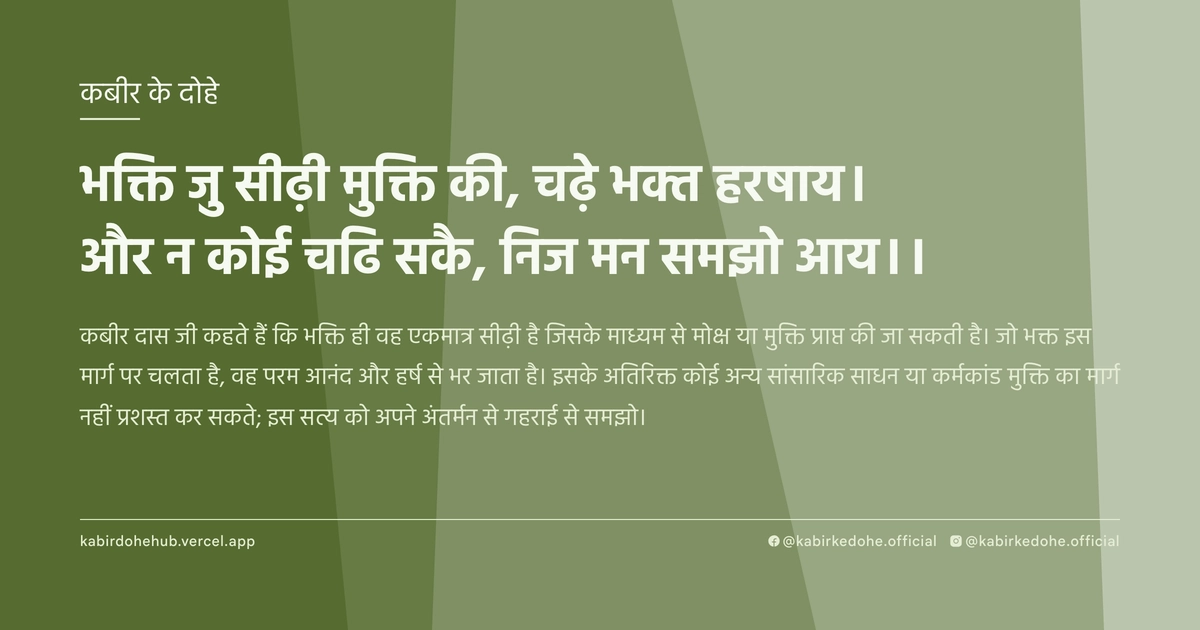
भक्ति जु सीढ़ी मुक्ति की, चढ़े भक्त हरषाय।
और न कोई चढि सकै, निज मन समझो आय।।
Bhakti ju seedhi mukti ki, chadhe bhakt harshay. Aur na koi chadhi sakai, nij man samjho aay.
इस पृष्ठ पर इस कबीर दोहे का अर्थ (meaning), हिंदी व्याख्या और अंग्रेज़ी अनुवाद, दार्शनिक विश्लेषण और व्यावहारिक जीवन सीख दी गई है। यह दोहा मुक्ति (Liberation) विषय से जुड़ा है — Kabir doha meaning and explanation in Hindi and English.
अर्थ (Meaning):
कबीर दास जी कहते हैं कि भक्ति ही वह एकमात्र सीढ़ी है जिसके माध्यम से मोक्ष या मुक्ति प्राप्त की जा सकती है। जो भक्त इस मार्ग पर चलता है, वह परम आनंद और हर्ष से भर जाता है। इसके अतिरिक्त कोई अन्य सांसारिक साधन या कर्मकांड मुक्ति का मार्ग नहीं प्रशस्त कर सकते; इस सत्य को अपने अंतर्मन से गहराई से समझो।
Kabir asserts that devotion (Bhakti) is the sole ladder leading to liberation (Mukti). The devotee who ascends this path does so with immense joy and spiritual ecstasy. No other worldly means, rituals, or intellectual pursuits can provide this ascent; one must realize this truth within the depths of their own consciousness.
व्याख्या (Interpretation):
यहाँ 'सीढ़ी' एक रूपक है जो आध्यात्मिक उत्थान की क्रमिक प्रक्रिया को दर्शाता है। शाब्दिक अर्थ में, यह भक्ति को मोक्ष का साधन बताता है, परंतु गहरा अर्थ यह है कि भक्ति केवल पूजा नहीं, बल्कि अहंकार का विसर्जन है। निर्गुण भक्ति के संदर्भ में, यह किसी बाहरी मूर्ति की नहीं, बल्कि उस निराकार ब्रह्म के प्रति पूर्ण समर्पण है। माया के बंधन मनुष्य को नीचे खींचते हैं, जबकि प्रेम और समर्पण उसे ऊपर उठाते हैं। जब भक्त 'हरषाय' (प्रसन्न) होता है, तो वह द्वैत से अद्वैत की ओर बढ़ता है, जहाँ आत्मा और परमात्मा का भेद मिट जाता है। यह विरोधाभास है कि जिसे हम 'पाने' की कोशिश करते हैं, वह वास्तव में स्वयं को 'खोने' (अहंकार मिटाने) से प्राप्त होता है।
The 'ladder' serves as a metaphor for the gradual process of spiritual ascension. While the literal meaning suggests devotion as a tool for salvation, the deeper esoteric meaning implies that Bhakti is the dissolution of the ego. In the context of Nirgun Bhakti, this is not devotion to a physical idol, but total surrender to the Formless Absolute. While Maya (illusion) pulls the soul downward into materiality, love and surrender elevate it. The state of 'harshay' (joy) signifies the transition from duality to non-duality, where the distinction between Atman and Brahman vanishes. It presents the central paradox: liberation is not 'acquired' through effort, but 'realized' through the annihilation of the self.
दार्शनिक विश्लेषण (Philosophical Analysis):
कबीर का यह दोहा उस युग की प्रतिक्रिया है जब धर्म केवल कर्मकांडों, जातिगत श्रेष्ठता और बाहरी आडंबरों में सिमट गया था। उन्होंने स्पष्ट किया कि मोक्ष किसी विशेष जाति, शास्त्र या मंदिर-मस्जिद जाने से नहीं, बल्कि हृदय की शुद्धता और प्रेम से मिलता है। यह विचार अद्वैत वेदांत के करीब है, जहाँ जीव और ब्रह्म की एकता पर बल दिया गया है, लेकिन कबीर इसे ज्ञान के बजाय 'प्रेम' के माध्यम से प्राप्त करने की बात करते हैं।
सूफी मत के 'इश्क-ए-हकीकी' (ईश्वरीय प्रेम) का प्रभाव यहाँ स्पष्ट है, जहाँ प्रेमी और प्रियतम का मिलन ही अंतिम लक्ष्य है। कबीर के लिए भक्ति कोई धार्मिक क्रिया नहीं, बल्कि एक मनोवैज्ञानिक रूपांतरण है। जब तक 'मैं' (अहंकार) मौजूद है, तब तक सीढ़ी पर चढ़ना असंभव है क्योंकि अहंकार सबसे भारी बोझ है।
वे उन लोगों को चुनौती देते हैं जो सोचते हैं कि केवल कठिन तपस्या या बौद्धिक विमर्श से मुक्ति मिलेगी। उनके अनुसार, बुद्धि केवल तर्क करती है, लेकिन भक्ति हृदय को खोलती है। यह 'सहज मार्ग' है, जो जटिलता को सरलता में बदल देता है।
ऐतिहासिक रूप से, कबीर ने सामाजिक पदानुक्रम को नकारते हुए यह स्थापित किया कि ईश्वर तक पहुँचने का मार्ग सबके लिए समान है। यह लोकतांत्रिक आध्यात्मिकता थी, जिसने धर्म को पुरोहितों के नियंत्रण से मुक्त कर आम आदमी के अंतर्मन में स्थापित किया।
अंततः, यह विश्लेषण दर्शाता है कि मुक्ति बाहरी दुनिया से पलायन नहीं है, बल्कि आंतरिक अज्ञानता का अंत है। जब भक्त हर्षित होकर चढ़ता है, तो वह वास्तव में अपनी वास्तविक प्रकृति को पहचान रहा होता है, जो पहले से ही मुक्त है।
This couplet is a direct response to an era where religion had devolved into mere ritualism, caste superiority, and external ostentation. Kabir clarifies that liberation is not achieved through specific castes, scriptures, or visiting temples and mosques, but through purity of heart and love. This aligns with Advaita Vedanta's emphasis on the unity of Atman and Brahman, yet Kabir advocates for achieving this through 'Love' rather than mere intellectual knowledge.
The influence of the Sufi concept of 'Ishq-e-Haqiqi' (Divine Love) is evident here, where the union of the lover and the Beloved is the ultimate goal. For Kabir, Bhakti is not a religious act but a psychological transformation. As long as the 'I' (ego) exists, ascending the ladder is impossible because the ego is the heaviest burden one carries.
He challenges those who believe that rigorous asceticism or intellectual discourse alone leads to salvation. According to him, the intellect only argues, while devotion opens the heart. This is the 'Sahaj Marg' (Natural Path), which transforms complexity into simplicity.
Historically, by rejecting social hierarchies, Kabir established that the path to the Divine is equidistant for everyone. This was a form of democratic spirituality that liberated religion from the control of priests and seated it within the inner consciousness of the common person.
Ultimately, this analysis reveals that liberation is not an escape from the external world, but the end of internal ignorance. When the devotee ascends with joy, they are actually recognizing their true nature, which is inherently free.
मूल संदेश (Core Message):
- कर्मकांड केवल बाहरी खोल हैं, वास्तविक मुक्ति आंतरिक प्रेम में है।
- अहंकार वह बोझ है जो आध्यात्मिक आरोहण को रोकता है।
- भक्ति का अर्थ पूजा नहीं, बल्कि पूर्ण समर्पण और विसर्जन है।
- खुशी (हर्ष) इस बात का प्रमाण है कि आप सही मार्ग पर हैं।
- परमात्मा को पाने का एकमात्र सरल मार्ग निस्वार्थ प्रेम है।
- Rituals are mere outer shells; true liberation lies in inner love.
- Ego is the weight that prevents spiritual ascension.
- Devotion is not about worship, but about total surrender and dissolution.
- Joy (Harsh) is the evidence that you are on the right path.
- The only simple way to reach the Divine is through selfless love.
व्यावहारिक उदाहरण (Practical Example):
वाराणसी के एक पुराने घाट पर रहने वाले माधव नाम के एक वृद्ध बुनकर थे। माधव जीवन भर केवल कपड़े बुनते रहे और मानते थे कि मोक्ष केवल कठिन तपस्या और शास्त्रों के गहन अध्ययन से मिलता है। वे हमेशा परेशान रहते थे, इस डर में कि क्या उन्होंने पर्याप्त पुण्य कमाया है।
उनके पड़ोस में एक साधारण सा व्यक्ति रहता था जो दिन भर मेहनत करता और शाम को बस शांत बैठकर ईश्वर के प्रति प्रेम व्यक्त करता। वह व्यक्ति हमेशा प्रसन्न रहता था, जबकि माधव तनाव में रहते थे।
एक दिन माधव ने उससे पूछा, 'तुम इतने खुश कैसे रहते हो? क्या तुमने वेदों का अध्ययन किया है?' उस व्यक्ति ने मुस्कुराकर कहा, 'मैं केवल प्रेम करना जानता हूँ, अध्ययन नहीं।'
माधव को लगा कि यह असंभव है। उन्होंने अपनी पूरी ऊर्जा नियमों के पालन में लगा दी, लेकिन उनका मन अशांत रहा।
एक शाम, माधव ने देखा कि वह व्यक्ति एक बीमार कुत्ते की सेवा कर रहा था और उसकी आँखों में वही करुणा थी जो किसी महान संत की होती है।
माधव को अचानक अहसास हुआ कि वे 'सीढ़ी' को बाहर खोज रहे थे, जबकि वह सीढ़ी उनके भीतर के प्रेम और करुणा में छिपी थी।
उन्होंने शास्त्रों की भारी किताबों को एक तरफ रखा और अपने काम को ही ईश्वर की सेवा मानना शुरू किया।
उन्होंने महसूस किया कि जब वे बिना किसी फल की इच्छा के दूसरों की मदद करते, तो उनके भीतर एक अजीब सी खुशी (हर्ष) पैदा होती थी।
यह 'कबीर ट्विस्ट' था—ज्ञान का बोझ उतरते ही, भक्ति की सीढ़ी अपने आप दिखने लगी।
माधव अब केवल एक बुनकर नहीं थे, बल्कि एक मुक्त आत्मा बन गए थे, जिन्होंने पाया कि प्रेम ही सबसे छोटा और सबसे सीधा रास्ता है।
In the ancient ghats of Varanasi lived an elderly weaver named Madhav. Throughout his life, Madhav believed that liberation could only be achieved through rigorous asceticism and the profound study of scriptures. He lived in constant anxiety, fearing whether he had accumulated enough merit.
Next to him lived a simple man who worked hard all day and spent his evenings in silent, loving communion with the Divine. This man was always joyful, while Madhav remained stressed.
One day, Madhav asked him, 'How are you so happy? Have you studied the Vedas?' The man smiled and replied, 'I only know how to love; I do not know how to study.'
Madhav found this impossible. He poured all his energy into following strict rules, yet his mind remained turbulent.
One evening, Madhav observed the man tending to a sick dog, with a compassion in his eyes that matched that of the greatest saints.
Madhav suddenly realized that he had been searching for the 'ladder' externally, while the ladder was hidden within the love and compassion of his own heart.
He set aside the heavy volumes of scriptures and began to view his daily work as a service to the Divine.
He noticed that whenever he helped others without expecting any reward, a strange, profound joy (harsh) blossomed within him.
This was the 'Kabir Twist'—the moment the burden of intellectual pride dropped, the ladder of devotion became visible.
Madhav was no longer just a weaver, but a liberated soul who discovered that love is the shortest and straightest path to the Truth.
अभ्यास मार्गदर्शन (Practice Guidance):
- दैनिक अभ्यास: प्रतिदिन 20 मिनट मौन बैठें और अपने हृदय में उस निराकार प्रेम को महसूस करें, बिना किसी मांग या इच्छा के।
- आत्म-पूछताछ जर्नल: लिखें कि आज आपने कहाँ अहंकार दिखाया और कैसे उस अहंकार को 'प्रेम' में बदला जा सकता था।
- व्यवहार परिवर्तन: दिन में कम से कम एक कार्य ऐसा करें जो पूरी तरह निस्वार्थ हो, जहाँ आप स्वयं को कर्ता न मानकर केवल एक माध्यम समझें।
- डायग्नोस्टिक चेकलिस्ट: यदि आप अभी भी परिणामों की चिंता कर रहे हैं या दूसरों से श्रेष्ठ महसूस कर रहे हैं, तो आप सीढ़ी पर नहीं, बल्कि अहंकार के बोझ तले दबे हैं।
- Daily Practice: Sit in silence for 20 minutes daily, feeling the formless love within your heart, without any demands or desires.
- Self-Inquiry Journal: Record instances where you exhibited ego today and reflect on how that ego could have been transformed into 'love'.
- Behavioral Change: Perform at least one completely selfless act daily, viewing yourself not as the 'doer' but merely as an instrument.
- Diagnostic Checklist: If you are still anxious about results or feeling superior to others, you are not ascending the ladder but are weighed down by ego.
चिंतन प्रश्न (Reflection Questions):
- क्या मेरी भक्ति वास्तव में ईश्वर के प्रति है, या मैं केवल अपनी मानसिक शांति के लिए 'भक्ति' का उपयोग कर रहा हूँ?
- मेरे जीवन में वह कौन सा 'भारी बोझ' (अहंकार) है जो मुझे आध्यात्मिक प्रगति करने से रोक रहा है?
- क्या मैं धर्म को एक सीढ़ी की तरह उपयोग कर रहा हूँ या एक दीवार की तरह, जो मुझे दूसरों से अलग करती है?
- यदि मुझसे मेरी सभी धार्मिक पहचानें छीन ली जाएं, तो क्या मेरे भीतर केवल प्रेम बचेगा?
- क्या मैं अपनी सफलता का श्रेय स्वयं को देता हूँ, या मैं इसे एक ईश्वरीय प्रवाह के रूप में देखता हूँ?
- Is my devotion truly toward the Divine, or am I using 'Bhakti' merely for my own psychological comfort?
- What is the specific 'heavy burden' (ego) in my life that prevents me from spiritual progress?
- Am I using religion as a ladder for growth or as a wall that separates me from others?
- If all my religious identities were stripped away, would only love remain within me?
- Do I take credit for my successes, or do I view them as a flow of Divine grace?