
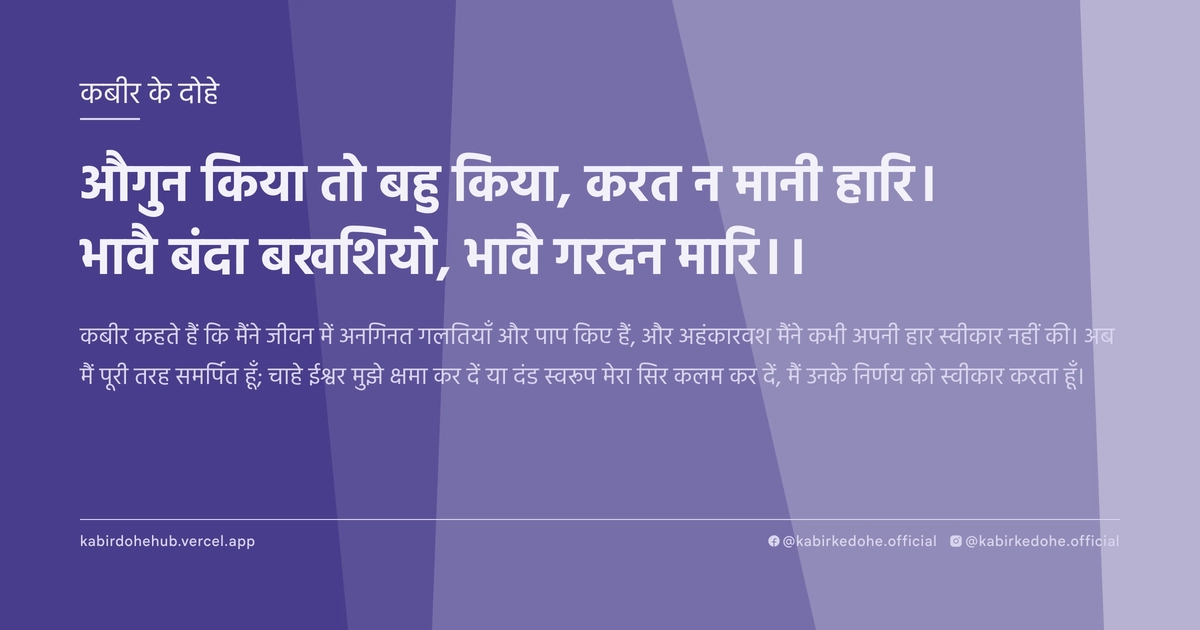
औगुन किया तो बहु किया, करत न मानी हारि।
भावै बंदा बखशियो, भावै गरदन मारि।।
Augun kiya to bahu kiya, karat na mani hari. Bhavai banda bakhshiyo, bhavai gardan mari.
इस पृष्ठ पर इस कबीर दोहे का अर्थ (meaning), हिंदी व्याख्या और अंग्रेज़ी अनुवाद, दार्शनिक विश्लेषण और व्यावहारिक जीवन सीख दी गई है। यह दोहा प्रपत्ति (Surrender) विषय से जुड़ा है — Kabir doha meaning and explanation in Hindi and English.
अर्थ (Meaning):
कबीर कहते हैं कि मैंने जीवन में अनगिनत गलतियाँ और पाप किए हैं, और अहंकारवश मैंने कभी अपनी हार स्वीकार नहीं की। अब मैं पूरी तरह समर्पित हूँ; चाहे ईश्वर मुझे क्षमा कर दें या दंड स्वरूप मेरा सिर कलम कर दें, मैं उनके निर्णय को स्वीकार करता हूँ।
Kabir confesses that he has committed countless transgressions and errors, driven by a stubborn ego that refused to surrender. He now stands in total submission, stating that whether the Divine chooses to forgive him or execute him, he accepts the verdict with absolute equanimity.
व्याख्या (Interpretation):
यह दोहा पूर्ण आत्म-समर्पण (Surrender) की पराकाष्ठा है। प्रारंभ में, कबीर अपनी त्रुटियों को स्वीकार कर 'अहंकार' के उस पर्दे को हटाते हैं जो मनुष्य और परमात्मा के बीच होता है। 'हारि' शब्द यहाँ केवल पराजय नहीं, बल्कि अहंकार का विसर्जन है। यह निर्गुण भक्ति का वह मार्ग है जहाँ साधक यह समझ जाता है कि जब तक 'मैं' (अहंकार) जीवित है, तब तक 'वह' (परमात्मा) प्रकट नहीं हो सकता। यहाँ 'गर्दन मारना' शारीरिक मृत्यु नहीं, बल्कि 'अहं' की मृत्यु है, जो अद्वैत वेदांत के उस सत्य की ओर ले जाती है जहाँ आत्मा और ब्रह्म एक हो जाते हैं। यह विरोधाभास है कि पूर्ण विनाश की इच्छा ही वास्तव में आध्यात्मिक पुनर्जन्म का द्वार खोलती है।
This couplet represents the pinnacle of total surrender (Prapatti). Kabir begins by acknowledging his flaws, thereby stripping away the veil of ego that separates the individual from the Divine. The word 'haari' (defeat) signifies not a failure of will, but the dissolution of the false self. In the path of Nirgun Bhakti, the seeker realizes that as long as the 'I' (ego) persists, the 'Thou' (Divine) remains hidden. The imagery of 'cutting the neck' is not a literal plea for death, but a metaphorical demand for the annihilation of the ego—the 'small self'—to make way for the Universal Self. This mirrors the Advaita Vedanta concept where the illusion of duality (Maya) is shattered. The paradox lies in the fact that only by accepting total destruction of the identity does one achieve eternal liberation.
दार्शनिक विश्लेषण (Philosophical Analysis):
कबीर का यह दोहा उस युग की प्रतिक्रिया है जहाँ धर्म केवल कर्मकांडों और बाहरी शुद्धता तक सीमित था। कबीर ने यह स्थापित किया कि ईश्वर की प्राप्ति मंदिर या मस्जिद में नहीं, बल्कि हृदय की ईमानदारी और पश्चाताप में है। यह सूफी मत के 'फना' (Fana) के सिद्धांत से गहराई से जुड़ा है, जहाँ प्रेमी अपने अस्तित्व को ईश्वर की इच्छा में विलीन कर देता है।
यहाँ कबीर जाति और सामाजिक प्रतिष्ठा के तमाम बंधनों को तोड़ते हैं। वे यह तर्क देते हैं कि पाप और पुण्य केवल सामाजिक लेबल हैं; वास्तविक सत्य यह है कि मनुष्य अपनी अज्ञानता (Avidya) के कारण भटकता है। जब वह अपनी त्रुटियों को स्वीकार करता है, तो वह वास्तव में माया के प्रभाव से मुक्त हो रहा होता है।
अद्वैत वेदांत के परिप्रेक्ष्य में, यह दोहा 'अहं ब्रह्मास्मि' की यात्रा का पहला कदम है—अहंकार का विलोपन। जब तक साधक यह सोचता है कि वह 'पापी' है, वह द्वैत में है। लेकिन जब वह कहता है कि 'जो होगा वह सही है', तो वह अपनी व्यक्तिगत इच्छा को सार्वभौमिक इच्छा (Divine Will) के साथ जोड़ देता है।
मनोवैज्ञानिक स्तर पर, यह दोहा 'छाया' (Shadow) के एकीकरण की प्रक्रिया है। अपनी गलतियों को स्वीकार करना मानसिक बोझ को कम करता है और व्यक्ति को वास्तविक परिवर्तन के लिए तैयार करता है। कबीर यहाँ यह चेतावनी देते हैं कि क्षमा की याचना से अधिक महत्वपूर्ण है—परिणाम को स्वीकार करने का साहस।
अंततः, यह दोहा यह संदेश देता है कि मोक्ष किसी बाहरी अनुष्ठान से नहीं, बल्कि आंतरिक ईमानदारी से मिलता है। यह उस स्थिति का वर्णन है जहाँ भक्त अब कुछ माँग नहीं रहा, बल्कि केवल समर्पण कर रहा है, जो भक्ति मार्ग की उच्चतम अवस्था है।
Kabir's verse is a profound reaction to an era where religion was reduced to mere ritualism and external purity. He asserts that the Divine is found not in temples or mosques, but in the honesty of the heart and the depth of repentance. This aligns closely with the Sufi concept of 'Fana' (annihilation), where the lover dissolves their individual existence into the will of the Beloved.
By admitting his faults, Kabir transcends the social hierarchies of caste and prestige. He argues that 'sin' and 'virtue' are often social labels; the actual truth is that humans wander due to spiritual ignorance (Avidya). The act of acknowledging one's errors is the first step in breaking the grip of Maya (illusion).
From the lens of Advaita Vedanta, this is the preliminary stage of realizing 'Aham Brahmasmi'—the dissolution of the ego. As long as the seeker identifies as a 'sinner,' they remain in duality. However, when they surrender to the Divine verdict, they align their individual will with the Universal Will, collapsing the distance between the seeker and the sought.
Psychologically, this represents the integration of the 'Shadow.' Admitting one's darkness is the only way to move toward light. Kabir emphasizes that the courage to accept the consequences is more spiritually potent than the mere plea for forgiveness.
Ultimately, the verse teaches that liberation is not a product of external rites but of internal transparency. It describes a state of 'Ishvara Pranidhana' (surrender to God), where the devotee stops asking for favors and starts accepting the Truth in whatever form it arrives, marking the highest stage of the Bhakti movement.
मूल संदेश (Core Message):
- अहंकार का अंत ही वास्तविक आध्यात्मिक यात्रा की शुरुआत है।
- अपनी त्रुटियों को स्वीकार करना ही सबसे बड़ी शुद्धि है।
- पूर्ण समर्पण में ही परम स्वतंत्रता और शांति निहित है।
- ईश्वर दंड या क्षमा नहीं, बल्कि केवल सत्य की प्रतीक्षा करता है।
- जब 'मैं' मिटता है, तभी 'वह' प्रकट होता है।
- The end of the ego is the true beginning of the spiritual journey.
- Acknowledging one's flaws is the highest form of purification.
- Absolute surrender is the only gateway to ultimate freedom and peace.
- The Divine seeks not our perfection, but our absolute honesty.
- Only when the 'I' vanishes does the 'Universal Truth' manifest.
व्यावहारिक उदाहरण (Practical Example):
वाराणसी के घाटों पर रहने वाला एक वृद्ध नाविक था, जिसका नाम माधव था। माधव का स्वभाव अत्यंत क्रोधी और अहंकारी था। वह अपनी नाव चलाने की कला पर इतना गर्व करता था कि अक्सर अन्य नाविकों का अपमान करता और अपने यात्रियों से रूखा व्यवहार करता था। उसने वर्षों तक अपने अहंकार को अपनी 'क्षमता' मानकर पाला था।
एक बार एक भीषण तूफान आया, जिसने उसकी नाव को पूरी तरह नष्ट कर दिया और उसे सड़क पर ला खड़ा किया। माधव ने पहले ईश्वर को कोसा, फिर अपनी किस्मत को। उसने सोचा कि उसने हमेशा गंगा की सेवा की, फिर उसके साथ ऐसा क्यों हुआ?
तभी उसकी मुलाकात एक फकीर से हुई, जिसने उसे कबीर का यह दोहा सुनाया। फकीर ने कहा, "माधव, तूने अपनी नाव खोई है, लेकिन तूने अपना अहंकार नहीं खोया। तू अभी भी यह सोच रहा है कि तू 'योग्य' था।"
माधव को पहली बार अपनी गलतियों का अहसास हुआ। उसने महसूस किया कि उसकी 'क्षमता' वास्तव में उसका अहंकार था जिसने उसे दूसरों से अलग कर दिया था। उसने अपनी आँखें बंद कीं और हृदय से कहा, "हे प्रभु, मैंने बहुत अहंकार किया, बहुत गलतियाँ कीं। अब मैं हार गया हूँ। आप मुझे क्षमा करें या मुझे पूरी तरह मिटा दें, मुझे अब कोई शिकायत नहीं है।"
इस पूर्ण समर्पण ने उसके भीतर एक अजीब सी शांति भर दी। उसका क्रोध गायब हो गया। उसने अब नाव चलाने के बजाय, घाट पर आने वाले असहाय यात्रियों की निःशुल्क मदद करना शुरू कर दिया।
उसने पाया कि जब उसने अपनी 'श्रेष्ठता' का बोझ उतार फेंका, तो वह वास्तव में हल्का महसूस करने लगा। वह अब दूसरों को नीचा नहीं दिखाता था, बल्कि हर व्यक्ति में उसी परमात्मा की छवि देखता था।
गाँव के लोग हैरान थे कि जो माधव कभी किसी की बात नहीं सुनता था, वह अब सबसे विनम्र व्यक्ति बन गया था। उसकी 'हार' ही उसकी सबसे बड़ी जीत बन गई थी।
माधव की कहानी यह सिखाती है कि जब हम अपनी गलतियों को स्वीकार कर पूरी तरह समर्पित हो जाते हैं, तब हमारा वास्तविक व्यक्तित्व उभरता है।
उसका जीवन अब एक संघर्ष नहीं, बल्कि एक प्रवाह बन गया था, ठीक उसी गंगा की तरह जिसे वह अब केवल एक नदी नहीं, बल्कि अपना अस्तित्व मानता था।
अंत में, माधव ने सीखा कि क्षमा केवल ईश्वर नहीं देता, बल्कि जब हम स्वयं को क्षमा कर अहंकार त्याग देते हैं, तो ईश्वर स्वयं हमारे भीतर उतर आता है।
In the ghats of Varanasi lived an elderly boatman named Madhav. Madhav was known for his fierce temper and immense pride. He took such pride in his navigation skills that he frequently belittled other boatmen and treated his passengers with cold indifference. For years, he mistook his arrogance for 'competence.'
One day, a violent storm struck the river, completely destroying his boat and leaving him destitute. Initially, Madhav cursed God and his fate, wondering why someone as 'skilled' as he was being punished.
During his despair, he met a wandering fakir who recited this specific Doha of Kabir. The fakir looked at him and said, "Madhav, you have lost your boat, but you have not yet lost your ego. You still believe you were 'worthy' of better treatment."
For the first time, Madhav confronted his own shadows. He realized that his perceived strength was actually a wall of arrogance that had isolated him from humanity. He closed his eyes and whispered, "Lord, I have erred greatly. I have been blind in my pride. I surrender now. Whether You forgive me or erase me from existence, I accept it without complaint."
This total surrender brought an unexpected, profound peace into his heart. His anger vanished. Instead of seeking a new boat to regain his status, he began helping stranded travelers on the ghats for free.
He discovered that by shedding the burden of his 'superiority,' he felt lighter than he ever had while owning the finest boat. He no longer looked down on others; instead, he saw a spark of the Divine in every stranger.
The locals were astonished. The man who once refused to listen to anyone had become the most humble soul in the city. His 'defeat' had become his greatest victory.
Madhav's story illustrates that when we stop fighting our fate and admit our flaws, our true essence emerges.
His life ceased to be a struggle for dominance and became a flow of service, mirroring the very Ganges he had navigated for decades.
Ultimately, Madhav learned that forgiveness is not just a gift from the Divine, but a state achieved when we drop the ego and allow the Divine to act through us.
अभ्यास मार्गदर्शन (Practice Guidance):
- दैनिक आत्म-निरीक्षण: प्रतिदिन 15 मिनट मौन बैठें और उन क्षणों को याद करें जब आपका अहंकार (Ego) आपके व्यवहार पर हावी हुआ। बिना किसी निर्णय के उन्हें स्वीकार करें।
- समर्पण अभ्यास: जब भी जीवन में कोई विपरीत परिस्थिति आए, तो लड़ने के बजाय यह कहें, "मैं इस अनुभव को स्वीकार करता हूँ, यह मेरी शुद्धि के लिए है।"
- जर्नलिंग प्रॉम्प्ट: "मेरे जीवन का वह कौन सा हिस्सा है जिसे मैं अभी भी अपनी 'श्रेष्ठता' के कारण पकड़ कर बैठा हूँ? यदि मैं इसे छोड़ दूँ, तो मैं कौन बनूँगा?"
- डायग्नोस्टिक चेकलिस्ट: क्या मैं दूसरों की गलती पर तुरंत प्रतिक्रिया देता हूँ? क्या मैं अपनी गलतियों के लिए दूसरों को जिम्मेदार ठहराता हूँ? यदि हाँ, तो अहंकार अभी जीवित है।
- Daily Self-Inquiry: Spend 15 minutes in silence daily, recalling moments where your ego dominated your behavior. Acknowledge them without judgment or guilt.
- Surrender Practice: When facing adversity, instead of resisting, consciously affirm: "I accept this experience; it is here for my purification."
- Journaling Prompt: "What part of my identity am I clinging to out of a sense of superiority? Who would I be if I let this identity go completely?"
- Diagnostic Checklist: Do I react instantly to others' mistakes? Do I shift blame for my own errors? If yes, the ego is still active and needs dissolution.
चिंतन प्रश्न (Reflection Questions):
- क्या मेरी 'अच्छाई' वास्तव में निस्वार्थ है, या यह मेरी सामाजिक छवि को बनाए रखने का एक तरीका है?
- यदि आज मेरा सारा सम्मान और पद छीन लिया जाए, तो मेरे भीतर क्या बचेगा?
- मैं अपनी गलतियों को स्वीकार करने में इतनी देरी क्यों करता हूँ? डर किसका है—समाज का या अपने स्वयं के झूठ का?
- क्या मैं वास्तव में क्षमा चाहता हूँ, या मैं केवल दंड से बचना चाहता हूँ?
- मेरे जीवन का वह कौन सा 'पवित्र' मुखौटा है जिसके पीछे मैं अपनी कमियों को छुपाता हूँ?
- Is my 'goodness' truly selfless, or is it a curated tool to maintain my social image?
- If all my titles, respect, and status were stripped away today, what would actually remain of me?
- Why do I hesitate to admit my mistakes? Am I afraid of society, or of the lie I have told myself?
- Do I genuinely seek forgiveness for the sake of growth, or am I merely trying to avoid the consequences?
- What 'holy mask' am I wearing to hide the imperfections of my true self?