
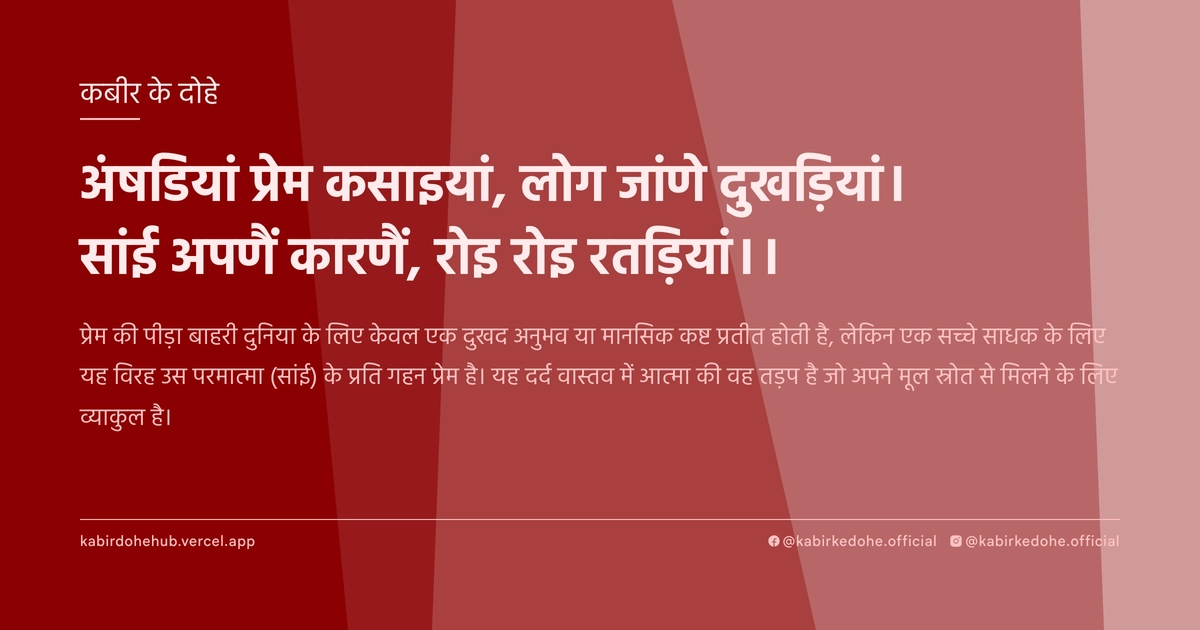
अंषडियां प्रेम कसाइयां, लोग जांणे दुखड़ियां।
सांई अपणैं कारणैं, रोइ रोइ रतड़ियां।।
Anshadiyan prem kasaiyan, log jaane dukhadiyan. Sai apnai kaaranai, roi roi ratadiyan.
इस पृष्ठ पर इस कबीर दोहे का अर्थ (meaning), हिंदी व्याख्या और अंग्रेज़ी अनुवाद, दार्शनिक विश्लेषण और व्यावहारिक जीवन सीख दी गई है। यह दोहा भक्ति (Bhakti) विषय से जुड़ा है — Kabir doha meaning and explanation in Hindi and English.
अर्थ (Meaning):
प्रेम की पीड़ा बाहरी दुनिया के लिए केवल एक दुखद अनुभव या मानसिक कष्ट प्रतीत होती है, लेकिन एक सच्चे साधक के लिए यह विरह उस परमात्मा (सांई) के प्रति गहन प्रेम है। यह दर्द वास्तव में आत्मा की वह तड़प है जो अपने मूल स्रोत से मिलने के लिए व्याकुल है।
The pangs of divine love are perceived by the worldly as mere suffering or misery. However, for the seeker, this agony is a sacred longing for the Beloved (the Divine). It is the soul's intense yearning to merge back into its original source, transforming pain into a spiritual catalyst.
व्याख्या (Interpretation):
कबीर यहाँ 'कसाइयां' शब्द का प्रयोग प्रेम की उस तीव्रता के लिए करते हैं जो मांस काटने वाले की छुरी की तरह अहंकार को काट देती है। सांसारिक लोग इसे 'दुख' समझते हैं क्योंकि वे केवल शरीर और मन के स्तर पर देखते हैं। लेकिन यह विरह वास्तव में 'निर्गुण भक्ति' का उच्चतम स्तर है जहाँ भक्त और भगवान के बीच का द्वैत समाप्त होने लगता है। यह तड़प माया के पर्दे को फाड़ देती है और आत्मा को यह अहसास कराती है कि वह पूर्ण नहीं है जब तक वह ब्रह्म में विलीन न हो जाए। यहाँ रोना शोक नहीं, बल्कि शुद्धि है। यह अद्वैत वेदांत की उस स्थिति को दर्शाता है जहाँ जीव अपनी पृथकता के दुख से मुक्त होकर पूर्णता की ओर बढ़ता है।
Kabir uses the metaphor of 'kasaiyan' (the butcher) to describe how divine love ruthlessly carves away the ego, much like a blade. To the uninitiated, this process looks like suffering, but it is actually the alchemy of the soul. In the context of Nirgun Bhakti, this longing represents the bridge between the individual Atman and the formless Brahman. The 'tears' mentioned are not of grief, but of spiritual purification, stripping away the illusions of Maya. This paradox suggests that only through the 'pain' of separation can one realize the 'truth' of eternal oneness. It is the necessary friction that ignites the fire of realization, turning a worldly existence into a mystical journey toward non-duality.
दार्शनिक विश्लेषण (Philosophical Analysis):
कबीर का यह दोहा उस युग की उपज है जहाँ धर्म केवल कर्मकांडों और बाहरी दिखावे तक सीमित था। उन्होंने स्पष्ट किया कि ईश्वर किसी मंदिर या मस्जिद में नहीं, बल्कि हृदय की उस तड़प में है जो अहंकार को मिटा देती है। यह सूफी मत के 'इश्क-ए-हकीकी' (दिव्य प्रेम) से गहराई से प्रेरित है, जहाँ प्रेमी अपने अस्तित्व को मिटाकर प्रियतम में समा जाना चाहता है।
अद्वैत वेदांत के दृष्टिकोण से, यह विरह वास्तव में एक भ्रम है, क्योंकि आत्मा और परमात्मा कभी अलग थे ही नहीं। फिर भी, यह 'भ्रमित विरह' आवश्यक है क्योंकि यह साधक को निरंतर याद दिलाता है कि वह इस भौतिक संसार का नहीं है। कबीर यहाँ ritualism का विरोध करते हुए कहते हैं कि माला जपना या व्रत रखना व्यर्थ है यदि हृदय में वह तड़प नहीं है जो व्यक्ति को उसके अहंकार से मुक्त करे।
मनोवैज्ञानिक स्तर पर, यह 'दुख' वास्तव में एक रूपांतरण प्रक्रिया है। जब मनुष्य अपनी पहचान को सामाजिक पद, जाति या संपत्ति से हटाकर केवल 'प्रेम' में केंद्रित करता है, तो वह अपनी सीमित पहचान (Ego) को खो देता है। यह 'अहं' का विसर्जन ही मोक्ष का द्वार है।
कबीर की दृष्टि में, जिसे दुनिया 'पागलपन' या 'दुख' कहती है, वही वास्तव में उच्चतम चेतना की अवस्था है। यह वह बिंदु है जहाँ तर्क समाप्त होता है और अनुभव शुरू होता है। यहाँ प्रेम कोई भावना नहीं, बल्कि एक आध्यात्मिक अनुशासन है जो साधक को शून्य की ओर ले जाता है।
अंततः, यह दोहा हमें सिखाता है कि आध्यात्मिक मार्ग पर आने वाली पीड़ा वास्तव में एक संकेत है कि हम सही दिशा में हैं। यह वह आग है जो सोने को शुद्ध करती है। बिना इस तड़प के, भक्ति केवल एक बौद्धिक व्यायाम बनकर रह जाती है, जिसमें गहराई और जीवंतता का अभाव होता है।
This couplet emerges from an era dominated by rigid ritualism and caste hierarchies. Kabir disrupts this by asserting that the only true path to the Divine is through an intense, visceral longing that annihilates the ego. This aligns closely with the Sufi concept of 'Ishq-e-Haqiqi' (Divine Love), where the lover seeks the total annihilation of the self (Fana) to merge with the Beloved.
From the lens of Advaita Vedanta, the feeling of separation is an illusion (Maya), as the Atman and Brahman are fundamentally one. However, this perceived separation serves a pedagogical purpose; the 'pain' of longing acts as the primary driver for the soul's evolution. Kabir rejects the superficiality of religious rites, suggesting that a thousand prayers are meaningless without the internal fire of yearning.
Psychologically, this state represents the transition from the 'small self' to the 'universal self.' The 'suffering' described is the friction caused when the ego resists its own dissolution. By embracing this pain, the seeker transforms their psychological structure, moving from a state of grasping to a state of surrender.
Kabir challenges the societal definition of sanity. What the world labels as 'misery' or 'madness' is, in the mystical tradition, the highest form of lucidity. It is the moment when the intellect surrenders to the heart, and the seeker stops seeking a 'destination' and becomes the 'journey' itself.
Ultimately, the philosophical core here is the necessity of spiritual crisis. Just as a seed must break open to become a tree, the human heart must be 'broken' by divine love to release the trapped divinity within. This is not a call to masochism, but a recognition that true transformation requires the courage to face the void of the ego.
मूल संदेश (Core Message):
- बाहरी दुख वास्तव में आंतरिक जागृति का संकेत है।
- अहंकार का विसर्जन ही दिव्य मिलन की पहली शर्त है।
- प्रेम वह आग है जो आत्मा को शुद्ध और पारदर्शी बनाती है।
- सांसारिक शांति अक्सर आध्यात्मिक जड़ता का दूसरा नाम है।
- परमात्मा की खोज बाहर नहीं, बल्कि हृदय की तड़प में है।
- External sorrow is often a signal of internal spiritual awakening.
- The dissolution of ego is the primary prerequisite for divine union.
- Love is the fire that renders the soul pure and transparent.
- Worldly peace is frequently a mask for spiritual stagnation.
- The Divine is found not in search, but in the ache of longing.
व्यावहारिक उदाहरण (Practical Example):
एक समय की बात है, वाराणसी के घाटों पर रामदीन नाम का एक वृद्ध बुनकर रहता था। वह दिन भर सूत कातता और रात को चुपचाप गंगा किनारे बैठकर शून्य में ताकता रहता। उसकी आँखों में हमेशा एक अजीब सी नमी रहती थी।
गाँव के लोग उसे 'पागल' कहते थे। वे कहते, "देखो इस बूढ़े को, न कोई संतान है, न धन, फिर भी यह ऐसे रोता है जैसे इसने अपना सब कुछ खो दिया हो। यह कितना दुखद जीवन है!"
रामदीन उनकी बातों से बेखबर रहता। उसके लिए वह रोना दुख नहीं, बल्कि एक उत्सव था। वह महसूस करता था कि वह उस अनंत परमात्मा से बिछड़ा हुआ है और उसकी हर सिसकी उसे उस अदृश्य प्रियतम के करीब ले जा रही है।
एक दिन एक अहंकारी पंडित उसके पास आया और बोला, "मूर्ख, तू इस तरह रोकर अपना समय व्यर्थ कर रहा है। शास्त्र पढ़, मंत्र जाप कर, तभी तुझे शांति मिलेगी। यह विलाप तुझे कहीं नहीं ले जाएगा।"
रामदीन ने मुस्कुराकर जवाब दिया, "पंडित जी, आपके मंत्रों ने आपको ज्ञान तो दिया, लेकिन क्या उन्होंने आपको तड़पाया? जिस दर्द में मैं हूँ, वह मुझे जगाए रखता है। आपकी शांति शायद एक गहरी नींद है, जबकि मेरा यह दुख एक जागृत स्वप्न है।"
पंडित को पहले तो यह बात समझ नहीं आई, लेकिन उसने देखा कि रामदीन के चेहरे पर एक ऐसी शांति थी जो किसी भी शास्त्रज्ञ के पास नहीं थी। वह दुख में भी आनंदित था।
धीरे-धीरे पंडित ने महसूस किया कि वह स्वयं अपनी उपलब्धियों के अहंकार में कैद था। उसने देखा कि रामदीन का 'दुख' वास्तव में एक ऐसा द्वार था जिसने उसे दुनिया के सारे बोझों से मुक्त कर दिया था।
पंडित ने अपनी पोथियाँ किनारे रखीं और रामदीन के पास बैठकर बस मौन रहने लगा। उसने महसूस किया कि जब तक हृदय में वह 'कसाइयां' प्रेम नहीं आता, तब तक ईश्वर केवल एक शब्द रहता है, अनुभव नहीं।
रामदीन की उस 'तड़प' ने पंडित के भीतर के अहंकार को काट दिया। अब वह भी उस दिव्य विरह का हिस्सा बन गया था, जहाँ रोना ही सबसे बड़ी मुस्कान बन गया था।
इस प्रकार, एक बुनकर की मौन तड़प ने एक विद्वान को यह सिखाया कि परमात्मा को पाने का रास्ता ज्ञान की सीढ़ियों से नहीं, बल्कि प्रेम के आंसुओं से होकर गुजरता है।
Once in the ghats of Varanasi, there lived an elderly weaver named Ramdeen. He spent his days spinning thread and his nights sitting in silence by the Ganges, staring into the void with eyes perpetually moist with unshed tears.
The villagers labeled him 'mad.' They would whisper, "Look at this old man; he has no children, no wealth, yet he weeps as if he has lost everything. What a miserable existence!"
Ramdeen remained oblivious to their judgment. For him, those tears were not a sign of misery but a sacred celebration. He felt a profound separation from the Infinite, and every sob was a rhythmic pulse drawing him closer to the Invisible Beloved.
One day, an arrogant scholar approached him and sneered, "Fool, you waste your life in this lamentation. Read the scriptures, chant the mantras, and only then will you find peace. This weeping will lead you nowhere."
Ramdeen smiled gently and replied, "Pandit ji, your mantras may have given you knowledge, but did they ever make you ache? The pain I carry keeps me awake. Your peace is perhaps a deep sleep, while my sorrow is a waking dream."
The scholar was initially baffled, but he noticed a radiance on Ramdeen's face—a serenity that transcended any academic achievement. The weaver was joyful in his very agony.
Gradually, the scholar realized he was a prisoner of his own intellectual pride. He saw that Ramdeen's 'sorrow' was actually a gateway that had liberated him from all worldly burdens and identities.
The scholar set aside his heavy volumes and sat beside Ramdeen in silence. He began to understand that until the 'butcher-like' love carves through the heart, God remains a mere word, not a living experience.
Ramdeen's longing eventually acted as a mirror, reflecting the scholar's own emptiness. The scholar's ego was finally severed, not by logic, but by the contagious purity of the weaver's longing.
Thus, the silent ache of a simple weaver taught a learned man that the path to the Divine is not paved with the stairs of knowledge, but with the tears of unconditional love.
अभ्यास मार्गदर्शन (Practice Guidance):
- प्रतिदिन 20 मिनट 'मौन विरह' का अभ्यास करें: शांत बैठें और महसूस करें कि आप अपनी आत्मा के मूल स्रोत से अलग हैं, फिर उस अलगाव की तड़प को महसूस करें।
- स्व-अन्वेषण जर्नल: लिखें कि आपके जीवन में कौन सी ऐसी इच्छाएं हैं जो आपको वास्तव में दुखी करती हैं, और विचार करें कि क्या यह दुख वास्तव में परमात्मा के लिए एक छिपी हुई पुकार है।
- व्यवहार परिवर्तन: जब भी आप किसी कठिन परिस्थिति में हों, उसे 'कष्ट' के बजाय 'शुद्धिकरण' के रूप में देखें। यह सोचें कि यह अनुभव आपके अहंकार के किस हिस्से को काट रहा है।
- निदान चेकलिस्ट: क्या आप अभी भी अपनी पहचान अपने पद या प्रतिष्ठा से जोड़ रहे हैं? क्या आप दुख आने पर डरते हैं या उसे स्वीकार करते हैं? यदि आप केवल सुख की खोज कर रहे हैं, तो आप इस ज्ञान को जीने में विफल हो रहे हैं।
- Practice 20 minutes of 'Silent Longing' daily: Sit in stillness and consciously feel the separation from your divine source, allowing the ache of that distance to surface.
- Self-Inquiry Journaling: Document the recurring sorrows in your life and analyze whether these pains are actually disguised calls for a deeper spiritual homecoming.
- Behavioral Shift: Reframe every hardship not as 'suffering' but as 'purification.' Ask yourself: "Which part of my ego is being carved away by this experience?"
- Diagnostic Checklist: Are you still defining yourself by your status or achievements? Do you recoil from pain or embrace it as a teacher? If you seek only comfort, you are missing the essence of this wisdom.
चिंतन प्रश्न (Reflection Questions):
- आपकी सार्वजनिक छवि (Public Identity) के पीछे कौन सा वह हिस्सा है जो वास्तव में अकेला और व्याकुल है?
- क्या आप अपने दुख को केवल एक समस्या मानते हैं, या इसे एक आध्यात्मिक उपकरण के रूप में देख सकते हैं?
- यदि आपका सारा सामाजिक सम्मान और डिजिटल पहचान छीन ली जाए, तो आपके भीतर क्या बचेगा?
- क्या आप वास्तव में प्रेम करना चाहते हैं, या आप केवल प्रेम के बदले मिलने वाले सुख की इच्छा रखते हैं?
- आपके जीवन का वह कौन सा 'अहंकार' है जिसे आप कभी कटने नहीं देना चाहते?
- क्या आपकी प्रार्थनाएं ईश्वर को पाने के लिए हैं, या अपनी इच्छाओं को पूरा करवाने के लिए?
- Behind your curated public identity, which part of you remains profoundly lonely and yearning?
- Do you view your suffering merely as a problem to be solved, or as a spiritual tool for evolution?
- If all your social status and digital validation were stripped away, what would remain of you?
- Do you truly desire to love, or do you only desire the comfort and rewards that come from being loved?
- Which specific part of your ego are you most terrified of losing to the 'butcher' of divine love?
- Are your prayers intended to reach the Divine, or are they merely negotiations for personal gain?