
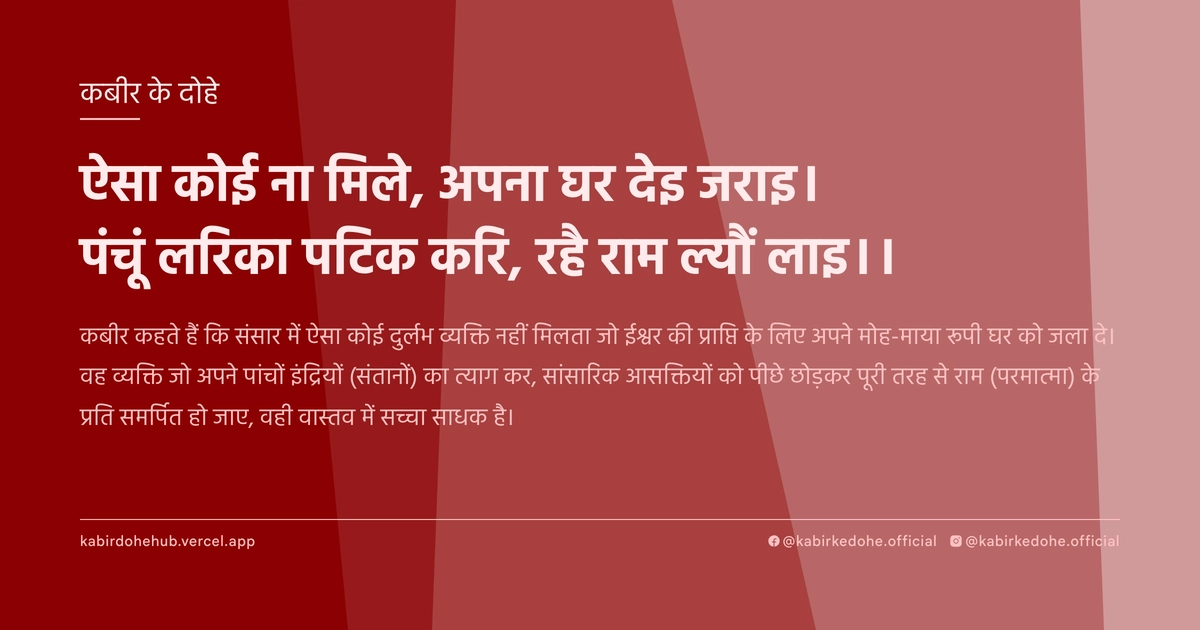
ऐसा कोई ना मिले, अपना घर देइ जराइ।
पंचूं लरिका पटिक करि, रहै राम ल्यौं लाइ।।
Aisa koi na mile, apna ghar dei jarai. Panchun larika patik kari, rahai Ram lyon lai.
इस पृष्ठ पर इस कबीर दोहे का अर्थ (meaning), हिंदी व्याख्या और अंग्रेज़ी अनुवाद, दार्शनिक विश्लेषण और व्यावहारिक जीवन सीख दी गई है। यह दोहा वैराग्य (Detachment) विषय से जुड़ा है — Kabir doha meaning and explanation in Hindi and English.
अर्थ (Meaning):
कबीर कहते हैं कि संसार में ऐसा कोई दुर्लभ व्यक्ति नहीं मिलता जो ईश्वर की प्राप्ति के लिए अपने मोह-माया रूपी घर को जला दे। वह व्यक्ति जो अपने पांचों इंद्रियों (संतानों) का त्याग कर, सांसारिक आसक्तियों को पीछे छोड़कर पूरी तरह से राम (परमात्मा) के प्रति समर्पित हो जाए, वही वास्तव में सच्चा साधक है।
Kabir asserts that it is exceedingly rare to find a soul willing to set fire to the 'house' of their worldly attachments. He speaks of the ultimate sacrifice where one casts aside the five clinging desires—symbolized as children—to dwell exclusively in the divine presence of Ram, achieving a state of total spiritual surrender.
व्याख्या (Interpretation):
यहाँ 'घर' भौतिक मकान नहीं, बल्कि अहंकार और सांसारिक पहचान का प्रतीक है। 'जलाना' विनाश नहीं, बल्कि रूपांतरण है—अहंकार का विसर्जन। 'पांचों लरिका' पांच ज्ञानेंद्रियों और उनसे जुड़ी वासनाओं को दर्शाते हैं। जब साधक इन इंद्रिय-बंधनों को 'पटिक' (त्याग) करता है, तब वह द्वैत से अद्वैत की ओर बढ़ता है। यह निर्गुण भक्ति का सार है जहाँ ईश्वर किसी मंदिर में नहीं, बल्कि स्वयं के भीतर के शून्य में मिलता है। यह विरोधाभास है कि सब कुछ खोकर ही वास्तव में सब कुछ प्राप्त किया जाता है।
The 'house' here is not a physical structure but a metaphor for the ego and the constructed identity of the self. 'Burning' signifies the alchemy of spiritual transformation—the incineration of the false self. The 'five children' represent the five senses and their corresponding cravings. By casting these aside, the seeker moves from duality to the non-dual realization of Atman-Brahman. This is the essence of Nirgun Bhakti, where the Divine is found not in idols, but in the void created by the absence of desire. The central paradox is that only through total loss does one achieve absolute gain.
दार्शनिक विश्लेषण (Philosophical Analysis):
कबीर का यह दोहा मध्यकालीन भारत के उस सामाजिक परिवेश से उपजा है जहाँ कर्मकांड और बाहरी दिखावे चरम पर थे। कबीर ने स्पष्ट किया कि मोक्ष किसी तीर्थयात्रा या अनुष्ठान से नहीं, बल्कि आंतरिक वैराग्य से आता है। यह विचार अद्वैत वेदांत के 'माया' सिद्धांत से मेल खाता है, जहाँ संसार को एक भ्रम माना गया है जो आत्मा को उसके वास्तविक स्वरूप से अलग करता है।
सूफीवाद के 'फना' (अस्तित्व का मिटना) के सिद्धांत की तरह, कबीर यहाँ 'अहं' के पूर्ण विनाश की बात करते हैं। जब तक 'मैं' जीवित है, तब तक 'राम' (परम सत्य) का अनुभव असंभव है। यह केवल भौतिक त्याग नहीं, बल्कि मनोवैज्ञानिक रूपांतरण है।
कबीर जाति और धर्म की सीमाओं को तोड़कर एक सार्वभौमिक सत्य की बात करते हैं। उनके लिए 'राम' कोई व्यक्ति नहीं, बल्कि वह चेतना है जो कण-कण में व्याप्त है। ritualism का विरोध करते हुए वे बताते हैं कि असली पूजा हृदय की शुद्धि और वासनाओं के त्याग में है।
अक्सर लोग इस दोहे को परिवार छोड़ने के रूप में गलत समझते हैं, जबकि कबीर का संकेत मानसिक आसक्ति की ओर है। वे गृहस्थी में रहकर भी 'अनासक्त' होने की प्रेरणा देते हैं।
अंततः, यह विश्लेषण दर्शाता है कि आध्यात्मिक उन्नति के लिए एक 'क्रिटिकल पॉइंट' आता है जहाँ साधक को अपनी पुरानी पहचान को पूरी तरह नष्ट करना पड़ता है ताकि एक नई, दिव्य चेतना का जन्म हो सके।
This couplet emerges from the socio-religious turbulence of medieval India, where ritualism and outward piety were dominant. Kabir dismantles the notion that liberation is achieved through pilgrimages or rites, arguing instead for an internal detachment. This aligns with the Advaita Vedanta concept of 'Maya,' where the material world is viewed as a veil obscuring the true nature of the Atman.
Parallel to the Sufi concept of 'Fana' (annihilation of the self), Kabir emphasizes the total erasure of the ego. As long as the 'I' persists, the experience of the Absolute (Ram) remains elusive. This is not a call for physical homelessness, but for a profound psychological transmutation.
Kabir transcends caste and creed to speak of a universal truth. For him, 'Ram' is not a mythological deity but the primordial consciousness pervading all existence. By rejecting ritualism, he posits that true worship lies in the purification of the heart and the cessation of craving.
Common literalist misconceptions often interpret this as a mandate to abandon one's family. However, Kabir's focus is on 'Vairagya' (dispassion)—the ability to live in the world without being owned by it.
Ultimately, this analysis reveals that spiritual evolution requires a 'critical point' of collapse, where the constructed identity must be incinerated to allow the emergence of the divine spark within.
मूल संदेश (Core Message):
- अहंकार का विनाश ही वास्तविक आध्यात्मिक जन्म है।
- इंद्रियों की गुलामी से मुक्ति ही सच्ची स्वतंत्रता है।
- जब तक 'मैं' है, तब तक 'वह' नहीं मिल सकता।
- त्याग भौतिक नहीं, बल्कि मानसिक और भावनात्मक होना चाहिए।
- परमात्मा के साथ मिलन के लिए शून्य होना अनिवार्य है।
- The annihilation of the ego is the only true spiritual birth.
- Liberation from sensory bondage is the only authentic freedom.
- As long as the 'I' exists, the 'Divine' remains hidden.
- Renunciation must be psychological and emotional, not merely physical.
- Becoming 'nothing' is the prerequisite for becoming 'Everything'.
व्यावहारिक उदाहरण (Practical Example):
वाराणसी के घाटों पर रहने वाले एक वृद्ध बुनकर, माधव की कहानी है। माधव ने जीवन भर बेहतरीन रेशमी साड़ियाँ बुनीं, लेकिन उसका मन हमेशा इस बात पर टिका रहा कि लोग उसकी कला की प्रशंसा करें। उसका 'घर' उसकी प्रसिद्धि और अहंकार था।
एक दिन उसने देखा कि एक छोटा बच्चा अपनी फटी हुई कमीज में भी खिलखिलाकर हंस रहा था, जबकि माधव अपनी महंगी पोशाकों के बावजूद भीतर से अशांत था।
उसे कबीर का यह दोहा याद आया। उसने महसूस किया कि उसकी 'पाँचों संतानें' उसकी इंद्रियाँ थीं जो केवल प्रशंसा और लालच की भूख मिटाना चाहती थीं।
माधव ने तय किया कि वह अब अपनी कला को 'अहंकार' के लिए नहीं, बल्कि 'सेवा' के लिए इस्तेमाल करेगा। उसने अपनी सबसे महंगी साड़ियाँ उन गरीब महिलाओं को देना शुरू किया जिनके पास पहनने को कुछ नहीं था।
शुरुआत में उसके मन में डर था कि उसकी प्रतिष्ठा कम हो जाएगी। यह उसके पुराने 'घर' के जलने की प्रक्रिया थी।
जैसे-जैसे वह अपनी पहचान का मोह छोड़ता गया, उसे एक अजीब सी शांति मिलने लगी। अब उसे किसी की तारीफ की जरूरत नहीं थी।
उसने पाया कि जब उसने 'मैं' को जला दिया, तो उसके भीतर एक अनंत आनंद का संचार हुआ। वह अब केवल एक बुनकर नहीं था, वह उस परमात्मा का हिस्सा महसूस करने लगा।
माधव का जीवन बदल गया; अब वह काम तो करता था, लेकिन फल की इच्छा पूरी तरह समाप्त हो चुकी थी।
उसने सीखा कि असली घर वह नहीं जो ईंटों से बना हो, बल्कि वह है जो वासनाओं से मुक्त हो।
अंत में, माधव की शांति देखकर लोग उसके पास आने लगे, न कि उसकी साड़ियों के लिए, बल्कि उसके भीतर के राम को देखने के लिए।
Consider the story of Madhav, an elderly master weaver living on the ghats of Varanasi. For decades, Madhav crafted the finest silk sarees, but his heart was forever tethered to the praise of others. His 'house' was his reputation and his towering ego.
One day, he observed a small child in tattered clothes laughing with pure joy, while Madhav, draped in expensive fabrics, felt a persistent inner void.
He recalled Kabir's words. He realized that his 'five children' were actually his senses, perpetually hungry for validation and greed.
Madhav decided that he would no longer weave for 'glory,' but for 'grace.' He began gifting his most exquisite creations to impoverished women who had nothing to wear.
Initially, he felt a searing fear that his social status was evaporating. This was the process of his old 'house' being set on fire.
As he let go of the attachment to his identity, a profound, unshakeable peace began to permeate his being. He no longer craved the applause of the marketplace.
He discovered that once the 'I' was incinerated, an infinite joy rushed in to fill the vacuum. He was no longer just a weaver; he felt himself as a ripple in the ocean of the Divine.
Madhav's life transformed; he continued his craft, but the desire for the fruit of his labor had vanished completely.
He learned that the true home is not built of bricks and mortar, but of liberation from craving.
Eventually, people flocked to Madhav—not for the beauty of his sarees, but to witness the radiance of the 'Ram' dwelling within him.
अभ्यास मार्गदर्शन (Practice Guidance):
- प्रतिदिन 20 मिनट मौन बैठें और विचार करें कि आपकी कौन सी पहचान (पद, प्रतिष्ठा, रिश्ता) आपके लिए 'घर' बन गई है जिसे अब जलना चाहिए।
- एक 'मोह-सूची' बनाएँ: उन पांच चीजों को लिखें जिनसे आप सबसे अधिक चिपके हुए हैं, और सचेत रूप से उनमें से एक का त्याग करें।
- स्व-पूछताछ: जब भी क्रोध या ईर्ष्या आए, पूछें—'यह कौन है जो दुखी है? क्या यह मेरा अहंकार है या मेरी आत्मा?'
- निदान चेकलिस्ट: यदि आप दूसरों की राय से विचलित होते हैं, तो आपका 'घर' अभी भी सुरक्षित है। यदि आप प्रशंसा और निंदा में समान रहते हैं, तो अग्नि कार्य कर रही है।
- Spend 20 minutes in daily silence, contemplating which identity (status, role, relationship) has become the 'house' that needs to be incinerated.
- Create an 'Attachment List': Identify the five primary cravings you cling to, and consciously practice releasing one of them each week.
- Self-Inquiry: Whenever anger or jealousy arises, ask—'Who is the one suffering? Is it the ego-construct or the eternal soul?'
- Diagnostic Checklist: If you are still swayed by external validation, your 'house' remains intact. If you remain equanimous in praise and blame, the fire of transformation is working.
चिंतन प्रश्न (Reflection Questions):
- यदि आज आपकी सारी सामाजिक पहचान (नाम, पद, संपत्ति) छीन ली जाए, तो आपके भीतर क्या बचेगा?
- आपकी वे कौन सी 'पांच संतानें' (इच्छाएं) हैं जो आपको वर्तमान क्षण में जीने से रोक रही हैं?
- क्या आप वास्तव में सत्य की खोज कर रहे हैं, या आप केवल अपनी वर्तमान पहचान को और अधिक चमकाना चाहते हैं?
- आपका 'डिजिटल अहंकार' (सोशल मीडिया इमेज) आपके वास्तविक स्वरूप को कितना ढक रहा है?
- क्या आप उस अग्नि का सामना करने के लिए तैयार हैं जो आपके भ्रमों को जला देगी, भले ही वह प्रक्रिया दर्दनाक हो?
- If all your social identities (name, title, wealth) were stripped away today, what would remain of you?
- Which 'five children' (deep-seated cravings) are preventing you from inhabiting the present moment?
- Are you truly seeking the Truth, or are you merely trying to polish the image of your current identity?
- To what extent does your 'digital ego' obscure the reality of your internal landscape?
- Are you prepared to face the fire that burns away your illusions, even if the process of incineration is painful?