
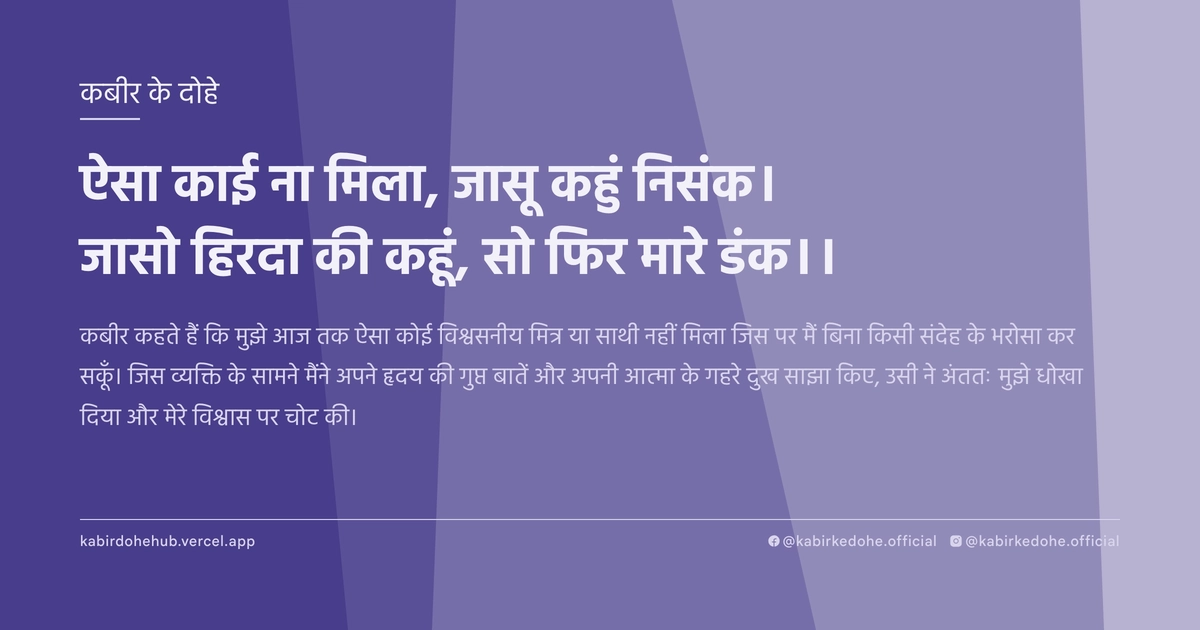
ऐसा काई ना मिला, जासू कहुं निसंक।
जासो हिरदा की कहूं, सो फिर मारे डंक।।
Aisa kai na mila, jaasu kahun nisank. Jaaso hirda ki kahun, so phir maare dank.
इस पृष्ठ पर इस कबीर दोहे का अर्थ (meaning), हिंदी व्याख्या और अंग्रेज़ी अनुवाद, दार्शनिक विश्लेषण और व्यावहारिक जीवन सीख दी गई है। यह दोहा सत्य (Truth) विषय से जुड़ा है — Kabir doha meaning and explanation in Hindi and English.
अर्थ (Meaning):
कबीर कहते हैं कि मुझे आज तक ऐसा कोई विश्वसनीय मित्र या साथी नहीं मिला जिस पर मैं बिना किसी संदेह के भरोसा कर सकूँ। जिस व्यक्ति के सामने मैंने अपने हृदय की गुप्त बातें और अपनी आत्मा के गहरे दुख साझा किए, उसी ने अंततः मुझे धोखा दिया और मेरे विश्वास पर चोट की।
Kabir laments that he has found no one truly trustworthy in this world, someone with whom he could share his innermost secrets without hesitation. He observes that those to whom he opened his heart and revealed his deepest vulnerabilities were the very ones who eventually betrayed him, striking him like a venomous sting.
व्याख्या (Interpretation):
यह दोहा मानवीय संबंधों की क्षणभंगुरता और विश्वासघात की पीड़ा से शुरू होता है, लेकिन इसका गहरा अर्थ आध्यात्मिक एकांत की ओर ले जाता है। 'डंक' यहाँ केवल शारीरिक या मानसिक चोट नहीं है, बल्कि वह अहंकार है जो दूसरे व्यक्ति में छिपा होता है। कबीर यहाँ 'माया' के प्रभाव को दर्शा रहे हैं, जहाँ मनुष्य स्वयं को दूसरे में देखता है लेकिन वास्तव में वह केवल अपने प्रतिबिंब या अपनी इच्छाओं से प्रेम करता है। जब वह प्रतिबिंब बदलता है, तो वह चोट बन जाता है। यह द्वैत (duality) की समस्या है; जब तक हम बाहरी दुनिया में पूर्णता खोजते हैं, हम केवल निराशा पाएंगे। यह निर्वाण की ओर पहला कदम है—यह समझना कि केवल 'निर्गुण ब्रह्म' ही वह एकमात्र साथी है जो कभी धोखा नहीं देता।
This couplet begins with the pain of human betrayal but transitions into a profound realization of spiritual solitude. The 'sting' (dank) represents not just emotional hurt, but the latent ego residing within every human interaction. Kabir illustrates the veil of 'Maya' (illusion), where humans seek completion in others, only to find that they are projecting their own needs onto a flawed mirror. The paradox here is that the search for an external confidant is the very barrier to finding the internal Divine. By highlighting the failure of human trust, Kabir points toward the 'Nirgun' (formless) reality—the only constant that does not betray. It is a movement from the duality of 'I and Thou' to the non-duality of 'Atman-Brahman,' where the only true relationship is the one with the Self.
दार्शनिक विश्लेषण (Philosophical Analysis):
कबीर का यह कथन केवल निराशावाद नहीं है, बल्कि यह उस युग की सामाजिक और धार्मिक पाखंडता पर प्रहार है जहाँ गुरु और शिष्य के संबंधों में भी स्वार्थ व्याप्त था। ऐतिहासिक रूप से, कबीर ने देखा कि कैसे धर्म के नाम पर लोग एक-दूसरे को विभाजित करते थे। यह विश्लेषण अद्वैत वेदांत के करीब है, जो कहता है कि संसार एक मिथ्या है और केवल ब्रह्म सत्य है। जब कबीर कहते हैं कि कोई विश्वसनीय नहीं मिला, तो वे वास्तव में 'सांसारिक आसक्ति' (worldly attachment) के विनाश की बात कर रहे हैं।
सूफी मत के 'फना' (ego-annihilation) के सिद्धांत की तरह, यहाँ भी अहंकार का मरना आवश्यक है। विश्वासघात वह उत्प्रेरक है जो साधक को बाहरी दुनिया से मोड़कर अंतर्मुखी बनाता है। यदि हमें दुनिया में पूर्ण विश्वास मिल जाता, तो हम कभी ईश्वर की खोज नहीं करते। अतः, यह 'डंक' वास्तव में एक आध्यात्मिक जागृति है।
कबीर ने जाति और कर्मकांडों का विरोध किया क्योंकि वे बाहरी पहचान पर आधारित थे। यह दोहा बताता है कि बाहरी पहचान (जैसे धर्म, जाति या पद) विश्वास का आधार नहीं हो सकती। सच्चा विश्वास केवल उस चेतना में संभव है जो शरीर और मन से परे है।
मनोवैज्ञानिक स्तर पर, यह दोहा 'प्रोजेक्शन' की प्रक्रिया को समझाता है। हम दूसरों में वह देखते हैं जो हम होना चाहते हैं, और जब वे हमारी अपेक्षाओं पर खरे नहीं उतरते, तो हमें चोट पहुँचती है। कबीर इस मनोवैज्ञानिक जाल को तोड़कर हमें आत्म-निर्भरता की ओर ले जाते हैं।
अंततः, यह दोहा हमें सिखाता है कि शून्य (Sunyata) या मौन ही वह स्थान है जहाँ कोई विश्वासघात संभव नहीं है। जब साधक 'मैं' और 'मेरा' के भाव को त्याग देता है, तो उसे चोट पहुँचाने वाला कोई बचता ही नहीं। यह पूर्ण समर्पण और वैराग्य की पराकाष्ठा है।
Kabir's statement is not mere pessimism; it is a surgical strike on the social and religious hypocrisy of his era, where even the sacred bond between guru and disciple was often tainted by ego. Historically, Kabir witnessed how religious identities were used to divide and deceive. This analysis aligns with Advaita Vedanta, which posits that the empirical world is 'Maya' (illusion) and only Brahman is the ultimate reality. By stating that no one is trustworthy, Kabir is advocating for the dissolution of 'Samsara' (worldly attachment).
Similar to the Sufi concept of 'Fana' (the annihilation of the self), the pain of betrayal serves as a catalyst for the seeker to turn inward. If we found absolute security in human relationships, the drive for spiritual transcendence would vanish. Thus, the 'sting' is actually a divine wake-up call, forcing the soul to stop seeking water in a mirage.
Kabir's rejection of caste and ritualism is mirrored here; he suggests that external labels are unreliable foundations for trust. True trust can only exist in the consciousness that transcends the physical body and social constructs. He challenges the notion that spiritual companionship is found in a person, suggesting instead that it is found in the State of Being.
Psychologically, this couplet addresses the mechanism of projection. We project our ideals onto others, and the 'sting' occurs when the other person reveals their own fragmented humanity. Kabir urges us to break this cycle by shifting the locus of security from the 'Other' to the 'Self.'
Ultimately, this teaching leads to the realization of 'Shunya' (Emptiness). When the seeker eradicates the 'I' and 'Mine,' there is no target left for the sting to hit. It is the pinnacle of Vairagya (detachment), where the soul finds a companionship with the Infinite that is immune to the fluctuations of human nature.
मूल संदेश (Core Message):
- बाहरी दुनिया में पूर्ण विश्वास एक मृगतृष्णा है।
- मानवीय संबंधों की अस्थिरता ही आध्यात्मिक जागृति का द्वार है।
- अपेक्षाओं का त्याग ही मानसिक शांति का एकमात्र मार्ग है।
- सच्चा साथी केवल आपका अपना अंतर्मन और निर्गुण ब्रह्म है।
- विश्वासघात वह चोट है जो अहंकार के खोल को तोड़ती है।
- Absolute trust in the external world is a mirage.
- The instability of human bonds is the gateway to spiritual awakening.
- Relinquishing expectations is the only path to enduring peace.
- The only true companion is your own inner Self and the Formless Divine.
- Betrayal is the sting that shatters the shell of the ego.
व्यावहारिक उदाहरण (Practical Example):
वाराणसी के घाटों पर रहने वाला एक वृद्ध बुनकर था, जिसका नाम माधव था। माधव ने अपना पूरा जीवन ईमानदारी से कपड़े बुने और अपने छोटे से समुदाय में सबको अपना माना। उसने एक युवा साथी को अपना सबसे करीबी मित्र बनाया और उसे अपने व्यापार के गुप्त तरीके और अपने जीवन की सारी व्यथाएं बता दीं।
माधव को लगा कि इस युवा में वही ईमानदारी है जो उसके अपने भीतर है। उसने उसे अपने घर की चाबियाँ तक सौंप दीं और उसे अपने परिवार जैसा माना।
लेकिन समय बदला और उस युवा की महत्वाकांक्षा बढ़ गई। उसने माधव के व्यापारिक संपर्कों को चुराया और धीरे-धीरे उसे समाज में बदनाम करना शुरू कर दिया ताकि वह खुद को एकमात्र कुशल बुनकर साबित कर सके।
एक दिन माधव को पता चला कि जिस व्यक्ति को उसने अपना हृदय सौंपा था, वही उसके पीछे उसकी बुराई कर रहा था और उसके संसाधनों को हड़प रहा था। माधव गहरे सदमे में चला गया।
वह कई दिनों तक मौन रहा, अपने पुराने विश्वासों पर सवाल उठाते हुए। उसे लगा कि दुनिया में कोई भी सच्चा नहीं है।
तभी उसने कबीर के इस दोहे को याद किया। उसने महसूस किया कि उसकी पीड़ा इस बात से नहीं थी कि वह धोखा खाया, बल्कि इस बात से थी कि उसने एक नश्वर मनुष्य से 'अविनाशी' विश्वास की उम्मीद की थी।
माधव ने यह समझा कि उसने अपनी खुशी की चाबी दूसरे के हाथ में दे दी थी। उसने उस युवा से नफरत करने के बजाय, उसे एक दर्पण की तरह देखा जिसने उसे उसकी अपनी गलती दिखाई थी।
उसने अब अपनी शांति बाहरी संबंधों में खोजना बंद कर दिया और अपने काम और अपने भीतर के मौन में शरण ली।
उसका व्यवहार बदल गया; वह अब भी सबके प्रति दयालु था, लेकिन अब वह किसी पर 'निर्भर' नहीं था।
उसने पाया कि जब उसने दूसरों से उम्मीदें छोड़ दीं, तो वह वास्तव में स्वतंत्र हो गया और उसका काम और भी निखर गया।
In the ancient lanes of Varanasi lived an elderly weaver named Madhav. Madhav had spent his entire life weaving exquisite fabrics with honesty and had treated everyone in his small community with immense warmth and trust.
He took a young apprentice under his wing, treating him not just as a student but as a soul-companion. Madhav shared with him the secret techniques of his craft and the deepest sorrows of his personal life, believing he had found a kindred spirit.
Madhav assumed that the youth possessed the same integrity that he held within himself. He trusted him with the keys to his home and the secrets of his trade, viewing him as a son.
However, as the youth's ambition grew, he began to see Madhav's kindness as weakness. He secretly stole Madhav's high-profile clients and began spreading subtle lies about Madhav's declining skill to establish himself as the sole master weaver.
One day, Madhav discovered the betrayal. The person to whom he had opened his heart had been systematically dismantling his life and reputation from the shadows.
Madhav fell into a deep depression, feeling the 'sting' of betrayal. He questioned the very nature of goodness and felt a profound sense of isolation in a crowded city.
During his solitude, he encountered Kabir's words. He realized that his agony didn't stem from the youth's betrayal, but from his own mistake of seeking 'eternal' loyalty in a 'transient' human being.
He understood that by placing his emotional security in another, he had surrendered his own peace. He stopped viewing the youth as an enemy and instead saw him as a mirror reflecting the illusion of worldly attachment.
Madhav shifted his focus. He continued to be kind to all, but he stopped being 'dependent' on the validation or loyalty of others for his inner stability.
By relinquishing the expectation of absolute trust in humans, he found an unshakable companionship within himself, and his art reached a level of purity it had never known before.
अभ्यास मार्गदर्शन (Practice Guidance):
- दैनिक चिंतन: प्रतिदिन 15 मिनट मौन बैठें और उन क्षणों को याद करें जब आपने दूसरों से अत्यधिक अपेक्षाएं रखीं। यह विश्लेषण करें कि क्या वह पीड़ा व्यक्ति के कारण थी या आपकी अपेक्षा के कारण।
- आत्म-पूछताछ जर्नल: एक डायरी लिखें जिसमें उन 'डंकों' (धोखों) का विवरण हो जिन्होंने आपको चोट पहुँचाई। फिर उनके बगल में लिखें कि उस अनुभव ने आपको अपनी आंतरिक शक्ति की ओर कैसे मोड़ा।
- व्यवहारिक परिवर्तन: किसी भी नए संबंध में 'पूर्ण विश्वास' के बजाय 'सचेत स्वीकृति' का अभ्यास करें। लोगों को वैसे ही स्वीकार करें जैसे वे हैं, न कि वैसे जैसा आप उन्हें देखना चाहते हैं।
- नैदानिक चेकलिस्ट: यदि आप अभी भी दूसरों के व्यवहार से विचलित हो रहे हैं या विश्वासघात के बाद क्रोध में हैं, तो इसका अर्थ है कि आप अभी भी बाहरी दुनिया में अपनी पूर्णता खोज रहे हैं।
- Daily Contemplation: Spend 15 minutes in silence daily, recalling moments where you held excessive expectations of others. Analyze whether the pain was caused by the person or by your own projection of an ideal.
- Self-Inquiry Journaling: Maintain a journal documenting the 'stings' (betrayals) you have faced. Beside each entry, write how that specific pain acted as a catalyst to push you toward internal strength.
- Behavioral Shift: Practice 'Conscious Acceptance' instead of 'Absolute Trust' in new relationships. Accept people as they are, rather than as you wish them to be, reducing the gap for disappointment.
- Diagnostic Checklist: If you still find your inner peace fluctuating based on others' loyalty or feel lingering resentment after a betrayal, it is a sign that you are still seeking your completion in the external world.
चिंतन प्रश्न (Reflection Questions):
- क्या मेरा 'विश्वास' वास्तव में दूसरे के प्रति है, या मैं केवल अपनी छवि को दूसरे में देखना चाहता हूँ?
- यदि दुनिया का हर व्यक्ति मुझे धोखा दे दे, तो मेरे भीतर ऐसा क्या बचेगा जो अभी भी अखंड और शांत रहे?
- मैं अपनी डिजिटल पहचान (सोशल मीडिया) पर जो विश्वास और प्रशंसा खोजता हूँ, वह किस प्रकार के 'डंक' का जोखिम उठा रहा है?
- क्या मैं वास्तव में लोगों को माफ करता हूँ, या मैं केवल अपनी श्रेष्ठता सिद्ध करने के लिए 'क्षमा' का ढोंग करता हूँ?
- मेरे जीवन का वह कौन सा गुप्त दुख है जिसे मैं किसी के साथ साझा नहीं कर सकता, और क्या वह अकेलापन वास्तव में एक वरदान है?
- Is my 'trust' truly in the other person, or am I merely seeking a reflection of my own ideal image in them?
- If every person in the world were to betray me, what remains within me that is still whole and undisturbed?
- In the trust and validation I seek through my digital identity, what kind of 'sting' am I risking?
- Do I truly forgive others, or do I perform 'forgiveness' as a way to maintain a sense of moral superiority?
- What is the secret sorrow in my life that I cannot share with anyone, and is that solitude actually a hidden blessing?