
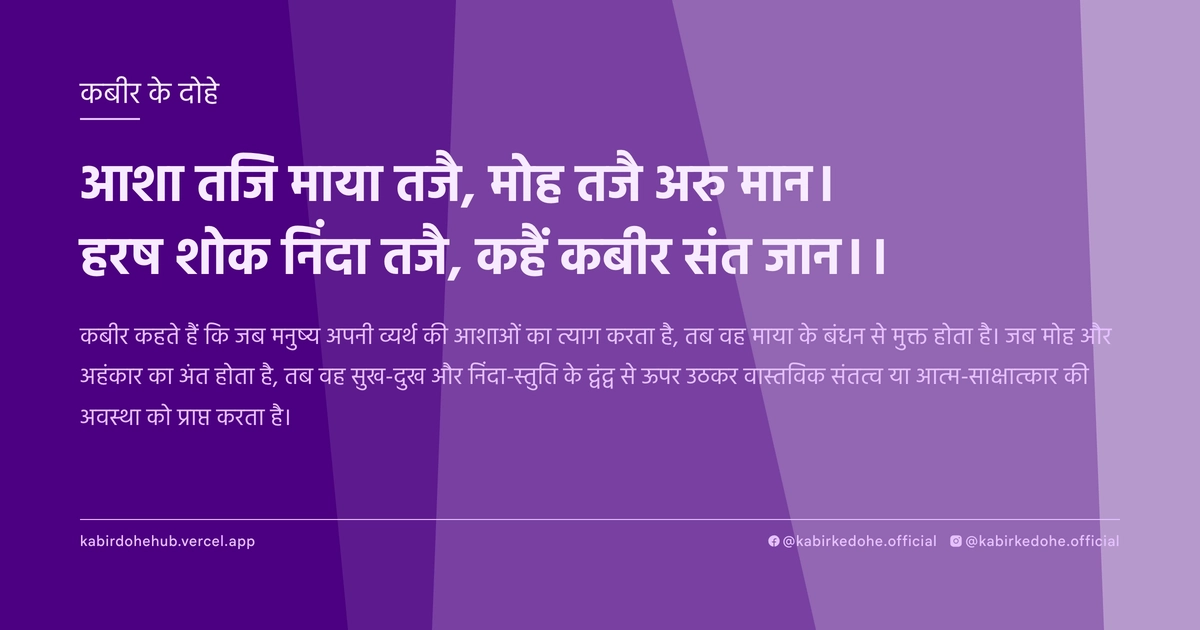
आशा तजि माया तजै, मोह तजै अरु मान।
हरष शोक निंदा तजै, कहैं कबीर संत जान।।
Aasha taji maya tajai, moh tajai aru maan. Harash shok ninda tajai, kahen Kabir sant jaan.
इस पृष्ठ पर इस कबीर दोहे का अर्थ (meaning), हिंदी व्याख्या और अंग्रेज़ी अनुवाद, दार्शनिक विश्लेषण और व्यावहारिक जीवन सीख दी गई है। यह दोहा वैराग्य (Detachment) विषय से जुड़ा है — Kabir doha meaning and explanation in Hindi and English.
अर्थ (Meaning):
कबीर कहते हैं कि जब मनुष्य अपनी व्यर्थ की आशाओं का त्याग करता है, तब वह माया के बंधन से मुक्त होता है। जब मोह और अहंकार का अंत होता है, तब वह सुख-दुख और निंदा-स्तुति के द्वंद्व से ऊपर उठकर वास्तविक संतत्व या आत्म-साक्षात्कार की अवस्था को प्राप्त करता है।
Kabir asserts that when a person renounces futile expectations, they liberate themselves from the grip of Maya. By shedding attachment and ego, one transcends the duality of joy, sorrow, and criticism, eventually attaining the state of a true saint or realized soul.
व्याख्या (Interpretation):
इस दोहे का शाब्दिक अर्थ है कि इच्छाओं का त्याग ही मुक्ति का मार्ग है। गहराई में, 'आशा' यहाँ केवल भौतिक इच्छा नहीं, बल्कि वह मानसिक प्रक्षेपण है जो हमें वर्तमान से दूर ले जाता है। माया वह भ्रम है जो आत्मा को शरीर और संसार के साथ जोड़ता है। मोह और मान (अहंकार) वे दीवारें हैं जो जीव को ब्रह्म से अलग करती हैं। जब साधक इन मानसिक विकारों को मिटाता है, तो वह 'स्थितप्रज्ञ' हो जाता है, जहाँ प्रशंसा और निंदा दोनों समान प्रतीत होते हैं। यह निर्गुण भक्ति का सार है, जहाँ ईश्वर किसी मूर्ति में नहीं, बल्कि अहंकार के विसर्जन के बाद बचे हुए शून्य में मिलता है। यह अद्वैत वेदांत की उस स्थिति को दर्शाता है जहाँ ज्ञाता, ज्ञान और ज्ञेय का भेद समाप्त हो जाता है।
Literally, the verse suggests that renunciation of desire is the path to liberation. Metaphorically, 'Aasha' refers not just to material longing, but to the mental projections that detach us from the present. Maya is the cosmic illusion that binds the Atman to the physical realm. Moha (attachment) and Maan (ego) are the psychological barriers separating the individual from the Universal Consciousness. As the seeker dissolves these distortions, they reach the state of 'Sthitapragya,' where praise and insult are perceived as identical. This embodies the essence of Nirgun Bhakti, where the Divine is found not in idols, but in the void remaining after the ego's annihilation. It mirrors Advaita Vedanta's realization of non-duality, where the distinction between the knower and the known vanishes.
दार्शनिक विश्लेषण (Philosophical Analysis):
कबीर का यह दर्शन उनके समय के कर्मकांडीय धर्मों के विरुद्ध एक सशक्त प्रहार था। उन्होंने देखा कि लोग तीर्थों और बाहरी आडंबरों में मुक्ति खोज रहे थे, जबकि मुक्ति आंतरिक मनोवैज्ञानिक रूपांतरण में निहित थी। यह दोहा 'अनासक्ति' के सिद्धांत पर आधारित है, जो न केवल हिंदू दर्शन बल्कि सूफी मत के 'फना' (अहंकार का विनाश) के करीब है।
माया यहाँ केवल धन-दौलत नहीं, बल्कि वह मानसिक पर्दा है जो सत्य को ढकता है। कबीर तर्क देते हैं कि जब तक 'मैं' (अहंकार) जीवित है, तब तक दुख का अस्तित्व रहेगा। अहंकार ही वह केंद्र है जहाँ मान और मोह पनपते हैं। जब यह केंद्र नष्ट होता है, तो व्यक्ति द्वंद्वों (Dualities) से मुक्त हो जाता है।
अद्वैत वेदांत के परिप्रेक्ष्य में, यह प्रक्रिया 'माया' के आवरण को हटाने जैसी है। जब हम यह पहचान लेते हैं कि हम शरीर नहीं बल्कि शुद्ध चेतना हैं, तो बाहरी दुनिया की निंदा या प्रशंसा हमें विचलित नहीं करती। यह एक मानसिक शून्यता की स्थिति है जो पूर्णता की ओर ले जाती है।
सूफीवाद के साथ इसका गहरा संबंध है, जहाँ 'इश्क-ए-हकीकी' (ईश्वर से प्रेम) के लिए 'इश्क-ए-मजाजी' (सांसारिक प्रेम/मोह) का त्याग आवश्यक है। कबीर यहाँ एक ऐसे मार्ग की बात कर रहे हैं जो धर्म और संप्रदाय से ऊपर उठकर केवल अनुभव पर आधारित है।
अंततः, यह दोहा मनोवैज्ञानिक स्वास्थ्य का एक मैनुअल है। यह सिखाता है कि हमारी पीड़ा बाहरी परिस्थितियों से नहीं, बल्कि उन परिस्थितियों के प्रति हमारी प्रतिक्रियाओं और अपेक्षाओं से उत्पन्न होती है। अहंकार का विसर्जन ही वास्तविक स्वतंत्रता है।
Kabir's philosophy serves as a potent critique of the ritualistic religions of his era. He observed people seeking liberation in pilgrimages and outward displays, while true liberation lay in internal psychological transformation. This verse is grounded in the principle of 'Anasakti' (non-attachment), which aligns not only with Hindu thought but also with the Sufi concept of 'Fana' (the annihilation of the ego).
Maya here is not merely material wealth, but the mental veil that obscures Truth. Kabir argues that as long as the 'I' (ego) persists, suffering will endure. The ego is the epicenter where pride and attachment flourish. Once this center is dissolved, the individual transcends dualities.
From the perspective of Advaita Vedanta, this process is akin to lifting the veil of Maya. When one realizes they are not the body but pure consciousness, external praise or criticism ceases to disturb them. This is a state of mental void that paradoxically leads to absolute fullness.
There is a profound connection to Sufism, where 'Ishq-e-Haqiqi' (Divine Love) requires the renunciation of 'Ishq-e-Majazi' (worldly attachment). Kabir proposes a path that transcends organized religion and sect, relying solely on direct experiential realization.
Ultimately, this verse acts as a manual for psychological well-being. It teaches that our suffering stems not from external circumstances, but from our expectations and reactions to them. The dissolution of the ego is the only true freedom.
मूल संदेश (Core Message):
- अपेक्षाओं का त्याग ही मानसिक शांति का एकमात्र द्वार है।
- माया बाहरी दुनिया में नहीं, बल्कि हमारी आंतरिक आसक्ति में है।
- अहंकार का अंत ही वास्तविक ज्ञान की शुरुआत है।
- सुख और दुख के बीच का संतुलन ही संतत्व है।
- जब 'मैं' मिटता है, तब 'ब्रह्म' प्रकट होता है।
- Renouncing expectations is the only gateway to mental peace.
- Maya exists not in the external world, but in our internal attachments.
- The end of the ego is the beginning of true knowledge.
- Equanimity between joy and sorrow is the essence of sainthood.
- When the 'I' dissolves, the Universal Truth reveals itself.
व्यावहारिक उदाहरण (Practical Example):
वाराणसी के एक पुराने घाट पर माधव नाम का एक वृद्ध बुनकर रहता था। माधव अपनी कला में निपुण था, लेकिन उसका मन हमेशा इस बात से परेशान रहता था कि लोग उसके कपड़ों की कितनी प्रशंसा करेंगे या उसकी गरीबी का मजाक उड़ाएंगे। वह अपनी हर कृति को इस उम्मीद (आशा) में बनाता था कि कोई बड़ा सेठ उसे भारी कीमत पर खरीदेगा, जिससे उसका सामाजिक स्तर (मान) बढ़ेगा।
एक दिन उसकी मुलाकात एक घुमक्कड़ फकीर से हुई। फकीर ने देखा कि माधव एक सुंदर रेशमी वस्त्र बुन रहा था, लेकिन उसका चेहरा तनाव से भरा था। फकीर ने पूछा, "तुम इस वस्त्र में क्या बुन रहे हो—धागे या अपनी चिंताएं?"
माधव ने अपनी व्यथा सुनाई कि कैसे वह अपनी पहचान और मान-सम्मान के लिए संघर्ष कर रहा है। फकीर ने उसे कबीर का यह दोहा सुनाया और कहा, "जब तक तुम इस कपड़े को अपनी पहचान मानोगे, तुम इसके गुलाम रहोगे। जिस दिन तुम इसे केवल एक सेवा मानोगे, तुम मुक्त हो जाओगे।"
शुरुआत में माधव को यह बात समझ नहीं आई। लेकिन उसने प्रयोग करना शुरू किया। उसने यह सोचना छोड़ दिया कि ग्राहक क्या कहेगा या पड़ोसी क्या सोचेगा। उसने अपनी 'आशा' को 'समर्पण' में बदल दिया।
धीरे-धीरे, माधव ने महसूस किया कि जब उसने प्रशंसा की इच्छा छोड़ी, तो उसका काम और अधिक निखर गया। अब वह कपड़े इसलिए नहीं बुनता था कि उसे 'मान' मिले, बल्कि इसलिए कि वह उस सृजन की प्रक्रिया में आनंद ले सके।
एक समय ऐसा आया जब शहर के सबसे बड़े व्यापारी ने उसके काम की कड़ी आलोचना की। पहले का माधव टूट जाता, लेकिन अब वह शांत रहा। उसे न तो उस निंदा से दुख हुआ और न ही प्रशंसा से अहंकार।
उसने पाया कि उसका घर अब भी छोटा था और वह अब भी गरीब था, लेकिन उसके भीतर का शोर शांत हो गया था। वह अब वास्तव में एक 'संत' की तरह जीवन जीने लगा था, जहाँ बाहरी दुनिया की लहरें उसे हिला नहीं पाती थीं।
माधव की यह यात्रा एक बुनकर से एक मुक्त आत्मा की यात्रा थी। उसने सीखा कि माया का त्याग घर छोड़ने में नहीं, बल्कि घर में रहते हुए मोह और अपेक्षाओं को छोड़ने में है।
उसने अपने जीवन के अंतिम वर्षों में बिना किसी लालसा के दूसरों को बुनना सिखाया, और उसकी शांति पूरे घाट पर प्रसिद्ध हो गई।
On an ancient ghat in Varanasi lived an elderly weaver named Madhav. Madhav was a master of his craft, yet his mind was perpetually troubled by how people perceived his work or mocked his poverty. He crafted every piece with the hope (Aasha) that a wealthy merchant would buy it for a high price, thereby elevating his social status (Maan).
One day, he encountered a wandering fakir. The fakir noticed Madhav weaving a stunning silk garment, but his face was clouded with tension. The fakir asked, "What are you weaving into this cloth—threads, or your anxieties?"
Madhav shared his struggle for recognition and respect. The fakir recited Kabir's verse and told him, "As long as you view this cloth as your identity, you remain its slave. The day you view it as a mere service, you will be free."
Initially, Madhav struggled to grasp this. However, he began to experiment. He stopped worrying about the customer's verdict or the neighbor's gossip. He transformed his 'hope' into 'surrender.'
Gradually, Madhav realized that by relinquishing the desire for praise, his artistry actually flourished. He no longer wove to gain 'Maan,' but to immerse himself in the joy of creation.
There came a time when the city's most prominent merchant harshly criticized his work. The old Madhav would have been devastated, but the new Madhav remained serene. Neither the insult wounded him, nor did praise inflate him.
He found that while his house remained small and he remained poor, the inner noise had ceased. He began to live like a true 'Sant,' where the external waves of the world could no longer shake his core.
Madhav's journey was a transition from being a mere weaver to becoming a liberated soul. He learned that renouncing Maya does not mean leaving one's home, but leaving behind attachment and expectation while staying within it.
In his final years, he taught others the art of weaving without any longing, and his tranquility became legendary across the ghats.
अभ्यास मार्गदर्शन (Practice Guidance):
- दैनिक साक्षी भाव: दिन में तीन बार 10 मिनट के लिए बैठें और अपने मन में उठने वाली 'आशाओं' और 'अपेक्षाओं' को केवल एक दर्शक की तरह देखें, उनमें शामिल न हों।
- अहंकार का विसर्जन जर्नल: प्रतिदिन रात को लिखें कि आज किस क्षण में आपको 'मान' (अहंकार) महसूस हुआ या किस निंदा ने आपको विचलित किया। विश्लेषण करें कि वह भावना किस 'मोह' से जुड़ी थी।
- मौन सेवा अभ्यास: सप्ताह में एक बार ऐसा कार्य करें जिसके लिए आपको कोई श्रेय न मिले और जिसके बारे में कोई न जाने। यह 'मान' को मिटाने का सबसे प्रभावी तरीका है।
- निदान चेकलिस्ट: स्वयं से पूछें—क्या मेरी खुशी दूसरों की प्रतिक्रिया पर निर्भर है? क्या मैं प्रशंसा में फूलता हूँ और आलोचना में सिकुड़ता हूँ? यदि हाँ, तो मैं अभी भी माया के प्रभाव में हूँ।
- Daily Witnessing: Three times a day, sit for 10 minutes and observe the 'hopes' and 'expectations' arising in your mind as a detached witness, without engaging with them.
- Ego Dissolution Journal: Every night, record the moments you felt 'Maan' (pride) or were disturbed by criticism. Analyze which specific 'attachment' triggered that emotion.
- Anonymous Service: Once a week, perform an act of kindness where you receive no credit and no one knows. This is the most effective way to erode the ego.
- Diagnostic Checklist: Ask yourself—Is my happiness dependent on others' reactions? Do I expand with praise and shrink with criticism? If yes, I am still under the influence of Maya.
चिंतन प्रश्न (Reflection Questions):
- यदि आपकी सारी उपलब्धियाँ और पद छीन लिए जाएँ, तो आपके व्यक्तित्व में क्या बचेगा?
- आपकी वह कौन सी 'आशा' है जो आपको वर्तमान क्षण का आनंद लेने से रोक रही है?
- क्या आप वास्तव में निंदा से मुक्त हैं, या आपने केवल एक मुखौटा पहन रखा है?
- आपका 'मान' (अहंकार) किन लोगों के सामने सबसे अधिक सक्रिय होता है और क्यों?
- क्या आप अपनी डिजिटल पहचान (Social Media Ego) को अपनी वास्तविक आत्मा से अलग देख पाते हैं?
- If all your achievements and titles were stripped away, what would remain of your personality?
- Which specific 'hope' is preventing you from experiencing the joy of the present moment?
- Are you truly free from the sting of criticism, or have you merely donned a mask of indifference?
- In whose presence does your 'Maan' (ego) become most active, and why?
- Can you distinguish your digital identity (Social Media Ego) from your authentic soul?