
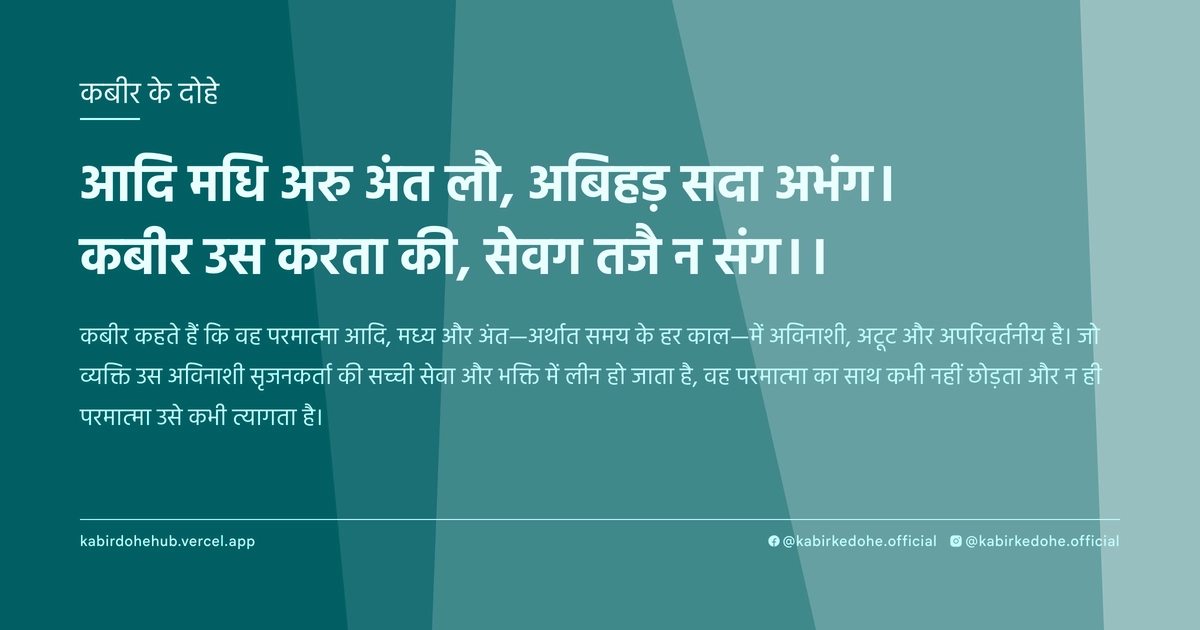
आदि मधि अरु अंत लौ, अबिहड़ सदा अभंग।
कबीर उस करता की, सेवग तजै न संग।।
Aadi madhi aru ant lau, abihad sada abhang. Kabir us karta ki, sevag taje na sang.
इस पृष्ठ पर इस कबीर दोहे का अर्थ (meaning), हिंदी व्याख्या और अंग्रेज़ी अनुवाद, दार्शनिक विश्लेषण और व्यावहारिक जीवन सीख दी गई है। यह दोहा निर्गुण ब्रह्म (Nirguna Brahman) विषय से जुड़ा है — Kabir doha meaning and explanation in Hindi and English.
अर्थ (Meaning):
कबीर कहते हैं कि वह परमात्मा आदि, मध्य और अंत—अर्थात समय के हर काल—में अविनाशी, अटूट और अपरिवर्तनीय है। जो व्यक्ति उस अविनाशी सृजनकर्ता की सच्ची सेवा और भक्ति में लीन हो जाता है, वह परमात्मा का साथ कभी नहीं छोड़ता और न ही परमात्मा उसे कभी त्यागता है।
Kabir asserts that the Divine is indestructible, unbroken, and immutable from the beginning, through the middle, and until the end of all time. He suggests that one who dedicates themselves to the selfless service of this Eternal Creator establishes an unbreakable bond, ensuring that the Divine presence never departs from their side.
व्याख्या (Interpretation):
शाब्दिक अर्थ में यह दोहा ईश्वर की शाश्वतता का वर्णन करता है। आध्यात्मिक स्तर पर, 'आदि, मधि, अंत' समय के मायावी चक्र को दर्शाते हैं, जबकि 'अबिहड़' उस सत्य को इंगित करता है जो समय से परे है। यह निर्गुण भक्ति का सार है, जहाँ ईश्वर किसी आकार में नहीं बल्कि एक सर्वव्यापी चेतना के रूप में है। यहाँ 'सेवग' का अर्थ केवल कर्मकांड नहीं, बल्कि अहंकार का विसर्जन है। जब साधक यह जान लेता है कि वह स्वयं उसी अविनाशी तत्व का हिस्सा है (अद्वैत), तब द्वैत समाप्त हो जाता है। यह विरोधाभास है कि जिसे हम बाहर खोज रहे हैं, वह वास्तव में हमारे अस्तित्व का सबसे स्थिर आधार है।
Literally, the verse describes the eternity of God. On a deeper level, 'beginning, middle, and end' represent the illusory cycle of time (Maya), while 'abihad' refers to the Truth that exists beyond temporal constraints. This is the essence of Nirgun Bhakti, where the Divine is not a persona but an omnipresent consciousness. 'Sevag' here does not imply ritualistic worship but the dissolution of the ego. When the seeker realizes they are an extension of this indestructible element (Advaita), duality vanishes. The central paradox lies in the fact that the Eternal, which seems distant, is actually the most stable foundation of one's own existence.
दार्शनिक विश्लेषण (Philosophical Analysis):
कबीर का यह दोहा उस कालखंड में लिखा गया जब समाज कर्मकांडों और बाहरी आडंबरों में जकड़ा हुआ था। कबीर ने मंदिर-मस्जिद के विवादों से ऊपर उठकर 'करता' (सृजनकर्ता) की बात की, जो किसी एक धर्म का नहीं बल्कि समस्त ब्रह्मांड का है। यह दृष्टिकोण सूफी मत के 'वहदत-उल-वजूद' (अस्तित्व की एकता) और अद्वैत वेदांत के 'ब्रह्म सत्यं जगन्मिथ्या' के करीब है।
यहाँ 'अबिहड़' शब्द का प्रयोग यह बताने के लिए किया गया है कि संसार की हर वस्तु क्षर (नाशवान) है, केवल वह तत्व ही अक्षर (अविनाशी) है। कबीर हमें भौतिक सुखों और सामाजिक पहचानों से हटाकर उस शाश्वत सत्य की ओर ले जाते हैं। वे तर्क देते हैं कि यदि हम नाशवान वस्तुओं से प्रेम करेंगे, तो अंततः दुख ही मिलेगा।
इस दर्शन में अहंकार का विनाश अनिवार्य है। जब तक 'मैं' मौजूद है, तब तक 'वह' अनुभव नहीं हो सकता। यह मनोवैज्ञानिक रूपांतरण की प्रक्रिया है जहाँ साधक अपनी सीमित पहचान को त्यागकर सार्वभौमिक चेतना में विलीन हो जाता है।
कबीर की अस्वीकृति केवल पुरोहितवाद की नहीं थी, बल्कि उस मानसिक जड़ता की थी जो मनुष्य को उसकी अपनी दिव्यता से दूर रखती है। वे सिखाते हैं कि सच्ची भक्ति किसी मूर्ति की पूजा नहीं, बल्कि उस निरंतरता का अनुभव करना है जो सांसों के बीच और सितारों के पार समान रूप से व्याप्त है।
अंततः, यह दोहा हमें यह विश्वास दिलाता है कि आध्यात्मिक यात्रा एकाकी नहीं है। यदि समर्पण पूर्ण है, तो वह 'करता' एक मार्गदर्शक और साथी के रूप में सदैव उपस्थित रहता है, जिससे साधक को संसार के झंझावातों में भी अभयता प्राप्त होती है।
This couplet was composed during an era when society was stifled by rigid rituals and outward displays of piety. Kabir transcended the conflicts of temple and mosque by speaking of the 'Karta' (Creator), who belongs not to a specific religion but to the entire cosmos. This perspective aligns closely with the Sufi concept of 'Wahdat-al-Wujud' (Unity of Existence) and the Advaita Vedanta principle of 'Brahman is the only truth, the world is an illusion.'
The use of the word 'abihad' emphasizes that everything in the material world is 'Kshara' (perishable), and only that singular element is 'Akshara' (imperishable). Kabir redirects our affection from transient pleasures and social identities toward the Eternal Truth, arguing that attachment to the perishable inevitably leads to suffering.
In this philosophy, the annihilation of the ego is mandatory. As long as the 'I' exists, the 'Divine' cannot be experienced. This is a process of psychological transformation where the seeker sheds their limited identity to merge into the universal consciousness.
Kabir's rejection was not merely of the priesthood, but of the mental inertia that separates humans from their own divinity. He teaches that true devotion is not the worship of an idol, but the realization of the continuity that exists equally between breaths and beyond the stars.
Ultimately, the verse assures us that the spiritual journey is not solitary. If the surrender is complete, the 'Karta' remains present as a guide and companion, granting the seeker fearlessness amidst the storms of worldly existence.
मूल संदेश (Core Message):
- समय का चक्र भ्रम है, केवल चेतना शाश्वत है।
- अहंकार का त्याग ही परमात्मा से मिलन का एकमात्र मार्ग है।
- सच्ची भक्ति कर्मकांडों में नहीं, बल्कि निरंतर उपस्थिति में है।
- जो अविनाशी से जुड़ता है, वह मृत्यु के भय से मुक्त हो जाता है।
- ईश्वर कोई बाहरी सत्ता नहीं, बल्कि अस्तित्व का मूल आधार है।
- The cycle of time is an illusion; only consciousness is eternal.
- The surrender of ego is the only path to union with the Divine.
- True devotion lies not in rituals, but in constant presence.
- One who connects with the Imperishable is liberated from the fear of death.
- God is not an external entity, but the fundamental ground of existence.
व्यावहारिक उदाहरण (Practical Example):
वाराणसी के घाटों पर रहने वाले एक वृद्ध बुनकर थे, जिनका नाम माधव था। माधव अपनी पूरी जिंदगी रेशमी कपड़ों में बारीक धागे पिरोते रहे, लेकिन उनका मन हमेशा इस बात से परेशान रहता था कि उनकी पहचान केवल एक मामूली बुनकर की है। वे समाज में सम्मान और अमरता की तलाश में थे, जिसके लिए वे कई धार्मिक अनुष्ठानों में पैसा खर्च करते थे।
एक दिन माधव ने देखा कि उनके पास की गली में एक छोटा बच्चा मिट्टी के घर बना रहा था। जैसे ही बारिश हुई, वह घर ढह गया। बच्चा रोया नहीं, बल्कि मुस्कुराकर फिर से मिट्टी उठाने लगा। माधव ने उससे पूछा, 'बेटा, तुम्हारा घर टूट गया, तुम्हें दुख नहीं हुआ?'
बच्चे ने मासूमियत से जवाब दिया, 'बाबा, घर तो मिट्टी का था, वह तो जाएगा ही। लेकिन मिट्टी तो अभी भी मेरे पास है, मैं फिर से बना लूँगा।'
यह बात माधव के हृदय में गहरे तक उतर गई। उन्हें एहसास हुआ कि वे अब तक 'मिट्टी के घरों' यानी अपनी सामाजिक प्रतिष्ठा, धन और शरीर की नश्वरता से चिपके हुए थे। उन्होंने महसूस किया कि जिस 'अविनाशी' की वे तलाश कर रहे थे, वह किसी बाहरी अनुष्ठान में नहीं, बल्कि उस चेतना में है जो हर बदलाव के बावजूद स्थिर रहती है।
माधव ने अपनी जीवनशैली बदल दी। अब वे केवल कपड़े नहीं बुनते थे, बल्कि हर धागे को उस ईश्वर की उपस्थिति का प्रतीक मानने लगे। उन्होंने अपनी संपत्ति का मोह छोड़ दिया और गरीबों की सेवा में लग गए।
जब उनके साथी बुनकरों ने उनसे पूछा कि वे अब इतने शांत और खुश क्यों रहते हैं, तो माधव ने कहा, 'मैंने उस साथी को पा लिया है जो कभी नहीं बदलता।'
उनकी खुशी अब इस बात पर निर्भर नहीं थी कि उनका कपड़ा कितना महंगा बिका, बल्कि इस बात पर थी कि वे उस अनंत के साथ जुड़े हुए हैं।
उनके जीवन का संघर्ष समाप्त हो गया क्योंकि उन्होंने 'मैं' (अहंकार) को 'हम' (ब्रह्मांडीय चेतना) में बदल दिया था।
अंत समय में, जब उनके साथी शोक मना रहे थे, माधव के चेहरे पर एक अलौकिक शांति थी।
उन्होंने अनुभव किया कि शरीर तो मिट्टी का घर था, लेकिन उनके भीतर का 'करता' अब अपने मूल घर लौट रहा था, जहाँ कोई अंत नहीं था।
In the ghats of Varanasi lived an elderly weaver named Madhav. All his life, Madhav had woven intricate threads into silk fabrics, yet his mind was perpetually troubled by the feeling that he was merely a humble weaver. He craved social recognition and immortality, spending much of his meager earnings on elaborate religious rituals.
One day, Madhav observed a small child in a nearby alley building houses out of mud. As soon as the rain fell, the house collapsed. The child did not cry; instead, he smiled and began gathering mud again.
Madhav asked him, 'Child, your house has broken; are you not sad?'
The child replied innocently, 'Baba, the house was made of mud, so it had to go. But the mud is still here with me; I will just build it again.'
These words struck a deep chord in Madhav's heart. He realized that he had been clinging to 'mud houses'—his social prestige, wealth, and the perishability of the body.
He understood that the 'Imperishable' he sought was not in external rituals, but in the consciousness that remains stable despite every change.
Madhav transformed his way of living. He no longer just wove cloth; he began to see every thread as a symbol of the Divine presence.
He relinquished his attachment to wealth and dedicated himself to the service of the poor.
When fellow weavers asked why he now seemed so serene and joyful, Madhav replied, 'I have found the Companion who never changes.'
His happiness no longer depended on how expensive his fabric sold, but on the fact that he was connected to the Infinite.
The struggle of his life ended because he had transformed the 'I' (ego) into 'We' (cosmic consciousness).
At the time of his passing, while his companions mourned, an otherworldly peace radiated from Madhav's face.
He experienced that while the body was a house of mud, the 'Creator' within him was now returning to its original home, where there is no end.
अभ्यास मार्गदर्शन (Practice Guidance):
- प्रतिदिन 20 मिनट मौन ध्यान करें, जहाँ आप अपने विचारों को केवल साक्षी भाव से देखें और महसूस करें कि आपके भीतर एक ऐसा केंद्र है जो कभी नहीं बदलता।
- स्व-पूछताछ जर्नल: प्रतिदिन लिखें कि आज आपने किन 'नाशवान' चीजों (जैसे प्रशंसा, क्रोध, भौतिक वस्तुएं) से अपनी खुशी जोड़ी और कैसे आप उन्हें 'अविनाशी' चेतना से बदल सकते हैं।
- व्यवहार परिवर्तन: दिन में कम से कम एक बार किसी ऐसे व्यक्ति की निस्वार्थ सेवा करें जिससे आपको कोई लाभ न हो, ताकि आप 'कर्ता' के साथ अपने संबंध को अनुभव कर सकें।
- निदान चेकलिस्ट: क्या आप छोटी विफलताओं पर टूट जाते हैं? क्या आप अपनी पहचान केवल अपने पद या संपत्ति से जोड़ते हैं? यदि हाँ, तो आप अभी भी 'मिट्टी के घरों' में जी रहे हैं।
- Practice 20 minutes of silent meditation daily, observing your thoughts as a witness and feeling the center within you that remains unchanged.
- Self-Inquiry Journal: Record daily the 'perishable' things (like praise, anger, or material objects) you tied your happiness to and how you can shift that focus to the 'Imperishable' consciousness.
- Behavioral Change: Perform one act of selfless service daily for someone from whom you expect nothing, to experience your connection with the 'Creator'.
- Diagnostic Checklist: Do you collapse under small failures? Do you define your identity solely by your rank or possessions? If yes, you are still living in 'mud houses'.
चिंतन प्रश्न (Reflection Questions):
- यदि आपकी सभी सामाजिक पहचानें (नाम, पेशा, रिश्ता) छीन ली जाएं, तो आपके भीतर क्या बचेगा?
- आप किन चीजों को 'स्थायी' मानते हैं, और क्या वे वास्तव में समय की कसौटी पर खरी उतरती हैं?
- क्या आपकी भक्ति ईश्वर को पाने के लिए है, या अपने अहंकार को संतुष्ट करने के लिए?
- आपकी डिजिटल पहचान (सोशल मीडिया) आपके वास्तविक आंतरिक स्वरूप को कितना ढक रही है?
- क्या आप उस शांति को महसूस कर सकते हैं जो शोर के बीच भी आपके भीतर मौजूद है?
- If all your social identities (name, profession, relationships) were stripped away, what would remain within you?
- What things do you consider 'permanent,' and do they truly stand the test of time?
- Is your devotion intended to reach the Divine, or to satisfy your own ego?
- To what extent does your digital identity (social media) mask your true internal nature?
- Can you feel the silence that exists within you even amidst the loudest noise?