
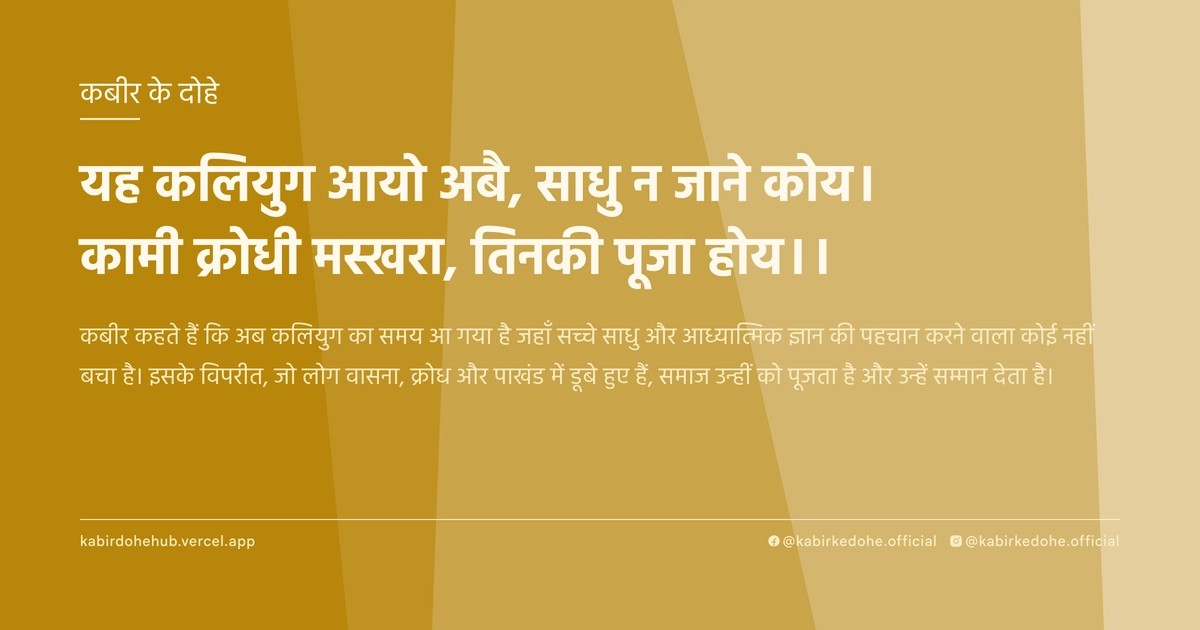
यह कलियुग आयो अबै, साधु न जाने कोय।
कामी क्रोधी मस्खरा, तिनकी पूजा होय।।
Yeh kaliyug aayo abai, sadhu na jaane koy. Kaami krodhi maskhara, tinki pooja hoye.
इस पृष्ठ पर इस कबीर दोहे का अर्थ (meaning), हिंदी व्याख्या और अंग्रेज़ी अनुवाद, दार्शनिक विश्लेषण और व्यावहारिक जीवन सीख दी गई है। यह दोहा धार्मिक पाखंड (Religious Hypocrisy) विषय से जुड़ा है — Kabir doha meaning and explanation in Hindi and English.
अर्थ (Meaning):
कबीर कहते हैं कि अब कलियुग का समय आ गया है जहाँ सच्चे साधु और आध्यात्मिक ज्ञान की पहचान करने वाला कोई नहीं बचा है। इसके विपरीत, जो लोग वासना, क्रोध और पाखंड में डूबे हुए हैं, समाज उन्हीं को पूजता है और उन्हें सम्मान देता है।
Kabir observes that the age of Kaliyuga has arrived, a time where true saints and genuine spiritual wisdom are unrecognized and ignored. Conversely, those consumed by lust, anger, and superficial pretension are the ones elevated to pedestals and worshipped by the masses.
व्याख्या (Interpretation):
इस दोहे का शाब्दिक अर्थ समाज में नैतिक मूल्यों के पतन की ओर संकेत करता है। गहरे स्तर पर, 'कलियुग' केवल एक समय चक्र नहीं, बल्कि चेतना की वह अवस्था है जहाँ सत्य और असत्य का भेद मिट गया है। 'साधु' यहाँ उस आंतरिक शुद्धता और निर्गुण ब्रह्म के साथ एकात्मता का प्रतीक है जिसे बाहरी दुनिया नकार देती है। 'कामी' और 'क्रोधी' वे मानसिक विकार हैं जो माया के प्रभाव में मनुष्य को अहंकार से जोड़ते हैं। यह विरोधाभास दर्शाता है कि जब समाज केवल बाहरी आडंबरों को पूजता है, तो वह वास्तव में अपने ही अज्ञान की पूजा कर रहा होता है। यह आत्मा और परमात्मा के बीच के पर्दे को और गहरा करता है, जिससे जीव माया के जाल में और अधिक उलझ जाता है।
Literally, this couplet points toward the decay of moral values in society. On a deeper level, 'Kaliyuga' is not merely a chronological era but a state of consciousness where the distinction between truth and illusion has blurred. The 'Sadhu' symbolizes that inner purity and oneness with the Nirgun Brahman which the external world fails to recognize. 'Lust' and 'Anger' represent the mental distortions that bind the human to the ego under the influence of Maya. This paradox reveals that when society worships outward appearances, it is essentially worshipping its own ignorance. This process thickens the veil between the Atman and the Paramatman, further entangling the soul in the web of illusion.
दार्शनिक विश्लेषण (Philosophical Analysis):
कबीर का यह प्रहार उनके युग के धार्मिक पाखंड और सामाजिक स्तरीकरण पर है। वे उस समय के पंडितों और मौलवियों की आलोचना करते हैं जो केवल बाहरी वस्त्रों और कर्मकांडों से अपनी श्रेष्ठता सिद्ध करते थे। उनका दर्शन 'निर्गुण भक्ति' पर आधारित है, जहाँ ईश्वर किसी मूर्ति या मंदिर में नहीं, बल्कि मनुष्य के भीतर स्थित है। वे तर्क देते हैं कि यदि भक्ति केवल दिखावा है, तो वह वास्तव में भक्ति नहीं बल्कि अहंकार की तुष्टि है।
अद्वैत वेदांत के परिप्रेक्ष्य में, यह दोहा 'अविद्या' (अज्ञान) की चर्चा करता है। जब मनुष्य अपनी वास्तविक प्रकृति (ब्रह्म) को भूलकर शरीर और सामाजिक पहचान से जुड़ जाता है, तो वह भ्रमित हो जाता है। वह उस व्यक्ति को पूजने लगता है जो वास्तव में विकारों से ग्रस्त है, क्योंकि वह व्यक्ति समाज के निर्धारित 'मानकों' पर खरा उतरता है।
सूफी मत के 'नफ्स' (अहंकार) की अवधारणा यहाँ स्पष्ट दिखती है। कबीर चेतावनी देते हैं कि जब तक व्यक्ति अपने भीतर के 'कामी' और 'क्रोधी' स्वभाव को नहीं मारता, वह सत्य तक नहीं पहुँच सकता। समाज द्वारा पूजे जाने वाले 'मस्खरे' वास्तव में आध्यात्मिक रिक्तता का प्रतीक हैं।
ऐतिहासिक रूप से, कबीर ने जाति व्यवस्था और धार्मिक कट्टरता को चुनौती दी। उन्होंने यह स्थापित किया कि पवित्रता जन्म या कुल से नहीं, बल्कि आचरण और आंतरिक शुद्धि से आती है। यह दोहा एक सामाजिक दर्पण है जो बताता है कि हम अक्सर गलत आदर्शों का अनुसरण करते हैं।
मनोवैज्ञानिक स्तर पर, यह 'कोग्निटिव डिसोनेंस' की स्थिति है। समाज वह देखता है जो वह देखना चाहता है, न कि वह जो वास्तव में है। कबीर इस भ्रम को तोड़कर व्यक्ति को आत्म-निरीक्षण की ओर ले जाना चाहते हैं, ताकि वह बाहरी शोर के बीच अपनी आंतरिक शांति को खोज सके।
Kabir's critique is aimed at the religious hypocrisy and social stratification of his era. He challenges the priests and clerics who claimed superiority through external attire and rituals. His philosophy is rooted in 'Nirgun Bhakti,' where the Divine resides not in idols or temples, but within the human heart. He argues that if devotion is merely a performance, it is not spirituality but the gratification of the ego.
From the lens of Advaita Vedanta, this couplet discusses 'Avidya' (ignorance). When a human forgets their true nature (Brahman) and identifies with the body or social labels, they become deluded. They begin to worship those who are internally corrupted simply because those individuals fit the society's superficial 'standards' of holiness.
The Sufi concept of 'Nafs' (the lower self/ego) is evident here. Kabir warns that until one annihilates the lustful and angry tendencies within, the Truth remains inaccessible. The 'pretenders' worshipped by society are symbols of spiritual emptiness.
Historically, Kabir challenged the caste system and religious bigotry. He established that purity is not a product of birth or lineage, but of conduct and internal purification. This doha acts as a social mirror, reflecting how humanity often follows the wrong idols.
Psychologically, this describes a state of cognitive dissonance. Society sees what it wants to see, rather than what is. Kabir seeks to shatter this illusion, urging the individual to move toward self-inquiry and find inner silence amidst the external noise.
मूल संदेश (Core Message):
- बाहरी चमक अक्सर आंतरिक अंधकार को छुपाती है।
- सच्ची आध्यात्मिकता प्रदर्शन में नहीं, बल्कि आचरण में है।
- अहंकार और वासना ही सत्य के मार्ग में सबसे बड़ी बाधाएं हैं।
- समाज के तय मानकों पर न जाएं, अंतरात्मा की आवाज सुनें।
- निस्वार्थ सेवा ही वास्तविक पूजा और ईश्वर की प्राप्ति है।
- साधु वह नहीं जो वस्त्र बदले, बल्कि वह जो स्वभाव बदले।
- External brilliance often masks internal darkness.
- True spirituality lies in conduct, not in performance.
- Ego and lust are the primary obstacles on the path to Truth.
- Do not follow societal standards; listen to the inner soul.
- Selfless service is the only real worship and path to the Divine.
- A saint is not one who changes their clothes, but one who transforms their nature.
व्यावहारिक उदाहरण (Practical Example):
वाराणसी के एक पुराने घाट पर रामदीन नाम का एक वृद्ध नाविक रहता था। वह बहुत कम बोलता था और दिन भर नाव चलाकर जो कुछ कमाता, उसका आधा हिस्सा भूखों को खिला देता था। लोग उसे 'मूर्ख' और 'अशिक्षित' कहकर नजरअंदाज करते थे।
उसी घाट के पास एक भव्य आश्रम था जहाँ एक प्रसिद्ध धर्मगुरु रहते थे। वे रेशमी वस्त्र पहनते, घंटों तक ऊंचे स्वर में प्रवचन देते और हजारों की भीड़ उन्हें पूजती थी। वह गुरु स्वयं को बहुत बड़ा साधु बताता था, लेकिन गुप्त रूप से वह अत्यंत क्रोधित और लोभी था।
एक बार शहर में भीषण बाढ़ आई। आश्रम के गुरु ने अपनी सुरक्षा के लिए अपने शिष्यों को पीछे छोड़ दिया और सबसे पहले सुरक्षित स्थान की ओर भागे। उनकी सारी बातें और उपदेश पानी में बह गए।
दूसरी ओर, रामदीन ने अपनी छोटी सी नाव का उपयोग उन लोगों को बचाने के लिए किया जो डूब रहे थे, चाहे वे किसी भी जाति या धर्म के हों। उसने अपनी जान जोखिम में डालकर दर्जनों लोगों को बचाया।
जब पानी उतरा, तो शहर के लोगों ने देखा कि जिस गुरु को वे पूजते थे, वह डरपोक और स्वार्थी था, जबकि जिस नाविक को वे तुच्छ समझते थे, वही असली 'साधु' था।
रामदीन ने जब लोगों से प्रशंसा सुनी, तो उसने विनम्रता से कहा, 'मैं कोई साधु नहीं हूँ, बस इस नाव की तरह मैं भी ईश्वर का एक यंत्र हूँ।'
इस घटना ने शहर के लोगों की आँखों से पर्दा हटा दिया। उन्हें समझ आया कि बाहरी चमक-धमक और शब्दों का जाल अक्सर सत्य को छुपा लेता है।
अब लोग केवल उपदेश सुनने के बजाय, दूसरों की निस्वार्थ सेवा करने लगे। उन्होंने सीखा कि वास्तविक धर्म मंदिर की दीवारों में नहीं, बल्कि करुणा के कार्यों में बसता है।
रामदीन की सादगी ने पूरे समुदाय को यह सिखाया कि अहंकार का त्याग ही सच्ची पूजा है।
इस प्रकार, एक साधारण नाविक ने कबीर के इस दोहे को जीवंत कर दिया कि सच्चा साधु वह है जो कर्म में लीन है, न कि वह जो केवल शब्दों का प्रदर्शन करता है।
On an ancient ghat in Varanasi lived an elderly boatman named Ramdeen. He spoke very little and spent half of his meager daily earnings feeding the hungry. People ignored him, calling him 'foolish' and 'uneducated.'
Near the same ghat was a grand ashram where a famous religious leader resided. He wore silk robes, delivered loud hours-long sermons, and was worshipped by thousands. This leader claimed to be a great saint, but secretly, he was consumed by anger and greed.
One year, a devastating flood hit the city. The ashram leader, fearing for his own life, abandoned his disciples and was the first to flee to safety. All his grand words and teachings were washed away by the current.
Meanwhile, Ramdeen used his small boat to rescue those who were drowning, regardless of their caste or creed. He risked his own life to save dozens of strangers.
When the waters receded, the townspeople realized that the guru they worshipped was a coward and a narcissist, while the boatman they had dismissed was the true 'Sadhu.'
When the people tried to praise Ramdeen, he humbly replied, 'I am no saint; I am merely an instrument of the Divine, much like this boat.'
This event lifted the veil from the eyes of the community. They realized that external glitter and a web of words often hide the truth.
From then on, people stopped merely listening to sermons and began practicing selfless service. They learned that true religion does not reside within temple walls, but in acts of compassion.
Ramdeen's simplicity taught the entire community that the renunciation of ego is the only true form of worship.
Thus, a simple boatman brought Kabir's couplet to life, proving that a true saint is one immersed in selfless action, not one who merely performs holiness.
अभ्यास मार्गदर्शन (Practice Guidance):
- दैनिक आत्म-निरीक्षण: प्रतिदिन 15 मिनट मौन बैठें और विचार करें कि आज आपने कितनी बार अपनी छवि (Image) को सुधारने के लिए झूठ बोला या दिखावा किया।
- अहंकार की पहचान: जब भी आपको किसी से प्रशंसा मिले, तो रुककर देखें कि क्या आपका मन फूल रहा है। इस 'अहंकार' को पहचानें और इसे साक्षी भाव से देखें।
- सेवा का अभ्यास: किसी ऐसे व्यक्ति की मदद करें जिससे आपको बदले में कोई सामाजिक सम्मान या पहचान न मिले। गुप्त दान या सेवा करें।
- डायग्नोस्टिक चेकलिस्ट: क्या मैं केवल उन्हीं लोगों का सम्मान करता हूँ जिनके पास पद या पैसा है? क्या मैं अपनी धार्मिक पहचान को दूसरों से श्रेष्ठ मानता हूँ? यदि हाँ, तो मैं अभी भी कलियुग के भ्रम में हूँ।
- Daily Self-Inquiry: Sit in silence for 15 minutes daily and reflect on how many times you lied or performed a role today just to polish your public image.
- Ego Mapping: Whenever you receive praise, pause and observe if your ego is inflating. Identify this 'inflation' and observe it with detachment (Sakshi Bhav).
- Anonymous Service: Help someone from whom you will receive no social recognition or reward. Practice secret charity or selfless service.
- Diagnostic Checklist: Do I only respect those with power or wealth? Do I consider my religious identity superior to others? If yes, I am still trapped in the illusion of Kaliyuga.
चिंतन प्रश्न (Reflection Questions):
- यदि आज मेरी सारी सामाजिक उपलब्धियां और पद छीन लिए जाएं, तो क्या मेरे भीतर कुछ बचेगा जिसे मैं 'मैं' कह सकूँ?
- मैं किन लोगों को 'पवित्र' मानता हूँ और क्या मेरा यह पैमाना केवल बाहरी व्यवहार पर आधारित है?
- मेरे जीवन का कौन सा हिस्सा केवल दूसरों को दिखाने के लिए है, और कौन सा वास्तव में मेरा अपना है?
- क्या मैं क्रोध या वासना के समय अपनी छवि को बचाने के लिए झूठ का सहारा लेता हूँ?
- क्या मैं वास्तव में सत्य की खोज कर रहा हूँ, या मैं केवल एक 'आध्यात्मिक' दिखने वाला व्यक्ति बनना चाहता हूँ?
- मेरे भीतर का 'मस्खरा' (पाखंडी) कब बाहर आता है, और वह क्या हासिल करने की कोशिश करता है?
- If all my social achievements and titles were stripped away today, would there be anything left within me that I could call 'I'?
- Whom do I consider 'holy,' and is my criterion based solely on external behavior?
- Which part of my life is lived purely for the gaze of others, and which part is authentically mine?
- Do I resort to lies to protect my image during moments of anger or lust?
- Am I truly seeking the Truth, or do I simply want to be perceived as a 'spiritual' person?
- When does the 'pretender' within me emerge, and what is it trying to achieve?