
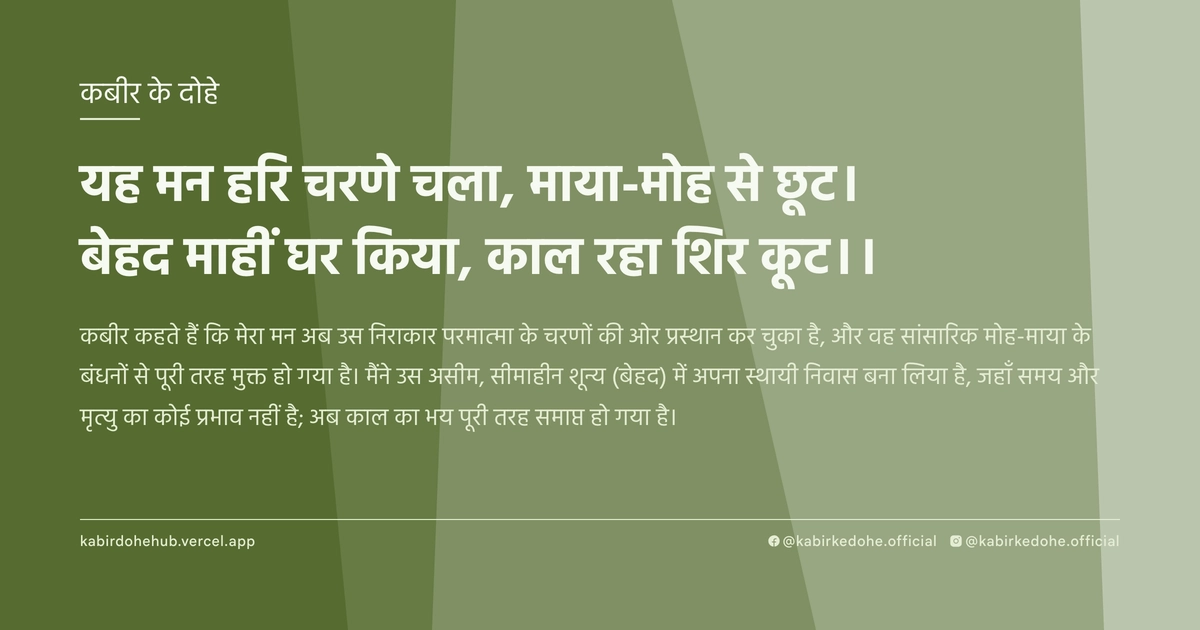
यह मन हरि चरणे चला, माया-मोह से छूट।
बेहद माहीं घर किया, काल रहा शिर कूट।।
Yah man hari charane chala, maya-moh se chhoot. Behad maahin ghar kiya, kaal raha shir koot.
इस पृष्ठ पर इस कबीर दोहे का अर्थ (meaning), हिंदी व्याख्या और अंग्रेज़ी अनुवाद, दार्शनिक विश्लेषण और व्यावहारिक जीवन सीख दी गई है। यह दोहा वैराग्य (Detachment) विषय से जुड़ा है — Kabir doha meaning and explanation in Hindi and English.
अर्थ (Meaning):
कबीर कहते हैं कि मेरा मन अब उस निराकार परमात्मा के चरणों की ओर प्रस्थान कर चुका है, और वह सांसारिक मोह-माया के बंधनों से पूरी तरह मुक्त हो गया है। मैंने उस असीम, सीमाहीन शून्य (बेहद) में अपना स्थायी निवास बना लिया है, जहाँ समय और मृत्यु का कोई प्रभाव नहीं है; अब काल का भय पूरी तरह समाप्त हो गया है।
Kabir declares that his mind has finally journeyed toward the feet of the Formless Divine, breaking free from the shackles of worldly attachment and illusion. He has established his eternal abode within the Boundless Infinite (Behad), where the constraints of time and the dread of mortality no longer hold any power over his liberated soul.
व्याख्या (Interpretation):
इस दोहे का शाब्दिक अर्थ मन का ईश्वर की शरण में जाना है, परंतु गहरा अर्थ 'अहंकार के विसर्जन' से है। 'हरि चरण' यहाँ किसी मूर्ति के पैर नहीं, बल्कि उस परम चेतना की स्थिति है जहाँ 'मैं' समाप्त हो जाता है। 'माया-मोह' वह मानसिक पर्दा है जो आत्मा को उसकी वास्तविक प्रकृति से अलग करता है। 'बेहद' शब्द सूफी मत के 'बेहद' (सीमाहीन) और वेदांत के 'ब्रह्म' का संगम है, जो यह दर्शाता है कि जब साधक द्वैत से ऊपर उठता है, तो वह समय (काल) के चक्र से मुक्त हो जाता है। यह एक ऐसी अवस्था है जहाँ जन्म और मृत्यु केवल एक खेल प्रतीत होते हैं। यहाँ 'घर' का अर्थ भौतिक मकान नहीं, बल्कि आत्म-साक्षात्कार की वह स्थिति है जहाँ आत्मा अपने मूल स्रोत में विलीन हो जाती है। यह विरोधाभास है कि घर पाने के लिए पहले सब कुछ खोना पड़ता है।
Literally, the verse describes the mind seeking refuge in God, but metaphorically, it signifies the total dissolution of the ego. 'Hari's feet' do not refer to a physical deity, but to the state of supreme consciousness where the 'I' ceases to exist. 'Maya-Moh' represents the psychic veil that separates the Atman from its true nature. The term 'Behad' bridges the Sufi concept of the Boundless and the Vedantic Brahman, suggesting that once a seeker transcends duality, they exit the linear cycle of time (Kaal). This is a state where birth and death are perceived as mere cosmic play. The 'home' mentioned is not a physical dwelling but the realization of one's primordial essence. It presents the spiritual paradox: to find the eternal home, one must first lose the perceived identity of the worldly self.
दार्शनिक विश्लेषण (Philosophical Analysis):
कबीर का यह दर्शन निर्गुण भक्ति की पराकाष्ठा है, जहाँ ईश्वर को किसी रूप, रंग या आकार में नहीं, बल्कि एक अनुभव के रूप में देखा जाता है। यह अद्वैत वेदांत के उस सिद्धांत से मेल खाता है जहाँ जीव और ब्रह्म एक ही हैं, बस अज्ञानता के कारण अलग प्रतीत होते हैं। कबीर यहाँ कर्मकांडों और बाहरी पूजा का खंडन करते हैं; उनके लिए 'हरि के चरण' आंतरिक मौन और शून्य में स्थित हैं।
ऐतिहासिक रूप से, कबीर ने एक ऐसे समाज में यह बात कही जहाँ धर्म के नाम पर गहरी विभाजन रेखाएँ थीं। उन्होंने सूफीवाद के 'फना' (अहंकार का विनाश) और हिंदू धर्म के 'मोक्ष' को एक सूत्र में पिरोया। उनके लिए माया केवल धन-संपत्ति नहीं, बल्कि वह मानसिक प्रोग्रामिंग है जो हमें यह विश्वास दिलाती है कि हम शरीर हैं।
मनोवैज्ञानिक स्तर पर, यह दोहा 'संज्ञानात्मक विस्थापन' की बात करता है। जब मन बाहरी दुनिया (माया) से हटकर आंतरिक केंद्र (बेहद) पर टिक जाता है, तो भय का अंत हो जाता है। भय हमेशा भविष्य या अतीत (काल) से जुड़ा होता है; वर्तमान के अनंत क्षण में काल का अस्तित्व नहीं रहता।
कबीर यहाँ 'काल' को केवल मृत्यु नहीं, बल्कि उस समय-चक्र के रूप में देखते हैं जो मनुष्य को पुनर्जन्म और दुखों में बांधे रखता है। इस चक्र को तोड़ने का एकमात्र तरीका है 'शून्य' में प्रवेश करना। यह शून्य रिक्तता नहीं, बल्कि पूर्णता है, जहाँ समस्त विरोधाभास समाप्त हो जाते हैं।
अंततः, यह विश्लेषण हमें बताता है कि मुक्ति कहीं बाहर जाने में नहीं, बल्कि अपनी ही चेतना के उस स्तर पर उतरने में है जहाँ कोई सीमा नहीं है। यह एक क्रांतिकारी विचार था जिसने उस समय के पंडितों और मुल्लाओं की सत्ता को चुनौती दी, क्योंकि इसने ईश्वर को मंदिर-मस्जिद से निकालकर मनुष्य के अपने भीतर स्थापित कर दिया।
Kabir's philosophy here represents the pinnacle of Nirgun Bhakti, where the Divine is experienced not as a form or image, but as a pure, formless presence. This aligns profoundly with Advaita Vedanta, which posits that the individual soul (Jiva) and the ultimate reality (Brahman) are identical, separated only by the veil of ignorance (Avidya). Kabir rejects ritualism, placing 'Hari's feet' within the sanctuary of internal silence and the void.
Historically, Kabir spoke during an era of rigid religious stratification. He synthesized the Sufi concept of 'Fana' (annihilation of the self) with the Vedantic goal of 'Moksha'. To Kabir, Maya is not merely material wealth but the mental programming that convinces the soul it is limited to the physical body.
Psychologically, the verse addresses a shift in consciousness. When the mind withdraws from external projections (Maya) and anchors itself in the center of being (Behad), fear vanishes. Fear is always tethered to the linear progression of time—past regrets or future anxieties. In the eternal present of the Infinite, time ceases to exert pressure.
Kabir views 'Kaal' not just as death, but as the temporal cycle of Samsara that binds the soul to suffering and rebirth. The only escape from this cycle is entering the 'Shunya' (the Void). This Void is not an emptiness of lack, but a plenum of all possibilities, where all dualities are resolved.
Ultimately, this analysis reveals that liberation is not a journey to a distant heaven, but a descent into the depths of one's own consciousness. This was a revolutionary stance that challenged the ecclesiastical authorities of his time by democratizing the Divine and relocating the sacred from the temple or mosque to the inner heart of the practitioner.
मूल संदेश (Core Message):
- बाहरी दुनिया एक भ्रम है, आंतरिक शून्य ही सत्य है।
- मोह का त्याग ही वास्तविक स्वतंत्रता का एकमात्र द्वार है।
- जब 'मैं' मिटता है, तब 'परमात्मा' का अनुभव शुरू होता है।
- समय का भय केवल उन लोगों को होता है जो शरीर को ही सत्य मानते हैं।
- असीम में निवास करने का अर्थ है—हर परिस्थिति में स्थिर रहना।
- The external world is a mirage; the internal void is the only truth.
- Renouncing attachment is the sole gateway to genuine liberation.
- When the 'I' dissolves, the experience of the Divine begins.
- The fear of time only haunts those who mistake the body for the truth.
- Dwelling in the Infinite means remaining steadfast in every circumstance.
व्यावहारिक उदाहरण (Practical Example):
एक समय की बात है, वाराणसी के घाटों पर माधव नाम का एक वृद्ध बुनकर रहता था। माधव दिन भर कपड़े बुनता और रात को कबीर के भजनों में लीन रहता। उसके पास बहुत कम संपत्ति थी, लेकिन उसका मन हमेशा इस बात से परेशान रहता था कि उसके बाद उसके परिवार का क्या होगा। वह अपनी छोटी सी दुकान और घर को बचाने के लिए दिन-रात संघर्ष करता, जिससे उसका मानसिक तनाव बढ़ता जा रहा था।
एक दिन, माधव ने देखा कि एक साधु नदी के किनारे शांत बैठा है, जबकि उसके पास कुछ भी नहीं था। माधव ने पूछा, 'महाराज, आप इतने निश्चिंत कैसे हैं? क्या आपको भविष्य की चिंता नहीं सताती?' साधु ने मुस्कुराकर कबीर का यह दोहा सुनाया और कहा, 'माधव, तुम उस घर को बचाने की कोशिश कर रहे हो जो मिट्टी का है, जबकि तुम्हारा असली घर तो उस असीम शून्य में है जहाँ समय की कोई पहुँच नहीं है।'
माधव को पहले यह बात समझ नहीं आई। उसने सोचा कि बिना धन के जीवन कैसे संभव है। लेकिन अगले कुछ हफ्तों तक उसने साधु के साथ बैठकर मौन का अभ्यास किया। उसने महसूस किया कि उसकी सारी चिंताएँ उसके 'मैं' और 'मेरे' के अहंकार से जुड़ी थीं। वह जितना अधिक अपने परिवार और संपत्ति को 'अपना' मानता, उतना ही वह डरता था।
एक रात, माधव के घर में भीषण आग लगी। उसकी सारी जमा पूँजी और वह करघा, जिससे वह कपड़े बुनता था, सब जलकर राख हो गए। उसके पड़ोसी घबरा गए और माधव को सांत्वना देने आए। लेकिन माधव के चेहरे पर एक अजीब सी शांति थी। वह रोने के बजाय चुपचाप खड़ा था।
उसके परिवार ने पूछा, 'क्या आपको दुख नहीं है? हमने सब कुछ खो दिया!' माधव ने शांति से उत्तर दिया, 'हमने केवल वह खोया है जो कभी हमारा था ही नहीं। हम तो उस घर के निवासी हैं जहाँ आग नहीं पहुँच सकती।'
यह 'कबीर ट्विस्ट' था। माधव ने महसूस किया कि जब उसने मोह का धागा तोड़ा, तो वह वास्तव में स्वतंत्र हो गया। उसने अब अपनी मेहनत को केवल लाभ के लिए नहीं, बल्कि सेवा के लिए उपयोग करना शुरू किया।
उसने गाँव के अन्य गरीब बुनकरों को मुफ्त में हुनर सिखाना शुरू किया। अब वह अपनी संपत्ति के लिए नहीं, बल्कि दूसरों की खुशी के लिए जीता था। उसका डर पूरी तरह समाप्त हो गया था क्योंकि उसने 'बेहद' में अपना घर पा लिया था।
माधव की यह आंतरिक क्रांति देखकर गाँव के अन्य लोग भी प्रेरित हुए। उन्होंने सीखा कि सुरक्षा बाहरी वस्तुओं में नहीं, बल्कि आंतरिक वैराग्य और परमात्मा के साथ एकात्मता में है। माधव अब एक साधारण बुनकर नहीं, बल्कि एक जीवित संत बन चुका था।
Once, on the ghats of Varanasi, lived an elderly weaver named Madhav. Madhav spent his days weaving cloth and his nights immersed in the hymns of Kabir. He possessed very little wealth, yet his mind was perpetually plagued by anxiety over the future of his family. He struggled relentlessly to protect his small shop and home, and this attachment fueled a growing internal stress.
One day, Madhav noticed a monk sitting in profound stillness by the river, possessing absolutely nothing. Madhav asked, 'Maharaj, how are you so serene? Does the uncertainty of the future not haunt you?' The monk smiled and recited this specific Doha, saying, 'Madhav, you are trying to protect a house made of clay, while your true home resides in the Boundless Infinite, where time has no reach.'
Initially, Madhav could not grasp this. He wondered how life was possible without financial security. However, over the next few weeks, he sat with the monk and practiced the art of silence. He began to realize that all his anxieties were tethered to the ego of 'I' and 'Mine'. The more he identified his family and property as 'his', the more he feared their loss.
One night, a devastating fire broke out in Madhav's house. All his savings and the loom he used for weaving were reduced to ashes. His neighbors were horrified and rushed to console him, expecting him to be broken.
But to their surprise, there was a strange, luminous peace on Madhav's face. He stood silently, without a single tear of grief. His family asked, 'Are you not in pain? We have lost everything!' Madhav replied calmly, 'We have only lost that which was never truly ours. We are citizens of a home where fire cannot reach.'
This was the 'Kabir Twist'. Madhav realized that by severing the thread of attachment, he had finally become free. He stopped working for mere profit and began to view his labor as a form of service.
He started teaching the craft of weaving to other impoverished villagers for free. He no longer lived for the accumulation of wealth, but for the joy of collective upliftment. His fear had vanished because he had found his dwelling in the 'Behad'.
Seeing Madhav's internal revolution, other villagers were inspired. They learned that true security is not found in external possessions, but in internal detachment and oneness with the Divine. Madhav was no longer just a weaver; he had become a living embodiment of the saint.
अभ्यास मार्गदर्शन (Practice Guidance):
- दैनिक अभ्यास: प्रतिदिन 20 मिनट 'शून्य ध्यान' करें। अपनी आँखें बंद करें और कल्पना करें कि आप एक असीम, नीले आकाश की तरह फैल रहे हैं, जहाँ कोई सीमा नहीं है।
- आत्म-पूछताछ जर्नल: प्रतिदिन एक ऐसी वस्तु या संबंध लिखें जिससे आप अत्यधिक जुड़ाव महसूस करते हैं। फिर खुद से पूछें, 'यदि यह आज समाप्त हो जाए, तो क्या मेरी आत्मा की शांति बनी रहेगी?'
- व्यवहार परिवर्तन: दिन में कम से कम एक बार किसी ऐसे व्यक्ति की मदद करें जिससे आपको कोई लाभ न हो, ताकि 'स्व' (Ego) का विसर्जन हो सके।
- डायग्नोस्टिक चेकलिस्ट: यदि आप छोटी बातों पर विचलित होते हैं या भविष्य की चिंता में वर्तमान खो देते हैं, तो समझें कि आप अभी भी 'माया-मोह' के प्रभाव में हैं। यदि आप हानि और लाभ दोनों में समान रहते हैं, तो आप 'बेहद' की ओर बढ़ रहे हैं।
- Daily Practice: Engage in 20 minutes of 'Shunya Meditation'. Close your eyes and visualize yourself expanding like an infinite blue sky, where no boundaries exist.
- Self-Inquiry Journal: Each day, list one object or relationship you are deeply attached to. Then ask yourself, 'If this were to vanish today, would the peace of my soul remain undisturbed?'
- Behavioral Shift: At least once a day, perform an act of selfless service for someone from whom you expect no return, facilitating the dissolution of the 'I'.
- Diagnostic Checklist: If you find yourself agitated by trivialities or losing the present to future anxieties, recognize that you are still under the influence of 'Maya-Moh'. If you remain equanimous in both loss and gain, you are progressing toward the 'Behad'.
चिंतन प्रश्न (Reflection Questions):
- मेरी वह कौन सी 'पहचान' है जिसे खोने के डर से मैं सबसे ज्यादा घबराता हूँ?
- क्या मेरा धर्म और मेरी पूजा मुझे वास्तव में मुक्त कर रहे हैं, या वे केवल नए मानसिक बंधन बन गए हैं?
- यदि मैं अपनी सभी सामाजिक उपलब्धियों और पदवियों को हटा दूँ, तो मेरे भीतर क्या बचेगा?
- मैं अपनी डिजिटल छवि (Social Media Ego) को बनाए रखने के लिए अपनी वास्तविक शांति का कितना बलिदान कर रहा हूँ?
- क्या मैं वास्तव में ईश्वर को खोज रहा हूँ, या मैं केवल अपनी इच्छाओं की पूर्ति के लिए एक दैवीय माध्यम चाहता हूँ?
- Which specific 'identity' of mine do I fear losing the most?
- Are my religious practices truly liberating me, or have they become new mental shackles?
- If I stripped away all my social achievements and titles, what would remain within me?
- How much of my authentic peace am I sacrificing to maintain my digital persona (Social Media Ego)?
- Am I truly seeking the Divine, or am I merely seeking a divine medium to fulfill my personal desires?