
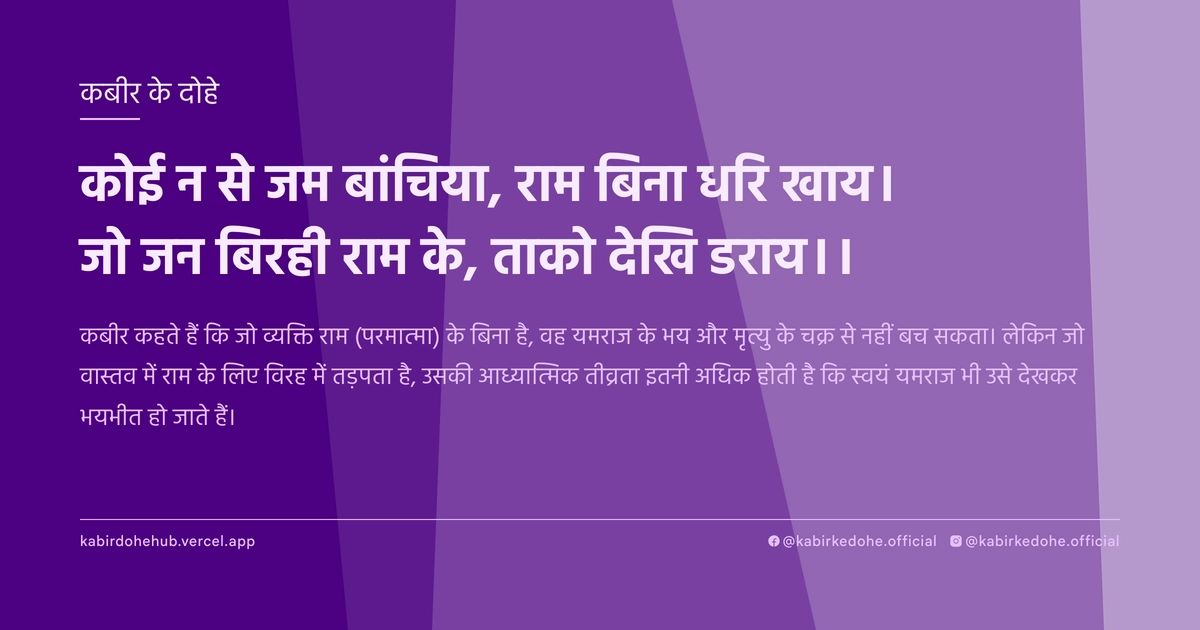
कोई न से जम बांचिया, राम बिना धरि खाय।
जो जन बिरही राम के, ताको देखि डराय।।
Koi na se jam baanchiya, raam bina dhari khaay. Jo jan birahi raam ke, taako dekh darray.
इस पृष्ठ पर इस कबीर दोहे का अर्थ (meaning), हिंदी व्याख्या और अंग्रेज़ी अनुवाद, दार्शनिक विश्लेषण और व्यावहारिक जीवन सीख दी गई है। यह दोहा भक्ति (Bhakti) विषय से जुड़ा है — Kabir doha meaning and explanation in Hindi and English.
अर्थ (Meaning):
कबीर कहते हैं कि जो व्यक्ति राम (परमात्मा) के बिना है, वह यमराज के भय और मृत्यु के चक्र से नहीं बच सकता। लेकिन जो वास्तव में राम के लिए विरह में तड़पता है, उसकी आध्यात्मिक तीव्रता इतनी अधिक होती है कि स्वयं यमराज भी उसे देखकर भयभीत हो जाते हैं।
Kabir asserts that one who exists without the realization of Ram (the Divine) cannot escape the clutches of Yama, the god of death. However, the seeker who burns in the agony of separation from the Divine attains a spiritual intensity so profound that even the lord of death is intimidated by their presence.
व्याख्या (Interpretation):
यहाँ 'राम' दशरथ पुत्र नहीं, बल्कि निर्गुण ब्रह्म हैं। शाब्दिक अर्थ में यह मृत्यु और भय की बात है, लेकिन रूपक के स्तर पर यह अहंकार और आत्मा के मिलन की चर्चा है। जब तक मनुष्य माया के मोह में है, वह यम (मृत्यु/अज्ञान) के अधीन है। लेकिन 'बिरह' या विरह वह अग्नि है जो अहंकार को जला देती है। जब साधक अपनी पूरी सत्ता को परमात्मा के लिए समर्पित कर देता है, तो वह द्वैत से ऊपर उठकर अद्वैत में स्थित हो जाता है। इस अवस्था में मृत्यु केवल एक वस्त्र परिवर्तन है, जिससे भय समाप्त हो जाता है। यह विरोधाभास है कि विरह का दुख ही अंततः परम आनंद और निर्भयता का मार्ग प्रशस्त करता है।
In this context, 'Ram' does not refer to the historical king, but to the Nirgun Brahman—the formless, omnipresent Absolute. Literally, the verse speaks of death and fear, but metaphorically, it explores the dissolution of the ego. As long as a human remains tethered to Maya (illusion), they are subject to Yama (the cycle of birth and death). However, 'Biraha' or the longing for the Divine is a spiritual fire that incinerates the false self. When a seeker surrenders their entire existence to the Divine, they transcend duality and merge into non-duality (Advaita). At this stage, death is merely a change of garments, and fear vanishes. The central paradox is that the agony of separation is the very catalyst for ultimate liberation and fearlessness.
दार्शनिक विश्लेषण (Philosophical Analysis):
कबीर का यह दोहा मध्यकालीन भारत के उस दौर का है जब धर्म कर्मकांडों और बाहरी आडंबरों में जकड़ा हुआ था। कबीर ने स्पष्ट किया कि मोक्ष किसी मंदिर, मस्जिद या कठिन अनुष्ठान से नहीं, बल्कि आंतरिक तड़प और प्रेम से मिलता है। यह विचार सूफी मत के 'इश्क-ए-हकीकी' (ईश्वरीय प्रेम) के अत्यंत निकट है, जहाँ प्रेमी अपने अस्तित्व को मिटाकर प्रिय में लीन हो जाता है।
अद्वैत वेदांत के परिप्रेक्ष्य में, यमराज अज्ञानता का प्रतीक हैं। जब तक हम स्वयं को शरीर मानते हैं, हम मृत्यु से डरते हैं। लेकिन जब 'बिरह' के माध्यम से यह बोध होता है कि आत्मा और परमात्मा एक ही हैं, तो भय का आधार ही समाप्त हो जाता है। कबीर यहाँ 'विरह' को एक साधना के रूप में प्रस्तुत कर रहे हैं, जो मन की अशुद्धियों को साफ करती है।
यह विश्लेषण हमें बताता है कि भक्ति केवल प्रार्थना नहीं, बल्कि एक मनोवैज्ञानिक रूपांतरण है। अहंकार का विसर्जन ही वास्तविक मृत्यु है; यदि हम जीवित रहते हुए मर सकें (अहंकार का अंत), तो भौतिक मृत्यु हमें स्पर्श नहीं कर सकती। यह कर्मकांडीय धर्म के विरुद्ध एक सशक्त प्रहार है, जो यह सिखाता है कि ईश्वर बाहरी दुनिया में नहीं, बल्कि हृदय की गहरी तड़प में बसता है।
सूफीवाद की तरह, कबीर भी 'फना' (स्वयं का विनाश) की बात करते हैं। जब 'मैं' मिट जाता है, तब केवल 'वह' बचता है। यमराज का डरना इस बात का संकेत है कि जिसने अपनी इच्छाओं और अहंकार पर विजय पा ली है, वह प्रकृति के सबसे कठोर नियम (मृत्यु) से भी ऊपर उठ गया है।
अंततः, यह दोहा मनुष्य को बाहरी सुरक्षा की तलाश छोड़ने और आंतरिक गहराई में उतरने का आह्वान करता है। यह सिखाता है कि आध्यात्मिक तीव्रता ही वह एकमात्र शस्त्र है जो संसार के सबसे बड़े भय—मृत्यु—को परास्त कर सकता है।
This couplet emerges from a medieval Indian era where religion was stifled by rigid rituals and external formalities. Kabir clarifies that liberation is not achieved through temples, mosques, or complex rites, but through internal longing and divine love. This philosophy closely aligns with the Sufi concept of 'Ishq-e-Haqiqi' (Divine Love), where the lover annihilates their own existence to merge with the Beloved.
From the perspective of Advaita Vedanta, Yama symbolizes ignorance (Avidya). As long as we identify with the physical body, we are subject to the fear of death. However, through 'Biraha' (longing), the realization dawns that the Atman (individual soul) and Brahman (universal soul) are one. Kabir presents longing not as a sorrow, but as a spiritual discipline that purifies the mind of all impurities.
This analysis reveals that Bhakti is not mere prayer but a psychological transformation. The dissolution of the ego is the only 'true death'; if one can die to the ego while still alive, physical death loses its power. This is a potent critique of ritualistic religion, emphasizing that the Divine resides in the depths of heartfelt yearning rather than in external structures.
Similar to the Sufi path of 'Fana' (annihilation), Kabir suggests that when the 'I' is erased, only the 'He' remains. The fact that Yama is terrified of the seeker signifies that one who has conquered their desires and ego has transcended the most rigid law of nature: mortality.
Ultimately, the verse calls upon the individual to stop seeking external security and instead dive into internal depth. It teaches that spiritual intensity is the only weapon capable of defeating the greatest human fear—the fear of the end.
मूल संदेश (Core Message):
- बाहरी अनुष्ठान व्यर्थ हैं; केवल आंतरिक तड़प ही सत्य है।
- अहंकार का अंत ही वास्तविक मृत्यु और मुक्ति है।
- ईश्वरीय प्रेम का विरह सबसे शक्तिशाली आध्यात्मिक शोधक है।
- जब 'मैं' मिटता है, तब मृत्यु का भय समाप्त हो जाता है।
- परमात्मा के साथ एकाकार होना ही परम निर्भयता है।
- External rituals are futile; only internal longing is true.
- The death of the ego is the only real liberation.
- The agony of Divine separation is the most powerful purifier.
- When the 'I' vanishes, the fear of death disappears.
- Union with the Absolute is the state of ultimate fearlessness.
व्यावहारिक उदाहरण (Practical Example):
वाराणसी के घाटों पर रहने वाले एक वृद्ध बुनकर, माधव की कहानी है। माधव जीवन भर सुंदर वस्त्र बुनता रहा, लेकिन उसका मन हमेशा इस बात से परेशान रहता था कि वह अपने पीछे क्या छोड़ेगा। वह अपनी संपत्ति और नाम को बचाने की कोशिश में दिन-रात मेहनत करता था, और मृत्यु के विचार से वह बुरी तरह डरता था।
एक दिन उसने एक फकीर को देखा जो सड़क किनारे बैठा था और उसकी आँखों में एक अजीब सी तड़प थी। फकीर न तो कुछ माँग रहा था और न ही किसी से डर रहा था। माधव ने उससे पूछा, 'आप इतने शांत कैसे हैं जबकि दुनिया इतनी अनिश्चित है?'
फकीर ने मुस्कुराकर कहा, 'मैं उस प्रेम में जल रहा हूँ जिसने मुझे पहले ही मार दिया है। जब सब कुछ जल गया, तो डरने के लिए बचा ही क्या?'
माधव को यह बात समझ नहीं आई, लेकिन उसने उस फकीर के साथ समय बिताना शुरू किया। उसने महसूस किया कि वह अब तक केवल 'कपड़े' बुन रहा था, जबकि उसे अपनी 'आत्मा' बुननी थी। उसने अपनी सारी चिंताएं और अहंकार धीरे-धीरे छोड़ना शुरू किया।
उसने देखा कि वह जितना अधिक दूसरों की सेवा करता और ईश्वर के प्रति अपनी तड़प बढ़ाता, उसका मृत्यु का भय उतना ही कम होता गया। वह अब धन संचय नहीं करता था, बल्कि प्रेम बांटने लगा।
वर्षों बाद, जब माधव गंभीर रूप से बीमार पड़ा और उसके अंतिम क्षण आए, तो उसके चेहरे पर कोई डर नहीं था। उसके परिवार वाले रो रहे थे, लेकिन माधव एक गहरी शांति और मुस्कान के साथ लेटा था।
उसकी आँखों में वह विरह की अग्नि थी जिसने उसके अहंकार को पूरी तरह भस्म कर दिया था। वह अब शरीर को एक पुराने कपड़े की तरह उतारने के लिए तैयार था।
उसकी इस स्थिति को देखकर उसके पास मौजूद लोग चकित थे। ऐसा लग रहा था जैसे मृत्यु उसे लेने नहीं आई, बल्कि वह स्वयं मृत्यु का स्वागत कर रहा था।
माधव ने यह जान लिया था कि जब हम परमात्मा के प्रेम में पूरी तरह डूब जाते हैं, तो यमराज का भय एक तुच्छ मजाक बन जाता है।
यह 'कबीर ट्विस्ट' था—संपत्ति बचाने की इच्छा से मुक्त होकर, प्रेम की तड़प में विलीन हो जाना ही वास्तविक सुरक्षा है।
Consider the story of Madhav, an elderly weaver living on the ghats of Varanasi. For decades, Madhav wove exquisite fabrics, but his mind was perpetually plagued by the fear of what he would leave behind. He worked tirelessly to preserve his wealth and reputation, terrified by the inevitable approach of death.
One day, he encountered a wandering dervish sitting by the roadside, whose eyes held a strange, piercing intensity. The dervish asked for nothing and feared nothing. Intrigued, Madhav asked, 'How are you so peaceful when the world is so uncertain?'
The dervish smiled and replied, 'I am burning in a love that has already killed me. When everything is burnt away, what is left to fear?'
Madhav did not understand at first, but he began spending time with the dervish. He realized that all his life he had been weaving 'cloth,' but he had neglected to weave his 'soul.' He slowly began to shed his anxieties and his ego.
He noticed that the more he served others and intensified his longing for the Divine, the more his fear of death evaporated. He stopped hoarding wealth and started distributing love.
Years later, when Madhav fell gravely ill and his final moments arrived, there was no trace of terror on his face. While his family wept around him, Madhav lay in a state of profound peace and a gentle smile.
In his eyes was the fire of 'Biraha' (longing) that had completely incinerated his ego. He was now ready to shed his body like an old, worn-out garment.
Those present were astonished by his composure. It seemed as if death had not come to claim him, but rather, he was welcoming death as an old friend.
Madhav had realized that when one is completely immersed in the love of the Divine, the fear of Yama becomes a trivial joke.
This was the 'Kabir Twist'—shifting from the desire to preserve material assets to the desire to be consumed by Divine love, which is the only true security.
अभ्यास मार्गदर्शन (Practice Guidance):
- दैनिक विरह ध्यान: प्रतिदिन 20 मिनट मौन बैठें और महसूस करें कि आप परमात्मा से अलग हैं, फिर उस अलगाव की तड़प को महसूस करें। यह तड़प ही अहंकार को गलाती है।
- आत्म-पूछताछ जर्नल: लिखें कि 'मैं' वास्तव में कौन हूँ? क्या मैं यह शरीर हूँ जो मर जाएगा, या वह चेतना जो शाश्वत है? अपने डर की सूची बनाएं और देखें कि वे सब अहंकार से कैसे जुड़े हैं।
- अहंकार विसर्जन अभ्यास: दिन में एक बार ऐसा कार्य करें जिसमें आपको कोई श्रेय न मिले और आप अपनी पहचान को पूरी तरह गुप्त रखें।
- निदान चेकलिस्ट: क्या मैं अभी भी मृत्यु या नुकसान से डरता हूँ? क्या मेरी प्रार्थनाएं केवल मांगने के लिए हैं या समर्पण के लिए? यदि डर बना हुआ है, तो समझें कि अहंकार अभी जीवित है।
- Daily Longing Meditation: Sit in silence for 20 minutes, acknowledging the feeling of separation from the Divine, and then lean into that longing. Let this spiritual ache dissolve the ego.
- Self-Inquiry Journaling: Write reflections on 'Who am I?' Am I this body that perishes, or the consciousness that is eternal? List your fears and trace them back to the ego.
- Ego-Dissolution Practice: Perform one act of selfless service daily where you receive no credit and keep your identity completely hidden.
- Diagnostic Checklist: Do I still fear death or loss? Are my prayers merely requests or true surrenders? If fear persists, recognize that the ego is still clinging to existence.
चिंतन प्रश्न (Reflection Questions):
- मेरा वह कौन सा हिस्सा है जो मृत्यु के विचार से सबसे अधिक डरता है—मेरा शरीर, मेरी प्रतिष्ठा, या मेरी अधूरी इच्छाएं?
- क्या मेरा 'भक्ति' का प्रदर्शन वास्तव में समर्पण है, या यह केवल मेरी सामाजिक छवि को बेहतर बनाने का एक तरीका है?
- यदि आज मेरा सब कुछ छीन लिया जाए, तो क्या मेरे भीतर कुछ ऐसा बचेगा जो अभी भी पूर्ण और शांत है?
- मैं अपनी डिजिटल पहचान (सोशल मीडिया) को कितना महत्व देता हूँ, और यह पहचान मेरे वास्तविक आत्म-बोध में कैसे बाधा डालती है?
- क्या मैं वास्तव में ईश्वर को चाहता हूँ, या मैं केवल उस सुरक्षा को चाहता हूँ जो ईश्वर के नाम से जुड़ी है?
- Which part of me fears death the most—my physical body, my reputation, or my unfulfilled desires?
- Is my display of 'devotion' a true surrender, or is it merely a tool to enhance my social image?
- If everything I possess were taken away today, would there be something within me that remains whole and peaceful?
- How much value do I place on my digital identity, and how does this persona obstruct my realization of the True Self?
- Do I truly long for the Divine, or do I only long for the security that comes with the idea of God?