
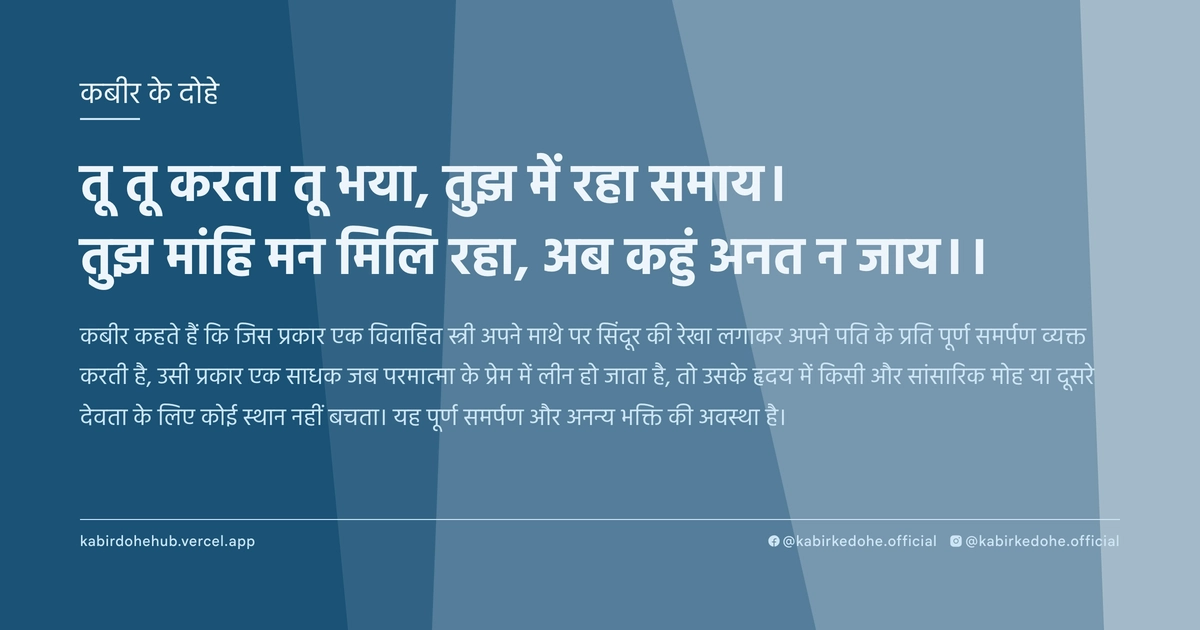
तू तू करता तू भया, तुझ में रहा समाय।
तुझ मांहि मन मिलि रहा, अब कहुं अनत न जाय।।
Tu tu karta tu bhaya, tujh me raha samaye. Tujh maahin man mili raha, ab kahun anat na jaaye.
इस पृष्ठ पर इस कबीर दोहे का अर्थ (meaning), हिंदी व्याख्या और अंग्रेज़ी अनुवाद, दार्शनिक विश्लेषण और व्यावहारिक जीवन सीख दी गई है। यह दोहा भक्ति (Bhakti) विषय से जुड़ा है — Kabir doha meaning and explanation in Hindi and English.
अर्थ (Meaning):
कबीर कहते हैं कि जिस प्रकार एक विवाहित स्त्री अपने माथे पर सिंदूर की रेखा लगाकर अपने पति के प्रति पूर्ण समर्पण व्यक्त करती है, उसी प्रकार एक साधक जब परमात्मा के प्रेम में लीन हो जाता है, तो उसके हृदय में किसी और सांसारिक मोह या दूसरे देवता के लिए कोई स्थान नहीं बचता। यह पूर्ण समर्पण और अनन्य भक्ति की अवस्था है।
Kabir asserts that just as a married woman marks her forehead with vermilion to signify her absolute devotion and commitment to her husband, a seeker who is immersed in the love of the Divine finds their heart so occupied that there is no room for any other worldly attachment or secondary deity. It is a state of total surrender and exclusive devotion.
व्याख्या (Interpretation):
यहाँ 'सिंदूर की रेखा' केवल वैवाहिक प्रतीक नहीं, बल्कि आत्मा और परमात्मा के बीच के अटूट बंधन का रूपक है। कबीर 'काजल' (काजर) के माध्यम से उन बाहरी आडंबरों और भटकावों की बात कर रहे हैं जो सत्य के मार्ग में बाधा बनते हैं। जब 'प्रीतम' (परमात्मा) तन और मन में पूरी तरह बस जाते हैं, तो द्वैत का अंत हो जाता है। यह निरगुण भक्ति का वह शिखर है जहाँ साधक और साध्य एक हो जाते हैं। यह अद्वैत वेदांत की उस स्थिति को दर्शाता है जहाँ 'मैं' और 'तू' का भेद मिट जाता है। माया का पर्दा तब गिरता है जब प्रेम की तीव्रता इतनी बढ़ जाए कि संसार की अन्य सभी वस्तुएं तुच्छ लगने लगें। अंततः, यह दोहा सिखाता है कि पूर्णता केवल एकनिष्ठता में है, बिखराव में नहीं।
Here, the 'line of vermilion' is not merely a marital symbol but a metaphor for the unbreakable bond between the soul and the Divine. Through 'kajar' (kohl), Kabir refers to the external distractions and rituals that obstruct the path to truth. When the 'Beloved' (the Divine) resides fully within the body and mind, duality ceases to exist. This represents the pinnacle of Nirgun Bhakti, where the seeker and the sought merge into one. It mirrors the state of Advaita Vedanta where the distinction between 'I' and 'Thou' vanishes. The veil of Maya falls only when the intensity of love grows so profound that all other worldly pursuits seem insignificant. Ultimately, this couplet teaches that fulfillment lies in singularity of purpose, not in fragmentation.
दार्शनिक विश्लेषण (Philosophical Analysis):
कबीर का यह दोहा उस युग की सामाजिक और धार्मिक जटिलताओं पर प्रहार करता है जहाँ लोग एक साथ कई विरोधाभासी विश्वासों को पकड़े रहते थे। कबीर यहाँ 'अनन्य भक्ति' पर जोर दे रहे हैं, जो सूफीवाद के 'फना' (अहंकार का विनाश) और वेदांत के 'अद्वैत' के करीब है। वे ritualism (कर्मकांड) का विरोध करते हुए यह समझाते हैं कि ईश्वर किसी बाहरी चिन्ह या मंदिर-मस्जिद में नहीं, बल्कि आंतरिक समर्पण में है।
ऐतिहासिक रूप से, कबीर ने जाति और धर्म की दीवारों को तोड़कर प्रेम को ही एकमात्र सेतु माना। उनके लिए परमात्मा कोई दूर बैठा न्यायाधीश नहीं, बल्कि हृदय में बसा एक प्रेमी है। यह दृष्टिकोण उस समय के कट्टरपंथियों के लिए एक चुनौती था, क्योंकि यह बाहरी पहचानों को नकार कर आंतरिक अनुभव को प्राथमिकता देता था।
दार्शनिक स्तर पर, यह दोहा 'चित्त की एकाग्रता' की बात करता है। जब मन विभिन्न इच्छाओं (काजल की रेखाओं) में बंटा होता है, तो वह कभी भी पूर्णता प्राप्त नहीं कर सकता। अहंकार का विसर्जन तभी संभव है जब साधक अपनी पूरी चेतना को एक ही केंद्र पर केंद्रित कर दे।
सूफी मत के 'इश्क-ए-हकीकी' (दिव्य प्रेम) की तरह, कबीर यहाँ सांसारिक प्रेम (इश्क-ए-मजाजी) को दिव्य प्रेम की सीढ़ी मानते हैं, लेकिन चेतावनी देते हैं कि अंतिम लक्ष्य केवल परमात्मा होना चाहिए। यदि मन में 'दूजा' (दूसरा) है, तो वह प्रेम अधूरा है।
अंततः, यह विश्लेषण हमें बताता है कि आध्यात्मिक प्रगति का अर्थ अधिक ज्ञान अर्जित करना नहीं, बल्कि उन अनावश्यक चीजों को हटाना है जो हमें सत्य से अलग करती हैं। यह 'नेति-नेति' (यह नहीं, वह नहीं) की प्रक्रिया है, जिससे केवल शुद्ध चेतना शेष बचती है।
This couplet strikes at the social and religious complexities of Kabir's era, where people clung to contradictory beliefs simultaneously. Kabir emphasizes 'exclusive devotion,' which aligns with the Sufi concept of 'Fana' (annihilation of the ego) and the Vedantic principle of 'Advaita' (non-duality). By opposing ritualism, he explains that the Divine is not found in external symbols or structures, but in internal surrender.
Historically, Kabir broke the barriers of caste and creed, proposing love as the only bridge. To him, the Divine was not a distant judge but a Beloved residing within the heart. This perspective challenged the orthodoxies of his time by prioritizing internal experience over external identity.
Philosophically, the verse speaks of 'concentration of consciousness.' When the mind is fragmented by various desires (the lines of kohl), it can never achieve wholeness. The dissolution of the ego is only possible when the seeker focuses their entire being on a single center.
Similar to the Sufi notion of 'Ishq-e-Haqiqi' (Divine Love), Kabir views worldly love ('Ishq-e-Majazi') as a stepping stone, but warns that the ultimate destination must be the Divine alone. If there is a 'second' (duja) in the heart, the love remains incomplete.
Ultimately, this analysis reveals that spiritual progress is not about accumulating more knowledge, but about removing the unnecessary clutter that separates us from Truth. It is a process of 'Neti-Neti' (not this, not that), leaving behind only pure consciousness.
मूल संदेश (Core Message):
- आंतरिक द्वंद्व ही आध्यात्मिक प्रगति का सबसे बड़ा अवरोध है।
- पूर्णता केवल एकनिष्ठ प्रेम और अटूट समर्पण में निहित है।
- बाहरी आडंबर केवल सत्य को छिपाने वाले काजल के समान हैं।
- जब अहंकार मिटता है, तब केवल दिव्य उपस्थिति शेष रहती है।
- सत्य की खोज बाहर नहीं, बल्कि स्वयं के भीतर के मिलन में है।
- Internal conflict is the greatest obstacle to spiritual progress.
- Wholeness resides only in singular love and unwavering surrender.
- External rituals are like kohl, merely masking the true light.
- When the ego dissolves, only the Divine presence remains.
- The search for Truth is not external, but in the union within.
व्यावहारिक उदाहरण (Practical Example):
वाराणसी के घाटों पर रहने वाले एक वृद्ध बुनकर, माधव, का जीवन केवल अपने करघे और अपनी कला के प्रति समर्पित था। वह दिन भर सूत कातता और रात को कबीर के पदों का गान करता। माधव की पत्नी का देहांत वर्षों पहले हो चुका था, लेकिन उसने कभी दोबारा विवाह नहीं किया, न ही वह किसी सांसारिक सुख की कामना करता था।
गाँव के लोग उसे पागल समझते थे क्योंकि वह अक्सर अपने करघे के सामने बैठकर घंटों मौन रहता, जैसे वह किसी अदृश्य सत्ता से बातें कर रहा हो। लोग उसे सलाह देते कि वह अपनी कला का उपयोग धन कमाने के लिए करे या किसी नए रिश्ते में बंध जाए ताकि उसका अकेलापन दूर हो सके।
एक दिन, शहर का एक बड़ा व्यापारी माधव के पास आया। उसने माधव के बनाए वस्त्रों की अद्भुत गुणवत्ता देखी और उसे एक बड़ा प्रस्ताव दिया। व्यापारी ने कहा, "तुम मेरे लिए काम करो, मैं तुम्हें महल जैसा घर और नौकर-चाकर दूँगा, बस तुम्हें अपनी इस पुरानी कुटिया और इस फकीरी को छोड़ना होगा।"
माधव ने मुस्कुराकर व्यापारी की ओर देखा और कहा, "सेठ जी, मेरे हृदय के करघे पर केवल एक ही धागा बंधा है—मेरे प्रिय परमात्मा का। यदि मैं आपके सोने के महल की लालसा करूँगा, तो मेरे मन में 'दूजा' आ जाएगा। और जिस हृदय में दो बसे हों, वहाँ न तो कला बचती है और न ही शांति।"
व्यापारी को लगा कि माधव केवल अपनी गरीबी को ढंकने के लिए ऐसी बातें कर रहा है। उसने माधव को लालच दिया, लेकिन माधव अडिग रहा। उसने व्यापारी को समझाया कि जैसे एक सिंदूर की रेखा एक स्त्री को उसके पति के प्रति समर्पित करती है, वैसे ही उसकी यह गरीबी और एकांत उसे उसके ईश्वर के प्रति समर्पित रखते हैं।
व्यापारी ने देखा कि माधव के चेहरे पर जो संतोष था, वह उसके करोड़ों रुपयों के बावजूद उसके अपने चेहरे पर नहीं था। वह समझ गया कि माधव का 'अकेलापन' वास्तव में 'पूर्णता' थी।
इस 'कबीर ट्विस्ट' ने व्यापारी के भीतर एक हलचल पैदा कर दी। उसने महसूस किया कि वह पूरी दुनिया को जीतने की कोशिश कर रहा है, लेकिन उसके अपने भीतर का घर खाली है। वह अपनी सारी उपलब्धियों के बावजूद भी अधूरा महसूस करता था क्योंकि उसका मन हजारों दिशाओं में बिखरा हुआ था।
व्यापारी ने उस दिन से अपनी जीवनशैली बदली। उसने भौतिक संग्रह को कम किया और माधव की तरह अपने भीतर के 'एक' को खोजने का प्रयास शुरू किया। उसने सीखा कि सच्ची खुशी बाहरी विस्तार में नहीं, बल्कि आंतरिक गहराई और अनन्य समर्पण में है।
Madhav, an elderly weaver living on the ghats of Varanasi, had dedicated his entire life to his loom and his craft. He spent his days spinning thread and his nights singing the verses of Kabir. His wife had passed away years ago, but he never remarried, nor did he long for any worldly pleasure.
The villagers considered him mad because he would often sit before his loom for hours in silence, as if conversing with an invisible presence. People advised him to use his skill to amass wealth or find a new companion to alleviate his loneliness.
One day, a wealthy merchant from the city visited Madhav. Impressed by the extraordinary quality of his fabrics, the merchant offered him a grand deal. "Work for me," he said, "and I will give you a palace-like home and servants; you only need to leave this old hut and your asceticism behind."
Madhav smiled and looked at the merchant. "Seth ji, on the loom of my heart, only one thread is tied—that of my Beloved Divine. If I long for your golden palace, a 'second' will enter my heart. And in a heart where two reside, neither art nor peace can survive."
The merchant thought Madhav was merely masking his poverty with spiritual rhetoric. He tried to tempt him further, but Madhav remained steadfast. He explained that just as a line of vermilion binds a woman to her husband, his poverty and solitude bind him to his God.
The merchant noticed a serenity on Madhav's face that he himself lacked, despite his millions. He realized that Madhav's 'loneliness' was actually 'wholeness.'
This 'Kabir Twist' triggered a profound shift in the merchant. He realized that while he was trying to conquer the world, his own internal home was empty. He felt incomplete because his mind was fragmented in a thousand different directions.
From that day on, the merchant changed his lifestyle. He reduced his material accumulation and, like Madhav, began the quest to find the 'One' within. He learned that true happiness lies not in external expansion, but in internal depth and exclusive surrender.
अभ्यास मार्गदर्शन (Practice Guidance):
- प्रतिदिन 20 मिनट मौन ध्यान करें, जहाँ आप अपने भीतर के 'प्रियतम' (दिव्य चेतना) को महसूस करें और बाहरी दुनिया के शोर को पूरी तरह भुला दें।
- एक 'समर्पण जर्नल' बनाएँ। हर दिन लिखें कि कौन सी सांसारिक इच्छा या 'दूजा' विचार आपके मानसिक संतुलन को बिगाड़ रहा है, और उसे सचेत रूप से त्यागने का संकल्प लें।
- व्यवहार परिवर्तन: दिन में कम से कम एक कार्य ऐसा करें जिसमें आपका कोई व्यक्तिगत लाभ न हो, केवल सेवा का भाव हो, ताकि अहंकार का विसर्जन हो सके।
- डायग्नोस्टिक चेकलिस्ट: क्या मैं एक साथ कई विरोधाभासी इच्छाओं के पीछे भाग रहा हूँ? क्या मेरी शांति बाहरी परिस्थितियों पर निर्भर है? यदि हाँ, तो आप 'दूजे' के प्रभाव में हैं।
- Practice 20 minutes of silent meditation daily, focusing on feeling the 'Beloved' (Divine Consciousness) within and completely forgetting the noise of the external world.
- Maintain a 'Surrender Journal.' Each day, record which worldly desire or 'second' thought is disrupting your mental equilibrium and consciously resolve to let it go.
- Behavioral Change: Perform at least one act daily with zero personal gain, driven only by the spirit of service, to facilitate the dissolution of the ego.
- Diagnostic Checklist: Am I chasing multiple contradictory desires simultaneously? Is my peace dependent on external circumstances? If yes, you are under the influence of the 'second'.
चिंतन प्रश्न (Reflection Questions):
- मेरे जीवन में वह 'सिंदूर की रेखा' क्या है जो मुझे मेरे उच्चतम सत्य से जोड़ती है, या क्या मैं केवल काजल की रेखाओं (दिखावे) में उलझा हूँ?
- मैं अपनी सार्वजनिक छवि (Digital Ego) को बनाए रखने के लिए अपने आंतरिक सत्य का कितना बलिदान करता हूँ?
- मेरे हृदय में वह 'दूजा' कौन है—कोई व्यक्ति, कोई पद, या कोई भौतिक वस्तु—जो मुझे पूर्ण समर्पण से रोक रहा है?
- क्या मेरा प्रेम वास्तव में निःस्वार्थ है, या यह केवल मेरी अपनी जरूरतों को पूरा करने का एक तरीका है?
- यदि आज मुझसे मेरी सारी पहचान (नाम, पद, संबंध) छीन ली जाए, तो मेरे भीतर क्या शेष बचेगा?
- What is the 'line of vermilion' in my life that connects me to my highest truth, or am I merely entangled in lines of kohl (pretensions)?
- How much of my internal truth do I sacrifice to maintain my public image (Digital Ego)?
- Who is the 'second' in my heart—a person, a position, or a material object—that prevents me from total surrender?
- Is my love truly selfless, or is it merely a mechanism to fulfill my own needs?
- If all my identities (name, rank, relationships) were stripped away today, what would remain within me?