
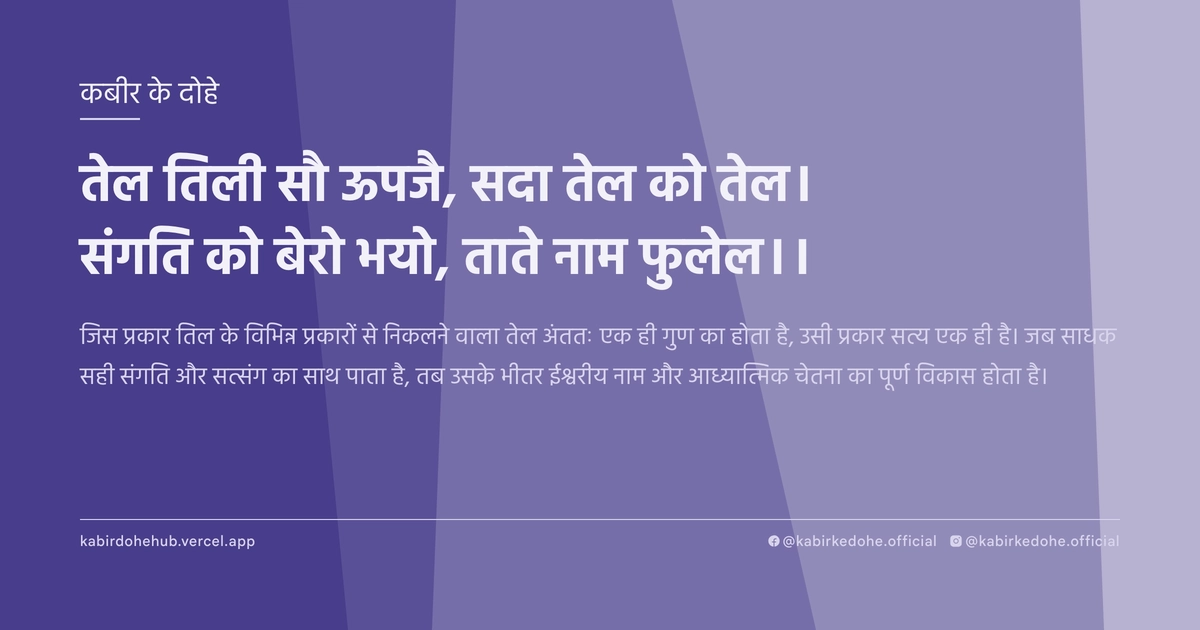
तेल तिली सौ ऊपजै, सदा तेल को तेल।
संगति को बेरो भयो, ताते नाम फुलेल।।
Tel tili sau oopjai, sada tel ko tel. Sangati ko bero bhayo, taate naam phulel.
इस पृष्ठ पर इस कबीर दोहे का अर्थ (meaning), हिंदी व्याख्या और अंग्रेज़ी अनुवाद, दार्शनिक विश्लेषण और व्यावहारिक जीवन सीख दी गई है। यह दोहा सत्संग (Satsang) विषय से जुड़ा है — Kabir doha meaning and explanation in Hindi and English.
अर्थ (Meaning):
जिस प्रकार तिल के विभिन्न प्रकारों से निकलने वाला तेल अंततः एक ही गुण का होता है, उसी प्रकार सत्य एक ही है। जब साधक सही संगति और सत्संग का साथ पाता है, तब उसके भीतर ईश्वरीय नाम और आध्यात्मिक चेतना का पूर्ण विकास होता है।
Just as oil extracted from various types of sesame seeds remains essentially the same oil, the ultimate Truth is one. When a seeker aligns themselves with the right spiritual company and divine association, the seed of the Holy Name blossoms into full spiritual awakening.
व्याख्या (Interpretation):
कबीर यहाँ तिल और तेल के माध्यम से सार और स्वरूप के अंतर को समझा रहे हैं। तिल अलग-अलग हो सकते हैं, लेकिन तेल का स्वभाव अपरिवर्तनीय है; यह निर्गुण ब्रह्म की एकता का प्रतीक है। 'संगति' यहाँ केवल बाहरी मेल नहीं, बल्कि चेतना का उच्च स्तरों के साथ मिलन है। माया के प्रभाव में हम विविधता देखते हैं, परंतु अद्वैत वेदांत के अनुसार, वह विविधता केवल एक ही तत्व का विस्तार है। जब अहंकार का पर्दा हटता है, तो नाम (दिव्य ध्वनि) केवल शब्द नहीं रहता, बल्कि एक अनुभव बन जाता है जो जीवन को पुष्पित करता है। यह विरोधाभास है कि हम बाहर खोजते हैं, जबकि तेल तिल के भीतर ही था, बस उसे निकालने के लिए सही दबाव (साधना) और संगति की आवश्यकता थी।
Kabir utilizes the metaphor of sesame seeds and oil to distinguish between the manifest form and the essential essence. While seeds may vary in appearance, the oil extracted is fundamentally the same, symbolizing the oneness of the Nirgun Brahman. 'Sangati' here refers not merely to social company, but to the alignment of one's consciousness with higher spiritual frequencies. Under the veil of Maya, we perceive multiplicity, yet according to Advaita Vedanta, this diversity is but a projection of a single underlying Reality. When the veil of ego is lifted, the 'Naam' (Divine Sound/Name) ceases to be a mere word and becomes a living experience that allows the soul to blossom. The central paradox lies in the fact that we seek the Truth externally, whereas the oil was always within the seed; it simply required the correct pressure of spiritual discipline and the catalyst of right association to be released.
दार्शनिक विश्लेषण (Philosophical Analysis):
कबीर का यह दोहा उस युग का प्रतिबिंब है जहाँ धार्मिक कट्टरता और बाह्य कर्मकांड चरम पर थे। उन्होंने यह स्पष्ट किया कि सत्य किसी विशेष जाति, धर्म या मंदिर में नहीं, बल्कि अस्तित्व के मूल स्वभाव में निहित है। यह दृष्टिकोण सूफी मत के 'वहदत-अल-वजूद' (अस्तित्व की एकता) और अद्वैत वेदांत के 'अहं ब्रह्मास्मि' के समानांतर है। कबीर का तर्क है कि जिस प्रकार तेल तिल का अभिन्न अंग है, उसी प्रकार परमात्मा आत्मा का अभिन्न अंग है।
ritualism के विरुद्ध उनका प्रहार यहाँ सूक्ष्म है; वे कहते हैं कि केवल पूजा-पाठ से नहीं, बल्कि 'संगति' (सत्संग) से परिवर्तन आता है। यहाँ संगति का अर्थ है—सत्य के प्रति समर्पित आत्माओं का साथ, जो हमें हमारे वास्तविक स्वरूप की याद दिलाते हैं। यह मनोवैज्ञानिक रूपांतरण की प्रक्रिया है जहाँ व्यक्ति अपनी सीमित पहचान (अहंकार) को त्यागकर सार्वभौमिक पहचान में विलीन होता है।
भक्ति आंदोलन के संदर्भ में, यह 'नाम' की महिमा है। कबीर के लिए 'नाम' कोई मंत्र नहीं, बल्कि वह कंपन है जो ब्रह्मांड के मूल तत्व से जुड़ा है। जब यह कंपन जागता है, तो व्यक्ति के भीतर का 'पुष्प' (चेतना) खिलता है। यह प्रक्रिया आंतरिक शुद्धिकरण की है, जहाँ अशुद्धियाँ दूर होती हैं और केवल शुद्ध सार शेष रहता है।
अक्सर लोग इसे केवल अच्छे दोस्तों के साथ रहने की सलाह मान लेते हैं, जो एक बड़ी भूल है। कबीर यहाँ 'तत्व' की बात कर रहे हैं। वे समझा रहे हैं कि जैसे तेल निकालने के लिए तिल को कुचलना पड़ता है, वैसे ही अहंकार के विनाश के बिना सत्य का प्रकटीकरण संभव नहीं है। यह विनाश विनाशकारी नहीं, बल्कि मुक्तिदायी है।
अंततः, यह दोहा हमें यह सिखाता है कि विविधता केवल सतही है। चाहे वह हिंदू हो या मुसलमान, अमीर हो या गरीब, सबके भीतर वही एक दैवीय तत्व है। जब हम इस एकता को पहचान लेते हैं, तो द्वैत समाप्त हो जाता है और प्रेम का उदय होता है। यही कबीर का क्रांतिकारी संदेश है—एकता का अनुभव, न कि केवल उसकी घोषणा।
This couplet reflects the era of Kabir, a time marked by rigid religious dogmatism and superficial ritualism. He asserts that Truth does not reside in a specific caste, religion, or temple, but is inherent in the very nature of existence. This perspective aligns seamlessly with the Sufi concept of 'Wahdat-al-Wujud' (Unity of Being) and the Advaita Vedanta realization of 'Aham Brahmasmi' (I am Brahman). Kabir argues that just as oil is an inseparable part of the seed, the Divine is an inseparable part of the soul.
His critique of ritualism is subtle yet profound; he suggests that transformation occurs not through rote prayer, but through 'Sangati' (spiritual association). Here, association means aligning oneself with souls dedicated to Truth, who act as mirrors reflecting our true nature. This is a process of psychological transmutation where the individual sheds the limited identity of the ego to merge into a universal consciousness.
Within the context of the Bhakti movement, this emphasizes the glory of the 'Naam'. For Kabir, the 'Naam' is not a mere mantra but the primordial vibration connected to the cosmic essence. When this vibration is awakened, the 'flower' of consciousness blooms within the seeker. This is a process of internal alchemy where impurities are purged, leaving only the pure essence behind.
Common literalist interpretations often mistake this for simple advice on choosing good friends, which is a significant oversight. Kabir is discussing 'Tattva' (Element). He implies that just as the seed must be crushed to extract the oil, the ego must be annihilated for the Truth to manifest. This destruction is not catastrophic but liberating.
Ultimately, the doha teaches that diversity is merely superficial. Whether one is Hindu or Muslim, rich or poor, the same divine element resides within all. Once this unity is recognized, duality vanishes, and universal love emerges. This is Kabir's revolutionary message: the experiential realization of oneness, rather than the mere intellectual proclamation of it.
मूल संदेश (Core Message):
- विविधता केवल बाहरी है, सार एक ही है।
- अहंकार का विनाश ही सत्य का प्रकटीकरण है।
- सही संगति आत्मा के बंद द्वारों को खोलती है।
- ईश्वरीय नाम केवल शब्द नहीं, एक आंतरिक अनुभव है।
- प्रेम और करुणा ही वास्तविक आध्यात्मिक उपलब्धि हैं।
- Diversity is superficial; the essence is singular.
- The annihilation of ego is the revelation of Truth.
- Right association unlocks the closed doors of the soul.
- The Divine Name is not a word, but an internal experience.
- Love and compassion are the only true spiritual achievements.
व्यावहारिक उदाहरण (Practical Example):
वाराणसी के एक पुराने घाट पर माधव नाम का एक वृद्ध बुनकर रहता था। वह अपनी कला में निपुण था, लेकिन उसका स्वभाव अत्यंत क्रोधी और अहंकारी था। वह मानता था कि उसकी बुनाई की श्रेष्ठता उसे अन्य बुनकरों से ऊपर रखती है। वह अक्सर दूसरों को नीचा दिखाता और खुद को श्रेष्ठ समझता, जिससे वह अकेला पड़ गया था।
एक दिन घाट पर एक फकीर आया, जो बिना किसी संपत्ति के केवल मुस्कुराहट बाँट रहा था। माधव ने उसे देखा और उसके शांत स्वभाव पर व्यंग्य किया। फकीर ने मुस्कुराकर माधव को एक मुट्ठी तिल दिए और कहा, 'इनमें से तेल निकालो।' माधव ने कोशिश की, पर तिल वैसे ही रहे।
फकीर ने कहा, 'तेल अंदर है, पर उसे निकालने के लिए तुम्हें इन्हें कुचलना होगा। ठीक वैसे ही, तुम्हारे भीतर प्रेम का तेल है, पर तुम्हारा अहंकार एक सख्त खोल की तरह है जिसने उसे कैद कर रखा है।'
माधव को यह बात चुभी, लेकिन उसने फकीर के साथ समय बिताना शुरू किया। वह फकीर की संगति में रहने लगा। फकीर उसे कोई उपदेश नहीं देता था, बस उसे दूसरों के दुखों को देखने और सुनने के लिए प्रेरित करता था। धीरे-धीरे माधव ने महसूस किया कि जिस श्रेष्ठता का वह गर्व करता था, वह वास्तव में उसके अकेलेपन का कारण थी।
एक समय ऐसा आया जब माधव ने देखा कि उसके पड़ोस का एक युवा बुनकर, जिसे वह मूर्ख समझता था, वास्तव में बहुत संघर्ष कर रहा था। माधव ने पहली बार अपना अहंकार किनारे रखकर उसकी मदद की। जैसे ही उसने दूसरों की सेवा शुरू की, उसके भीतर एक असीम शांति का अनुभव हुआ।
उसने महसूस किया कि वह और वह युवा बुनकर, दोनों अलग-अलग दिखते थे, लेकिन उनके भीतर की तड़प और मानवीय भावना एक ही थी—ठीक वैसे ही जैसे अलग-अलग तिल से एक ही तेल निकलता है।
उसकी संगति अब केवल श्रेष्ठ लोगों की नहीं, बल्कि उन लोगों की थी जो सच्चे और सरल थे। इस 'संगति' ने उसके जीवन के कठोर खोल को तोड़ दिया।
माधव अब केवल कपड़े नहीं बुनता था, बल्कि वह लोगों के दिलों को जोड़ना सीख गया था। उसका क्रोध शांत हो गया और उसकी कला में अब एक दैवीय चमक थी क्योंकि वह अब अहंकार से नहीं, बल्कि प्रेम से सृजन कर रहा था।
गाँव के लोग अब उसे उसके कौशल के लिए नहीं, बल्कि उसकी करुणा के लिए जानने लगे। माधव का जीवन अब उस 'नाम' की तरह खिल गया था, जिसका जिक्र कबीर ने किया था।
उसने जान लिया था कि सत्य बाहर नहीं, बल्कि भीतर है, बस उसे निकालने के लिए अहंकार के कुचलने और सही संगति की आवश्यकता होती है।
On an ancient ghat in Varanasi lived an elderly weaver named Madhav. He was a master of his craft, but his nature was profoundly angry and arrogant. He believed his superior weaving skills placed him above all other artisans, and he frequently belittled others, which eventually left him isolated and lonely.
One day, a wandering dervish arrived at the ghat, possessing no worldly goods, only a serene smile. Madhav observed him and mocked his detached state. The dervish smiled and handed Madhav a handful of sesame seeds, saying, 'Extract the oil from these.' Madhav tried, but the seeds remained unchanged.
The dervish explained, 'The oil is inside, but to release it, you must crush the seeds. Similarly, the oil of love is within you, but your ego is like a hard shell that keeps it imprisoned.'
Though the words stung, Madhav began spending time with the dervish. He entered the dervish's 'Sangati' (company). The dervish gave no formal sermons; he simply encouraged Madhav to observe and listen to the suffering of others. Gradually, Madhav realized that the superiority he prized was actually the source of his profound loneliness.
Eventually, Madhav noticed a young weaver nearby, whom he had long dismissed as incompetent, struggling deeply with poverty. For the first time, Madhav set aside his pride and offered his help. As he began serving others, he experienced an unprecedented sense of inner peace.
He realized that he and the young weaver, despite their outward differences, shared the same human longing and essence—just as different sesame seeds yield the same oil.
His association was no longer with those who were 'superior' in status, but with those who were authentic and simple. This 'Sangati' broke the rigid shell of his identity.
Madhav no longer just wove cloth; he learned to weave connections between hearts. His anger vanished, and his art acquired a divine luminosity because he was now creating from love rather than ego.
The villagers began to know him not for his skill, but for his compassion. Madhav's life had finally blossomed like the 'Naam' mentioned by Kabir.
He understood that Truth is not external, but internal, requiring the crushing of the ego and the catalyst of right association to be revealed.
अभ्यास मार्गदर्शन (Practice Guidance):
- प्रतिदिन 20 मिनट मौन ध्यान करें, जहाँ आप अपने भीतर के 'तेल' (शुद्ध चेतना) को महसूस करें, न कि अपने बाहरी व्यक्तित्व को।
- एक 'अहंकार डायरी' लिखें: दिन भर में उन क्षणों को दर्ज करें जब आपने खुद को दूसरों से श्रेष्ठ या निम्न महसूस किया, और विश्लेषण करें कि यह भ्रम कहाँ से आया।
- सत्संग का अभ्यास: ऐसे व्यक्तियों के साथ समय बिताएं जो आपको चुनौती दें और आपके अहंकार को तोड़ें, न कि आपकी प्रशंसा करें।
- निदान चेकलिस्ट: क्या मैं दूसरों की सफलता से ईर्ष्या करता हूँ? क्या मैं अपनी पहचान को अपनी उपलब्धियों से जोड़ता हूँ? यदि हाँ, तो आप अभी भी 'खोल' में हैं।
- Practice 20 minutes of silent meditation daily, focusing on feeling the 'oil' (pure consciousness) within, rather than your external persona.
- Maintain an 'Ego Journal': Record moments throughout the day when you felt superior or inferior to others, and analyze the origin of this illusion.
- Practice Sangati: Spend time with individuals who challenge your beliefs and dismantle your ego, rather than those who merely flatter you.
- Diagnostic Checklist: Do I feel jealousy at others' success? Do I tie my identity to my achievements? If yes, you are still trapped within the 'shell'.
चिंतन प्रश्न (Reflection Questions):
- मेरी वह कौन सी 'श्रेष्ठता' है जो वास्तव में मुझे दूसरों से अलग कर रही है?
- यदि मेरी सारी उपलब्धियाँ और पद छीन लिए जाएँ, तो मेरा 'सार' क्या बचेगा?
- क्या मैं वास्तव में सत्य की खोज कर रहा हूँ, या केवल अपनी मान्यताओं की पुष्टि?
- मेरे जीवन में वह कौन सी 'संगति' है जो मुझे मेरे वास्तविक स्वरूप की याद दिलाती है?
- मैं अपने भीतर के उस 'कठोर खोल' को कैसे पहचानूँ जिसे मैं सुरक्षा समझकर पकड़े हुए हूँ?
- What is the 'superiority' I cling to that actually isolates me from others?
- If all my achievements and titles were stripped away, what 'essence' would remain?
- Am I truly seeking Truth, or merely seeking confirmation of my own beliefs?
- Who in my life provides the 'Sangati' that reminds me of my authentic self?
- How do I recognize the 'hard shell' within me that I mistake for protection?