
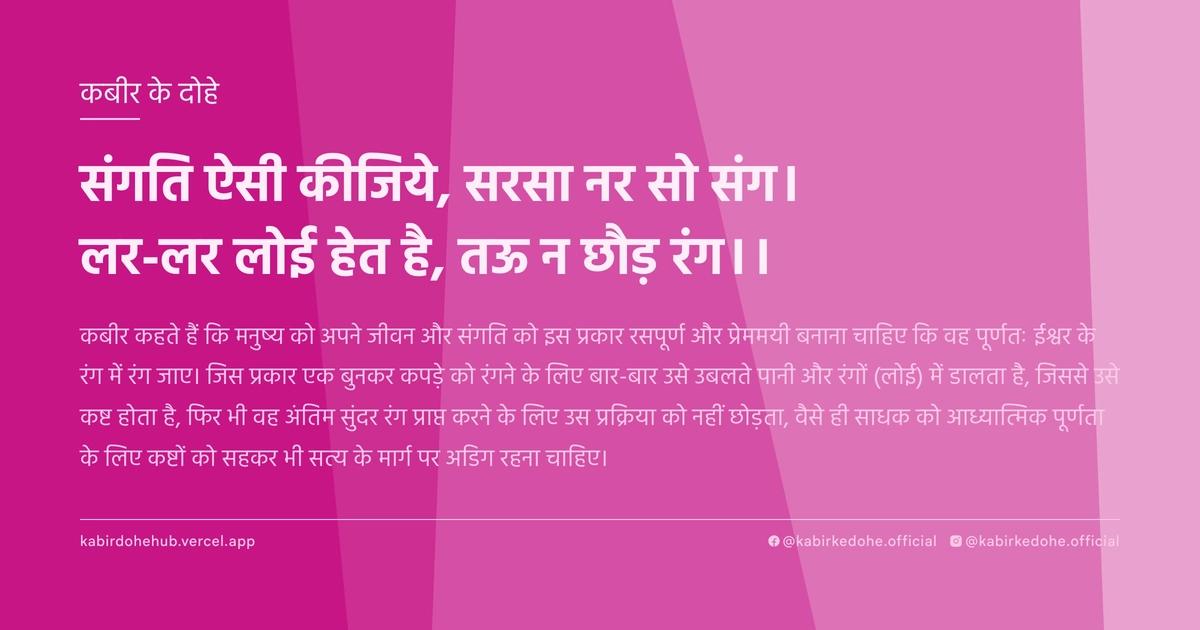
संगति ऐसी कीजिये, सरसा नर सो संग।
लर-लर लोई हेत है, तऊ न छौड़ रंग।।
Sangati aisi kariye, sarsa nar so sang. Lar-lar loi het hai, tau na chhod rang.
इस पृष्ठ पर इस कबीर दोहे का अर्थ (meaning), हिंदी व्याख्या और अंग्रेज़ी अनुवाद, दार्शनिक विश्लेषण और व्यावहारिक जीवन सीख दी गई है। यह दोहा सत्संग (Satsang) विषय से जुड़ा है — Kabir doha meaning and explanation in Hindi and English.
अर्थ (Meaning):
कबीर कहते हैं कि मनुष्य को अपने जीवन और संगति को इस प्रकार रसपूर्ण और प्रेममयी बनाना चाहिए कि वह पूर्णतः ईश्वर के रंग में रंग जाए। जिस प्रकार एक बुनकर कपड़े को रंगने के लिए बार-बार उसे उबलते पानी और रंगों (लोई) में डालता है, जिससे उसे कष्ट होता है, फिर भी वह अंतिम सुंदर रंग प्राप्त करने के लिए उस प्रक्रिया को नहीं छोड़ता, वैसे ही साधक को आध्यात्मिक पूर्णता के लिए कष्टों को सहकर भी सत्य के मार्ग पर अडिग रहना चाहिए।
Kabir urges the seeker to cultivate a companionship with the Divine that is so saturated with spiritual essence that it transforms their entire being. He uses the metaphor of a dyer: just as a cloth must be repeatedly dipped into boiling dyes and endure the harshness of the process to achieve a permanent, vibrant hue, a seeker must endure the trials of spiritual discipline and the shedding of the ego to be permanently colored by the Truth, never abandoning the path despite the inherent struggle.
व्याख्या (Interpretation):
यह दोहा प्रतीकात्मक रूप से आध्यात्मिक रूपांतरण की प्रक्रिया को दर्शाता है। 'रंग' यहाँ परमात्मा के प्रेम और ज्ञान का प्रतीक है, जबकि 'लोई' या उबलता पानी सांसारिक दुखों और कठोर साधना का प्रतिनिधित्व करता है। कबीर निरगुण भक्ति के माध्यम से समझाते हैं कि आत्मा का परमात्मा में विलीनीकरण सहज नहीं होता; यह माया के आवरण को हटाने की एक दर्दनाक प्रक्रिया है। अद्वैत वेदांत के अनुसार, जब तक 'मैं' (अहंकार) जीवित है, तब तक पूर्ण रंग नहीं चढ़ सकता। यह विरोधाभास है कि जिसे हम कष्ट समझते हैं, वही वास्तव में हमें शुद्ध कर रहा है। अंततः, यह दोहा संदेश देता है कि सत्य की प्राप्ति के लिए अहंकार का दहन अनिवार्य है, और जो इस प्रक्रिया से डरकर पीछे हट जाता है, वह कभी उस शाश्वत आनंद को प्राप्त नहीं कर सकता जिसे कबीर 'रंग' कह रहे हैं।
This couplet symbolically depicts the process of spiritual transmutation. The 'color' (rang) represents the love and knowledge of the Divine, while the 'boiling dye' (loi) signifies worldly suffering and the rigors of ascetic discipline. Through the lens of Nirgun Bhakti, Kabir explains that the merging of the Atman with Brahman is not a passive event; it is a painful stripping away of the veils of Maya. According to Advaita Vedanta, as long as the 'I' (ego) persists, the permanent hue of Truth cannot be absorbed. The central paradox is that the very suffering we flee is the catalyst for our purification. Ultimately, the verse asserts that the incineration of the ego is mandatory for spiritual attainment; those who retreat in fear of the process remain colorless and fragmented, never achieving the singular, luminous unity of the Absolute.
दार्शनिक विश्लेषण (Philosophical Analysis):
कबीर का यह दोहा उनके बुनकर होने के व्यावहारिक अनुभव और उनके गहन आध्यात्मिक दर्शन का एक अद्भुत संगम है। ऐतिहासिक रूप से, कबीर ने उस समय के कर्मकांडीय धर्म का विरोध किया जहाँ केवल बाहरी दिखावे को पवित्रता माना जाता था। यहाँ 'रंग' का अर्थ केवल भक्ति नहीं, बल्कि चेतना का पूर्ण परिवर्तन है। वे सूफी मत के 'फना' (अहंकार का विनाश) और वेदांत के 'अद्वैत' (दो नहीं, एक) के सिद्धांतों को जोड़ते हैं। उनके लिए, ईश्वर किसी मंदिर या मस्जिद में नहीं, बल्कि उस आंतरिक रूपांतरण में है जो व्यक्ति को उसके सीमित स्व से मुक्त कर उसे सार्वभौमिक बनाता है।
वे इस बात पर जोर देते हैं कि आध्यात्मिक मार्ग पर आने वाले कष्ट वास्तव में 'शुद्धिकरण' हैं। जैसे कपड़े की अशुद्धियाँ गर्म पानी में निकलती हैं, वैसे ही मनुष्य के भीतर के विकार—काम, क्रोध, लोभ—तपस्या की अग्नि में जलते हैं। यह प्रक्रिया मनोवैज्ञानिक रूप से 'मृत्यु और पुनर्जन्म' के समान है, जहाँ पुराना व्यक्तित्व मरता है ताकि एक नया, दैवीय व्यक्तित्व जन्म ले सके।
कबीर का विरोध उन लोगों से है जो केवल 'सुखद' आध्यात्मिकता चाहते हैं। वे चेतावनी देते हैं कि बिना संघर्ष के प्राप्त ज्ञान सतही होता है। वास्तविक भक्ति वह है जो व्यक्ति को उसकी जड़ों से उखाड़कर उसे शून्य में विलीन कर दे। यह 'शून्य' ही वह स्थान है जहाँ कोई भेद नहीं रहता, न हिंदू-मुसलमान का, न ऊंच-नीच का।
यहाँ 'संग' का अर्थ केवल बाहरी साथ नहीं, बल्कि अपने भीतर के उस साक्षी (Witness) के साथ एकाकार होना है। जब साधक अपने भीतर के ईश्वर के साथ 'सरसा' (रसपूर्ण) संबंध बना लेता है, तो बाहरी दुनिया के उतार-चढ़ाव उसे विचलित नहीं करते। यह मानसिक स्थिरता ही वह बिंदु है जहाँ पहुँचकर मनुष्य वास्तव में स्वतंत्र होता है।
अंततः, यह दर्शन हमें सिखाता है कि जीवन के संघर्ष व्यर्थ नहीं हैं। यदि हम उन्हें ईश्वर की इच्छा और स्वयं की शुद्धि के रूप में देखें, तो हर दुख एक अवसर बन जाता है। कबीर का मार्ग कठिन है क्योंकि यह पूर्ण समर्पण की मांग करता है, लेकिन इसका फल शाश्वत शांति और पूर्णता है, जो किसी भी सांसारिक सुख से कहीं अधिक श्रेष्ठ है।
This couplet is a masterful synthesis of Kabir's practical experience as a weaver and his profound metaphysical insights. Historically, Kabir stood against the ritualistic orthodoxy of his era, which prioritized outward displays of piety over inner transformation. Here, 'color' does not merely signify devotion but a total ontological shift in consciousness. He bridges the Sufi concept of 'Fana' (the annihilation of the self) with the Advaita Vedantic realization of non-duality, suggesting that the seeker must vanish for the Truth to appear.
He emphasizes that the hardships encountered on the spiritual path are not obstacles but 'purifications.' Just as impurities are stripped from fabric in boiling water, the human vices of lust, anger, and greed are incinerated in the fire of tapasya (discipline). Psychologically, this is akin to a process of death and rebirth, where the limited, egoic identity is dismantled to make way for the universal consciousness.
Kabir critiques those seeking a 'comfortable' spirituality. He warns that knowledge acquired without struggle is superficial. True Bhakti is that which uproots the individual from their conditioned identity and merges them into the 'Shunya' (Void). In this Void, all dualities—caste, creed, and religion—dissolve, leaving only the singular reality of existence.
The term 'sang' (companionship) refers not to external social circles but to the internal union with the Witness Consciousness. When the seeker develops a 'rasa-filled' (essence-rich) relationship with the Divine within, external fluctuations cease to disturb them. This state of equanimity is the threshold of true liberation, where the seeker is no longer a slave to circumstance.
Ultimately, this philosophy teaches that life's struggles are not meaningless. If viewed as divine alchemy, every sorrow becomes an opportunity for refinement. Kabir's path is rigorous because it demands absolute surrender, but its reward is an eternal peace and wholeness that far transcends any transient worldly pleasure.
मूल संदेश (Core Message):
- कष्ट केवल बाधा नहीं, बल्कि आत्मा के परिमार्जन का साधन हैं।
- अहंकार का विसर्जन ही ईश्वरीय प्रेम के रंग में रंगने की पहली शर्त है।
- सच्ची भक्ति सुख की खोज नहीं, बल्कि सत्य के लिए कष्ट सहने का साहस है।
- बाहरी संघर्ष आंतरिक शांति प्राप्त करने की एक अनिवार्य सीढ़ी है।
- जब 'मैं' मिटता है, तभी 'वह' (परमात्मा) प्रकट होता है।
- Suffering is not a barrier, but the very tool for the soul's refinement.
- The dissolution of the ego is the prerequisite for absorbing the Divine hue.
- True devotion is not the pursuit of comfort, but the courage to endure for Truth.
- External conflict is an essential ladder toward achieving internal stillness.
- Only when the 'I' vanishes does the 'Universal One' manifest.
व्यावहारिक उदाहरण (Practical Example):
वाराणसी के एक पुराने मोहल्ले में रामदीन नाम का एक वृद्ध बुनकर रहता था। वह अपनी कला में निपुण था, लेकिन उसका मन हमेशा अशांत रहता था। वह अपनी गरीबी और समाज में अपनी निम्न स्थिति को लेकर बहुत दुखी रहता था। वह अक्सर सोचता था कि ईश्वर ने उसे ही इतनी कठिनाइयों में क्यों डाला।
एक दिन उसने एक संत को कबीर के इस दोहे का पाठ करते सुना। संत ने समझाया कि जैसे कपड़े को सुंदर रंग देने के लिए उसे उबलते पानी की तपन सहनी पड़ती है, वैसे ही जीवन के दुख हमें निखारने के लिए आते हैं। रामदीन को पहली बार अपनी पीड़ा का एक नया अर्थ समझ आया।
उसने तय किया कि वह अब अपनी परिस्थितियों से लड़ेगा नहीं, बल्कि उन्हें अपनी शुद्धि का माध्यम बनाएगा। जब उसके घर में पानी भर जाता या उसकी मेहनत की कमाई कम पड़ती, तो वह चिढ़ने के बजाय यह सोचता कि यह उसकी सहनशक्ति की परीक्षा है और उसका अहंकार कम करने का तरीका है।
धीरे-धीरे उसके व्यवहार में बदलाव आया। वह अब मोहल्ले के अन्य बुनकरों की मदद करने लगा, जो पहले केवल अपने लाभ के बारे में सोचते थे। उसने अपनी कला को केवल पैसा कमाने का जरिया नहीं, बल्कि ईश्वर की प्रार्थना माना।
एक समय ऐसा आया जब उसके पास बहुत कम संसाधन थे, लेकिन उसके चेहरे पर एक ऐसी शांति और चमक थी जिसे देखकर लोग हैरान रह जाते थे। वह अब गरीबी में भी खुश था क्योंकि उसने 'दुख' के रंग को 'आनंद' के रंग में बदल लिया था।
उसकी पत्नी, जो पहले हमेशा शिकायत करती थी, अब उसके साथ ध्यान लगाने लगी। उनके छोटे से घर में अब तनाव नहीं, बल्कि एक आध्यात्मिक संगीत गूँजने लगा।
रामदीन ने महसूस किया कि जब उसने अपनी तकलीफों को स्वीकार कर लिया और उन्हें ईश्वर की इच्छा मानकर गले लगाया, तो वह तकलीफें गायब नहीं हुईं, बल्कि उनका प्रभाव बदल गया। अब वे उसे तोड़ती नहीं थीं, बल्कि उसे और मजबूत बना रही थीं।
अंत में, रामदीन उस मोहल्ले का सबसे सम्मानित व्यक्ति बन गया, न इसलिए कि उसके पास धन था, बल्कि इसलिए क्योंकि उसने जीवन की कड़वाहट को प्रेम के रस में घोल दिया था। उसने वास्तव में कबीर के 'रंग' को पा लिया था।
In an ancient lane of Varanasi lived an elderly weaver named Ramdeen. Though a master of his craft, his mind was a storm of unrest. He harbored deep resentment toward his poverty and the low social status imposed upon him by caste, often questioning why the Divine had burdened him with such a bleak existence.
One afternoon, he overheard a wandering saint reciting this specific Doha of Kabir. The saint explained that just as a fabric must endure the searing heat of boiling water to hold a vibrant, permanent color, a human soul must endure the fires of life's hardships to achieve spiritual brilliance.
For the first time, Ramdeen perceived his suffering not as a punishment, but as a process of refinement. He decided to stop fighting his circumstances and instead treat them as a medium for purification. Whenever his hut flooded during the monsoon or his earnings dwindled, he ceased his complaints and viewed the struggle as a tool to erode his ego.
Slowly, a transformation took hold. He began assisting other weavers in the colony, people he had previously viewed as competitors. He stopped treating his weaving as a mere chore for survival and began to see every thread as a prayer, every movement of the shuttle as a meditation.
Eventually, despite his meager possessions, a luminous peace settled upon his face—a radiance that bewildered his neighbors. He had discovered a way to be wealthy in spirit, having transmuted the 'color' of grief into the 'color' of grace.
His wife, once his most frequent critic, was drawn to this change and began joining him in silent contemplation. Their small, damp home, once filled with arguments, became a sanctuary of spiritual harmony.
Ramdeen realized that by accepting his pain and embracing it as the Divine's will, the pain did not vanish, but its nature changed. It no longer broke him; it forged him into something stronger and more compassionate.
In the end, Ramdeen became the most revered man in the neighborhood—not because of wealth, but because he had dissolved the bitterness of life into the nectar of love. He had truly been dyed in the 'color' of the Truth.
अभ्यास मार्गदर्शन (Practice Guidance):
- प्रतिदिन 20 मिनट 'साक्षी भाव' का अभ्यास करें: अपने जीवन में आने वाली कठिनाइयों को एक तीसरे व्यक्ति की तरह देखें, यह महसूस करते हुए कि यह आपकी आत्मा की शुद्धि की प्रक्रिया है।
- आत्म-पूछताछ जर्नल: हर उस घटना को लिखें जिसने आपको मानसिक कष्ट दिया, और उसके बगल में लिखें कि यह घटना आपके किस अहंकार (जैसे- श्रेष्ठता, अधिकार, या अपेक्षा) को नष्ट कर रही है।
- व्यवहारिक परिवर्तन: जब भी क्रोध या निराशा महसूस हो, तो तुरंत रुकें और मन में कहें, 'यह वह उबलता पानी है जो मुझे शुद्ध कर रहा है।'
- निदान चेकलिस्ट: क्या मैं अभी भी परिस्थितियों को दोष दे रहा हूँ? (यदि हाँ, तो रंग अभी कच्चा है)। क्या मैं दुख में भी एक आंतरिक स्थिरता महसूस करता हूँ? (यदि हाँ, तो रंग चढ़ना शुरू हो गया है)।
- Practice 'Witness Consciousness' for 20 minutes daily: Observe the hardships of your life from a third-person perspective, recognizing them as the necessary heat for spiritual purification.
- Self-Inquiry Journaling: Record every event that caused you mental distress, and beside it, analyze which specific ego-construct (e.g., superiority, entitlement, or expectation) is being dismantled by this experience.
- Behavioral Shift: Whenever anger or despair arises, pause immediately and mentally affirm: 'This is the boiling water that is purifying my soul.'
- Diagnostic Checklist: Am I still blaming external circumstances for my pain? (If yes, the color is still raw). Do I feel an underlying stability even amidst turmoil? (If yes, the color is beginning to set).
चिंतन प्रश्न (Reflection Questions):
- मेरे जीवन का वह कौन सा 'उबलता पानी' (कष्ट) है जिसे मैं स्वीकार करने से डर रहा हूँ?
- क्या मेरी आध्यात्मिक खोज केवल मानसिक शांति के लिए है, या मैं वास्तव में अपने अहंकार के विनाश के लिए तैयार हूँ?
- मैं अपनी सार्वजनिक छवि (Digital Ego) को बनाए रखने के लिए कितनी ऊर्जा नष्ट करता हूँ, जबकि सत्य मेरी खामियों को स्वीकार करने में है?
- यदि मेरे जीवन से सभी संघर्ष अचानक समाप्त हो जाएं, तो क्या मैं वास्तव में विकसित हो पाऊंगा या केवल स्थिर रह जाऊंगा?
- मेरे भीतर का कौन सा हिस्सा अभी भी यह मानता है कि मैं दूसरों से अलग या श्रेष्ठ हूँ?
- What is the 'boiling water' (hardship) in my life that I am currently resisting or fearing?
- Is my spiritual pursuit merely a search for mental comfort, or am I truly prepared for the annihilation of my ego?
- How much energy do I waste maintaining my public persona (Digital Ego), while Truth lies in the acceptance of my flaws?
- If all struggles were suddenly removed from my life, would I actually evolve, or would I simply stagnate in comfort?
- Which part of my identity still clings to the illusion that I am separate from or superior to others?