
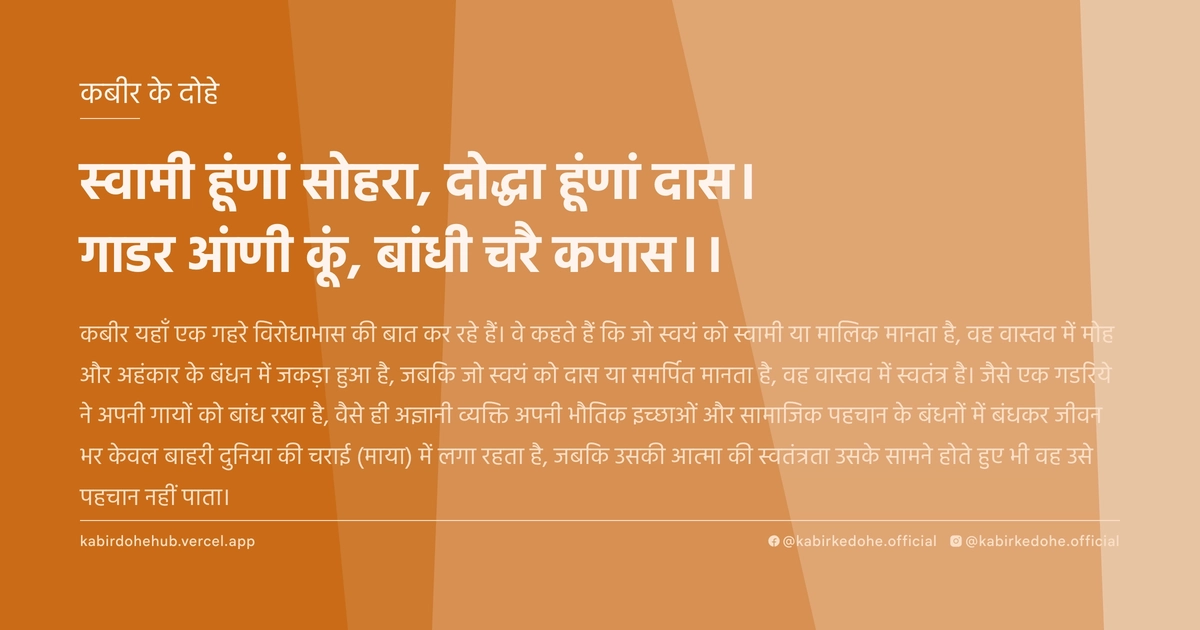
स्वामी हूंणां सोहरा, दोद्धा हूंणां दास।
गाडर आंणी कूं, बांधी चरै कपास।।
Swami hunaan sohra, doddha hunaan daas. Gaadar aani kun, baandhi charai kapaas.
इस पृष्ठ पर इस कबीर दोहे का अर्थ (meaning), हिंदी व्याख्या और अंग्रेज़ी अनुवाद, दार्शनिक विश्लेषण और व्यावहारिक जीवन सीख दी गई है। यह दोहा पद-प्रतिष्ठा का अहंकार (The Vanity of Status) विषय से जुड़ा है — Kabir doha meaning and explanation in Hindi and English.
अर्थ (Meaning):
कबीर यहाँ एक गहरे विरोधाभास की बात कर रहे हैं। वे कहते हैं कि जो स्वयं को स्वामी या मालिक मानता है, वह वास्तव में मोह और अहंकार के बंधन में जकड़ा हुआ है, जबकि जो स्वयं को दास या समर्पित मानता है, वह वास्तव में स्वतंत्र है। जैसे एक गडरिये ने अपनी गायों को बांध रखा है, वैसे ही अज्ञानी व्यक्ति अपनी भौतिक इच्छाओं और सामाजिक पहचान के बंधनों में बंधकर जीवन भर केवल बाहरी दुनिया की चराई (माया) में लगा रहता है, जबकि उसकी आत्मा की स्वतंत्रता उसके सामने होते हुए भी वह उसे पहचान नहीं पाता।
Kabir presents a profound paradox regarding mastery and servitude. He suggests that he who considers himself a master or a lord is actually enslaved by ego and attachment, whereas he who accepts the state of a servant—surrendering the ego—finds true liberation. He likens the ignorant person to a herdsman who keeps his cattle bound; though the cattle graze on the cotton fields (the material world), they are tethered. Similarly, the human soul, blinded by the illusion of ownership and status, remains bound by the ropes of Maya, grazing on the superficialities of existence while missing the infinite freedom of the spirit.
व्याख्या (Interpretation):
इस दोहे का शाब्दिक अर्थ है कि स्वामी बनना वास्तव में बंधन है और दास बनना मुक्ति। यहाँ 'स्वामी' शब्द उस अहंकार का प्रतीक है जो 'मैं' और 'मेरा' की भावना से संचालित होता है। यह अहंकार ही वह रस्सी है जिसने मनुष्य को संसार के मोह-माया के खेत में बांध रखा है। निर्गुण भक्ति के परिप्रेक्ष्य में, जब तक साधक अपनी व्यक्तिगत पहचान (अहंकार) को नहीं मिटाता, वह ब्रह्म के साथ एकाकार नहीं हो सकता। 'कपास चरना' यहाँ सांसारिक सुखों और कर्मकांडों में उलझे रहने का संकेत है। यह अद्वैत वेदांत के उस सिद्धांत को दर्शाता है जहाँ जीव स्वयं को शरीर और मन समझकर अलग महसूस करता है, जबकि वह वास्तव में शुद्ध चेतना है। विरोधाभास यह है कि मुक्ति पाने के लिए पहले अपनी सत्ता का त्याग करना पड़ता है।
Literally, the verse posits that being a master is a bondage and being a servant is liberation. The term 'Swami' symbolizes the ego driven by the notions of 'I' and 'Mine.' This ego is the very rope that binds the human being to the fields of worldly attachment. In the context of Nirgun Bhakti, unless the seeker annihilates their individual identity, union with the Formless Divine remains impossible. 'Grazing on cotton' signifies being entangled in mundane pleasures and ritualistic formalities. This mirrors the Advaita Vedanta principle where the Jiva perceives itself as a separate entity—body and mind—while it is actually pure consciousness. The central paradox is that to achieve ultimate sovereignty over one's soul, one must first surrender the illusion of worldly mastery.
दार्शनिक विश्लेषण (Philosophical Analysis):
कबीर का यह दोहा उनके युग के सामाजिक और धार्मिक पाखंड पर एक तीखा प्रहार है। उस समय समाज जाति, वर्ण और पद के आधार पर बंटा हुआ था, जहाँ 'स्वामी' होने का अर्थ दूसरों पर नियंत्रण और श्रेष्ठता का भाव था। कबीर ने इस सामाजिक पदानुक्रम को आध्यात्मिक दृष्टिकोण से उलट दिया। वे तर्क देते हैं कि जो व्यक्ति स्वयं को उच्च मानता है, वह वास्तव में अपनी श्रेष्ठता के अहंकार का कैदी है। यह विचार सूफीवाद के 'फना' (अहंकार का विनाश) के सिद्धांत से मेल खाता है, जहाँ ईश्वर तक पहुँचने का एकमात्र रास्ता स्वयं को मिटाना है।
दार्शनिक रूप से, यह दोहा माया के सूक्ष्म जाल की व्याख्या करता है। हम अक्सर सोचते हैं कि धन, शक्ति या ज्ञान हमें स्वतंत्र बनाएंगे, लेकिन कबीर कहते हैं कि ये चीजें वास्तव में हमें और अधिक बांधती हैं। यह अद्वैत वेदांत के उस सत्य की पुष्टि करता है कि बंधन बाहरी नहीं, बल्कि आंतरिक है। जब तक 'अहंकार' जीवित है, तब तक द्वैत (दो होने का भाव) बना रहता है। जैसे ही 'दास' भाव (पूर्ण समर्पण) आता है, द्वैत समाप्त हो जाता है और केवल एक ही तत्व शेष रहता है।
कबीर यहाँ कर्मकांडीय धर्म की भी आलोचना कर रहे हैं। जो लोग केवल बाहरी पूजा-पाठ या तीर्थयात्राओं के माध्यम से मुक्ति खोजते हैं, वे उसी गडरिये की गायों की तरह हैं जो एक सीमित दायरे में बंधकर घास चर रही हैं। वे सोचते हैं कि वे आध्यात्मिक प्रगति कर रहे हैं, लेकिन वास्तव में वे केवल अपनी आदतों और मान्यताओं के दायरे में घूम रहे हैं। वास्तविक मुक्ति आंतरिक रूपांतरण से आती है, न कि बाहरी पदवियों से।
मनोवैज्ञानिक स्तर पर, यह दोहा नियंत्रण की इच्छा (Need for Control) और शांति के बीच के संघर्ष को दर्शाता है। मनुष्य जितना अधिक बाहरी परिस्थितियों को नियंत्रित करने की कोशिश करता है, वह उतना ही तनावग्रस्त और बंधा हुआ महसूस करता है। समर्पण का अर्थ कमजोरी नहीं, बल्कि सत्य की स्वीकृति है। जब हम यह स्वीकार कर लेते हैं कि हम ब्रह्मांड की विशाल चेतना का एक छोटा सा हिस्सा हैं, तब नियंत्रण का बोझ उतर जाता है और वास्तविक स्वतंत्रता का अनुभव होता है।
अंततः, कबीर यह संदेश देते हैं कि मुक्ति किसी बाहरी स्थान या पद में नहीं, बल्कि चेतना के स्तर में बदलाव में है। 'स्वामी' से 'दास' बनने की यात्रा वास्तव में अज्ञान से ज्ञान की ओर, और अहंकार से प्रेम की ओर यात्रा है। यह एक ऐसी क्रांति है जो व्यक्ति को सामाजिक पहचानों के पार ले जाकर उसे सार्वभौमिक सत्य से जोड़ती है।
This couplet is a sharp critique of the social and religious hypocrisies of Kabir's era. Society was rigidly divided by caste and status, where being a 'Swami' (Master) implied dominance and a sense of superiority. Kabir flips this social hierarchy from a spiritual perspective, arguing that the person who considers themselves superior is actually a prisoner of their own pride. This aligns with the Sufi concept of 'Fana' (annihilation of the self), where the only path to the Divine is through the total erasure of the ego.
Philosophically, the verse explains the subtle trap of Maya. We often believe that wealth, power, or intellectual knowledge will bring us freedom, but Kabir asserts that these are the very chains that bind us more tightly. This confirms the Advaita Vedanta truth that bondage is not external but internal. As long as the 'Ahamkara' (ego) exists, duality persists. Once the state of 'Das' (complete surrender) is achieved, duality vanishes, leaving only the One Absolute Truth.
Kabir also critiques ritualistic religion here. Those who seek liberation through external rituals or pilgrimages are like the herdsman's cattle—grazing within a confined circle. They believe they are making spiritual progress, but they are merely circling within the boundaries of their conditioned beliefs. True liberation comes from internal transformation, not from external titles or religious labels.
On a psychological level, the verse highlights the conflict between the desire for control and the attainment of peace. The more a human attempts to control external circumstances, the more stressed and bound they become. Surrender here does not mean weakness, but the acceptance of Truth. When we acknowledge that we are a small part of a vast universal consciousness, the burden of control lifts, and genuine freedom is experienced.
Ultimately, Kabir conveys that liberation is not found in a place or a position, but in a shift of consciousness. The journey from 'Master' to 'Servant' is actually a journey from ignorance to enlightenment, and from ego to love. It is a revolution that transcends social identities and connects the individual to the universal truth.
मूल संदेश (Core Message):
- अहंकार ही वह रस्सी है जो आत्मा को माया के खेत में बांधे रखती है।
- वास्तविक स्वतंत्रता स्वयं को मिटाने और पूर्ण समर्पण में निहित है।
- पद और प्रतिष्ठा केवल मानसिक बंधन हैं, आध्यात्मिक मुक्ति नहीं।
- जब 'मैं' समाप्त होता है, तभी 'वह' (परमात्मा) प्रकट होता है।
- सेवा का भाव ही अहंकार के विनाश का सबसे तीव्र मार्ग है।
- Ego is the rope that keeps the soul tethered to the fields of illusion.
- True liberation lies in the annihilation of the self and total surrender.
- Status and prestige are merely mental bonds, not spiritual freedom.
- Only when the 'I' vanishes does the 'Divine' manifest.
- The spirit of service is the fastest path to destroying the ego.
व्यावहारिक उदाहरण (Practical Example):
एक समय की बात है, बनारस के घाटों पर माधव नाम का एक अत्यंत विद्वान पंडित रहता था। माधव को अपनी शास्त्र विद्या पर बहुत गर्व था। वह स्वयं को ज्ञान का 'स्वामी' मानता था और अन्य लोगों को अज्ञानी समझकर उनसे बात करने में संकोच करता था। वह दिन भर शास्त्रों की व्याख्या करता और लोगों को बताता कि मोक्ष कैसे प्राप्त किया जाए, लेकिन उसके भीतर एक गहरा असंतोष और क्रोध हमेशा बना रहता था। वह अपनी प्रतिष्ठा की रक्षा करने के लिए हर समय चिंतित रहता था।
एक दिन माधव की मुलाकात एक साधारण से मोची से हुई, जो फटे हुए जूतों को सिलते हुए निरंतर ईश्वर के नाम का जाप कर रहा था। मोची के चेहरे पर एक ऐसी शांति और संतोष था जो माधव ने अपने जीवन के सबसे कठिन तप और अध्ययन के बाद भी प्राप्त नहीं किया था। माधव ने अहंकारवश मोची से पूछा, "तुम एक तुच्छ मोची हो, जिसे शास्त्रों का ज्ञान नहीं, फिर भी तुम इतने प्रसन्न कैसे हो? क्या तुम्हें पता भी है कि मुक्ति का मार्ग क्या है?"
मोची ने मुस्कुराते हुए उत्तर दिया, "पंडित जी, मैं तो बस अपने मालिक का एक छोटा सा दास हूँ। मैंने अपनी सारी इच्छाएं, अपना सारा अहंकार और अपनी सारी चतुराई उस परमात्मा के चरणों में समर्पित कर दी है। मैं यह नहीं जानता कि मुक्ति क्या है, लेकिन मैं यह जानता हूँ कि जब तक मैं खुद को 'कुछ' समझता था, मैं दुखी था। जिस दिन मैंने मान लिया कि मैं 'कुछ भी नहीं' हूँ, मैं आजाद हो गया।"
माधव को पहले तो यह बात बेतुकी लगी। उसने सोचा कि बिना ज्ञान के कोई कैसे स्वतंत्र हो सकता है? लेकिन फिर उसने गौर किया कि वह स्वयं अपनी विद्वत्ता के बोझ तले दबा हुआ था। वह अपनी छवि, अपनी प्रतिष्ठा और अपनी श्रेष्ठता को बनाए रखने की कोशिश में एक ऐसे मानसिक पिंजरे में कैद था, जहाँ से वह बाहर नहीं निकल पा रहा था। वह 'स्वामी' तो था, लेकिन अपनी ही मान्यताओं का गुलाम था।
उस रात माधव सो नहीं सका। उसे मोची की बात याद आती रही। उसने महसूस किया कि वह अब तक केवल 'कपास चर' रहा था—अर्थात वह केवल बौद्धिक विलासिता और सामाजिक सम्मान के पीछे भाग रहा था, जबकि वास्तविक सत्य उसकी पहुँच से दूर था क्योंकि उसका अहंकार बीच में खड़ा था। उसने महसूस किया कि उसकी विद्वत्ता उसके लिए एक बंधन बन गई थी।
अगली सुबह, माधव ने अपने सारे अहंकार को त्यागने का निर्णय लिया। उसने अपनी पोथियों को किनारे रखा और पहली बार एक साधारण मनुष्य की तरह दूसरों की सेवा करना शुरू किया। उसने यह सोचना छोड़ दिया कि वह दूसरों से श्रेष्ठ है। उसने स्वयं को ईश्वर का एक छोटा सा सेवक माना।
जैसे-जैसे माधव का 'स्वामी' होने का भाव कम हुआ, उसके जीवन से तनाव और क्रोध गायब होने लगे। उसने पाया कि जब वह दूसरों को छोटा समझना बंद कर देता है, तो उसे दुनिया में हर जगह ईश्वर दिखने लगता है। उसकी आंतरिक शांति अब उसकी किताबों पर नहीं, बल्कि उसके समर्पण पर टिकी थी।
माधव अब भी शास्त्र पढ़ता था, लेकिन अब वह ज्ञान का उपयोग दूसरों को नीचा दिखाने के लिए नहीं, बल्कि दूसरों की सेवा के लिए करता था। उसने जान लिया था कि असली आजादी खुद को बड़ा बनाने में नहीं, बल्कि खुद को मिटाकर उस अनंत में विलीन हो जाने में है।
इस प्रकार, एक अहंकारी विद्वान, जो स्वयं को ज्ञान का स्वामी मानता था, एक साधारण मोची के शब्दों से प्रेरित होकर 'दास' बना और वास्तव में स्वतंत्र हुआ।
Once, on the ghats of Varanasi, lived a highly learned scholar named Madhav. Madhav was immensely proud of his mastery over the scriptures. He considered himself a 'Swami' (Master) of knowledge and hesitated to speak with others, whom he viewed as ignorant. He spent his days interpreting texts and instructing people on the path to salvation, yet within him, there was a persistent sense of dissatisfaction and anger. He was constantly anxious about protecting his reputation.
One day, Madhav encountered a simple cobbler who was humming the name of the Divine while stitching worn-out shoes. The cobbler's face radiated a peace and contentment that Madhav had never achieved, despite years of rigorous study and penance. Driven by ego, Madhav asked, "You are a mere cobbler with no knowledge of the scriptures, yet how are you so happy? Do you even know the path to liberation?"
The cobbler smiled and replied, "Pandit ji, I am but a small servant of my Master. I have surrendered all my desires, my ego, and all my cleverness at the feet of the Divine. I do not know what liberation is, but I know that as long as I thought I was 'something,' I was miserable. The day I accepted that I am 'nothing,' I became free."
At first, Madhav found this absurd. He wondered how someone could be free without intellectual knowledge. But then he noticed that he himself was crushed under the weight of his own scholarship. In his effort to maintain his image, prestige, and superiority, he was trapped in a mental cage from which he could not escape. He was a 'Master,' but a slave to his own beliefs.
Madhav could not sleep that night. The cobbler's words echoed in his mind. He realized that he had been 'grazing on cotton'—meaning he was merely chasing intellectual luxury and social validation, while the actual truth remained distant because his ego stood in the way. He realized his erudition had become his bondage.
The next morning, Madhav decided to renounce his arrogance. He set aside his scrolls and, for the first time, began to serve others as a common man. He stopped thinking of himself as superior. He began to view himself as a humble servant of the Divine.
As Madhav's sense of being a 'Master' diminished, the stress and anger vanished from his life. He discovered that when he stopped viewing others as inferior, he began to see the Divine everywhere. His inner peace no longer depended on his books, but on his surrender.
Madhav continued to study the scriptures, but he no longer used his knowledge to belittle others; instead, he used it to serve. He understood that true freedom lies not in making oneself great, but in erasing the self to merge with the Infinite.
Thus, an arrogant scholar, who believed himself to be the master of knowledge, was inspired by a simple cobbler to become a 'servant' and finally found true liberation.
अभ्यास मार्गदर्शन (Practice Guidance):
- प्रतिदिन 20 मिनट मौन ध्यान करें, जहाँ आप अपने भीतर के 'स्वामी' (अहंकार) को पहचानें और उसे धीरे-धीरे विसर्जित करें।
- एक 'अहंकार डायरी' लिखें: दिन भर में उन क्षणों को नोट करें जब आपने महसूस किया कि आप दूसरों से श्रेष्ठ हैं या जब आपने नियंत्रण करने की कोशिश की।
- व्यवहार परिवर्तन: सप्ताह में एक बार ऐसा कार्य करें जिसमें आप अपनी पहचान पूरी तरह छिपाकर किसी की निस्वार्थ सेवा करें।
- निदान चेकलिस्ट: क्या आप दूसरों की आलोचना करते समय श्रेष्ठता महसूस करते हैं? क्या आप अपनी उपलब्धियों के लिए प्रशंसा की उम्मीद करते हैं? यदि हाँ, तो आप अभी भी 'स्वामी' के बंधन में हैं।
- Practice 20 minutes of silent meditation daily, identifying the 'Master' (ego) within and consciously letting it dissolve.
- Maintain an 'Ego Journal': Note moments throughout the day when you felt superior to others or felt a compulsive need to control a situation.
- Behavioral Shift: Once a week, perform an act of selfless service while completely concealing your identity and status.
- Diagnostic Checklist: Do you feel a sense of superiority while criticizing others? Do you crave validation for your achievements? If yes, you are still bound by the 'Master' illusion.
चिंतन प्रश्न (Reflection Questions):
- आपकी वह कौन सी सामाजिक पहचान (डिग्री, पद, जाति) है जिसे आप खोने से सबसे ज्यादा डरते हैं?
- क्या आपकी 'मदद' वास्तव में निस्वार्थ है, या यह आपकी श्रेष्ठता की भावना को पुष्ट करने का एक तरीका है?
- यदि आज आपकी सारी उपलब्धियां छीन ली जाएं, तो आपके पास 'स्वयं' के रूप में क्या बचेगा?
- आप अपने जीवन में किन चीजों पर नियंत्रण पाने की कोशिश कर रहे हैं, और यह प्रयास आपको कितना तनाव दे रहा है?
- क्या आप वास्तव में स्वतंत्र हैं, या आप केवल अपनी पसंद के बंधनों को स्वतंत्रता समझ रहे हैं?
- Which social identity (degree, position, caste) are you most afraid of losing?
- Is your 'help' truly selfless, or is it a way to reinforce your feeling of superiority?
- If all your achievements were stripped away today, what would remain of 'you'?
- What things in your life are you desperately trying to control, and how much stress is this effort causing you?
- Are you truly free, or are you simply mistaking your preferred bonds for freedom?