
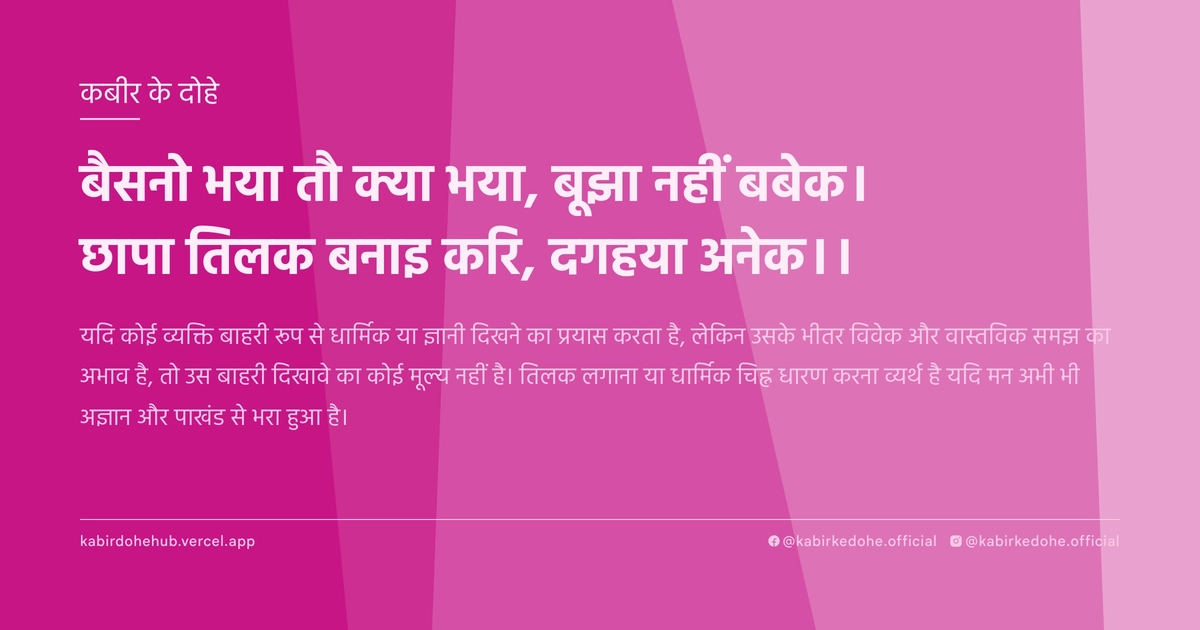
बैसनो भया तौ क्या भया, बूझा नहीं बबेक।
छापा तिलक बनाइ करि, दगहया अनेक।।
Baisano bhaya tau kya bhaya, bujha nahi babek. Chhapa tilak banai kari, dagahya anek.
इस पृष्ठ पर इस कबीर दोहे का अर्थ (meaning), हिंदी व्याख्या और अंग्रेज़ी अनुवाद, दार्शनिक विश्लेषण और व्यावहारिक जीवन सीख दी गई है। यह दोहा धार्मिक पाखंड (Religious Hypocrisy) विषय से जुड़ा है — Kabir doha meaning and explanation in Hindi and English.
अर्थ (Meaning):
यदि कोई व्यक्ति बाहरी रूप से धार्मिक या ज्ञानी दिखने का प्रयास करता है, लेकिन उसके भीतर विवेक और वास्तविक समझ का अभाव है, तो उस बाहरी दिखावे का कोई मूल्य नहीं है। तिलक लगाना या धार्मिक चिह्न धारण करना व्यर्थ है यदि मन अभी भी अज्ञान और पाखंड से भरा हुआ है।
If a person attempts to appear religious or scholarly on the outside, yet lacks inner discernment and true understanding, such outward displays are meaningless. Applying a tilak or wearing religious symbols is futile if the mind remains clouded by ignorance and hypocrisy.
व्याख्या (Interpretation):
कबीर यहाँ 'बबेक' (विवेक) की अनुपस्थिति पर प्रहार कर रहे हैं। शाब्दिक अर्थ यह है कि तिलक लगाने से कोई पंडित नहीं बनता। रूपक के स्तर पर, यह 'माया' के उस जाल को दर्शाता है जहाँ मनुष्य अपनी पहचान बाहरी प्रतीकों में खोजता है। निर्गुण भक्ति के अनुसार, ईश्वर किसी चिह्न में नहीं, बल्कि शुद्ध चेतना में है। जब तक अहंकार (Ego) जीवित है, बाहरी अनुष्ठान केवल एक मुखौटा हैं जो आत्मा और परमात्मा के बीच की दूरी को बढ़ाते हैं। यह द्वैतवाद का चरम है जहाँ व्यक्ति स्वयं को 'धार्मिक' मानकर दूसरों को 'अधार्मिक' समझने की भूल करता है।
Kabir strikes at the absence of 'Babek' (discernment). Literally, applying a tilak does not make one a scholar. Metaphorically, this represents the trap of 'Maya' where humans seek identity in external symbols. According to Nirgun Bhakti, the Divine resides not in symbols, but in pure consciousness. As long as the ego survives, external rituals are merely masks that widen the gap between the Atman and Brahman. This is the peak of dualism, where an individual mistakenly perceives themselves as 'religious' while viewing others as 'unreligious'.
दार्शनिक विश्लेषण (Philosophical Analysis):
कबीर का यह दोहा उनके युग के कट्टरपंथ और कर्मकांडीय अंधविश्वास पर एक तीखा प्रहार है। उस समय धर्म केवल बाहरी प्रतीकों, जैसे तिलक, जनेऊ और विशेष वस्त्रों तक सीमित हो गया था। कबीर ने इस 'दिखावे की संस्कृति' को चुनौती दी और स्पष्ट किया कि वास्तविक आध्यात्मिकता आंतरिक रूपांतरण है, न कि सामाजिक प्रदर्शन।
अद्वैत वेदांत के परिप्रेक्ष्य में, यह दोहा 'अविद्या' (ignorance) की चर्चा करता है। जब तक व्यक्ति यह नहीं समझता कि वह स्वयं ब्रह्म है, तब तक वह बाहरी दुनिया में सत्य को खोजने का प्रयास करता रहता है। तिलक लगाना एक मानसिक प्रक्षेपण है जहाँ व्यक्ति अपनी आंतरिक रिक्तता को बाहरी रंग से भरने की कोशिश करता है।
सूफी मत के साथ इसका गहरा संबंध है, जहाँ 'नफ्स' (अहंकार) के विनाश पर जोर दिया गया है। सूफीवाद और कबीर दोनों मानते हैं कि ईश्वर तक पहुँचने का मार्ग 'स्व' के विसर्जन से होकर गुजरता है। जो व्यक्ति तिलक लगाकर गर्व करता है, वह वास्तव में अपने अहंकार को और अधिक पुष्ट कर रहा होता है, जो मोक्ष के मार्ग में सबसे बड़ी बाधा है।
सामाजिक स्तर पर, कबीर जाति और वर्ग के उन विभाजनों को नकारते हैं जो धार्मिक प्रतीकों के माध्यम से बनाए गए थे। वे तर्क देते हैं कि यदि हृदय में करुणा और सत्य नहीं है, तो कोई भी धार्मिक पहचान व्यक्ति को श्रेष्ठ नहीं बनाती। यह एक क्रांतिकारी विचार था जिसने धर्म को मंदिर और मस्जिद से निकालकर मनुष्य के अंतर्मन में स्थापित किया।
मनोवैज्ञानिक रूप से, यह 'संज्ञानात्मक विसंगति' (Cognitive Dissonance) की स्थिति है। व्यक्ति समाज में एक आदर्श छवि (Persona) बनाए रखता है, जबकि उसका वास्तविक स्वरूप (Shadow) अंतर्विरोधों से भरा होता है। कबीर इस विसंगति को समाप्त कर 'सत्य' और 'आचरण' के एकीकरण का आह्वान करते हैं।
This couplet is a sharp critique of the bigotry and ritualistic superstition prevalent during Kabir's era. At that time, religion had become confined to external symbols such as the tilak, the sacred thread, and specific attire. Kabir challenged this 'culture of appearance,' clarifying that true spirituality is internal transformation, not social performance.
From the perspective of Advaita Vedanta, this doha discusses 'Avidya' (ignorance). Until an individual realizes they are Brahman, they continue to seek truth in the external world. Applying a tilak is a psychological projection where one attempts to fill internal emptiness with external colors.
There is a profound connection here with Sufism, which emphasizes the annihilation of the 'Nafs' (ego). Both Sufism and Kabir believe that the path to the Divine leads through the dissolution of the self. One who takes pride in their tilak is actually strengthening their ego, the primary obstacle to liberation.
Socially, Kabir rejects the divisions of caste and class created through religious symbols. He argues that if the heart lacks compassion and truth, no religious identity makes a person superior. This was a revolutionary thought that moved religion from temples and mosques into the human heart.
Psychologically, this represents a state of 'cognitive dissonance.' The individual maintains an ideal social persona while their true shadow is filled with contradictions. Kabir calls for the resolution of this dissonance through the integration of truth and conduct.
मूल संदेश (Core Message):
- बाहरी प्रतीकों से सत्य नहीं मिलता।
- अहंकार का त्याग ही वास्तविक विवेक है।
- दिखावा आत्मा की गहराई को घटाता है।
- आचरण ही सबसे बड़ा धर्म है।
- सत्य आंतरिक अनुभव है, बाहरी प्रदर्शन नहीं।
- External symbols do not grant truth.
- The surrender of ego is true discernment.
- Pretense diminishes the depth of the soul.
- Conduct is the highest form of religion.
- Truth is an internal experience, not a public display.
व्यावहारिक उदाहरण (Practical Example):
वाराणसी के एक पुराने घाट पर रामदीन नाम का एक वृद्ध नाविक रहता था। वह शहर का सबसे 'धार्मिक' व्यक्ति माना जाता था क्योंकि वह हमेशा माथे पर बड़ा तिलक लगाता, गले में कई मालाएं पहनता और हर पूजा में सबसे आगे खड़ा होता। लोग उसकी भक्ति की प्रशंसा करते थे।
लेकिन रामदीन का स्वभाव अत्यंत कठोर था। वह अपने छोटे सहयोगियों को गाली देता, नाव के किराए के लिए गरीब यात्रियों को ठगता और अपने घर में अपनी पत्नी के साथ दुर्व्यवहार करता था। उसके लिए धर्म केवल एक सामाजिक पोशाक थी जिसे वह दुनिया को दिखाने के लिए पहनता था।
एक दिन, एक फकीर उसकी नाव पर सवार हुआ। फकीर ने देखा कि रामदीन एक यात्री को जबरन ज्यादा पैसे देने के लिए धमका रहा है, जबकि उसी समय वह अपने माथे के तिलक को ठीक कर रहा था। फकीर मुस्कुराया और बोला, 'रामदीन, यह रंग माथे पर तो सुंदर है, लेकिन क्या यह तुम्हारे शब्दों की कड़वाहट को मिटा पाया?'
रामदीन को लगा कि फकीर उसका मजाक उड़ा रहा है। उसने गुस्से में कहा, 'मैं इस शहर का सबसे बड़ा भक्त हूँ, तुम मुझे क्या सिखाओगे?' फकीर ने शांति से जवाब दिया, 'भक्ति वह नहीं जो दुनिया देखे, भक्ति वह है जो तुम्हारा अहंकार मिटा दे। तुम्हारा तिलक तो चमक रहा है, लेकिन तुम्हारा विवेक सो रहा है।'
उस रात रामदीन सो नहीं सका। फकीर के शब्द 'विवेक सो रहा है' उसके कानों में गूँजते रहे। उसने महसूस किया कि वह अब तक केवल एक 'भक्त का अभिनय' कर रहा था। उसने कभी यह नहीं सोचा था कि उसके व्यवहार और उसके प्रतीकों के बीच कितनी गहरी खाई है।
अगली सुबह, रामदीन ने तिलक तो लगाया, लेकिन उसने सबसे पहले उस यात्री से माफी मांगी जिसे उसने ठगा था। उसने अपनी पत्नी के पैर छुए और अपने सहयोगियों को सम्मान देना शुरू किया। उसने महसूस किया कि असली पूजा मंदिर में नहीं, बल्कि दूसरों के प्रति व्यवहार में है।
धीरे-धीरे उसका व्यवहार बदलने लगा। अब लोग उसकी प्रशंसा उसके तिलक के लिए नहीं, बल्कि उसकी विनम्रता के लिए करने लगे। उसने पाया कि जब उसने बाहरी दिखावे के अहंकार को छोड़ा, तब उसे पहली बार वास्तविक शांति का अनुभव हुआ।
रामदीन की कहानी यह सिखाती है कि धर्म प्रतीकों का संग्रह नहीं, बल्कि चरित्र का परिमार्जन है। जब तक आंतरिक शुद्धि नहीं होती, बाहरी श्रृंगार केवल एक भ्रम है।
On an old ghat in Varanasi lived an elderly boatman named Ramdeen. He was considered the most 'religious' man in town because he always wore a large tilak on his forehead, many garlands around his neck, and stood at the forefront of every prayer. People praised his devotion.
However, Ramdeen's nature was extremely harsh. He would abuse his junior assistants, cheat poor passengers regarding boat fares, and mistreat his wife at home. For him, religion was merely a social costume he wore to show the world.
One day, a wandering dervish boarded his boat. The dervish noticed Ramdeen threatening a passenger to pay more money, all while simultaneously adjusting the tilak on his forehead. The dervish smiled and said, 'Ramdeen, this color is beautiful on your forehead, but has it managed to erase the bitterness of your words?'
Ramdeen felt the dervish was mocking him. He angrily replied, 'I am the greatest devotee in this city; what could you possibly teach me?' The dervish calmly replied, 'Devotion is not what the world sees; it is that which annihilates your ego. Your tilak shines, but your discernment is asleep.'
Ramdeen could not sleep that night. The words 'your discernment is asleep' echoed in his ears. He realized he had been merely 'acting' the part of a devotee. He had never considered the vast chasm between his symbols and his behavior.
The next morning, Ramdeen applied his tilak, but first, he apologized to the passenger he had cheated. He touched his wife's feet and began treating his assistants with respect. He realized that true worship is not in the temple, but in one's conduct toward others.
Gradually, his behavior changed. People no longer praised him for his tilak, but for his humility. He discovered that once he let go of the ego of outward appearance, he experienced true peace for the first time.
Ramdeen's story teaches that religion is not a collection of symbols, but a refinement of character. Until there is internal purification, external adornment is merely an illusion.
अभ्यास मार्गदर्शन (Practice Guidance):
- प्रतिदिन 15 मिनट मौन बैठें और विचार करें कि आपके कौन से व्यवहार आपके द्वारा प्रदर्शित की जाने वाली छवि के विपरीत हैं।
- एक 'विवेक जर्नल' बनाएँ: लिखें कि आज आपने कहाँ अहंकारवश प्रतिक्रिया दी और कहाँ सत्य को प्राथमिकता दी।
- किसी भी धार्मिक या सामाजिक पहचान को गर्व के साथ व्यक्त करने से पहले स्वयं से पूछें, 'क्या मेरा आचरण इस पहचान के योग्य है?'
- डायग्नोस्टिक चेकलिस्ट: क्या मैं दूसरों के दोषों को तुरंत देखता हूँ? क्या मैं अपनी धार्मिकता का उपयोग दूसरों को छोटा दिखाने के लिए करता हूँ? क्या मेरी शांति बाहरी परिस्थितियों पर निर्भर है?
- Sit in silence for 15 minutes daily and reflect on which of your behaviors contradict the image you project to the world.
- Maintain a 'Discernment Journal': Record instances where you reacted out of ego versus where you prioritized truth.
- Before expressing any religious or social identity with pride, ask yourself, 'Does my conduct align with the dignity of this identity?'
- Diagnostic Checklist: Do I notice others' flaws instantly? Do I use my perceived righteousness to belittle others? Is my peace dependent on external validation?
चिंतन प्रश्न (Reflection Questions):
- मेरी वह कौन सी 'धार्मिक' या 'नैतिक' पहचान है जिसका उपयोग मैं अनजाने में दूसरों से श्रेष्ठ दिखने के लिए करता हूँ?
- यदि मुझसे मेरे सभी बाहरी पद, उपाधियाँ और प्रतीक छीन लिए जाएँ, तो मेरे व्यक्तित्व में क्या शेष बचेगा?
- क्या मेरा डिजिटल व्यक्तित्व (सोशल मीडिया) मेरे वास्तविक आंतरिक संघर्षों को छिपाने का एक आधुनिक 'तिलक' है?
- मैं कितनी बार सत्य बोलने के बजाय 'सही दिखने' का चुनाव करता हूँ?
- मेरे जीवन में 'विवेक' की कमी कहाँ है, जहाँ मैं केवल परंपराओं का पालन कर रहा हूँ बिना उनके अर्थ को समझे?
- Which 'religious' or 'moral' identity do I unconsciously use to feel superior to others?
- If all my external titles, positions, and symbols were stripped away, what would remain of my personality?
- Is my digital persona (social media) a modern 'tilak' used to hide my actual internal struggles?
- How often do I choose to 'look right' instead of 'be true'?
- Where is the lack of 'discernment' in my life, where I follow traditions without understanding their essence?