
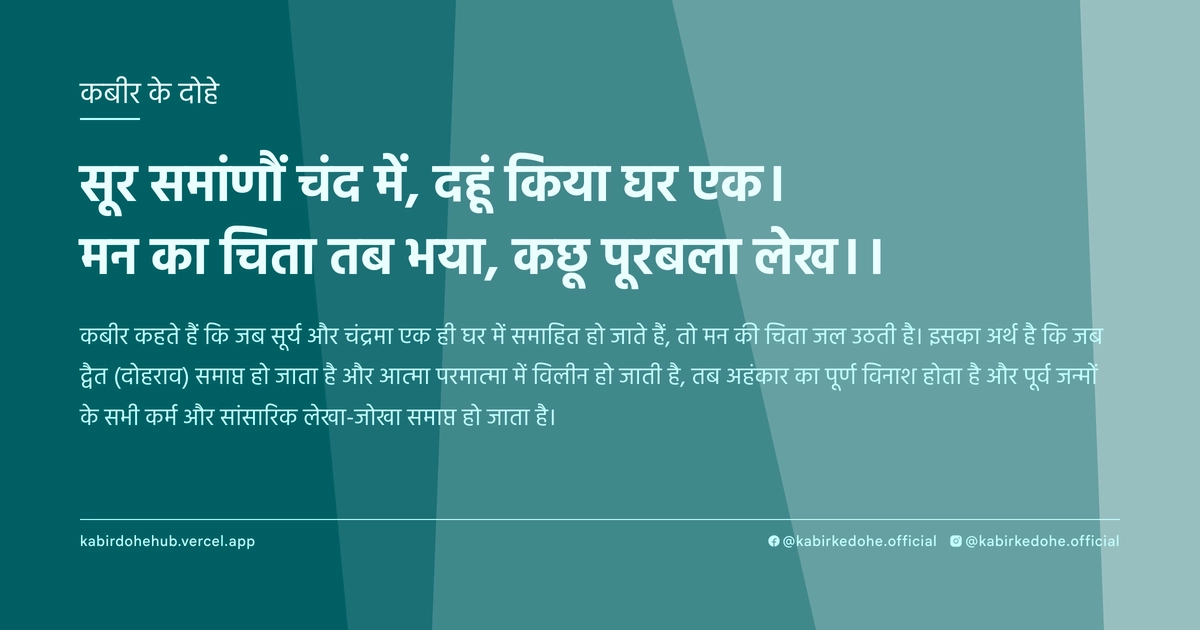
सूर समांणौं चंद में, दहूं किया घर एक।
मन का चिता तब भया, कछू पूरबला लेख।।
Sur samanau chand me, dahu kiya ghar ek. Man ka chita tab bhaya, kachhu purbala lekh.
इस पृष्ठ पर इस कबीर दोहे का अर्थ (meaning), हिंदी व्याख्या और अंग्रेज़ी अनुवाद, दार्शनिक विश्लेषण और व्यावहारिक जीवन सीख दी गई है। यह दोहा आत्मनिरीक्षण (Self-introspection) विषय से जुड़ा है — Kabir doha meaning and explanation in Hindi and English.
अर्थ (Meaning):
कबीर कहते हैं कि जब सूर्य और चंद्रमा एक ही घर में समाहित हो जाते हैं, तो मन की चिता जल उठती है। इसका अर्थ है कि जब द्वैत (दोहराव) समाप्त हो जाता है और आत्मा परमात्मा में विलीन हो जाती है, तब अहंकार का पूर्ण विनाश होता है और पूर्व जन्मों के सभी कर्म और सांसारिक लेखा-जोखा समाप्त हो जाता है।
Kabir suggests that when the sun and the moon merge into a single abode, the funeral pyre of the mind is ignited. This signifies that when duality vanishes and the individual soul merges with the Universal Consciousness, the ego is utterly consumed, erasing all previous karmic accounts and worldly attachments.
व्याख्या (Interpretation):
यहाँ 'सूर्य' और 'चंद्र' विपरीत प्रवृत्तियों, जैसे ज्ञान और भावना, या पुरुष और प्रकृति के प्रतीक हैं। जब ये दोनों एक बिंदु पर मिलते हैं, तो वह अवस्था 'अद्वैत' की होती है। 'मन की चिता' का अर्थ शारीरिक मृत्यु नहीं, बल्कि मानसिक अहंकार (I-ness) का दहन है। यह निरगुण भक्ति का चरम है जहाँ साधक यह अनुभव करता है कि वह और ईश्वर अलग नहीं हैं। माया का पर्दा हटते ही, व्यक्ति को बोध होता है कि जिसे वह 'अपना' कह रहा था, वह केवल एक भ्रम था। इस मिलन में पुराने संस्कारों का क्षय होता है, जिससे आत्मा पूर्णतः मुक्त हो जाती है।
Here, the 'Sun' and 'Moon' symbolize opposing forces, such as knowledge and emotion, or the masculine and feminine principles of existence. When these two merge into one 'house,' it represents the state of Advaita (non-duality). The 'funeral pyre of the mind' does not refer to physical death, but to the incineration of the ego and the false sense of separate identity. This is the pinnacle of Nirgun Bhakti, where the seeker realizes that the self and the Divine are one. As the veil of Maya lifts, the illusion of 'mine' and 'thine' dissolves. In this union, all past karmic imprints are erased, leading to absolute spiritual liberation.
दार्शनिक विश्लेषण (Philosophical Analysis):
कबीर का यह दोहा मध्यकालीन भारत के उस सामाजिक-धार्मिक संघर्ष का प्रतिबिंब है जहाँ धर्म को बाहरी कर्मकांडों और विभाजनों में बाँटा गया था। कबीर ने स्पष्ट रूप से मंदिर-मस्जिद के द्वंद्व को नकारते हुए 'एक' की बात की है। यह दर्शन अद्वैत वेदांत के करीब है, जहाँ ब्रह्म ही एकमात्र सत्य है और जगत मिथ्या है।
सूफीवाद के 'फना' (annihilation) के सिद्धांत के साथ इसका गहरा संबंध है, जहाँ प्रेमी (साधक) अपने अस्तित्व को मिटाकर प्रिय (परमात्मा) में लीन हो जाता है। कबीर यहाँ तर्क देते हैं कि जब तक मन में 'मैं' और 'तू' का भेद है, तब तक मुक्ति संभव नहीं है।
ritualism के प्रति उनकी घृणा यहाँ स्पष्ट है; वे कहते हैं कि कोई भी बाहरी पूजा तब तक व्यर्थ है जब तक आंतरिक द्वंद्व समाप्त न हो जाए। यह मनोवैज्ञानिक रूपांतरण की प्रक्रिया है जहाँ व्यक्ति अपनी पहचान को सामाजिक पद, जाति या धर्म से हटाकर शुद्ध चेतना में स्थापित करता है।
अहंकार का दहन ही वास्तविक ज्ञान है। अधिकांश लोग ज्ञान को सूचना मानते हैं, लेकिन कबीर के लिए ज्ञान वह अग्नि है जो अज्ञानता के कूड़े को जला देती है। यह एक क्रांतिकारी विचार था जिसने तत्कालीन समाज की रूढ़ियों को चुनौती दी।
अंततः, यह दोहा हमें सिखाता है कि मोक्ष कहीं बाहर नहीं, बल्कि भीतर के विरोधाभासों के समाधान में है। जब विपरीत विचार एक लय में आ जाते हैं, तब मनुष्य अपनी वास्तविक प्रकृति को पहचान लेता है और जन्म-मृत्यु के चक्र से मुक्त हो जाता है।
This couplet reflects the socio-religious turmoil of medieval India, where spirituality was fragmented into external rituals and rigid divisions. Kabir explicitly rejects the duality of temple and mosque, advocating for the 'One.' This philosophy aligns closely with Advaita Vedanta, asserting that Brahman is the only reality and the perceived world is Maya.
There is a profound connection here to the Sufi concept of 'Fana' (annihilation), where the lover (seeker) dissolves their individual existence into the Beloved (Divine). Kabir argues that liberation is impossible as long as the distinction between 'I' and 'Thou' persists.
His disdain for ritualism is evident; he suggests that external worship is futile unless internal contradictions are resolved. This is a process of psychological transformation where the individual shifts their identity from social status, caste, or religion to pure consciousness.
The incineration of the ego is the only true knowledge. While most perceive knowledge as the accumulation of information, Kabir views it as a fire that consumes the debris of ignorance. This was a revolutionary stance that challenged the orthodoxies of his time.
Ultimately, the Doha teaches that salvation is not found externally but in the resolution of internal opposites. When conflicting thoughts harmonize into a single rhythm, the human recognizes their true nature and breaks the cycle of birth and death.
मूल संदेश (Core Message):
- द्वैत का अंत ही वास्तविक शांति का आरंभ है।
- अहंकार की मृत्यु के बिना आत्मा का पुनर्जन्म असंभव है।
- विरोधाभासों का मिलन ही परमात्मा की प्राप्ति है।
- सांसारिक लेखा-जोखा केवल माया का एक जाल है।
- जब 'मैं' मिटता है, तब केवल 'वह' (ब्रह्म) शेष रहता है।
- The end of duality is the beginning of true peace.
- Rebirth of the soul is impossible without the death of the ego.
- The union of opposites is the realization of the Divine.
- Worldly accounts are merely a web woven by Maya.
- When the 'I' vanishes, only the 'One' remains.
व्यावहारिक उदाहरण (Practical Example):
वाराणसी के घाटों पर रहने वाले एक वृद्ध विधवा, जानकी, का जीवन केवल शोक और कठोर नियमों में बीता था। वह मानती थीं कि उनका जीवन केवल पापों के प्रायश्चित और मृत्यु की प्रतीक्षा के लिए है।
वह हर दिन गंगा किनारे बैठकर केवल अपनी विरह वेदना और पुराने दुखों को याद करती थीं, जिससे उनका मन एक अंतहीन युद्धक्षेत्र बना रहता था।
एक दिन उनकी मुलाकात एक घुमंतू साधु से हुई, जिन्होंने उन्हें कबीर का यह दोहा सुनाया और समझाया कि दुख और सुख, विरह और मिलन वास्तव में एक ही सिक्के के दो पहलू हैं।
साधु ने उनसे कहा, "जब तक आप अपने दुख को खुद से अलग मानकर उससे लड़ेंगी, आप कभी शांत नहीं होंगी। जिस दिन आप दुख को ही परमात्मा का रूप मानकर उसमें समा जाएंगी, आपका अहंकार जल जाएगा।"
जानकी ने इस विचार पर मंथन किया। उन्होंने महसूस किया कि उनका 'शोक' वास्तव में उनका अहंकार था, जो यह मान रहा था कि उनके साथ अन्याय हुआ है।
धीरे-धीरे उन्होंने अपनी पीड़ा को स्वीकार करना शुरू किया और उसे ब्रह्मांडीय प्रेम में बदल दिया। उन्होंने देखा कि उनकी व्यक्तिगत व्यथा अब पूरी मानवता की व्यथा बन गई है।
एक सुबह, जब सूर्य और चंद्रमा के मिलन जैसा एक आंतरिक मौन उनके भीतर उतरा, उन्हें महसूस हुआ कि अब न कोई शिकायत बची है और न कोई इच्छा।
उनका मन, जो अब तक यादों की चिता में जल रहा था, अब शांति की राख में बदल गया था। उन्होंने अपने जीवन के सभी पुराने 'लेखा-जोखा' (शिकायतों की सूची) को त्याग दिया।
जानकी अब केवल एक विधवा नहीं थीं, बल्कि एक ऐसी चेतना बन गईं जो हर किसी में ईश्वर देखती थीं। उनके चेहरे पर एक ऐसी मुस्कान थी जो किसी भी सांसारिक सुख से परे थी।
इस 'कबीर ट्विस्ट' ने उन्हें एक पीड़ित से एक मुक्त आत्मा में बदल दिया, जिससे उनके जीवन का अंतिम समय भय के बजाय आनंद में बीता।
Janaki, an elderly widow living on the ghats of Varanasi, had spent her life bound by grief and rigid social restrictions. She believed her existence was merely for the atonement of sins and the anticipation of death.
Every day, sitting by the Ganges, she dwelled upon her loneliness and past sorrows, turning her mind into an endless battlefield of regrets.
One day, she met a wandering monk who recited this Doha and explained that sorrow and joy, separation and union, are actually two sides of the same coin.
The monk told her, "As long as you fight your grief as something separate from yourself, you will never find peace. The day you embrace your sorrow as a form of the Divine, your ego will burn away."
Janaki pondered this. She realized that her 'grief' was actually her ego, clinging to the belief that she had been treated unfairly by fate.
Slowly, she began to accept her pain and transform it into universal love. She noticed that her personal agony was merging into the collective suffering of all humanity.
One morning, as an internal silence—akin to the merging of the sun and moon—descended upon her, she felt that no complaints or desires remained.
Her mind, which had been burning in the pyre of memories, turned into the ash of absolute peace. She discarded the entire 'account book' of her life's grievances.
Janaki was no longer just a widow; she became a consciousness that saw the Divine in everyone. A smile graced her face, one that transcended all worldly pleasures.
This 'Kabir Twist' transformed her from a victim into a liberated soul, ensuring that the final chapter of her life was written in joy rather than fear.
अभ्यास मार्गदर्शन (Practice Guidance):
- प्रतिदिन 20 मिनट मौन ध्यान करें, जहाँ आप अपने भीतर के विपरीत विचारों (जैसे क्रोध और प्रेम) को एक साथ देखने का प्रयास करें बिना किसी निर्णय के।
- एक 'अहंकार पत्रिका' (Ego Journal) बनाएँ। लिखें कि दिन भर में कितनी बार आपने 'मैं', 'मेरा' या 'मेरे साथ ऐसा क्यों हुआ' जैसे शब्दों का प्रयोग किया।
- जब भी मन में द्वंद्व हो, स्वयं से पूछें: "क्या यह संघर्ष सत्य है, या यह केवल मेरी धारणाओं का टकराव है?"
- निदान चेकलिस्ट: यदि आप अभी भी दूसरों की गलतियों का हिसाब रख रहे हैं या अतीत की कड़वाहट को ढो रहे हैं, तो इसका अर्थ है कि आपकी 'मन की चिता' अभी पूरी तरह नहीं जली है।
- Practice 20 minutes of silent meditation daily, observing opposing thoughts (e.g., anger and love) simultaneously without judgment.
- Maintain an 'Ego Journal.' Record how many times a day you used words like 'I,' 'Mine,' or 'Why did this happen to me?'
- Whenever a mental conflict arises, ask yourself: "Is this struggle real, or is it merely a clash of my own perceptions?"
- Diagnostic Checklist: If you are still keeping a tally of others' mistakes or carrying bitterness from the past, your 'mind's pyre' has not yet fully consumed the ego.
चिंतन प्रश्न (Reflection Questions):
- मेरे व्यक्तित्व का वह कौन सा हिस्सा है जिसे मैं खोने से सबसे ज्यादा डरता हूँ?
- क्या मेरी धार्मिक पहचान मुझे दूसरों से जोड़ती है या मुझे श्रेष्ठता का भ्रम देती है?
- यदि मेरा सारा सामाजिक सम्मान और उपलब्धियां छीन ली जाएं, तो मेरे भीतर क्या बचेगा?
- मैं किन पुरानी शिकायतों को 'लेखा-जोखा' की तरह पकड़ कर बैठा हूँ, जो मुझे वर्तमान से दूर रखती हैं?
- क्या मैं वास्तव में शांति चाहता हूँ, या मैं केवल अपने विचारों की जीत चाहता हूँ?
- Which part of my identity am I most terrified of losing?
- Does my religious identity connect me to others, or does it feed a delusion of superiority?
- If all my social status and achievements were stripped away, what would remain within me?
- What old grievances am I holding onto like an account book, keeping me detached from the present?
- Do I truly desire peace, or do I simply desire the victory of my own perspectives?