
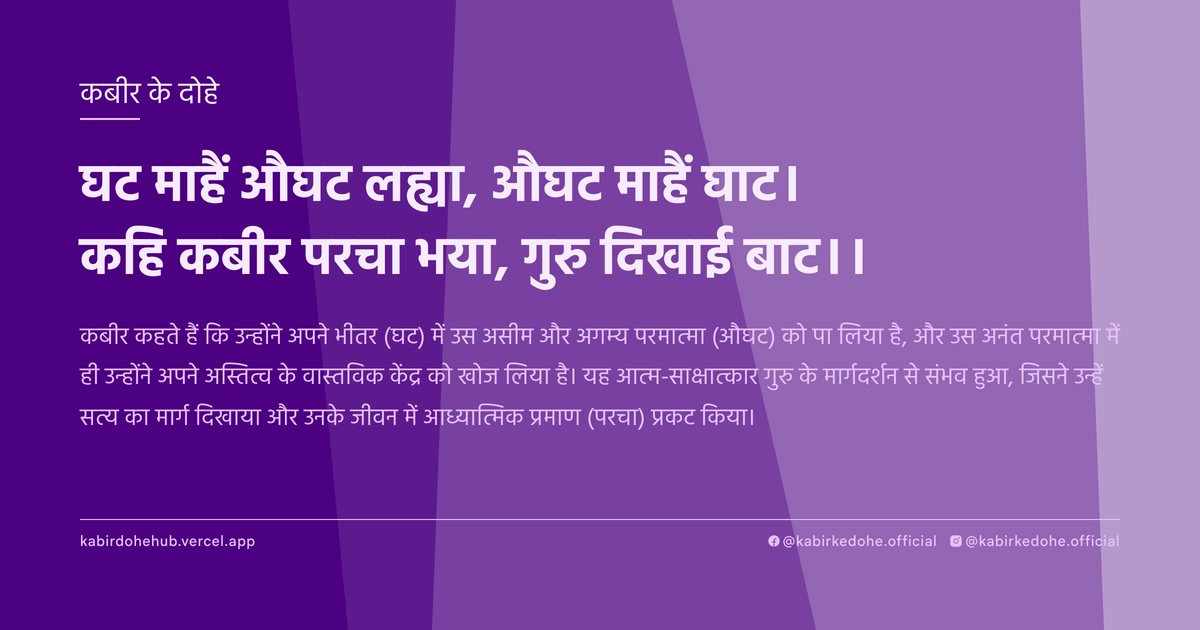
घट माहैं औघट लह्या, औघट माहैं घाट।
कहि कबीर परचा भया, गुरु दिखाई बाट।।
Ghat maahin aughat lahya, aughat maahin ghat. Kahi Kabir parcha bhaya, guru dikhayi baat.
इस पृष्ठ पर इस कबीर दोहे का अर्थ (meaning), हिंदी व्याख्या और अंग्रेज़ी अनुवाद, दार्शनिक विश्लेषण और व्यावहारिक जीवन सीख दी गई है। यह दोहा गुरु महत्व (The Guru's Importance) विषय से जुड़ा है — Kabir doha meaning and explanation in Hindi and English.
अर्थ (Meaning):
कबीर कहते हैं कि उन्होंने अपने भीतर (घट) में उस असीम और अगम्य परमात्मा (औघट) को पा लिया है, और उस अनंत परमात्मा में ही उन्होंने अपने अस्तित्व के वास्तविक केंद्र को खोज लिया है। यह आत्म-साक्षात्कार गुरु के मार्गदर्शन से संभव हुआ, जिसने उन्हें सत्य का मार्ग दिखाया और उनके जीवन में आध्यात्मिक प्रमाण (परचा) प्रकट किया।
Kabir proclaims that within the small vessel of the human body (Ghat), he has discovered the unfathomable, infinite Divine (Aughat), and within that infinity, he has found the true essence of his own being. This profound realization was made possible through the guidance of the Guru, who illuminated the path and manifested the spiritual evidence of truth in his life.
व्याख्या (Interpretation):
इस दोहे में 'घट' शरीर या व्यक्तिगत अहंकार का प्रतीक है, जबकि 'औघट' उस असीम ब्रह्म का, जिसकी कोई सीमा नहीं है। कबीर यहाँ एक महान विरोधाभास प्रस्तुत करते हैं: वह जो अनंत है, वह इस सीमित शरीर के भीतर ही निवास करता है। यह अद्वैत वेदांत के 'अहं ब्रह्मास्मि' के सिद्धांत को दर्शाता है, जहाँ आत्मा और परमात्मा का भेद मिट जाता है। जब साधक माया के पर्दे हटते ही यह अनुभव करता है कि वह स्वयं वह अनंत है, तो वह 'परचा' या आध्यात्मिक प्रमाण प्राप्त करता है। यह अनुभव केवल बौद्धिक नहीं, बल्कि अनुभवात्मक है। गुरु यहाँ केवल एक शिक्षक नहीं, बल्कि वह प्रकाश है जो साधक को बाहरी कर्मकांडों से हटाकर अंतर्मुखी बनाता है। अंततः, यह दोहा सिखाता है कि सत्य कहीं बाहर खोजने की वस्तु नहीं, बल्कि भीतर की गहराई में उतरने की प्रक्रिया है।
In this couplet, 'Ghat' symbolizes the physical body or the limited ego, while 'Aughat' represents the unfathomable, boundless Divine. Kabir presents a profound paradox: the Infinite resides within the finite vessel of the human form. This aligns with the Advaita Vedanta principle of 'Aham Brahmasmi' (I am Brahman), where the duality between the individual soul and the Universal Spirit dissolves. When the seeker pierces through the veil of Maya (illusion), they realize that the vastness of the cosmos is mirrored within their own heart, leading to a 'Parcha' or a spiritual manifestation of truth. This realization is not an intellectual exercise but a direct experiential shift. The Guru serves not merely as a teacher but as the catalyst who redirects the seeker's gaze from external rituals to internal stillness. Ultimately, the verse teaches that Truth is not an object to be sought externally, but a state of being to be uncovered within.
दार्शनिक विश्लेषण (Philosophical Analysis):
कबीर का यह दृष्टिकोण निर्गुण भक्ति की पराकाष्ठा है, जहाँ ईश्वर किसी मूर्ति या मंदिर में नहीं, बल्कि चेतना के उच्चतम स्तर पर अनुभव किया जाता है। उनके समय में धर्म बाहरी आडंबरों, तीर्थयात्राओं और जातिगत श्रेष्ठता में जकड़ा हुआ था। कबीर ने इन सबको नकारते हुए 'सहज' मार्ग पर जोर दिया। उन्होंने यह स्थापित किया कि यदि परमात्मा सर्वव्यापी है, तो वह मनुष्य के भीतर भी होना चाहिए।
यह दर्शन सूफी मत के 'इंसान-ए-कामिल' (पूर्ण मनुष्य) के विचार से मेल खाता है, जहाँ मनुष्य अपने भीतर के ईश्वरीय नूर को पहचानकर पूर्णता प्राप्त करता है। कबीर का 'औघट' वही नूर है जो सीमाओं से परे है। यहाँ अहंकार का विसर्जन अनिवार्य है; जब तक 'मैं' (छोटा घट) मौजूद है, तब तक 'वह' (अनंत औघट) प्रकट नहीं हो सकता।
अद्वैत वेदांत के परिप्रेक्ष्य में, यह दोहा जीव और ब्रह्म की एकता की घोषणा है। कबीर तर्क देते हैं कि अज्ञानता ही वह पर्दा है जो हमें यह विश्वास दिलाता है कि हम अलग हैं। जब गुरु का ज्ञान इस अज्ञान को नष्ट करता है, तो साधक को यह बोध होता है कि वह सागर की एक बूंद नहीं, बल्कि बूंद के रूप में पूरा सागर है।
कबीर की इस शिक्षा में सामाजिक क्रांति भी छिपी है। यदि हर व्यक्ति के भीतर वही दिव्य तत्व है, तो जाति, वर्ण और धर्म के आधार पर भेदभाव करना हास्यास्पद है। यह विचार मनुष्य को उसकी सामाजिक पहचान से ऊपर उठाकर एक वैश्विक आध्यात्मिक पहचान प्रदान करता है।
मनोवैज्ञानिक स्तर पर, यह 'स्व' (Self) के विस्तार की प्रक्रिया है। व्यक्ति अपनी संकीर्ण पहचान (नाम, पेशा, जाति) से मुक्त होकर ब्रह्मांडीय चेतना के साथ एकाकार होता है। यह मानसिक शांति और भयमुक्ति का एकमात्र मार्ग है, क्योंकि जो अनंत है, उसे मृत्यु या हानि का भय नहीं होता।
Kabir's perspective represents the pinnacle of Nirgun Bhakti, where the Divine is not found in idols or temples but experienced at the highest level of consciousness. During his era, religion was shackled by external rituals, pilgrimages, and caste hierarchies. Kabir rejected these, emphasizing the 'Sahaj' (natural/spontaneous) path, asserting that if the Divine is omnipresent, it must necessarily reside within the human being.
This philosophy resonates with the Sufi concept of 'Insan-e-Kamil' (the Perfect Human), where an individual attains perfection by recognizing the Divine Light (Noor) within. Kabir's 'Aughat' is that very light which transcends all boundaries. In this process, the annihilation of the ego is mandatory; as long as the 'I' (the small vessel) exists, the 'Infinite' cannot manifest.
From the lens of Advaita Vedanta, this doha is a proclamation of the non-duality of the Jiva (individual soul) and Brahman (Universal Soul). Kabir argues that ignorance is the only veil creating the illusion of separation. When the Guru's wisdom shatters this ignorance, the seeker realizes they are not a drop in the ocean, but the entire ocean in a single drop.
There is a hidden social revolution in this teaching. If the same divine element resides in every person, then discrimination based on caste, creed, or religion becomes absurd. This perspective elevates the human being above social identities, granting them a universal spiritual identity.
Psychologically, this is a process of expanding the 'Self.' The individual transcends their narrow identity—name, profession, or social status—and merges with cosmic consciousness. This is the only path to true mental peace and liberation from fear, for that which is infinite cannot be touched by death or loss.
मूल संदेश (Core Message):
- बाहरी खोज व्यर्थ है, सत्य अंतर्मन की गहराई में स्थित है।
- अहंकार की सीमितता को तोड़कर ही अनंत का अनुभव संभव है।
- गुरु वह कुंजी है जो आंतरिक द्वार खोलकर परमात्मा से मिलाती है।
- आत्मा और परमात्मा अलग नहीं, बल्कि एक ही तत्व के दो रूप हैं।
- साक्षात्कार का प्रमाण बाहरी चमत्कार नहीं, बल्कि आंतरिक शांति है।
- External searches are futile; Truth resides in the depths of the inner self.
- The experience of the Infinite is possible only by breaking the limits of ego.
- The Guru is the key that opens the inner door to the Divine.
- Soul and Supreme Soul are not separate, but two forms of one essence.
- The proof of realization is not external miracles, but internal serenity.
व्यावहारिक उदाहरण (Practical Example):
वाराणसी के एक पुराने घाट पर माधव नाम का एक वृद्ध नाविक रहता था। माधव का पूरा जीवन दूसरों को नदी पार कराने में बीत गया, लेकिन उसका अपना मन अशांति और क्रोध के भंवर में फंसा रहता था। वह अक्सर अपनी गरीबी और किस्मत को कोसता था, यह मानते हुए कि ईश्वर केवल अमीर पुजारियों और ऊंचे कुल के लोगों की सुनता है।
एक दिन, उसकी नाव पर एक फकीर सवार हुआ, जिसकी आँखों में एक अजीब सी शांति थी। माधव ने गुस्से में फकीर से कहा, "बाबा, इस दुनिया में कोई न्याय नहीं है, हम जैसे छोटे लोगों के लिए ईश्वर केवल एक सपना है।"
फकीर मुस्कुराया और उसने माधव से पूछा, "नाविक, तूने इस नदी की गहराई को मापा है?" माधव ने गर्व से कहा, "हाँ, मैं इसके हर मोड़ को जानता हूँ।"
फकीर ने धीरे से कहा, "जिस नदी को तू बाहर देख रहा है, वही नदी तेरे भीतर भी बह रही है। तू बाहर लहरें गिन रहा है, जबकि गहराई तेरे अपने हृदय में है। तू खुद को एक छोटी नाव समझ रहा है, जबकि तू वह पूरा सागर है जिसमें यह नदी गिरती है।"
माधव को पहले यह बात समझ नहीं आई, लेकिन फकीर के शब्दों ने उसके भीतर एक बीज बो दिया। उसने अपनी नाव चलाना जारी रखा, लेकिन अब वह हर सवारी को केवल एक यात्री नहीं, बल्कि अपने ही स्वरूप का विस्तार मानने लगा।
धीरे-धीरे, माधव का क्रोध शांत होने लगा। उसने महसूस किया कि जब वह दूसरों की मदद करता था, तो उसे जो खुशी मिलती थी, वह वास्तव में उसके अपने ही भीतर की शांति थी। उसने बाहरी मंदिर जाना छोड़ दिया और अपने हृदय को ही मंदिर बना लिया।
एक दिन, एक बहुत अमीर व्यापारी उसकी नाव पर आया और उसे सोने की मोहरें देने की पेशकश की ताकि वह उसे जल्दी पार कराए। माधव ने शांति से मना कर दिया और कहा, "समय सबका एक ही है, चाहे वह सोने का हो या मिट्टी का। हम सब एक ही अनंत यात्रा पर हैं।"
व्यापारी उसकी इस निडरता और शांति को देखकर दंग रह गया। माधव अब केवल एक नाविक नहीं था; वह एक जागृत आत्मा बन चुका था। उसने जान लिया था कि उसका 'घट' (छोटा शरीर) वास्तव में 'औघट' (अनंत ईश्वर) का घर है।
उसकी इस आंतरिक क्रांति ने पूरे घाट के माहौल को बदल दिया। लोग अब उसके पास केवल नदी पार करने नहीं, बल्कि जीवन की उलझनों का समाधान खोजने आने लगे। माधव ने गुरु के शब्दों को अपने जीवन में उतारकर यह सिद्ध कर दिया कि सत्य कहीं दूर नहीं, बल्कि हमारे भीतर ही छिपा है।
अंततः, माधव की मृत्यु के समय उसके चेहरे पर एक ऐसी मुस्कान थी, जैसे वह किसी बहुत पुराने मित्र से मिल रहा हो। उसने अपनी सीमित पहचान को त्याग कर उस अनंत में विलीन होने का 'परचा' पा लिया था।
On an ancient ghat in Varanasi lived an elderly boatman named Madhav. Madhav had spent his entire life ferrying others across the river, yet his own mind remained trapped in whirlpools of unrest and anger. He often cursed his poverty and fate, believing that God only listened to wealthy priests and those of high birth.
One day, a wandering dervish boarded his boat, carrying a strange, profound peace in his eyes. In a fit of frustration, Madhav told the dervish, "Baba, there is no justice in this world; for small people like us, God is nothing but a dream."
The dervish smiled and asked, "Boatman, have you measured the depths of this river?" Madhav replied with pride, "Yes, I know every bend and current of this water."
The dervish softly replied, "The river you see outside is also flowing within you. You are counting the waves on the surface, while the true depth lies within your own heart. You perceive yourself as a small boat, yet you are the entire ocean into which this river flows."
Madhav did not understand at first, but the dervish's words planted a seed. He continued rowing his boat, but now he began to see every passenger not as a stranger, but as an extension of his own being.
Gradually, Madhav's anger subsided. He realized that the joy he felt while helping others was actually the reflection of the peace within himself. He stopped visiting external temples and turned his own heart into a sanctuary.
One day, a wealthy merchant boarded his boat and offered gold coins to be ferried across faster. Madhav calmly declined, saying, "Time is the same for everyone, whether they carry gold or clay. We are all on the same infinite journey."
The merchant was stunned by his fearlessness and serenity. Madhav was no longer just a boatman; he had become an awakened soul. He had realized that his 'Ghat' (small body) was in fact the home of the 'Aughat' (Infinite Divine).
This internal revolution transformed the atmosphere of the entire ghat. People no longer came to him just to cross the river, but to find solutions to their life's turmoil. By embodying the Guru's words, Madhav proved that Truth is not distant, but hidden within.
Ultimately, at the moment of his death, a smile graced Madhav's face, as if he were meeting an old friend. He had found the 'Parcha'—the evidence—of merging his limited identity into the Infinite.
अभ्यास मार्गदर्शन (Practice Guidance):
- प्रतिदिन 20 मिनट मौन अभ्यास करें, जहाँ आप अपने शरीर को एक छोटे पात्र (घट) और अपनी चेतना को एक अनंत आकाश (औघट) के रूप में महसूस करें।
- एक 'स्व-अन्वेषण जर्नल' बनाएँ। प्रतिदिन लिखें कि आज आपने अपनी किस सीमित पहचान (जैसे- क्रोध, पद, या जाति) को ईश्वरीय प्रेम में विलीन किया।
- जब भी आप किसी से विवाद करें, रुककर सोचें: "क्या मैं इस व्यक्ति के बाहरी रूप से लड़ रहा हूँ या उसके भीतर छिपे उसी अनंत तत्व से बात कर रहा हूँ?"
- निदान चेकलिस्ट: यदि आप अभी भी बाहरी प्रशंसा के भूखे हैं या दूसरों को छोटा समझते हैं, तो आप 'घट' (अहंकार) में फंसे हैं। यदि आप हर जीव में स्वयं को देखते हैं, तो आप 'औघट' की ओर बढ़ रहे हैं।
- Practice 20 minutes of daily silence, visualizing your body as a small vessel (Ghat) and your consciousness as the infinite sky (Aughat).
- Maintain a 'Self-Inquiry Journal.' Each day, record which limited identity (e.g., anger, status, or caste) you dissolved into divine love.
- Whenever you encounter conflict, pause and ask: "Am I fighting this person's external mask, or am I speaking to the same Infinite Element residing within them?"
- Diagnostic Checklist: If you still crave external validation or perceive others as inferior, you are trapped in the 'Ghat' (ego). If you see yourself in every living being, you are moving toward the 'Aughat' (Infinite).
चिंतन प्रश्न (Reflection Questions):
- आपकी वह कौन सी 'सामाजिक पहचान' है जिसे आप सबसे अधिक पकड़ कर रखते हैं, और वह आपको अनंत होने से कैसे रोक रही है?
- क्या आप वास्तव में दूसरों की मदद करते हैं, या आप अपनी 'मदद करने वाले' की छवि (डिजिटल या सामाजिक ईगो) को संतुष्ट कर रहे हैं?
- यदि आज आपकी सारी उपलब्धियाँ और पद छीन लिए जाएँ, तो आपके भीतर क्या बचेगा?
- आपकी अंतरात्मा में वह कौन सा डर है जो आपको यह मानने से रोकता है कि आप स्वयं पूर्ण और दिव्य हैं?
- क्या आपका धर्म आपको दूसरों से जोड़ने का माध्यम है या उन्हें छोटा दिखाने का हथियार?
- Which 'social identity' do you cling to most tightly, and how is it preventing you from experiencing your own infinity?
- Do you truly help others, or are you merely satisfying the image of being a 'helper' (digital or social ego)?
- If all your achievements and titles were stripped away today, what would remain within you?
- What is the hidden fear in your soul that prevents you from believing that you are already complete and divine?
- Is your religion a bridge to connect you with others, or a weapon to make them feel inferior?