
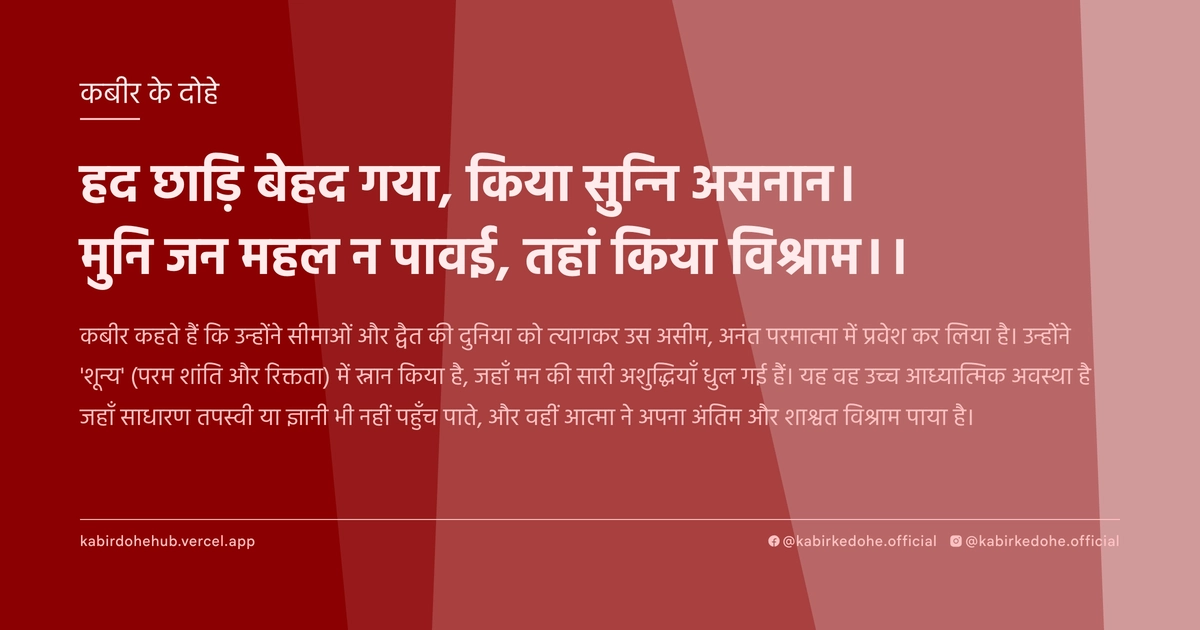
हद छाड़ि बेहद गया, किया सुन्नि असनान।
मुनि जन महल न पावई, तहां किया विश्राम।।
Had chhad behad gaya, kiya sunni asnan. Muni jan mahal na pavai, taha kiya vishram.
इस पृष्ठ पर इस कबीर दोहे का अर्थ (meaning), हिंदी व्याख्या और अंग्रेज़ी अनुवाद, दार्शनिक विश्लेषण और व्यावहारिक जीवन सीख दी गई है। यह दोहा ध्यान (Meditation) विषय से जुड़ा है — Kabir doha meaning and explanation in Hindi and English.
अर्थ (Meaning):
कबीर कहते हैं कि उन्होंने सीमाओं और द्वैत की दुनिया को त्यागकर उस असीम, अनंत परमात्मा में प्रवेश कर लिया है। उन्होंने 'शून्य' (परम शांति और रिक्तता) में स्नान किया है, जहाँ मन की सारी अशुद्धियाँ धुल गई हैं। यह वह उच्च आध्यात्मिक अवस्था है जहाँ साधारण तपस्वी या ज्ञानी भी नहीं पहुँच पाते, और वहीं आत्मा ने अपना अंतिम और शाश्वत विश्राम पाया है।
Kabir proclaims that he has transcended the boundaries of the finite world to merge with the Infinite. He has bathed in the 'Shunya' (the Great Void), cleansing himself of all worldly impurities and dualities. This is a state of supreme consciousness that even the most learned sages struggle to attain, and it is here that the soul has finally found its eternal and absolute rest.
व्याख्या (Interpretation):
इस दोहे में 'हद' का अर्थ है सीमाएं—जैसे शरीर, जाति, धर्म और अहंकार। 'बेहद' वह असीम चेतना है जो इन सीमाओं से परे है। 'सुन्नी असनान' का अर्थ केवल शारीरिक स्नान नहीं, बल्कि शून्य में विलीन होना है, जहाँ ज्ञाता, ज्ञान और ज्ञेय का भेद मिट जाता है। यह निर्गुण भक्ति का शिखर है जहाँ आत्मा ब्रह्म में लीन हो जाती है। कबीर यहाँ अद्वैत वेदांत की उस स्थिति का वर्णन कर रहे हैं जहाँ 'मैं' और 'तू' का अंतर समाप्त हो जाता है। यह विरोधाभास है कि जिसे दुनिया 'शून्य' या रिक्तता कहती है, वही वास्तव में पूर्णता है। यहाँ विश्राम का अर्थ आलस्य नहीं, बल्कि संघर्षों का अंत और परम शांति की प्राप्ति है।
In this verse, 'Had' represents the limitations of the finite—the body, caste, creed, and the ego. 'Behad' is the Infinite Consciousness that exists beyond these boundaries. 'Sunni Asnaan' refers not to a physical bath, but to a spiritual immersion in the Void, where the distinction between the knower, the known, and the knowledge dissolves. This represents the pinnacle of Nirgun Bhakti, where the individual soul merges into the formless Absolute. Kabir describes the state of Advaita Vedanta, where the duality of 'I' and 'Thou' vanishes. The central paradox is that what the world perceives as 'Shunya' (emptiness) is actually 'Purnata' (fullness). Rest here does not mean inactivity, but the cessation of all spiritual struggle and the attainment of absolute peace.
दार्शनिक विश्लेषण (Philosophical Analysis):
कबीर का यह दोहा उनके युग के कर्मकांडीय धर्म के विरुद्ध एक सशक्त प्रहार है। उस समय धर्म बाहरी प्रतीकों, तीर्थों और कठोर तपस्या (मुनि जन) तक सीमित था। कबीर तर्क देते हैं कि मोक्ष किसी बाहरी यात्रा या कठिन शारीरिक तप से नहीं, बल्कि आंतरिक शून्यता और अहंकार के विसर्जन से मिलता है। वे यहाँ 'शून्य' की अवधारणा को सूफी मत के 'फना' (अहंकार का विनाश) और बौद्ध धर्म के 'शून्यता' से जोड़ते हैं।
दार्शनिक स्तर पर, यह अद्वैत वेदांत के उस सत्य की पुष्टि करता है जहाँ माया का पर्दा हटते ही यह बोध होता है कि आत्मा और परमात्मा एक ही हैं। 'हद' वह माया है जो हमें अलग-अलग महसूस कराती है। जब साधक इस सीमा को पार करता है, तो वह उस सत्य को अनुभव करता है जो शब्दों और तर्क से परे है।
कबीर ने स्पष्ट किया कि केवल शास्त्रों का ज्ञान या संन्यासी का चोला पहनना (मुनि जन) पर्याप्त नहीं है। वास्तविक ज्ञान वह है जो साधक को उसके अस्तित्व के मूल केंद्र तक ले जाए। यह मनोवैज्ञानिक रूपांतरण की प्रक्रिया है जहाँ व्यक्ति अपनी पहचान को सामाजिक और व्यक्तिगत लेबल से हटाकर सार्वभौमिक चेतना में विलीन कर देता है।
यहाँ 'स्नान' का रूपक अत्यंत गहरा है। जिस प्रकार जल शरीर की गंदगी साफ करता है, उसी प्रकार शून्य का अनुभव मन के विकारों, वासनाओं और द्वैत को मिटा देता है। यह एक ऐसी मानसिक स्थिति है जहाँ कोई इच्छा शेष नहीं रहती, क्योंकि साधक स्वयं वह बन जाता है जिसकी वह खोज कर रहा था।
अंततः, यह दोहा हमें सिखाता है कि परम सत्य किसी भौगोलिक स्थान या धार्मिक संस्था में नहीं, बल्कि स्वयं के भीतर की उस असीम गहराई में है जिसे हम अक्सर डर या अज्ञानता के कारण अनदेखा कर देते हैं। यह अहंकार की मृत्यु और आत्मा के पुनर्जन्म की घोषणा है।
This Doha is a powerful critique of the ritualistic religion of Kabir's era, where spirituality was confined to external symbols, pilgrimages, and rigorous asceticism (Muni Jan). Kabir argues that liberation is not achieved through external journeys or physical penance, but through internal emptiness and the dissolution of the ego. He aligns the concept of 'Shunya' with the Sufi notion of 'Fana' (annihilation of the self) and the Buddhist concept of 'Sunyata'.
Philosophically, this affirms the truth of Advaita Vedanta, where the lifting of the veil of Maya reveals that the Atman and Brahman are one. 'Had' is the illusion of separation. When the seeker transcends this limit, they experience a truth that lies beyond words and logic.
Kabir clarifies that mere scriptural knowledge or wearing the robes of a sanyasi is insufficient. True knowledge is that which leads the seeker to the core center of their existence. This is a process of psychological transformation where one shifts their identity from social and personal labels to a universal consciousness.
The metaphor of the 'bath' is profoundly deep. Just as water cleanses the body, the experience of the Void washes away the impurities of the mind, desires, and duality. It is a state of being where no longing remains, because the seeker has become that which they were seeking.
Ultimately, this verse teaches that the Ultimate Truth does not reside in a geographical location or a religious institution, but in the infinite depth within oneself, which we often ignore due to fear or ignorance. It is a declaration of the death of the ego and the rebirth of the soul into the Absolute.
मूल संदेश (Core Message):
- बाहरी सीमाओं और सामाजिक पहचान का मोह ही सबसे बड़ी बाधा है।
- परम शांति केवल अहंकार के पूर्ण विसर्जन (शून्य) में संभव है।
- आध्यात्मिक उपलब्धि कर्मकांडों से नहीं, बल्कि आंतरिक रूपांतरण से आती है।
- जब 'मैं' मिटता है, तभी 'वह' (अनंत) प्रकट होता है।
- सच्चा विश्राम संसार को छोड़ने में नहीं, बल्कि संसार के प्रति मोह छोड़ने में है।
- Attachment to external boundaries and social identities is the greatest obstacle.
- Supreme peace is possible only through the complete dissolution of the ego (the Void).
- Spiritual attainment comes from internal transformation, not from rituals.
- When the 'I' vanishes, only then does the 'Infinite' manifest.
- True rest is not in leaving the world, but in relinquishing attachment to it.
व्यावहारिक उदाहरण (Practical Example):
वाराणसी के एक पुराने मोहल्ले में माधव नाम का एक बुनकर रहता था। वह अपने काम में निपुण था, लेकिन उसका मन हमेशा इस बात से अशांत रहता था कि समाज उसे उसकी जाति के कारण छोटा समझता है। वह अक्सर मंदिरों के बाहर खड़ा होकर यह सोचता था कि क्या ईश्वर वास्तव में केवल उन्हीं के लिए है जो ऊंचे कुल में जन्मे हैं या जिन्होंने कठिन तपस्या की है।
माधव ने कई पंडितों और साधुओं से संपर्क किया, लेकिन उन्हें केवल नियमों, वर्जनाओं और कठिन अनुष्ठानों के बारे में बताया गया। उसे कहा गया कि उसे पहले अपनी 'अशुद्धता' को मिटाना होगा। माधव इस मानसिक बोझ तले दबा रहा, वह जितना प्रयास करता, उतना ही खुद को सीमित महसूस करता।
एक दिन उसकी मुलाकात एक घुमक्कड़ फकीर से हुई, जिसने माधव की बेचैनी को देखा। फकीर ने उससे कहा, "तू जिस सीमा को पार करने की कोशिश कर रहा है, वह बाहर नहीं, तेरे भीतर है। तू खुद को एक 'बुनकर' और 'नीच' मानकर अपनी सीमाएं खुद तय कर रहा है।"
माधव ने पूछा, "तो मैं क्या करूँ?" फकीर ने मुस्कुराते हुए कहा, "सब कुछ छोड़ दे। अपनी पहचान, अपना डर, अपनी उम्मीदें—सब कुछ शून्य कर दे। जब तू यह भूल जाएगा कि तू कौन है, तब तू जान पाएगा कि तू वास्तव में क्या है।"
माधव ने इस बात पर विचार करना शुरू किया। उसने ध्यान लगाया कि वह केवल एक शरीर या एक नाम नहीं है। उसने धीरे-धीरे अपने भीतर के उस शोर को शांत किया जो उसे बताता था कि वह 'अधूरा' है। उसने अपनी पहचान के सारे लेबल्स को एक-एक कर उतारना शुरू किया।
एक दोपहर, जब वह करघे पर काम कर रहा था, अचानक उसे एक गहरा अनुभव हुआ। उसे महसूस हुआ कि धागे, करघा, उसका शरीर और बाहर की दुनिया—सब एक ही ऊर्जा का हिस्सा हैं। वह 'मैं' जो दुखी था, वह गायब हो गया। वह एक ऐसी शांति में डूब गया जहाँ न कोई छोटा था, न बड़ा।
उसने अनुभव किया कि वह अब तक जिस 'हद' (सीमा) में कैद था, वह केवल उसके मन का भ्रम था। उसने उस शून्य का अनुभव किया जहाँ कोई भेद नहीं था। यह उसके लिए 'सुन्नी असनान' जैसा था, जिसने उसके मन की सारी कड़वाहट और हीन भावना को धो दिया।
अब माधव के जीवन में एक अद्भुत बदलाव आया। वह अब भी बुनता था, लेकिन अब वह काम उसके लिए बोझ नहीं, बल्कि प्रार्थना बन गया था। उसने अपनी जाति की चिंता छोड़ दी और हर इंसान में उसी असीम परमात्मा को देखने लगा।
उसका व्यवहार इतना शांत और प्रेमपूर्ण हो गया कि जो लोग पहले उसे तुच्छ समझते थे, वे अब उसके पास मानसिक शांति की तलाश में आने लगे। माधव ने उन्हें सिखाया कि मोक्ष किसी महल या मंदिर में नहीं, बल्कि अहंकार के विसर्जन में है।
माधव ने अंततः उस 'विश्राम' को पा लिया था जिसकी बात कबीर ने की थी। उसने जान लिया कि जब हम अपनी सीमाओं को छोड़ देते हैं, तभी हम वास्तव में अनंत हो जाते हैं।
In an old neighborhood of Varanasi lived a weaver named Madhav. He was skilled in his craft, but his mind was perpetually restless because society viewed him as inferior due to his caste. He would often stand outside temples, wondering if God was only for those born into high lineages or those who performed rigorous penance.
Madhav approached many pundits and sages, but they only spoke of rules, prohibitions, and complex rituals. He was told he must first cleanse his 'impurity.' Madhav remained crushed under this mental burden; the more he strove, the more limited he felt.
One day, he met a wandering fakir who noticed Madhav's distress. The fakir told him, "The boundary you are trying to cross is not outside, but within you. By identifying yourself as a 'weaver' and 'inferior,' you are creating your own limits."
Madhav asked, "Then what should I do?" The fakir smiled and said, "Let go of everything. Your identity, your fear, your expectations—reduce them all to zero. When you forget who you think you are, you will realize what you truly are."
Madhav began to contemplate this. He meditated on the fact that he was not merely a body or a name. He slowly silenced the internal noise that told him he was 'incomplete.' He began stripping away the labels of his identity one by one.
One afternoon, while working at his loom, he had a profound experience. He felt that the threads, the loom, his body, and the external world were all parts of the same single energy. The 'I' that was suffering vanished. He sank into a peace where there was no high or low.
He realized that the 'Had' (boundary) he had been imprisoned in was merely a delusion of his mind. He experienced that Void where no distinctions existed. It was like a 'Sunni Asnaan' (bath in the void), washing away all the bitterness and inferiority from his mind.
A wonderful change came over Madhav's life. He still wove, but his work was no longer a burden; it became a prayer. He stopped worrying about his caste and began seeing the same Infinite Divine in every human being.
His demeanor became so calm and loving that people who once looked down upon him now sought him out for mental peace. Madhav taught them that liberation is not found in a palace or a temple, but in the dissolution of the ego.
Madhav had finally found the 'rest' that Kabir spoke of. He understood that only when we abandon our limitations do we truly become infinite.
अभ्यास मार्गदर्शन (Practice Guidance):
- प्रतिदिन 20 मिनट 'शून्य ध्यान' का अभ्यास करें, जहाँ आप अपने विचारों को केवल साक्षी भाव से देखें और उन्हें धीरे-धीरे विलीन होने दें।
- स्व-पूछताछ (Self-Inquiry) जर्नल लिखें: "मैं कौन हूँ?" इस प्रश्न का उत्तर देते समय हर लेबल (नाम, पेशा, रिश्ता) को हटाते जाएं जब तक कि केवल शुद्ध जागरूकता न बचे।
- व्यवहारिक परिवर्तन: दिन में कम से कम एक बार ऐसी स्थिति में खुद को रखें जहाँ आपका अहंकार चोटिल हो, और उस समय प्रतिक्रिया करने के बजाय उस 'शून्यता' को महसूस करें जहाँ कोई 'मैं' नहीं है।
- निदान चेकलिस्ट: क्या आप अभी भी अपनी पहचान को अपनी उपलब्धियों या सामाजिक स्थिति से जोड़ रहे हैं? क्या आप दूसरों को उनकी सीमाओं (जाति, धर्म) से आंकते हैं? यदि हाँ, तो आप अभी भी 'हद' में हैं।
- Practice 20 minutes of 'Void Meditation' daily, observing your thoughts as a witness and allowing them to gradually dissolve into nothingness.
- Maintain a Self-Inquiry journal: Ask "Who am I?" and strip away every label (name, profession, relationship) until only pure awareness remains.
- Behavioral Change: Once a day, consciously place yourself in a situation where your ego feels bruised, and instead of reacting, feel the 'emptiness' where there is no 'I' to be offended.
- Diagnostic Checklist: Are you still tying your identity to your achievements or social status? Do you judge others by their limitations (caste, religion)? If yes, you are still residing within the 'Had' (boundary).
चिंतन प्रश्न (Reflection Questions):
- वह कौन सी 'सीमा' (Had) है जिसे मैंने अपनी पहचान बना लिया है और जिसे मैं छोड़ने से डरता हूँ?
- यदि मेरी सारी सामाजिक प्रतिष्ठा और उपलब्धियाँ छीन ली जाएँ, तो मेरे भीतर क्या बचेगा?
- क्या मेरा धर्म या मेरी विचारधारा मुझे दूसरों से जोड़ रही है, या यह एक दीवार बनकर मुझे अलग कर रही है?
- मैं अपनी 'डिजिटल पहचान' (सोशल मीडिया इमेज) को बनाए रखने के लिए अपने वास्तविक स्वरूप को कितना दबा रहा हूँ?
- क्या मैं वास्तव में शांति चाहता हूँ, या मैं केवल अपनी इच्छाओं की पूर्ति के बाद मिलने वाले अस्थायी सुख को शांति समझ रहा हूँ?
- What is the 'boundary' (Had) that I have mistaken for my identity and am afraid to let go of?
- If all my social prestige and achievements were stripped away, what would remain within me?
- Is my religion or ideology connecting me to others, or is it acting as a wall that separates me?
- How much of my true self am I suppressing to maintain my 'digital identity' (social media image)?
- Do I truly desire peace, or am I mistaking the temporary pleasure following the fulfillment of desires for peace?