
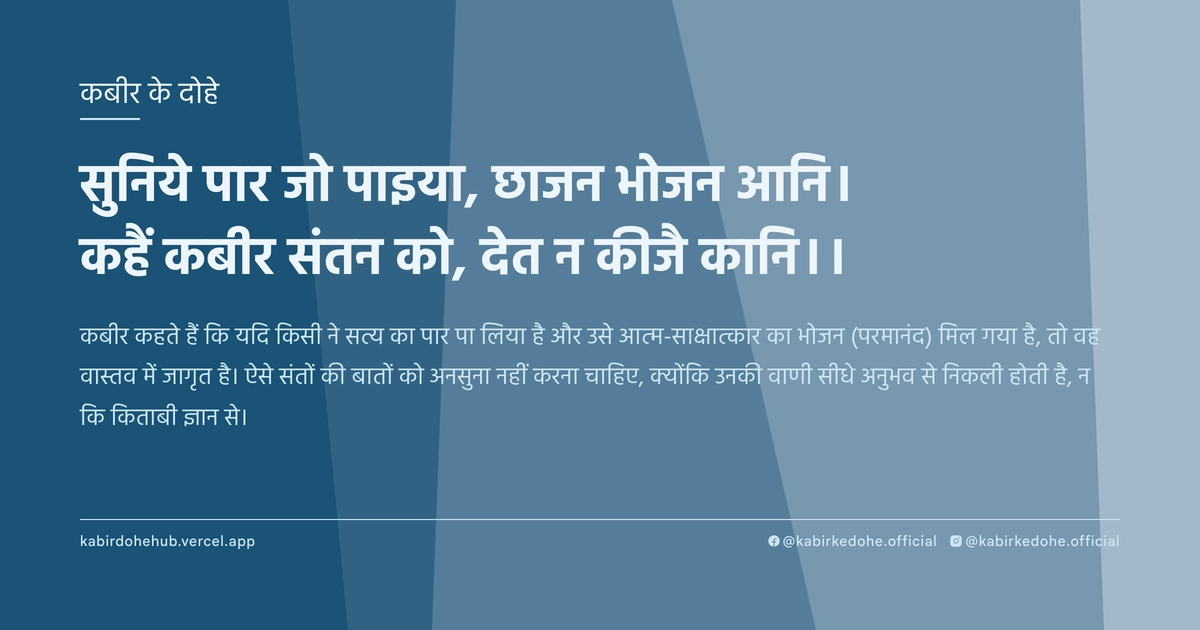
सुनिये पार जो पाइया, छाजन भोजन आनि।
कहैं कबीर संतन को, देत न कीजै कानि।।
Suniye paar jo paiya, chhaajan bhojan aani. Kahen Kabir santan ko, det na keeje kaani.
इस पृष्ठ पर इस कबीर दोहे का अर्थ (meaning), हिंदी व्याख्या और अंग्रेज़ी अनुवाद, दार्शनिक विश्लेषण और व्यावहारिक जीवन सीख दी गई है। यह दोहा सत्संग (Satsang) विषय से जुड़ा है — Kabir doha meaning and explanation in Hindi and English.
अर्थ (Meaning):
कबीर कहते हैं कि यदि किसी ने सत्य का पार पा लिया है और उसे आत्म-साक्षात्कार का भोजन (परमानंद) मिल गया है, तो वह वास्तव में जागृत है। ऐसे संतों की बातों को अनसुना नहीं करना चाहिए, क्योंकि उनकी वाणी सीधे अनुभव से निकली होती है, न कि किताबी ज्ञान से।
Kabir asserts that one who has crossed the ocean of existence and tasted the celestial food of divine realization is truly awakened. He warns that the words of such realized saints should not be ignored or dismissed, as their wisdom springs from direct experience rather than scholarly rote learning.
व्याख्या (Interpretation):
यहाँ 'पार पाना' संसार के मोह-माया के पार जाने और मोक्ष की प्राप्ति का प्रतीक है। 'छाजन भोजन' वह आध्यात्मिक तृप्ति है जो केवल आत्म-साक्षात्कार से मिलती है। कबीर इस विरोधाभास को उजागर करते हैं कि दुनिया अक्सर उन लोगों को अनदेखा करती है जो वास्तव में सत्य को जानते हैं, क्योंकि वे बाहरी आडंबरों से मुक्त होते हैं। यह निरुगुण भक्ति का मार्ग है जहाँ ईश्वर किसी मूर्ति में नहीं, बल्कि अनुभव में है। अद्वैत वेदांत के अनुसार, जब साधक यह जान लेता है कि वह और ब्रह्म एक ही हैं, तब वह 'पार' पा लेता है। यह स्थिति अहंकार के पूर्ण विसर्जन की है, जहाँ केवल शुद्ध चेतना शेष रहती है।
The phrase 'crossing over' symbolizes the transcendence of worldly attachments and the attainment of liberation. 'Celestial food' represents the spiritual satiety found only through self-realization. Kabir highlights the paradox where society often ignores those who truly know the Truth because they lack external religious ornamentation. This aligns with Nirgun Bhakti, where the Divine is formless and experienced internally. According to Advaita Vedanta, when the seeker realizes the non-duality of Atman and Brahman, they have 'crossed over.' This state marks the complete dissolution of the ego, leaving only pure, witnessing consciousness.
दार्शनिक विश्लेषण (Philosophical Analysis):
कबीर का यह दोहा उस युग की प्रतिक्रिया है जहाँ धर्म केवल कर्मकांडों और पंडितों के नियंत्रण में था। वे बाहरी दिखावे के बजाय आंतरिक अनुभव (अनुभूति) पर जोर देते हैं। यहाँ 'भोजन' का अर्थ भौतिक आहार नहीं, बल्कि वह ज्ञान है जो आत्मा को तृप्त करता है। यह सूफी मत के 'फना' होने के करीब है, जहाँ व्यक्ति अपनी पहचान को ईश्वर में विलीन कर देता है।
कबीर जाति और वर्ण व्यवस्था का खंडन करते हुए यह बताते हैं कि सत्य का ज्ञान किसी विशेष कुल या शास्त्र पढ़ने से नहीं, बल्कि साधना से आता है। वे ritualism की कड़ी आलोचना करते हैं, क्योंकि उनके अनुसार मंदिर-मस्जिद जाने से अधिक महत्वपूर्ण है अपने भीतर के मंदिर को खोजना।
दार्शनिक रूप से, यह दोहा 'श्रवण' (सुनने) की महत्ता को दर्शाता है। लेकिन यह सुनना केवल कानों से नहीं, बल्कि हृदय से है। जब अहंकार जीवित रहता है, तो वह सत्य को 'कान' नहीं देता, बल्कि उसे अपनी पूर्वधारणाओं के चश्मे से देखता है।
अद्वैत वेदांत के परिप्रेक्ष्य में, यह दोहा माया के पर्दे को हटाने की बात करता है। जब तक हम द्वैत (मैं और तुम) में फंसे हैं, हम सत्य को नहीं सुन सकते। संत वह सेतु हैं जो हमें इस द्वैत से अद्वैत की ओर ले जाते हैं।
अंततः, कबीर मनोवैज्ञानिक रूपांतरण की बात करते हैं। वे चाहते हैं कि मनुष्य अपनी बौद्धिक श्रेष्ठता के अहंकार को त्याग कर उस सरलता को अपनाए जो केवल एक अनुभवसिद्ध संत में होती है। यह बौद्धिक तर्क से ऊपर उठकर प्रेम और समर्पण का मार्ग है।
Kabir's couplet is a reaction to an era where religion was confined to rituals and controlled by a priestly class. He emphasizes internal experience (Anubhuti) over external display. Here, 'food' does not refer to physical sustenance but to the gnosis that satiates the soul. This mirrors the Sufi concept of 'Fana,' where the individual identity is annihilated in the Divine.
By rejecting caste and lineage, Kabir argues that truth is attained through spiritual practice (Sadhana), not through birth or scholarly study. He critiques ritualism, suggesting that finding the temple within is far more vital than visiting physical shrines.
Philosophically, this verse underscores the importance of 'Shravana' (listening). However, this is not auditory hearing but heart-listening. As long as the ego persists, it does not truly 'listen' to truth but filters it through preconceived biases.
From the lens of Advaita Vedanta, this verse speaks of lifting the veil of Maya. As long as we are trapped in duality (the sense of 'I' and 'Other'), we cannot perceive the truth. The Saint acts as the bridge from duality to non-duality.
Ultimately, Kabir advocates for a psychological transformation. He urges the human to shed the ego of intellectual superiority and embrace the simplicity found in a realized soul. It is a path of love and surrender that transcends logical argumentation.
मूल संदेश (Core Message):
- बौद्धिक अहंकार सत्य के मार्ग में सबसे बड़ी बाधा है।
- अनुभवजन्य ज्ञान किताबी ज्ञान से कहीं अधिक श्रेष्ठ है।
- सत्य अक्सर उन लोगों के पास होता है जिन्हें दुनिया अनदेखा करती है।
- आंतरिक तृप्ति ही वास्तविक आध्यात्मिक भोजन है।
- विनम्रता ही वह द्वार है जिससे सत्य का प्रवेश होता है।
- Intellectual ego is the primary obstacle on the path to truth.
- Experiential wisdom far surpasses theoretical or scholarly knowledge.
- Truth often resides in those whom the world chooses to ignore.
- Internal satiety is the only true spiritual nourishment.
- Humility is the only gateway through which truth can enter.
व्यावहारिक उदाहरण (Practical Example):
वाराणसी के घाटों पर रहने वाले एक वृद्ध विधवा, जानकी, का जीवन केवल भिक्षा और पूजा-पाठ में बीता था। वह मानती थी कि मोक्ष केवल कठिन तप और शास्त्रों के पाठ से मिलता है।
एक दिन उसकी मुलाकात एक फकीर से हुई, जो फटे कपड़ों में था और जिसके पास कोई शास्त्र नहीं था, लेकिन उसकी आँखों में एक असीम शांति थी।
जानकी ने शुरू में उसे तुच्छ समझा और उसकी बातों को अनसुना कर दिया, क्योंकि वह फकीर किसी मंदिर का पुजारी नहीं था।
फकीर ने उससे कहा, 'माँ, तुम पत्थर की पूजा कर रही हो, जबकि वह पत्थर तुम्हारे भीतर धड़क रहा है।'
जानकी को यह बात अजीब लगी, लेकिन फकीर की वाणी में एक ऐसी कशिश थी जिसने उसे सोचने पर मजबूर कर दिया।
उसने महसूस किया कि वर्षों की पूजा के बाद भी उसके मन में क्रोध और शिकायतें भरी थीं, जबकि उस फकीर के पास कुछ न होते हुए भी वह पूर्णतः तृप्त था।
यह 'कबीर ट्विस्ट' था—जब जानकी ने अपनी बौद्धिक और धार्मिक श्रेष्ठता का अहंकार छोड़ा और फकीर की बात को 'कान दिया'।
उसने पाया कि वास्तविक 'भोजन' बाहरी अनुष्ठान नहीं, बल्कि आंतरिक मौन और समर्पण है।
जानकी ने शास्त्रों को पढ़ना कम किया और अपने भीतर के शून्य को सुनना शुरू किया।
परिणामस्वरूप, उसका जीवन भय और मोह से मुक्त हो गया और वह वास्तव में उस शांति को पा सकी जिसे वह वर्षों से खोज रही थी।
Janki, an elderly widow living on the ghats of Varanasi, spent her life in alms and rigid rituals. She believed liberation came only through severe penance and the recitation of scriptures.
One day, she encountered a wandering fakir, dressed in rags, possessing no books, yet carrying an infinite peace in his eyes.
Initially, Janki dismissed him as insignificant, ignoring his words because he was not a temple priest or a recognized scholar.
The fakir told her, 'Mother, you worship the stone outside, while the living stone beats within your own heart.'
Janki found this absurd, yet there was a magnetic resonance in the fakir's voice that forced her to pause.
She realized that despite years of ritualistic prayer, her mind was still cluttered with anger and grievances, while the fakir, owning nothing, was completely satiated.
This was the 'Kabir Twist'—the moment Janki surrendered her ego of religious superiority and truly 'gave ear' to the realized soul.
She discovered that the true 'food' was not external ceremony, but internal silence and absolute surrender.
Janki began to spend less time with texts and more time listening to the void within herself.
Consequently, her life became free from fear and attachment, and she finally attained the peace she had sought for decades.
अभ्यास मार्गदर्शन (Practice Guidance):
- प्रतिदिन 20 मिनट मौन बैठें और अपने भीतर उठने वाले विचारों को बिना किसी निर्णय के केवल देखें।
- एक डायरी लिखें जिसमें आप उन क्षणों को दर्ज करें जब आपने अपने अहंकार के कारण किसी की सच्ची सलाह को अनसुना किया।
- व्यवहार परिवर्तन: किसी ऐसे व्यक्ति की बात ध्यान से सुनें जिसे समाज 'अयोग्य' या 'अशिक्षित' मानता है, और उसमें छिपे सत्य को खोजने का प्रयास करें।
- डायग्नोस्टिक चेकलिस्ट: क्या मैं केवल उन्हीं की सुनता हूँ जो मेरी मान्यताओं की पुष्टि करते हैं? क्या मैं सत्य से अधिक अपनी 'सही होने की इच्छा' को महत्व देता हूँ? यदि हाँ, तो मैं अभी भी 'कान' नहीं दे रहा हूँ।
- Sit in silence for 20 minutes daily, observing the arising thoughts without judgment or attachment.
- Maintain a journal recording instances where you ignored genuine wisdom due to your own ego or prejudices.
- Behavioral Shift: Actively listen to someone whom society deems 'unqualified' or 'uneducated,' and attempt to find the seed of truth in their experience.
- Diagnostic Checklist: Do I only listen to those who confirm my existing beliefs? Do I value 'being right' over 'finding the truth'? If yes, I am still refusing to 'give ear' to the realized.
चिंतन प्रश्न (Reflection Questions):
- मेरा 'डिजिटल ईगो' मुझे किन वास्तविक मानवीय अनुभवों से दूर कर रहा है?
- मैं किन लोगों को अपनी सामाजिक या शैक्षिक स्थिति के कारण सुनने के योग्य नहीं समझता?
- क्या मेरी धार्मिक पहचान मुझे सत्य खोजने से रोक रही है या उसकी मदद कर रही है?
- मेरे जीवन का वह कौन सा 'अधूरापन' है जिसे मैं बाहरी उपलब्धियों के भोजन से भरने की कोशिश कर रहा हूँ?
- यदि सत्य मेरे सबसे गहरे विश्वासों के विपरीत प्रकट हो, तो क्या मैं उसे सुनने का साहस रखूँगा?
- How is my 'digital ego' distancing me from authentic, raw human experiences?
- Whom do I deem unworthy of being heard based on their social or educational status?
- Is my religious identity acting as a bridge to the truth, or as a wall blocking it?
- What is the 'emptiness' in my life that I am trying to fill with the food of external achievements?
- If the truth appeared in a form that contradicted my deepest beliefs, would I have the courage to listen?