
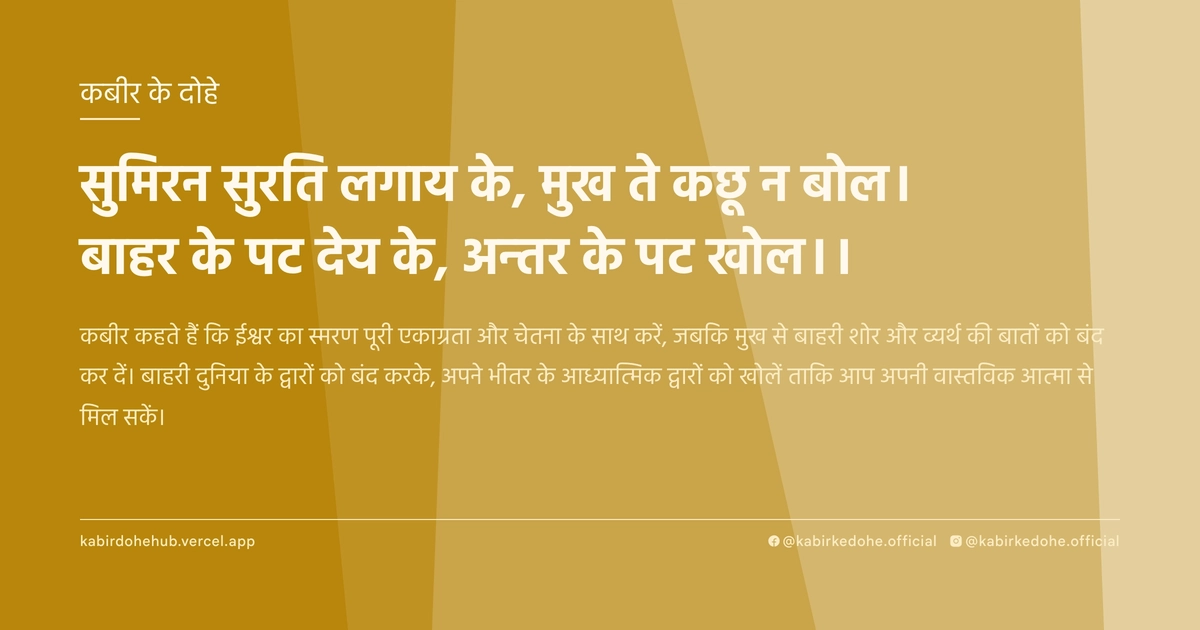
सुमिरन सुरति लगाय के, मुख ते कछू न बोल।
बाहर के पट देय के, अन्तर के पट खोल।।
Sumiran surati lagaay ke, mukh te kachhu na bol. Baahar ke pat dey ke, antar ke pat khol.
इस पृष्ठ पर इस कबीर दोहे का अर्थ (meaning), हिंदी व्याख्या और अंग्रेज़ी अनुवाद, दार्शनिक विश्लेषण और व्यावहारिक जीवन सीख दी गई है। यह दोहा अंतर ज्योति (The Inner Light) विषय से जुड़ा है — Kabir doha meaning and explanation in Hindi and English.
अर्थ (Meaning):
कबीर कहते हैं कि ईश्वर का स्मरण पूरी एकाग्रता और चेतना के साथ करें, जबकि मुख से बाहरी शोर और व्यर्थ की बातों को बंद कर दें। बाहरी दुनिया के द्वारों को बंद करके, अपने भीतर के आध्यात्मिक द्वारों को खोलें ताकि आप अपनी वास्तविक आत्मा से मिल सकें।
Kabir advises practicing remembrance of the Divine with absolute conscious awareness while maintaining external silence. He urges the seeker to shut the doors of the external sensory world and open the inner portals of the heart to realize the inherent divinity within.
व्याख्या (Interpretation):
यह दोहा मौन और अंतर्मुखी होने की शक्ति पर केंद्रित है। 'सुमिरन' केवल शब्दों का दोहराव नहीं, बल्कि 'सुरति' यानी सजग जागरूकता है। बाहरी पट (द्वार) हमारी इंद्रियों और सामाजिक मुखौटों का प्रतीक हैं, जो हमें माया के भ्रम में उलझाए रखते हैं। जब हम बाहरी शोर को शांत करते हैं, तब हम 'अन्तर के पट' खोलते हैं, जो अद्वैत वेदांत के उस सत्य की ओर ले जाता है जहाँ आत्मा और परमात्मा एक हो जाते हैं। यह निर्गुण भक्ति का मार्ग है जहाँ ईश्वर मंदिर या मस्जिद में नहीं, बल्कि मौन के गहरे शून्य में मिलता है।
This couplet focuses on the potency of silence and introversion. 'Sumiran' is not mere rote repetition but 'Surati'—conscious awareness. The 'outer doors' symbolize the senses and social masks that keep us entangled in the illusion of Maya. By closing these external gateways, the seeker opens the 'inner portals,' leading to the Advaita Vedanta truth where Atman and Brahman merge. This is the path of Nirgun Bhakti, asserting that the Formless Divine is found not in temples or mosques, but in the profound void of inner silence.
दार्शनिक विश्लेषण (Philosophical Analysis):
कबीर का यह दर्शन उस युग की प्रतिक्रिया है जहाँ धर्म केवल बाहरी कर्मकांडों, तीर्थयात्राओं और दिखावे तक सीमित हो गया था। वे स्पष्ट करते हैं कि ईश्वर की प्राप्ति किसी बाहरी यात्रा से नहीं, बल्कि आंतरिक यात्रा से संभव है। यह दृष्टिकोण सूफीवाद के 'फना' (अहंकार का विनाश) और अद्वैत वेदांत के 'अहं ब्रह्मास्मि' के करीब है।
यहाँ 'मुख ते कछू न बोल' का अर्थ केवल शारीरिक मौन नहीं, बल्कि मानसिक शोर का अंत है। जब तक मन में इच्छाएं और द्वंद्व चलते रहते हैं, तब तक सत्य का अनुभव नहीं हो सकता। कबीर यहाँ मनोवैज्ञानिक रूपांतरण की बात कर रहे हैं, जहाँ साधक अपनी पहचान को बाहरी दुनिया की उपलब्धियों से हटाकर आंतरिक शांति में स्थापित करता है।
जाति और धर्म के भेदभाव को नकारते हुए, कबीर यह संदेश देते हैं कि आंतरिक द्वार सबके लिए समान हैं। चाहे कोई पंडित हो या जुलाहा, सत्य का अनुभव केवल मौन और सजगता से ही संभव है। यह ritualism के खिलाफ एक सशक्त प्रहार है, जो यह सिखाता है कि माला फेरना व्यर्थ है यदि मन विचलित है।
दार्शनिक स्तर पर, यह 'साक्षी भाव' (Witness Consciousness) की स्थापना है। जब हम बाहरी दुनिया के प्रति उदासीन होते हैं, तब हम वास्तव में दुनिया को बेहतर तरीके से देख पाते हैं क्योंकि हमारा दृष्टिकोण अब अहंकार से दूषित नहीं होता।
अंततः, यह दोहा हमें सिखाता है कि सत्य 'खोजने' की वस्तु नहीं, बल्कि 'अनकवर' करने की वस्तु है। जैसे ही बाहरी शोर का पर्दा गिरता है, जो शेष बचता है, वही शाश्वत सत्य है।
Kabir's philosophy serves as a reaction to an era where religion had devolved into mere external rituals, pilgrimages, and performative piety. He asserts that the realization of the Divine is achieved not through an external journey, but through an internal odyssey. This perspective aligns closely with the Sufi concept of 'Fana' (annihilation of the ego) and the Advaita Vedanta realization of 'Aham Brahmasmi' (I am Brahman).
'Mukh te kachu na bol' refers not merely to physical silence, but to the cessation of mental noise. As long as desires and dualities churn within the mind, the experience of Truth remains elusive. Kabir is advocating for a psychological transformation where the seeker shifts their identity from external achievements to internal stillness.
By rejecting caste and creed, Kabir emphasizes that the inner portals are equidistant for all. Whether one is a priest or a weaver, Truth is accessible only through silence and mindfulness. This is a powerful critique of ritualism, suggesting that counting beads is futile if the mind remains distracted.
Philosophically, this is the establishment of 'Sakshi Bhava' (Witness Consciousness). When we become detached from the external clamor, we perceive the world more clearly because our vision is no longer clouded by the ego.
Ultimately, this couplet teaches that Truth is not something to be 'found' but something to be 'uncovered.' Once the veil of external noise drops, what remains is the Eternal Truth.
मूल संदेश (Core Message):
- बाहरी शोर केवल भ्रम पैदा करता है, सत्य मौन में बसता है।
- सजगता के बिना किया गया स्मरण केवल एक यांत्रिक क्रिया है।
- इंद्रियों के द्वार बंद करना ही आंतरिक ज्ञान की पहली सीढ़ी है।
- मौन केवल शब्दों का अभाव नहीं, बल्कि चेतना की पूर्णता है।
- स्वयं को जानना ही ईश्वर को जानने का एकमात्र वास्तविक मार्ग है।
- External noise creates illusion; Truth resides in silence.
- Remembrance without awareness is merely a mechanical act.
- Closing the sensory gates is the first step toward inner gnosis.
- Silence is not the absence of words, but the fullness of consciousness.
- Knowing oneself is the only authentic path to knowing the Divine.
व्यावहारिक उदाहरण (Practical Example):
वाराणसी के घाटों पर रहने वाले एक वृद्ध विधवा, जानकी, का जीवन केवल दूसरों की सेवा और मंदिर की लंबी कतारों में बीतता था। वह मानती थी कि जितना अधिक वह मंत्रों का जाप करेगी और बाहरी अनुष्ठानों में समय बिताएगी, उसे मोक्ष मिलेगा।
वह हर समय दूसरों को उपदेश देती और धार्मिक चर्चाओं में व्यस्त रहती, लेकिन उसके मन के भीतर एक गहरी बेचैनी और अकेलापन था। वह शोर में शांति खोज रही थी।
एक दिन उसकी मुलाकात एक मौन साधु से हुई, जिसने उसे केवल एक इशारा किया—अपने होंठों पर उंगली रखकर आँखें बंद करने को। जानकी ने पहली बार कोशिश की कि वह कुछ न बोले, न ही किसी को कुछ सिखाए।
शुरुआत में, उसका मन विद्रोह करने लगा। उसे लगा कि वह समय बर्बाद कर रही है। उसे अपने अतीत के दुख, समाज के ताने और भविष्य की चिंताएं शोर की तरह सुनाई देने लगीं।
लेकिन जैसे-जैसे उसने बाहरी दुनिया के प्रति अपनी उत्सुकता कम की, उसने महसूस किया कि वह जिसे 'ईश्वर' बाहर खोज रही थी, वह वास्तव में उसके भीतर की एक गहरी शांति थी।
उसने पाया कि जब वह चुप रहती थी, तो उसे अपने आस-पास के लोगों का दर्द अधिक स्पष्ट सुनाई देता था, बिना किसी निर्णय के। उसकी करुणा अब उपदेशात्मक नहीं, बल्कि वास्तविक थी।
उसने मंदिर जाना नहीं छोड़ा, लेकिन अब वह वहां मंत्र पढ़ने नहीं, बल्कि उस मौन को महसूस करने जाती थी जो मंदिर की दीवारों से परे था।
उसका व्यवहार बदल गया। वह अब कम बोलती थी, लेकिन उसकी उपस्थिति मात्र से दूसरों को सुकून मिलता था। उसने सीखा कि मौन सबसे शक्तिशाली प्रार्थना है।
उसकी आंतरिक शांति ने उसे यह एहसास दिलाया कि मोक्ष किसी स्थान पर जाने में नहीं, बल्कि स्वयं के भीतर ठहरने में है।
जानकी अब एक ऐसी स्त्री बन गई थी जिसने बाहरी शोर के पट बंद कर दिए थे और अपने हृदय के द्वार प्रेम और शांति के लिए खोल दिए थे।
Janaki, an elderly widow living on the ghats of Varanasi, spent her life in the service of others and in long queues at temples. She believed that the more she chanted mantras and engaged in external rituals, the closer she would get to liberation.
She was constantly giving advice to others and engaging in religious debates, yet within her lay a deep restlessness and loneliness. She was searching for peace amidst the noise.
One day, she met a silent monk who gave her a simple gesture—placing a finger on his lips and closing his eyes. For the first time, Janaki attempted to remain silent, neither speaking nor teaching anyone.
Initially, her mind rebelled. She felt she was wasting time. The sorrows of her past, the taunts of society, and anxieties about the future began to roar like a storm within her.
However, as she diminished her curiosity toward the external world, she realized that the 'God' she was seeking outside was actually a profound stillness within her own being.
She discovered that when she remained silent, she could hear the pain of those around her more clearly, without judgment. Her compassion was no longer preachy; it became authentic.
She did not stop visiting the temple, but now she went there not to recite mantras, but to feel the silence that existed beyond the temple walls.
Her behavior transformed. She spoke less, but her mere presence brought solace to others. She learned that silence is the most powerful prayer.
Her inner peace made her realize that liberation is not about going to a specific place, but about abiding within oneself.
Janaki became a woman who had shut the doors of external noise and opened the portals of her heart to love and peace.
अभ्यास मार्गदर्शन (Practice Guidance):
- प्रतिदिन 20 मिनट का 'पूर्ण मौन' अभ्यास करें, जहाँ न केवल वाणी, बल्कि मानसिक संवाद को भी रोकने का प्रयास करें।
- एक डायरी लिखें जिसमें आप उन 'बाहरी शोरों' (सामाजिक अपेक्षाएं, दूसरों की राय) की सूची बनाएं जो आपको स्वयं से दूर रखते हैं।
- सांसों के प्रति सजगता का अभ्यास करें; जब भी मन बाहरी दुनिया में भटके, धीरे से उसे 'अन्तर के पट' यानी हृदय केंद्र पर वापस लाएं।
- निदान चेकलिस्ट: क्या मैं प्रतिक्रिया देने से पहले रुकता हूँ? क्या मेरी शांति बाहरी परिस्थितियों पर निर्भर है? क्या मैं मौन में असहज महसूस करता हूँ?
- Practice 20 minutes of 'Absolute Silence' daily, attempting to still not only the voice but also the internal mental dialogue.
- Maintain a journal listing the 'external noises' (social expectations, opinions of others) that keep you detached from your true self.
- Practice breath awareness; whenever the mind wanders to the external world, gently bring it back to the 'inner portal' or the heart center.
- Diagnostic Checklist: Do I pause before reacting? Is my peace dependent on external circumstances? Do I feel uncomfortable in silence?
चिंतन प्रश्न (Reflection Questions):
- मेरे जीवन में वह कौन सा 'बाहरी शोर' है जिसे मैं शांति के नाम पर ढो रहा हूँ?
- क्या मेरी धार्मिक या आध्यात्मिक पहचान केवल एक सामाजिक मुखौटा है?
- जब मैं पूरी तरह अकेला और मौन होता हूँ, तो मुझे अपने भीतर किस डर का सामना करना पड़ता है?
- मैं दूसरों को उपदेश देने में इतना विश्वास क्यों रखता हूँ कि मैं स्वयं के मौन को सुनने से डरता हूँ?
- क्या मेरा 'डिजिटल अस्तित्व' मेरे वास्तविक आंतरिक अस्तित्व को निगल रहा है?
- यदि मैं अपनी सभी उपलब्धियों और उपाधियों को हटा दूँ, तो मेरे भीतर क्या शेष बचेगा?
- What is the 'external noise' in my life that I am carrying under the guise of peace?
- Is my religious or spiritual identity merely a social mask?
- When I am completely alone and silent, what fear must I face within myself?
- Why do I trust giving advice to others more than I trust listening to my own silence?
- Is my 'digital existence' consuming my actual internal existence?
- If I strip away all my achievements and titles, what remains within me?