
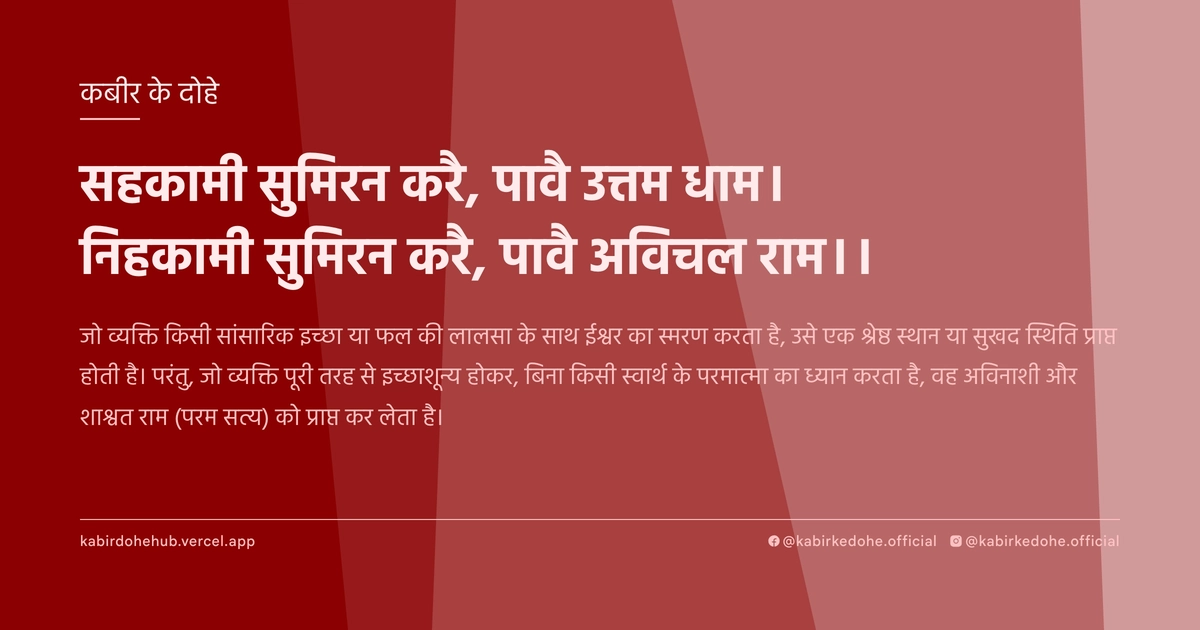
सहकामी सुमिरन करै, पावै उत्तम धाम।
निहकामी सुमिरन करै, पावै अविचल राम।।
Sahkaami sumiran karai, paavai uttam dhaam. Nihkaami sumiran karai, paavai avichal raam.
इस पृष्ठ पर इस कबीर दोहे का अर्थ (meaning), हिंदी व्याख्या और अंग्रेज़ी अनुवाद, दार्शनिक विश्लेषण और व्यावहारिक जीवन सीख दी गई है। यह दोहा भक्ति (Bhakti) विषय से जुड़ा है — Kabir doha meaning and explanation in Hindi and English.
अर्थ (Meaning):
जो व्यक्ति किसी सांसारिक इच्छा या फल की लालसा के साथ ईश्वर का स्मरण करता है, उसे एक श्रेष्ठ स्थान या सुखद स्थिति प्राप्त होती है। परंतु, जो व्यक्ति पूरी तरह से इच्छाशून्य होकर, बिना किसी स्वार्थ के परमात्मा का ध्यान करता है, वह अविनाशी और शाश्वत राम (परम सत्य) को प्राप्त कर लेता है।
One who remembers the Divine with a desire for reward or worldly gain attains a superior state or a heavenly abode. However, one who remembers the Divine with complete detachment, devoid of all selfish desires, attains the Eternal Ram—the unchanging, absolute Truth that transcends all existence.
व्याख्या (Interpretation):
यह दोहा भक्ति के दो स्तरों के बीच के सूक्ष्म अंतर को स्पष्ट करता है। 'सहकामी' वह है जिसकी भक्ति में अभी भी 'मैं' और 'मेरा' शेष है; वह मोक्ष या स्वर्ग चाहता है, जो कि अंततः एक सूक्ष्म इच्छा ही है। जब तक इच्छा है, तब तक बंधन है, भले ही वह बंधन 'उत्तम धाम' का ही क्यों न हो। इसके विपरीत, 'निहकामी' वह है जिसने अपनी इच्छाओं का पूर्ण विसर्जन कर दिया है। यहाँ 'राम' किसी व्यक्ति या मूर्ति के रूप में नहीं, बल्कि उस निर्गुण ब्रह्म के रूप में हैं जो अपरिवर्तनीय है। यह अद्वैत वेदांत के उस सिद्धांत को दर्शाता है जहाँ साधक और साध्य का भेद मिट जाता है। माया का पर्दा तब गिरता है जब 'पाने' की इच्छा समाप्त हो जाती है, और केवल 'होने' का भाव शेष रहता है। यह विरोधाभास है कि जो कुछ नहीं चाहता, वही सब कुछ प्राप्त कर लेता है।
This couplet elucidates the subtle distinction between two levels of devotion. The 'Sahkaami' is one whose devotion still harbors the 'I' and 'mine'; they seek liberation or heaven, which is ultimately a refined desire. As long as desire exists, bondage persists, even if that bondage is to a 'superior abode.' In contrast, the 'Nihkaami' is one who has completely dissolved their desires. Here, 'Ram' does not refer to a deity or an image, but to the Nirgun Brahman—the formless, unchanging Absolute. This reflects the core of Advaita Vedanta, where the distinction between the seeker and the sought vanishes. The veil of Maya falls only when the desire to 'acquire' ceases, leaving only the state of 'being.' It is the great spiritual paradox: only he who seeks nothing attains everything.
दार्शनिक विश्लेषण (Philosophical Analysis):
कबीर का यह दर्शन उनके समय के कर्मकांडीय और फल-केंद्रित धर्म के विरुद्ध एक सशक्त प्रहार है। मध्यकालीन भारत में, धर्म अक्सर स्वर्ग की प्राप्ति या नर्क से बचने का साधन बन गया था। कबीर ने इस 'सौदेबाजी वाली भक्ति' को खारिज करते हुए शुद्ध प्रेम और निस्वार्थ समर्पण की वकालत की। उनका दृष्टिकोण सूफी मत के 'फना' (अहंकार का विनाश) और वेदांत के 'अद्वैत' (गैर-द्वैत) का एक अनूठा संगम है।
दार्शनिक स्तर पर, 'सहकामी' अवस्था मनोवैज्ञानिक आसक्ति को दर्शाती है। जब हम ईश्वर से कुछ मांगते हैं, तो हम वास्तव में अपनी इच्छाओं को पुष्ट कर रहे होते हैं, न कि उन्हें मिटा रहे होते हैं। यह 'सकाम भक्ति' है, जो साधक को एक बेहतर मानसिक या आध्यात्मिक स्थिति (उत्तम धाम) तक तो ले जा सकती है, लेकिन वह अंतिम मुक्ति नहीं है क्योंकि वह अभी भी द्वैत (दो अलग अस्तित्व) में फंसा है।
'निहकामी' अवस्था वह है जहाँ अहंकार का पूर्ण विलोपन हो जाता है। सूफीवाद में इसे 'इश्क-ए-हकीकी' कहा गया है, जहाँ प्रेमी अपने अस्तित्व को मिटाकर केवल प्रिय (परमात्मा) में विलीन हो जाता है। जब 'मैं' मिटता है, तो केवल 'राम' बचते हैं। यह 'अविचल' राम हैं क्योंकि वे समय, स्थान और परिस्थिति से परे हैं।
कबीर यहाँ यह समझा रहे हैं कि मुक्ति किसी बाहरी स्थान की यात्रा नहीं है, बल्कि आंतरिक रूपांतरण है। ritualism या बाहरी दिखावा केवल 'सहकामी' स्तर पर काम करता है। वास्तविक आध्यात्मिक प्रगति तब होती है जब प्रार्थना एक मांग नहीं, बल्कि एक समर्पण बन जाती है।
अतः, यह दोहा हमें चेतावनी देता है कि आध्यात्मिक मार्ग पर सबसे बड़ी बाधा बाहरी पाप नहीं, बल्कि आंतरिक सूक्ष्म इच्छाएं हैं। जब तक हम मोक्ष की इच्छा रखते हैं, वह इच्छा ही मोक्ष के मार्ग में बाधा बन जाती है। पूर्ण शून्यता ही पूर्णता का द्वार है।
Kabir’s philosophy here is a potent critique of the ritualistic and reward-centric religion of his era. In medieval India, religion had often devolved into a transaction—a means to secure heaven or avoid hell. Kabir rejected this 'bargaining devotion,' advocating instead for pure love and selfless surrender. His perspective is a unique synthesis of the Sufi concept of 'Fana' (annihilation of the ego) and the Vedantic principle of 'Advaita' (non-duality).
On a philosophical level, the 'Sahkaami' state represents psychological attachment. When we ask God for something, we are actually reinforcing our desires rather than extinguishing them. This is 'Sakama Bhakti' (devotion with desire), which may lead the seeker to a superior mental or spiritual state (Uttam Dhaam), but it is not final liberation because the seeker remains trapped in duality—the separation between the self and the Divine.
The 'Nihkaami' state is where the ego is completely dissolved. In Sufism, this is akin to 'Ishq-e-Haqiqi,' where the lover erases their own existence to merge entirely into the Beloved. When the 'I' vanishes, only 'Ram' remains. This is the 'Avichal' (unchanging) Ram, who exists beyond time, space, and circumstance.
Kabir teaches that liberation is not a journey to an external location but an internal transformation. Ritualism and outward displays only function at the 'Sahkaami' level. True spiritual progress occurs when prayer ceases to be a request and becomes a total surrender.
Thus, the couplet warns us that the greatest obstacle on the spiritual path is not external sin, but subtle internal desires. As long as we desire liberation, that very desire becomes the barrier to liberation. Absolute emptiness is the only gateway to absolute fullness.
मूल संदेश (Core Message):
- इच्छाएं आध्यात्मिक प्रगति की सबसे बड़ी बाधा हैं।
- सकाम भक्ति केवल सुख देती है, मुक्ति नहीं।
- निस्वार्थता ही परमात्मा से मिलन का एकमात्र द्वार है।
- अहंकार का विसर्जन ही वास्तविक प्रार्थना है।
- शाश्वत सत्य केवल शून्य होने पर ही प्राप्त होता है।
- Desires are the greatest obstacles to spiritual progress.
- Desire-driven devotion brings comfort, not liberation.
- Selflessness is the only gateway to union with the Divine.
- The dissolution of ego is the only true prayer.
- Eternal Truth is realized only when one becomes nothing.
व्यावहारिक उदाहरण (Practical Example):
वाराणसी के एक पुराने घाट पर माधव नाम का एक वृद्ध नाविक रहता था। माधव का पूरा जीवन दूसरों को नदी पार कराने में बीता था, लेकिन उसका अपना मन अशांत था। वह प्रतिदिन गंगा आरती में जाता और भगवान से प्रार्थना करता कि उसे अगले जन्म में एक अमीर जमींदार बनाया जाए ताकि वह सुख से रह सके। वह घंटों मंत्र जाप करता, लेकिन उसके मन में हमेशा एक सौदा चलता था—'मैं इतनी सेवा कर रहा हूँ, तो मुझे यह फल मिलना ही चाहिए।'
माधव को लगता था कि वह बहुत धार्मिक है, लेकिन उसकी प्रार्थनाएं वास्तव में उसकी इच्छाओं की सूची थीं। वह 'सहकामी' था। उसे मानसिक शांति तो मिलती थी, लेकिन वह गहरा संतोष नहीं था जिसे वह खोज रहा था।
एक दिन उसकी मुलाकात एक फकीर से हुई जो घाट की सीढ़ियों पर चुपचाप बैठा था। फकीर ने माधव की बेचैनी देख कर उससे पूछा, 'तुम क्या मांग रहे हो?' माधव ने गर्व से अपनी लंबी सूची गिनाई। फकीर मुस्कुराया और बोला, 'जब तक तुम हाथ फैलाकर मांग रहे हो, तुम केवल अपनी कमी को याद कर रहे हो। जिस दिन हाथ मांगने के लिए नहीं, बल्कि सब कुछ सौंपने के लिए खुलेंगे, उस दिन तुम पाओगे कि तुम पहले से ही पूर्ण हो।'
यह बात माधव के हृदय में गहरे तक उतर गई। उसने महसूस किया कि उसकी सारी भक्ति वास्तव में उसके अहंकार की तुष्टि के लिए थी। उसने तय किया कि वह अब कुछ नहीं मांगेगा।
शुरुआत में यह कठिन था। जब भी वह आँखें बंद करता, पुरानी इच्छाएं वापस आ जातीं। लेकिन उसने धीरे-धीरे अभ्यास किया कि वह केवल 'होने' का आनंद ले। उसने प्रार्थना करना बंद नहीं किया, बल्कि प्रार्थना का स्वरूप बदल दिया। अब वह यह नहीं कहता था कि 'मुझे यह दे दो', बल्कि वह कहता था, 'मैं जो कुछ भी हूँ, आपका हूँ।'
महीनों बाद, माधव के जीवन में एक अद्भुत परिवर्तन आया। वह अब अमीर बनने की इच्छा नहीं करता था, फिर भी वह खुद को सबसे समृद्ध महसूस करने लगा। उसकी नाव चलाने की क्रिया अब एक सेवा बन गई थी, बोझ नहीं।
एक दिन एक बड़ा तूफान आया और कई नावें डूबने लगीं। जहाँ अन्य नाविक डर के मारे चिल्ला रहे थे, माधव शांत था। उसने बिना किसी डर या फल की चिंता के अपनी जान जोखिम में डालकर कई लोगों को बचाया।
जब लोगों ने उससे उसकी निडरता का राज पूछा, तो उसने बस इतना कहा, 'जब खोने के लिए कुछ बचा ही नहीं, तो डर कैसा?' माधव अब 'निहकामी' हो चुका था। उसने उस 'अविचल राम' को पा लिया था, जो किसी स्वर्ग में नहीं, बल्कि उसके अपने निस्वार्थ भाव में स्थित था।
On an ancient ghat in Varanasi lived an elderly boatman named Madhav. Madhav had spent his entire life ferrying others across the river, yet his own mind remained restless. Every day, he attended the Ganga Aarti and prayed to the Divine to make him a wealthy landlord in his next life so that he could live in comfort. He spent hours chanting mantras, but in his mind, there was always a transaction—'I am serving so much, so I must receive this reward.'
Madhav believed he was very religious, but his prayers were actually just a list of desires. He was a 'Sahkaami.' He achieved a certain level of mental peace, but not the profound contentment he truly sought.
One day, he met a wandering fakir sitting silently on the steps of the ghat. Seeing Madhav's restlessness, the fakir asked, 'What are you asking for?' Madhav proudly listed his desires. The fakir smiled and said, 'As long as your hands are outstretched in asking, you are only reminding yourself of your lack. The day your hands open not to ask, but to surrender everything, you will realize that you are already complete.'
These words pierced Madhav's heart. He realized that all his devotion was actually to satisfy his own ego. He decided that from then on, he would ask for nothing.
Initially, it was difficult. Whenever he closed his eyes, old desires resurfaced. But he slowly practiced the art of simply 'being.' He didn't stop praying; he changed the nature of his prayer. Instead of saying 'Give me this,' he began to say, 'Whatever I am, I am Yours.'
Months later, a wonderful transformation occurred in Madhav's life. He no longer desired wealth, yet he felt like the richest man alive. The act of rowing his boat became a service, no longer a burden.
One day, a massive storm hit, and many boats began to sink. While other boatmen screamed in terror, Madhav remained calm. Without any fear or thought of reward, he risked his own life to save many people.
When people asked the secret of his fearlessness, he simply replied, 'When there is nothing left to lose, why should there be fear?' Madhav had become 'Nihkaami.' He had found that 'Avichal Ram,' who resided not in some distant heaven, but within his own selfless state of being.
अभ्यास मार्गदर्शन (Practice Guidance):
- साक्षी भाव का अभ्यास: दिन में तीन बार 10 मिनट के लिए बैठें और अपनी इच्छाओं को केवल एक दर्शक की तरह देखें। उनसे जुड़ें नहीं, बस उन्हें आते-जाते देखें।
- निस्वार्थ सेवा (Karma Yoga): प्रतिदिन एक ऐसा कार्य करें जिसके बदले में आप किसी से कोई प्रशंसा, धन्यवाद या भौतिक लाभ की अपेक्षा न करें।
- आत्म-पूछताछ जर्नल: हर रात लिखें—'आज मैंने जो प्रार्थनाएं कीं, क्या वे मेरी जरूरतों के लिए थीं या परमात्मा के प्रति प्रेम के लिए?'
- निदान चेकलिस्ट: यदि आप किसी कार्य के बाद फल न मिलने पर क्रोध या निराशा महसूस करते हैं, तो आप 'सहकामी' अवस्था में हैं। यदि आप परिणाम की परवाह किए बिना कार्य में लीन हैं, तो आप 'निहकामी' मार्ग पर हैं।
- Practice of Witness Consciousness: Three times a day, sit for 10 minutes and observe your desires as a mere spectator. Do not attach to them; simply watch them arise and dissolve.
- Selfless Service (Karma Yoga): Perform one act daily for which you expect absolutely no praise, gratitude, or material gain in return.
- Self-Inquiry Journaling: Every night, write—'Were the prayers I offered today driven by my needs or by pure love for the Divine?'
- Diagnostic Checklist: If you feel anger or disappointment when a result is not achieved after an action, you are in the 'Sahkaami' state. If you are immersed in the action regardless of the outcome, you are on the 'Nihkaami' path.
चिंतन प्रश्न (Reflection Questions):
- क्या मेरी आध्यात्मिकता वास्तव में समर्पण है, या यह केवल एक बेहतर जीवन के लिए की गई 'डील' है?
- यदि मुझे पता चले कि मेरी सभी अच्छी कृत्यों का कोई फल नहीं मिलेगा, तो क्या मैं फिर भी उन्हें करना चाहूँगा?
- मेरे भीतर का वह कौन सा हिस्सा है जो अभी भी 'पाने' की जिद पर अड़ा है?
- क्या मैं अपनी पहचान अपनी उपलब्धियों से जोड़ता हूँ, और क्या यही मेरी 'सहकामी' वृत्ति है?
- क्या मैं वास्तव में ईश्वर को चाहता हूँ, या मैं केवल उस सुख को चाहता हूँ जो ईश्वर के साथ जुड़ा है?
- Is my spirituality truly a surrender, or is it merely a 'deal' struck for a better life?
- If I knew that all my good deeds would yield no reward, would I still choose to do them?
- Which part of me is still stubbornly clinging to the need to 'acquire'?
- Do I tie my identity to my achievements, and is this the root of my 'Sahkaami' nature?
- Do I truly desire the Divine, or do I only desire the bliss associated with the Divine?