
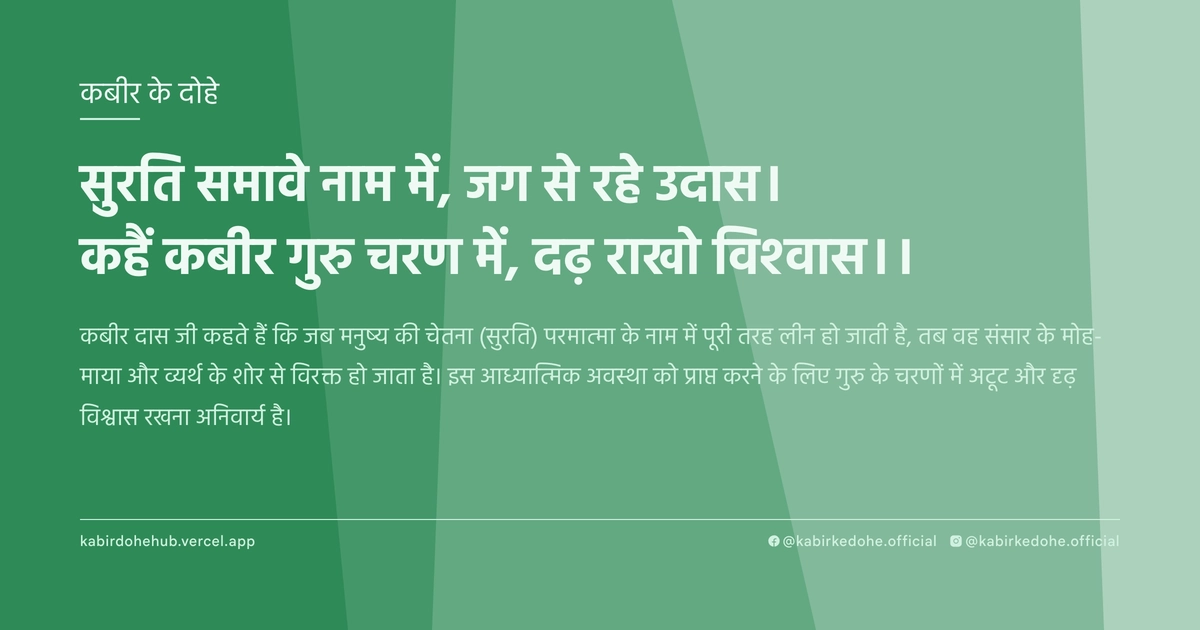
सुरति समावे नाम में, जग से रहे उदास।
कहैं कबीर गुरु चरण में, दढ़ राखो विश्वास।।
Surati samaave naam me, jag se rahe udaas. Kahain kabir guru charan me, dadh raakho vishwas.
इस पृष्ठ पर इस कबीर दोहे का अर्थ (meaning), हिंदी व्याख्या और अंग्रेज़ी अनुवाद, दार्शनिक विश्लेषण और व्यावहारिक जीवन सीख दी गई है। यह दोहा गुरु महत्व (The Guru's Importance) विषय से जुड़ा है — Kabir doha meaning and explanation in Hindi and English.
अर्थ (Meaning):
कबीर दास जी कहते हैं कि जब मनुष्य की चेतना (सुरति) परमात्मा के नाम में पूरी तरह लीन हो जाती है, तब वह संसार के मोह-माया और व्यर्थ के शोर से विरक्त हो जाता है। इस आध्यात्मिक अवस्था को प्राप्त करने के लिए गुरु के चरणों में अटूट और दृढ़ विश्वास रखना अनिवार्य है।
Kabir explains that when one's conscious awareness (Surati) becomes completely absorbed in the Divine Name, a natural detachment from the worldly illusions and chaotic distractions of the material world arises. To achieve this state of transcendence, one must maintain an unwavering and absolute faith in the guidance of the Guru.
व्याख्या (Interpretation):
यहाँ 'सुरति' का अर्थ केवल स्मृति नहीं, बल्कि वह सूक्ष्म चेतना है जो इंद्रियों के माध्यम से बाहर भटकती है। जब यह चेतना अंतर्मुखी होकर 'नाम' (निराकार ब्रह्म) में विलीन होती है, तो 'उदास' होने का अर्थ दुख नहीं, बल्कि वैराग्य है। यह निर्गुण भक्ति का सार है जहाँ साधक रूप और गुण से परे उस शून्य में प्रवेश करता है। यह अद्वैत वेदांत की उस स्थिति को दर्शाता है जहाँ आत्मा और परमात्मा का भेद मिट जाता है। माया का पर्दा तब हटता है जब विश्वास केवल बाहरी कर्मकांडों पर नहीं, बल्कि गुरु के ज्ञान पर केंद्रित होता है। यह विरोधाभास है कि संसार में रहते हुए भी संसार से अलग होना ही वास्तविक मुक्ति है।
In this context, 'Surati' refers not merely to memory, but to the subtle consciousness that typically wanders through the senses. When this awareness turns inward and merges with the 'Naam' (the Formless Absolute), being 'udaas' does not signify sadness, but a profound spiritual detachment or Vairagya. This is the essence of Nirgun Bhakti, where the seeker transcends form and attribute to enter the primordial void. It mirrors the Advaita Vedanta realization where the duality between Atman and Brahman dissolves. The veil of Maya is lifted only when faith shifts from external rituals to the internal light ignited by the Guru. The central paradox lies in existing within the world while remaining fundamentally untouched by its illusions.
दार्शनिक विश्लेषण (Philosophical Analysis):
कबीर का यह दोहा उस कालखंड का प्रतिनिधित्व करता है जब समाज कर्मकांडों और बाह्य आडंबरों में जकड़ा हुआ था। कबीर ने मंदिर-मस्जिद के विवादों से ऊपर उठकर 'नाम' की महिमा बताई, जो किसी भाषा या धर्म की बपौती नहीं है। यह सूफी मत के 'फना' (अहंकार का विनाश) और वेदांत के 'मोक्ष' का एक सुंदर संगम है। यहाँ 'नाम' कोई शब्द नहीं, बल्कि वह कंपन है जो सृष्टि के मूल में है।
कबीर का तर्क है कि जब तक मनुष्य की चेतना बाहरी दुनिया की इच्छाओं में उलझी रहेगी, वह सत्य को नहीं देख पाएगा। यह मनोवैज्ञानिक रूपांतरण की प्रक्रिया है जहाँ 'अहं' (Ego) का विसर्जन होता है। वे जाति और वर्ण के भेदभाव को नकारते हुए कहते हैं कि केवल श्रद्धा और समर्पण ही सत्य के द्वार खोलते हैं।
गुरु की भूमिका यहाँ एक मार्गदर्शक की है जो साधक को यह बताता है कि ईश्वर बाहर नहीं, बल्कि उसकी अपनी श्वास और चेतना में है। यह विश्वास अंधविश्वास नहीं, बल्कि एक प्रयोगात्मक समर्पण है। जब साधक गुरु के निर्देशों पर चलता है, तो वह धीरे-धीरे यह अनुभव करता है कि जिसे वह 'जग' समझ रहा था, वह केवल एक स्वप्न था।
दार्शनिक स्तर पर, यह दोहा द्वैत से अद्वैत की ओर यात्रा है। यह सिखाता है कि संसार का त्याग भौतिक पलायन नहीं, बल्कि मानसिक विरक्ति है। जब आंतरिक रिक्तता 'नाम' से भर जाती है, तो बाहरी अभाव कष्ट नहीं देते।
अंततः, कबीर यह स्पष्ट करते हैं कि बिना गुरु के मार्गदर्शन के, नाम का जप केवल एक यांत्रिक क्रिया बनकर रह जाता है। वास्तविक रूपांतरण तब होता है जब विश्वास इतना गहरा हो कि साधक स्वयं को पूरी तरह मिटा दे और केवल वह 'नाम' शेष रहे।
This couplet represents an era where society was stifled by rigid ritualism and external displays of piety. Kabir transcends the conflicts of temple and mosque by emphasizing the 'Naam' (the Divine Name), which belongs to no specific language or religion. It is a sophisticated synthesis of the Sufi concept of 'Fana' (annihilation of the self) and the Vedantic pursuit of 'Moksha' (liberation).
Kabir argues that as long as human consciousness remains entangled in worldly desires, the ultimate Truth remains obscured. This is a process of psychological transformation where the 'Aham' or ego is systematically dismantled. By rejecting caste and creed, he asserts that only sincere devotion and surrender can unlock the gates of realization.
The Guru's role here is that of a catalyst who reveals that the Divine is not an external entity but resides within one's own breath and awareness. This faith is not blind superstition but an experimental surrender. As the seeker follows the Guru's guidance, they realize that the 'world' they clung to was merely a projection of Maya.
Philosophically, this is a journey from duality to non-duality. It teaches that renunciation is not a physical flight from society, but a mental detachment. When the internal void is filled with the resonance of the Divine Name, external lack ceases to cause suffering.
Ultimately, Kabir clarifies that without the Guru's light, the repetition of a name is merely a mechanical act. True transformation occurs when faith is so absolute that the seeker vanishes, and only the Divine Name remains as the sole reality.
मूल संदेश (Core Message):
- बाहरी शोर को आंतरिक मौन से जीतें।
- नाम केवल शब्द नहीं, चेतना का रूपांतरण है।
- वैराग्य दुख नहीं, बल्कि वास्तविक स्वतंत्रता है।
- गुरु का विश्वास अहंकार के विसर्जन की कुंजी है।
- संसार में रहें, पर संसार को अपने भीतर न बसने दें।
- Conquer external noise with internal silence.
- The Name is not a word, but a transformation of consciousness.
- Detachment is not sorrow, but true liberation.
- Faith in the Guru is the key to dissolving the ego.
- Live in the world, but do not let the world live in you.
व्यावहारिक उदाहरण (Practical Example):
वाराणसी के एक पुराने घाट पर माधव नाम का एक वृद्ध बुनकर रहता था। वह दिन भर कपड़े बुनता, लेकिन उसका मन हमेशा इस बात से परेशान रहता कि उसके बेटे उसे छोड़कर शहर चले गए हैं और उसकी कोई संतान उसकी सेवा के लिए नहीं बची। वह अक्सर मंदिर जाता और घंटों प्रार्थना करता, लेकिन उसके मन में शिकायतें और दुख भरा रहता था।
एक दिन उसकी मुलाकात एक फकीर से हुई जिसने उसे इस दोहे का अर्थ समझाया। फकीर ने कहा, 'माधव, तुम मंदिर तो जाते हो, लेकिन तुम्हारी सुरति (चेतना) अभी भी उन बेटों की यादों और दुनिया के दुखों में भटक रही है। तुम नाम जपते हो, पर तुम्हारा मन शिकायतें बुन रहा है।'
माधव ने पूछा, 'मैं क्या करूँ?' फकीर ने उसे सलाह दी कि वह अपने काम को ही प्रार्थना बना ले और अपने गुरु के शब्दों पर विश्वास रखे कि ईश्वर उसके भीतर है, न कि केवल मूर्तियों में।
माधव ने अभ्यास शुरू किया। जब वह करघे पर धागे पिरोता, तो वह केवल धागों को नहीं देखता, बल्कि हर सांस के साथ 'नाम' का स्मरण करता। उसने यह सोचना छोड़ दिया कि दुनिया उसे क्या दे रही है या उससे क्या छीन रही है।
धीरे-धीरे, उसके काम में एक अद्भुत शांति आ गई। वह अब भी वही पुराने कपड़े बुनता था, लेकिन अब वह दुखी नहीं था। वह 'उदास' हो गया था—अर्थात, वह दुनिया की उम्मीदों से मुक्त हो गया था।
एक दिन उसके बेटे वापस आए, लेकिन माधव अब उनके आने या न आने से विचलित नहीं था। उसने उन्हें प्रेम से स्वीकार किया, लेकिन अब उसकी खुशी बेटों पर निर्भर नहीं थी।
उसके पड़ोसियों ने देखा कि माधव के चेहरे पर एक अलौकिक चमक थी। वह अब भी गरीब था, लेकिन वह दुनिया का सबसे अमीर व्यक्ति महसूस करता था क्योंकि उसकी चेतना अब 'नाम' में समा गई थी।
उसने महसूस किया कि जब उसने गुरु के शब्दों पर विश्वास किया और अपनी चेतना को बाहरी दुनिया से हटाकर भीतर लगाया, तो उसका सारा मानसिक बोझ उतर गया।
माधव की कहानी यह दिखाती है कि कैसे एक साधारण बुनकर ने अपने दैनिक कार्य को ही साधना बना लिया और संसार में रहते हुए भी उससे मुक्त हो गया।
यह 'कबीर ट्विस्ट' था: उसने बाहरी दुनिया को बदलने की कोशिश छोड़ दी और अपनी आंतरिक सुरति को बदल लिया, जिससे उसका पूरा जीवन रूपांतरित हो गया।
In the ancient ghats of Varanasi lived an elderly weaver named Madhav. He spent his days weaving cloth, but his mind was perpetually clouded by the grief that his sons had abandoned him for the city, leaving him alone in his old age. He visited temples daily, yet his prayers were laced with complaints and sorrow.
One day, he encountered a wandering Sufi mystic who explained the essence of this Doha to him. The mystic said, 'Madhav, you go to the temple, but your Surati (consciousness) is still wandering in the memories of your sons and the miseries of the world. You chant the Name, but your mind is weaving grievances.'
Madhav asked, 'What must I do?' The mystic advised him to turn his work into prayer and trust the Guru's word that the Divine resides within him, not just in stone idols.
Madhav began to practice. As he threaded the loom, he stopped seeing only the yarn; instead, with every breath, he anchored himself in the 'Naam'. He ceased pondering what the world owed him or what it had stolen from him.
Gradually, a profound peace descended upon his work. He continued to weave the same old fabrics, but the sorrow had vanished. He became 'udaas'—not sad, but detached from the expectations of the world.
One day, his sons returned, but Madhav was no longer shaken by their presence or absence. He welcomed them with love, but his happiness was no longer dependent on them.
His neighbors noticed a celestial glow on Madhav's face. He remained poor in material terms, but felt like the wealthiest man alive because his consciousness had merged with the Name.
He realized that by trusting the Guru's guidance and shifting his awareness from the external chaos to the internal silence, his mental burdens had evaporated.
Madhav's story illustrates how a simple weaver transformed his daily labor into a spiritual discipline, achieving liberation while remaining in the heart of society.
This was the 'Kabir Twist': he stopped trying to change the external world and instead shifted his internal Surati, which fundamentally transformed his entire existence.
अभ्यास मार्गदर्शन (Practice Guidance):
- प्रतिदिन 20 मिनट मौन बैठें और अपनी सांसों के साथ एक सरल 'नाम' या मंत्र का मानसिक जाप करें, यह देखते हुए कि आपकी चेतना बाहर से भीतर की ओर खिंच रही है।
- एक डायरी लिखें जिसमें आप उन तीन चीजों को दर्ज करें जिन्होंने आज आपकी 'सुरति' को विचलित किया, और फिर विश्लेषण करें कि कैसे वे चीजें वास्तव में माया का हिस्सा थीं।
- व्यवहार परिवर्तन: दिन में तीन बार (सुबह, दोपहर, शाम) 1 मिनट के लिए सब कुछ छोड़कर केवल अपनी आंतरिक उपस्थिति का अनुभव करें, चाहे आप किसी भी काम में व्यस्त हों।
- डायग्नोस्टिक चेकलिस्ट: क्या मैं छोटी बातों पर विचलित होता हूँ? क्या मेरी खुशी दूसरों के व्यवहार पर निर्भर है? क्या मैं प्रार्थना केवल मांगने के लिए करता हूँ या जुड़ने के लिए? यदि हाँ, तो आपकी सुरति अभी भी 'जग' में है।
- Sit in silence for 20 minutes daily, chanting a simple 'Naam' or mantra mentally, visualizing your consciousness being drawn from the external periphery to the internal center.
- Maintain a journal recording three instances each day where your 'Surati' was distracted, then analyze how those distractions were merely manifestations of Maya.
- Behavioral Shift: Three times a day (morning, noon, evening), pause for 60 seconds regardless of your activity to simply experience your internal presence.
- Diagnostic Checklist: Do I get easily agitated by trivialities? Is my happiness dependent on others' behavior? Do I pray only to ask or to connect? If yes, your Surati is still entangled in the 'Jag'.
चिंतन प्रश्न (Reflection Questions):
- मेरी 'सुरति' का अधिकांश समय कहाँ व्यतीत होता है—अपनी उपलब्धियों के प्रदर्शन में या अपनी आत्मा के अवलोकन में?
- क्या मेरा 'विश्वास' केवल परंपराओं पर आधारित है, या मैंने कभी अपने भीतर उस सत्य का अनुभव किया है?
- मैं जिन रिश्तों या वस्तुओं से चिपका हूँ, क्या वे मुझे मुक्त कर रहे हैं या मेरी चेतना को सीमित कर रहे हैं?
- यदि आज मेरी सारी सामाजिक पहचान (पद, नाम, प्रतिष्ठा) छीन ली जाए, तो मेरे भीतर क्या शेष बचेगा?
- क्या मैं वास्तव में 'उदास' (विरक्त) होने का साहस रखता हूँ, या मैं केवल भीड़ का हिस्सा बनकर सुरक्षित महसूस करता हूँ?
- Where does the majority of my 'Surati' reside—in the projection of my achievements or in the observation of my soul?
- Is my 'faith' merely based on tradition, or have I ever experienced that Truth within myself?
- The relationships or possessions I cling to—are they liberating me or restricting my consciousness?
- If all my social identities (rank, name, reputation) were stripped away today, what would remain within me?
- Do I possess the courage to be truly 'udaas' (detached), or do I merely feel safe being part of the crowd?