
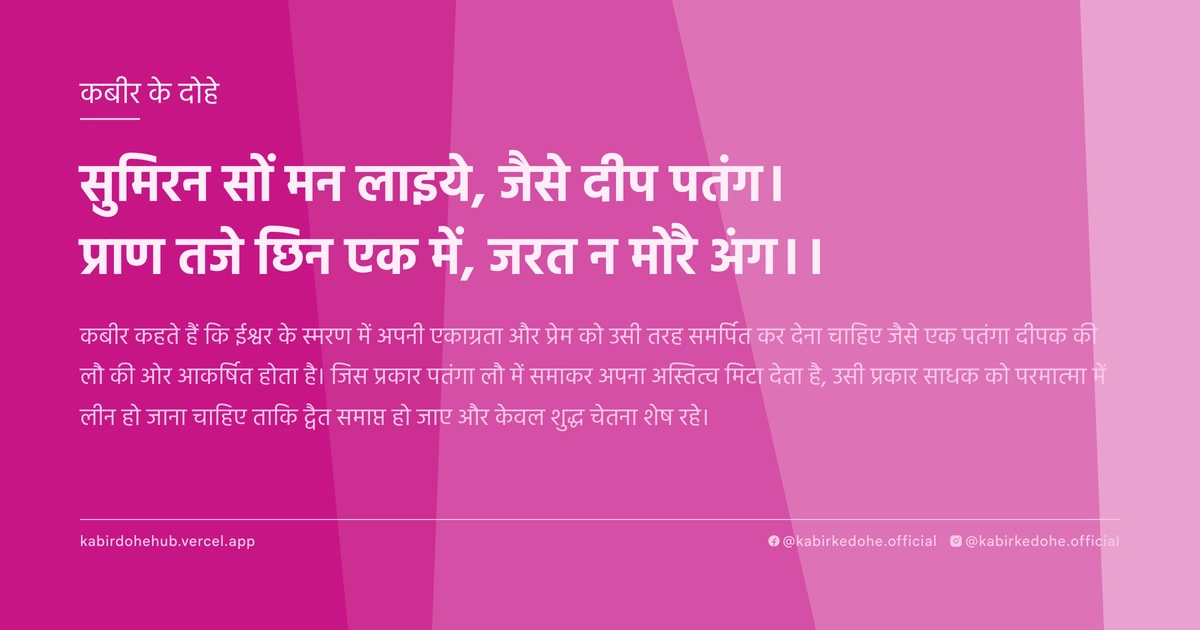
सुमिरन सों मन लाइये, जैसे दीप पतंग।
प्राण तजे छिन एक में, जरत न मोरै अंग।।
Sumiran son man laaiye, jaise deep patang. Praan taje chhin ek me, jarat na morai ang.
इस पृष्ठ पर इस कबीर दोहे का अर्थ (meaning), हिंदी व्याख्या और अंग्रेज़ी अनुवाद, दार्शनिक विश्लेषण और व्यावहारिक जीवन सीख दी गई है। यह दोहा भक्ति (Bhakti) विषय से जुड़ा है — Kabir doha meaning and explanation in Hindi and English.
अर्थ (Meaning):
कबीर कहते हैं कि ईश्वर के स्मरण में अपनी एकाग्रता और प्रेम को उसी तरह समर्पित कर देना चाहिए जैसे एक पतंगा दीपक की लौ की ओर आकर्षित होता है। जिस प्रकार पतंगा लौ में समाकर अपना अस्तित्व मिटा देता है, उसी प्रकार साधक को परमात्मा में लीन हो जाना चाहिए ताकि द्वैत समाप्त हो जाए और केवल शुद्ध चेतना शेष रहे।
Kabir urges the seeker to attach their mind to the remembrance of the Divine with the same absolute intensity as a moth is drawn to a flame. Just as the moth surrenders its entire existence in a single moment of union with the light, the devotee must dissolve their ego into the Infinite, achieving a state where the separation between the seeker and the sought vanishes entirely.
व्याख्या (Interpretation):
यह दोहा 'समर्पण' और 'विलय' की पराकाष्ठा को दर्शाता है। यहाँ 'दीपक' परमात्मा का प्रतीक है और 'पतंगा' मानवीय अहंकार या जीवात्मा का। जब पतंगा लौ में गिरता है, तो वह जलता नहीं है, बल्कि प्रकाश में परिवर्तित हो जाता है। यह निरगुण भक्ति का सार है जहाँ साधक अपनी सीमित पहचान (माया) को त्यागकर उस निराकार ब्रह्म में विलीन हो जाता है। यह अद्वैत वेदांत के उस सिद्धांत को पुष्ट करता है जहाँ आत्मा और परमात्मा के बीच का पर्दा हट जाता है। यहाँ 'प्राण तजना' शारीरिक मृत्यु नहीं, बल्कि 'अहंकार की मृत्यु' है। जब तक 'मैं' जीवित है, तब तक 'वह' प्राप्त नहीं हो सकता। इस विरोधाभास में ही मोक्ष निहित है—स्वयं को खोकर स्वयं को पाना।
This couplet illustrates the pinnacle of 'surrender' and 'merging.' The 'lamp' symbolizes the Divine Light, while the 'moth' represents the human ego or the individual soul (Jivatman). When the moth plunges into the flame, it does not merely burn; it transforms into the light itself. This is the essence of Nirgun Bhakti, where the seeker sheds their limited identity (Maya) to merge into the Formless Brahman. It reinforces the Advaita Vedanta principle that the veil between the soul and the Absolute is an illusion. The phrase 'giving up life' does not refer to physical death, but to the 'death of the ego.' As long as the 'I' persists, the 'Thou' remains distant. In this paradox lies liberation—finding oneself by losing oneself.
दार्शनिक विश्लेषण (Philosophical Analysis):
कबीर का यह दर्शन उनके समय के कर्मकांडीय धर्म के विरुद्ध एक सशक्त प्रहार था। जहाँ उस युग में लोग बाहरी अनुष्ठानों, तीर्थयात्राओं और मूर्तियों में ईश्वर को खोज रहे थे, कबीर ने 'अंतर्मुखी सुमिरन' पर जोर दिया। उन्होंने बताया कि परमात्मा किसी मंदिर या मस्जिद में नहीं, बल्कि हृदय की गहन एकाग्रता में है। यह दृष्टिकोण सूफी मत के 'फना' (Fana) के सिद्धांत से गहराई से मेल खाता है, जहाँ साधक ईश्वर के प्रेम में अपनी व्यक्तिगत पहचान को पूरी तरह मिटा देता है।
अद्वैत वेदांत के परिप्रेक्ष्य में, यह दोहा 'माया' के विनाश की बात करता है। माया वह भ्रम है जो हमें यह विश्वास दिलाता है कि हम शरीर हैं और ईश्वर से अलग हैं। जब सुमिरन की तीव्रता पतंगे जैसी हो जाती है, तो यह भ्रम टूट जाता है। कबीर यहाँ यह स्पष्ट कर रहे हैं कि भक्ति केवल माला जपना नहीं है, बल्कि एक ऐसी मानसिक अवस्था है जहाँ प्रेमी और प्रियतम एक हो जाते हैं।
ऐतिहासिक रूप से, कबीर ने जाति और वर्ग के भेदों को नकारते हुए यह संदेश दिया कि आध्यात्मिक उत्थान केवल आंतरिक तीव्रता और प्रेम से संभव है, न कि जन्म या शास्त्र ज्ञान से। उनका विरोध उन पाखंडियों से था जो धर्म को केवल सामाजिक प्रतिष्ठा का साधन मानते थे।
मनोवैज्ञानिक स्तर पर, यह 'अहंकार के विसर्जन' की प्रक्रिया है। जब मनुष्य अपनी इच्छाओं और पहचान के प्रति आसक्ति छोड़ देता है, तो वह मानसिक शांति और ब्रह्मांडीय चेतना का अनुभव करता है। यह एक ऐसी स्थिति है जहाँ भय समाप्त हो जाता है क्योंकि डर केवल 'अलग' होने के अहसास से पैदा होता है।
अंततः, कबीर यह समझाते हैं कि वास्तविक ज्ञान वह नहीं है जो पढ़ा जाए, बल्कि वह है जो अनुभव किया जाए। 'जरत न मोरै अंग' का अर्थ है कि जब आत्मा परमात्मा में लीन होती है, तो वह कष्ट नहीं पाती, बल्कि एक अनंत आनंद और पूर्णता का अनुभव करती है, क्योंकि वह अपने मूल स्रोत में लौट आई है।
Kabir's philosophy here is a potent strike against the ritualistic religion of his era. While contemporaries sought the Divine through external rituals, pilgrimages, and idols, Kabir emphasized 'internal remembrance' (Antarmukhi Sumiran). He asserted that the Divine resides not in temples or mosques, but in the profound concentration of the heart. This perspective aligns deeply with the Sufi concept of 'Fana' (annihilation), where the seeker completely erases their personal identity in the love of God.
From the lens of Advaita Vedanta, this doha speaks of the destruction of 'Maya.' Maya is the illusion that convinces us we are the physical body and separate from the Absolute. When the intensity of remembrance becomes like that of the moth, this illusion shatters. Kabir clarifies that devotion is not merely the mechanical chanting of beads, but a psychological state where the lover and the Beloved become one.
Historically, Kabir rejected caste and class distinctions, preaching that spiritual elevation is achieved solely through internal intensity and love, not through birth or scriptural scholarship. His opposition was directed at hypocrites who used religion as a tool for social prestige.
Psychologically, this is the process of 'ego dissolution.' When a human relinquishes attachment to their desires and identity, they experience mental peace and cosmic consciousness. This is a state where fear vanishes, for fear is born only from the perception of separation.
Ultimately, Kabir explains that true knowledge is not that which is read, but that which is experienced. The phrase 'without the limbs being burnt' implies that when the soul merges into the Divine, it does not suffer; rather, it experiences infinite bliss and wholeness, having returned to its primordial source.
मूल संदेश (Core Message):
- अधूरा सुमिरन केवल शब्दों का खेल है, पूर्ण सुमिरन स्वयं का विसर्जन है।
- प्रेम की पराकाष्ठा वह है जहाँ प्रेमी और प्रियतम के बीच का अंतर समाप्त हो जाए।
- अहंकार की मृत्यु ही वास्तविक जीवन का प्रारंभ है।
- बाहरी कर्मकांड केवल भ्रम हैं; आंतरिक एकाग्रता ही एकमात्र मार्ग है।
- जब 'मैं' मिटता है, तभी 'वह' प्रकट होता है।
- Incomplete remembrance is a play of words; complete remembrance is the dissolution of the self.
- The peak of love is where the distinction between the lover and the Beloved vanishes.
- The death of the ego is the true beginning of authentic life.
- External rituals are mere illusions; internal concentration is the only path.
- Only when the 'I' is erased does the 'Absolute' manifest.
व्यावहारिक उदाहरण (Practical Example):
वाराणसी के घाटों पर रहने वाली एक वृद्ध विधवा, जानकी, का जीवन केवल दूसरों की सेवा और मंदिर की सीढ़ियों पर बिताए समय तक सीमित था। वह प्रतिदिन घंटों जाप करती थी, लेकिन उसके मन में अभी भी अपने बेटों के प्रति शिकायतें और समाज के प्रति कड़वाहट थी। उसका 'सुमिरन' केवल एक आदत थी, प्रेम नहीं।
एक दिन उसने एक फकीर को देखा जो बिना किसी माला के, बस अपनी आँखें बंद किए एक गहरी शांति में डूबा था। जब जानकी ने उससे पूछा कि वह क्या जप रहा है, तो फकीर ने मुस्कुराकर कहा, 'मैं जप नहीं रहा, मैं बस उस प्रकाश में खो गया हूँ जिसे मैं खोज रहा था।'
जानकी को समझ आया कि वह अब तक केवल शब्दों को दोहरा रही थी, जबकि उसका 'अहंकार' (मैं पीड़ित हूँ, मैं उपेक्षित हूँ) अभी भी जीवित था। उसने तय किया कि वह अब केवल शब्दों का जाप नहीं करेगी, बल्कि अपने भीतर के क्रोध और दुख को उस परमात्मा की लौ में समर्पित कर देगी।
शुरुआत में यह कठिन था। जब भी उसके बेटों की याद आती और गुस्सा आता, वह अपनी आँखें बंद करती और कल्पना करती कि वह एक छोटा सा पतंगा है और उसका क्रोध एक जलती हुई लौ है। वह अपने क्रोध को उस लौ में झोंक देती।
धीरे-धीरे, उसकी शिकायतें खत्म होने लगीं। उसने महसूस किया कि जब वह अपनी 'पीड़ा' की पहचान को छोड़ देती है, तो वह वास्तव में स्वतंत्र हो जाती है। वह अब केवल एक 'दुखी विधवा' नहीं थी, बल्कि एक शांत आत्मा थी।
उसने अपने मोह को त्याग दिया और यह महसूस किया कि उसका अस्तित्व उस अनंत प्रेम का हिस्सा है। अब उसकी सेवा में दिखावा नहीं था, बल्कि एक सहज प्रवाह था।
वह अब मंदिर की सीढ़ियों पर बैठकर केवल माला नहीं फेरती थी, बल्कि मौन रहकर उस आंतरिक प्रकाश का अनुभव करती थी। उसके चेहरे पर एक ऐसी चमक आ गई जो किसी बाहरी पूजा से नहीं आई थी।
जानकी का जीवन बदल गया क्योंकि उसने 'सुमिरन' को एक क्रिया से बदलकर एक 'अवस्था' बना लिया। उसने अपनी पहचान को परमात्मा की लौ में विलीन कर दिया, और इस तरह वह बिना किसी बाहरी संघर्ष के आंतरिक शांति पा सकी।
Janaki, an elderly widow living on the ghats of Varanasi, spent her days in service to others and sitting on temple steps. She chanted for hours daily, yet her heart remained heavy with grievances against her sons and bitterness toward society. Her 'remembrance' was a mere habit, devoid of love.
One day, she observed a wandering dervish who sat in profound silence, without any prayer beads, immersed in a deep peace. When Janaki asked what he was chanting, the dervish smiled and replied, 'I am not chanting; I have simply lost myself in the light I was seeking.'
Janaki realized she had been merely repeating words, while her 'ego' (the identity of being a victim, being neglected) was still very much alive. She decided she would no longer just repeat syllables but would surrender her anger and sorrow into the flame of the Divine.
Initially, it was difficult. Whenever memories of her sons triggered anger, she would close her eyes and visualize herself as a tiny moth and her anger as a burning flame. She would cast her anger into that fire.
Gradually, her complaints vanished. She realized that when she relinquished the identity of her 'suffering,' she became truly free. She was no longer just a 'grieving widow,' but a tranquil soul.
She let go of her attachments and felt that her existence was a part of an infinite love. Now, her service to others was not a duty or a show, but a spontaneous flow of compassion.
She no longer sat on the temple steps merely to count beads; she sat in silence to experience the internal light. A radiance appeared on her face that no external ritual could have provided.
Janaki's life transformed because she shifted 'remembrance' from an action to a state of being. She merged her identity into the Divine flame, achieving internal peace without any external struggle.
अभ्यास मार्गदर्शन (Practice Guidance):
- प्रतिदिन 20 मिनट 'शून्य ध्यान' का अभ्यास करें, जहाँ आप किसी मंत्र का जाप न करें, बल्कि केवल उस मौन के प्रति समर्पित हो जाएं जो आपके भीतर है।
- स्व-अन्वेषण जर्नल: प्रतिदिन लिखें कि आज किस क्षण में आपका 'अहंकार' (मैं, मेरा, मुझे) सबसे अधिक सक्रिय था और उसे एक 'लौ' में विलीन होते हुए देखें।
- व्यवहार परिवर्तन: जब भी किसी के प्रति क्रोध या ईर्ष्या महसूस हो, तो तुरंत रुकें और सोचें—'क्या यह मेरा अहंकार बोल रहा है या मेरी आत्मा?'
- नैदानिक चेकलिस्ट: यदि आप अभी भी दूसरों की प्रशंसा या आलोचना से विचलित होते हैं, तो इसका अर्थ है कि आपका 'पतंगा' अभी भी लौ से दूर है। यदि आप शांति में स्थिर हैं, तो विलय शुरू हो चुका है।
- Practice 20 minutes of 'Zero Meditation' daily, where you do not chant any mantra but simply surrender to the silence that exists within you.
- Self-Inquiry Journal: Write daily about the moments when your 'ego' (I, mine, me) was most active and visualize it dissolving into a divine flame.
- Behavioral Shift: Whenever you feel anger or jealousy toward another, stop immediately and ask—'Is this my ego speaking, or my soul?'
- Diagnostic Checklist: If you are still disturbed by praise or criticism from others, your 'moth' is still far from the flame. If you remain equanimous, the merging has begun.
चिंतन प्रश्न (Reflection Questions):
- वह कौन सी पहचान है जिसे आप इतनी मजबूती से पकड़े हुए हैं कि उसे छोड़ने के विचार से ही आपको डर लगता है?
- क्या आपका आध्यात्मिक अभ्यास आपको विनम्र बना रहा है, या यह आपके 'धार्मिक अहंकार' को और बढ़ा रहा है?
- यदि आज आपकी सारी सामाजिक उपलब्धियाँ और रिश्ते छीन लिए जाएँ, तो आपके भीतर क्या शेष रहेगा?
- आपकी डिजिटल पहचान (सोशल मीडिया) आपके वास्तविक आंतरिक स्वरूप को कितना ढक रही है?
- क्या आप ईश्वर को 'पाने' की कोशिश कर रहे हैं, या आप स्वयं को 'खोने' का साहस रखते हैं?
- What is the identity you hold onto so tightly that the mere thought of letting it go terrifies you?
- Is your spiritual practice making you humble, or is it inflating your 'religious ego'?
- If all your social achievements and relationships were stripped away today, what would remain within you?
- To what extent does your digital identity (social media) mask your true internal nature?
- Are you trying to 'attain' God, or do you have the courage to 'lose' yourself?