
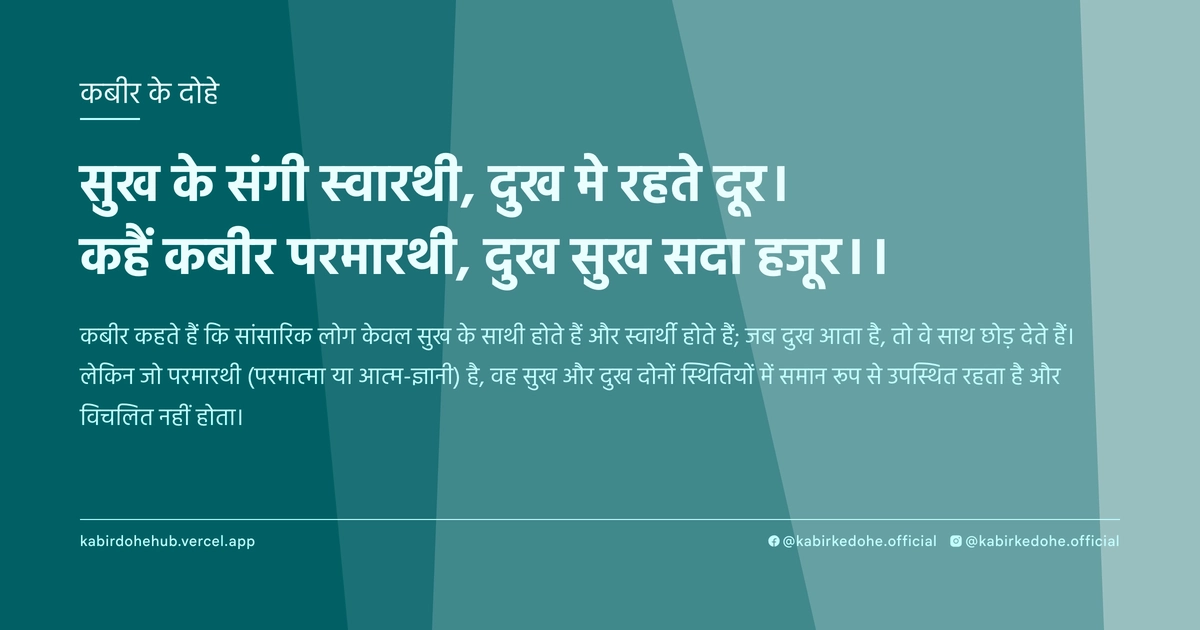
सुख के संगी स्वारथी, दुख मे रहते दूर।
कहैं कबीर परमारथी, दुख सुख सदा हजूर।।
Sukh ke sangi swarthi, dukh me rehte door. Kahein kabir paramarthi, dukh sukh sada hazur.
इस पृष्ठ पर इस कबीर दोहे का अर्थ (meaning), हिंदी व्याख्या और अंग्रेज़ी अनुवाद, दार्शनिक विश्लेषण और व्यावहारिक जीवन सीख दी गई है। यह दोहा दुख और सुख (Sorrow and Joy) विषय से जुड़ा है — Kabir doha meaning and explanation in Hindi and English.
अर्थ (Meaning):
कबीर कहते हैं कि सांसारिक लोग केवल सुख के साथी होते हैं और स्वार्थी होते हैं; जब दुख आता है, तो वे साथ छोड़ देते हैं। लेकिन जो परमारथी (परमात्मा या आत्म-ज्ञानी) है, वह सुख और दुख दोनों स्थितियों में समान रूप से उपस्थित रहता है और विचलित नहीं होता।
Kabir observes that worldly companions are driven by selfishness, clustering around you in times of prosperity but vanishing during adversity. In contrast, the Paramarthi—the Supreme Soul or the enlightened one—remains equanimously present and unwavering, regardless of whether the tide brings joy or sorrow.
व्याख्या (Interpretation):
इस दोहे का शाब्दिक अर्थ है कि दुनिया के रिश्ते स्वार्थ पर टिके हैं। रूपकात्मक स्तर पर, 'सुख' और 'दुख' केवल बाहरी लहरें हैं जो मन की शांति को बाधित करती हैं। कबीर यहाँ 'परमारथी' के माध्यम से उस अवस्था की बात कर रहे हैं जहाँ व्यक्ति द्वंद्वों (dualities) से ऊपर उठ जाता है। यह निर्गुण भक्ति का सार है, जहाँ ईश्वर किसी बाहरी रूप में नहीं, बल्कि उस आंतरिक स्थिरता में है जो विपरीत परिस्थितियों में भी नहीं डगमगाती। माया हमें विश्वास दिलाती है कि सुख स्थायी है, जबकि सत्य यह है कि सुख और दुख एक ही सिक्के के दो पहलू हैं। जब साधक इस अद्वैत भाव को समझ लेता है, तो वह बाहरी सहारे की खोज बंद कर देता है और अपने भीतर के शाश्वत साथी को पा लेता है।
Literally, the verse critiques the fragility of human relationships based on utility. Metaphorically, 'pleasure' and 'pain' are depicted as transient waves that disturb the surface of the mind. Kabir invokes the 'Paramarthi' to represent the state of consciousness that transcends duality. This is the essence of Nirgun Bhakti, where the Divine is not a distant deity but the internal stillness that remains undisturbed by external storms. Maya creates the illusion that happiness is a destination, while the truth is that joy and sorrow are interdependent polarities. Once the seeker realizes the non-duality (Advaita) of these experiences, they cease seeking external validation and discover the eternal companion within—the Atman—which is the only constant in the flux of existence.
दार्शनिक विश्लेषण (Philosophical Analysis):
कबीर का यह दोहा उस सामाजिक और आध्यात्मिक परिवेश से उपजा है जहाँ बाहरी आडंबरों और जातिगत श्रेष्ठता का बोलबाला था। वे यहाँ मानवीय स्वभाव की उस बुनियादी कमजोरी पर प्रहार कर रहे हैं जहाँ प्रेम केवल लाभ पर आधारित होता है। यह विचार सूफीवाद के 'फना' (अहंकार का विनाश) और अद्वैत वेदांत के 'साक्षी भाव' से गहराई से जुड़ा है। कबीर यह समझाते हैं कि जब तक मनुष्य अपनी पहचान बाहरी संबंधों और भौतिक सुखों से जोड़ता है, वह निरंतर भय और अकेलेपन में रहेगा।
यहाँ 'परमारथी' शब्द केवल ईश्वर के लिए नहीं, बल्कि उस जागृत चेतना के लिए है जो यह जानती है कि आत्मा अविनाशी है। यह विश्लेषण हमें बताता है कि दुःख वास्तव में एक उपकरण है जो हमें बाहरी दुनिया के भ्रम से हटाकर आंतरिक सत्य की ओर ले जाता है। कबीर का विरोध उन लोगों से है जो केवल 'शुभ' समय में धर्म की बात करते हैं, जबकि वास्तविक आध्यात्मिकता वह है जो प्रतिकूलता में भी अडिग रहे।
ऐतिहासिक रूप से, कबीर ने बुनकर समुदाय से होते हुए समाज के सबसे निचले तबके के संघर्षों को देखा था, जहाँ उन्होंने अनुभव किया कि सामाजिक समर्थन अक्सर सशर्त होता है। इसलिए, उनका दर्शन 'आत्म-निर्भरता' और 'ईश्वर-निर्भरता' का मिश्रण है। वे ritualism (कर्मकांड) को इसलिए नकारते हैं क्योंकि मंदिर या मस्जिद जाने से वह आंतरिक स्थिरता नहीं आती जो आत्म-साक्षात्कार से आती है।
मनोवैज्ञानिक स्तर पर, यह दोहा 'इगो' (अहंकार) के विसर्जन की बात करता है। जब हम कहते हैं 'मेरा दुख', तो हम अहंकार को पुष्ट करते हैं। लेकिन जब हम दुख को एक साक्षी की तरह देखते हैं, तो हम उस 'परमारथी' भाव में प्रवेश करते हैं। यह विस्थापन ही मुक्ति का मार्ग है।
अंततः, कबीर यह संदेश देते हैं कि संसार की नश्वरता को स्वीकार करना ही वास्तविक शांति का द्वार है। जो व्यक्ति सुख में अहंकारी नहीं होता और दुख में निराश नहीं होता, वही वास्तव में स्वतंत्र है। यह संतुलन ही जीवन की सर्वोच्च उपलब्धि है, जिसे कबीर ने 'सहज अवस्था' कहा है।
Kabir's couplet emerges from a socio-spiritual milieu dominated by rigid ritualism and caste hierarchies. He strikes at the fundamental flaw of human nature: the tendency to build relationships on utility rather than unconditional love. This perspective aligns closely with the Sufi concept of 'Fana' (annihilation of the ego) and the Advaita Vedanta principle of 'Sakshi' (the witness consciousness). Kabir argues that as long as an individual anchors their identity in external associations and material pleasures, they are condemned to a cycle of anxiety and abandonment.
The term 'Paramarthi' does not merely refer to a distant God, but to the awakened consciousness that recognizes the Atman as indestructible. This analysis reveals that suffering is actually a catalyst; it strips away the illusions of Maya, forcing the seeker to turn inward. Kabir critiques those who practice spirituality only during 'auspicious' times, asserting that true spiritual maturity is forged in the crucible of adversity.
Historically, Kabir's experience as a weaver in a marginalized community provided him a front-row seat to the conditional nature of social support. His philosophy is thus a synthesis of radical self-reliance and absolute surrender to the Formless Divine. He rejects ritualism because external ceremonies cannot provide the internal equilibrium that only self-realization can offer.
Psychologically, the verse addresses the dissolution of the ego. By claiming 'my pain,' we reinforce the separate self. However, by observing pain as a transient phenomenon, we shift into the state of the Paramarthi. This shift from 'I am suffering' to 'Suffering is happening' is the gateway to liberation.
Ultimately, Kabir posits that accepting the transience of the world is the only path to lasting peace. The individual who remains unswayed by pleasure and uncrushed by pain achieves what Kabir calls 'Sahaj'—the state of natural, effortless equilibrium. This balance is the highest human achievement, transcending the binary of joy and sorrow.
मूल संदेश (Core Message):
- बाहरी रिश्ते अक्सर लाभ की नींव पर टिके होते हैं।
- सुख और दुख मन की अस्थिर अवस्थाएं हैं, सत्य नहीं।
- परमात्मा वह आंतरिक स्थिरता है जो द्वंद्वों से परे है।
- अकेलापन वास्तव में स्वयं से मिलने का एक अवसर है।
- सच्ची स्वतंत्रता बाहरी सहारे के अभाव में भी शांत रहने में है।
- External relationships are often anchored in the foundation of utility.
- Joy and sorrow are unstable states of mind, not the ultimate truth.
- The Divine is the internal stability that exists beyond all dualities.
- Loneliness is actually an opportunity to encounter one's true self.
- True freedom lies in remaining peaceful even in the absence of external support.
व्यावहारिक उदाहरण (Practical Example):
वाराणसी के एक पुराने घाट पर रामदीन नाम का एक वृद्ध नाविक रहता था। उसकी पूरी जिंदगी पर्यटकों को नाव की सैर कराने में बीती। जब तक उसका शरीर स्वस्थ था और पर्यटक आते थे, पूरा मोहल्ला उसकी प्रशंसा करता था और उसके घर पर दावतें होती थीं। लोग उसे 'घाट का राजा' कहते थे और उसकी बातों को सम्मान देते थे।
लेकिन समय बदला और रामदीन को एक गंभीर बीमारी ने घेर लिया। उसकी नाव सड़ गई और वह चलने-फिरने में असमर्थ हो गया। अचानक, वे सभी 'मित्र' जो उसकी समृद्धि के समय उसके साथ हँसते थे, गायब हो गए। अब उसके घर के सामने से गुजरने वाले लोग भी उसकी ओर नहीं देखते थे। वह अकेलापन और शारीरिक पीड़ा के गहरे गर्त में गिर गया।
एक शाम, जब वह अपनी टूटी हुई खाट पर लेटा हुआ था, उसे कबीर का यह दोहा याद आया। उसने महसूस किया कि वह अब तक जिन लोगों को अपना 'संगी' समझ रहा था, वे केवल उसकी 'सुविधा' के साथी थे, उसके 'अस्तित्व' के नहीं। उसने अपनी आँखें बंद कीं और उस शून्य में झाँकने की कोशिश की जहाँ कोई बाहरी शोर नहीं था।
उसने महसूस किया कि उसका दुख उसे एक ऐसी जगह ले आया है जहाँ अब कोई मुखौटा नहीं बचा। उसने अपने भीतर एक ऐसी शांति खोजना शुरू किया जो किसी बाहरी व्यक्ति की उपस्थिति पर निर्भर नहीं थी। उसने अपनी बीमारी को अपना शत्रु मानने के बजाय, उसे एक शिक्षक की तरह देखना शुरू किया जो उसे दुनिया की असलियत सिखा रहा था।
धीरे-धीरे, रामदीन का व्यवहार बदल गया। उसने दूसरों से उम्मीद करना छोड़ दिया। जब कभी कोई पुराना परिचित दया भाव से उससे मिलने आता, तो वह अब क्रोध या शिकायत नहीं करता, बल्कि एक मंद मुस्कान के साथ उनका स्वागत करता। उसने पाया कि जब उसने बाहरी सहारे की उम्मीद छोड़ दी, तो वह भीतर से अधिक शक्तिशाली हो गया।
उसकी इस नई शांति ने मोहल्ले के लोगों को हैरान कर दिया। जो लोग उसे 'बेचारा' समझ रहे थे, उन्होंने देखा कि रामदीन अब सबसे अधिक प्रसन्न व्यक्ति था, जबकि वह सबसे अधिक कष्ट में था। उसकी आँखों में एक ऐसी चमक थी जो पहले कभी नहीं देखी गई थी।
एक दिन एक युवा लड़का उसके पास आया और पूछा, "बाबा, आपके पास अब कुछ नहीं बचा, फिर भी आप इतने शांत कैसे हैं?" रामदीन ने धीमे स्वर में कहा, "बेटा, जब तक मैं सुख के पीछे भाग रहा था, मैं डर में था कि वह छिन जाएगा। अब जब दुख मेरा स्थायी साथी बन गया है, तो मैंने जान लिया है कि असली साथी तो वह है जो मेरे भीतर है, जो कभी नहीं बदलता।"
रामदीन की यह रूपांतरण यात्रा एक 'कबीर ट्विस्ट' थी। उसने दुख को एक बाधा नहीं, बल्कि एक द्वार बना लिया। उसने सीखा कि परमारथी होने का अर्थ यह नहीं है कि जीवन में दुख नहीं आएगा, बल्कि यह है कि दुख आने पर आप बिखरेंगे नहीं, बल्कि और अधिक निखरेंगे।
On an ancient ghat in Varanasi lived an elderly boatman named Ramdeen. His entire life was spent ferrying tourists across the river. As long as his body was healthy and the tourists flocked to him, the entire neighborhood praised him, and feasts were held at his home. People called him the 'King of the Ghat' and treated his words with immense respect.
But time shifted, and a severe illness gripped Ramdeen. His boat decayed, and he became unable to walk. Suddenly, all those 'friends' who laughed with him during his prosperity vanished. Now, people passing by his house didn't even glance his way. He fell into a deep abyss of loneliness and physical agony.
One evening, lying on his broken cot, he recalled this specific Doha of Kabir. He realized that the people he had considered his 'companions' were merely companions of his 'convenience,' not of his 'existence.' He closed his eyes and attempted to peer into the silence where no external noise existed.
He felt that his suffering had brought him to a place where no masks remained. He began to seek a peace within that did not depend on the presence of any other human being. Instead of viewing his illness as an enemy, he began to see it as a teacher revealing the true nature of the world.
Gradually, Ramdeen's behavior transformed. He stopped expecting anything from others. Whenever an old acquaintance visited out of pity, he no longer responded with anger or complaint, but welcomed them with a gentle smile. He discovered that once he abandoned the hope for external support, he became internally more powerful.
This new serenity astonished the neighborhood. People who viewed him as 'pitiful' noticed that Ramdeen was now the happiest person among them, despite being in the most pain. There was a radiance in his eyes that had never been seen before.
One day, a young boy approached him and asked, "Baba, you have nothing left, yet how are you so peaceful?" Ramdeen replied softly, "Son, as long as I chased pleasure, I lived in fear that it would be snatched away. Now that pain has become my constant companion, I have realized that the only true companion is the one within me, who never changes."
Ramdeen's journey of transformation was a 'Kabir Twist.' He turned suffering not into a barrier, but into a gateway. He learned that being a 'Paramarthi' does not mean that pain will not come, but that when it arrives, you do not shatter; instead, you refine yourself.
अभ्यास मार्गदर्शन (Practice Guidance):
- दैनिक साक्षी अभ्यास: दिन में तीन बार 10 मिनट के लिए बैठें और अपने सुखद और दुखद अनुभवों को केवल एक 'दर्शक' की तरह देखें, बिना किसी निर्णय के।
- आत्म-पूछताछ जर्नल: लिखें कि किन परिस्थितियों में आप दूसरों पर सबसे अधिक निर्भर महसूस करते हैं और वह निर्भरता आपके भीतर किस डर को जन्म देती है।
- व्यवहारिक परिवर्तन: जब आप किसी संकट में हों, तो बाहरी मदद मांगने से पहले 15 मिनट मौन रहकर यह अनुभव करें कि आपकी आंतरिक चेतना अभी भी स्थिर है।
- डायग्नोस्टिक चेकलिस्ट: क्या मैं किसी की प्रशंसा मिलने पर अति-उत्साहित होता हूँ? क्या मैं किसी की उपेक्षा मिलने पर गहरे अवसाद में जाता हूँ? यदि हाँ, तो मैं अभी भी 'सुख के संगी' की मानसिकता में हूँ।
- Daily Witness Practice: Sit for 10 minutes three times a day and observe your pleasant and unpleasant experiences as a mere 'spectator,' without judgment.
- Self-Inquiry Journal: Document the specific situations where you feel most dependent on others and identify the underlying fear that this dependency creates.
- Behavioral Shift: When facing a crisis, spend 15 minutes in silence before seeking external help, experiencing that your internal consciousness remains stable despite the turmoil.
- Diagnostic Checklist: Do I become over-excited by praise? Do I fall into deep despair upon being ignored? If yes, I am still operating from the 'companion of pleasure' mindset.
चिंतन प्रश्न (Reflection Questions):
- मेरे जीवन के वे कौन से रिश्ते हैं जो केवल मेरी सफलता या उपयोगिता पर आधारित हैं?
- यदि आज मेरा सामाजिक स्तर और पहचान छीन ली जाए, तो मेरे पास क्या बचेगा?
- क्या मैं अपने दुख को इसलिए स्वीकार नहीं कर पा रहा हूँ क्योंकि मुझे लगता है कि यह मेरी छवि को खराब कर रहा है?
- मैं अपनी डिजिटल पहचान (Social Media) के माध्यम से किस तरह के 'सुख के संगी' इकट्ठा कर रहा हूँ?
- क्या मेरी भक्ति केवल तब जागती है जब मैं संकट में होता हूँ, या मैं सुख में भी उस 'परमारथी' को याद रखता हूँ?
- Which relationships in my life are based solely on my success or utility?
- If my social status and identity were stripped away today, what would actually remain of me?
- Am I resisting my suffering because I feel it tarnishes the image I project to the world?
- What kind of 'companions of pleasure' am I gathering through my digital identity and social media?
- Does my spirituality only awaken during crises, or do I remember the 'Paramarthi' even in times of abundance?