
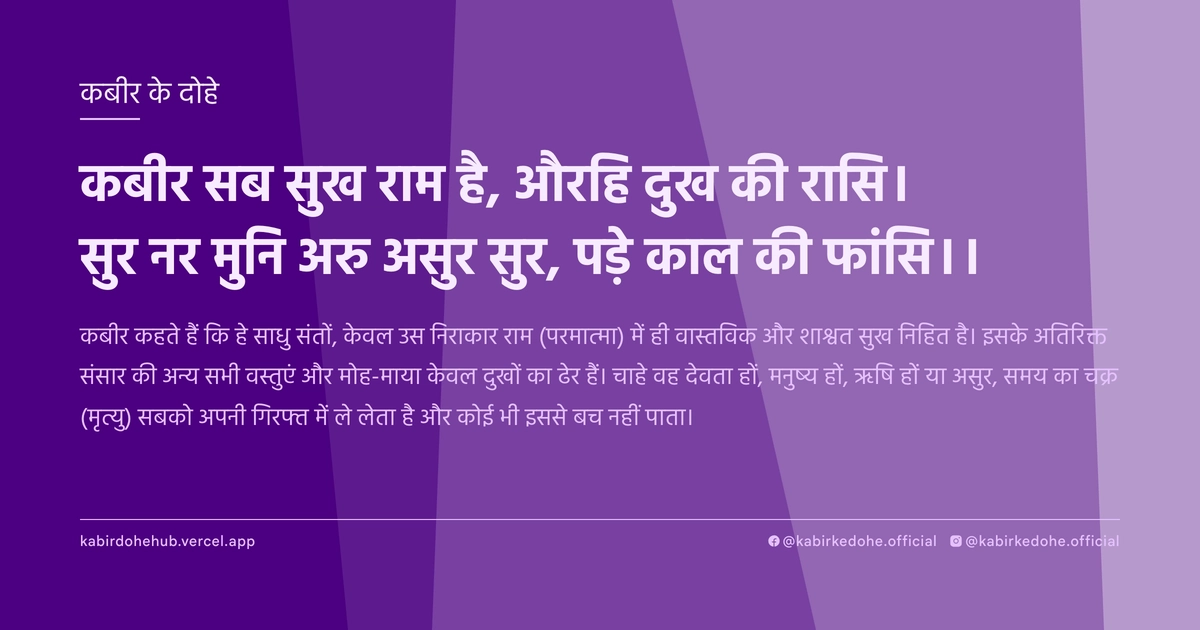
कबीर सब सुख राम है, औरहि दुख की रासि।
सुर नर मुनि अरु असुर सुर, पड़े काल की फांसि।।
Kabir sab sukh ram hai, aurahi dukh ki rasi. Sur nar muni aru asur sur, pade kaal ki phansi.
इस पृष्ठ पर इस कबीर दोहे का अर्थ (meaning), हिंदी व्याख्या और अंग्रेज़ी अनुवाद, दार्शनिक विश्लेषण और व्यावहारिक जीवन सीख दी गई है। यह दोहा निर्गुण ब्रह्म (Nirguna Brahman) विषय से जुड़ा है — Kabir doha meaning and explanation in Hindi and English.
अर्थ (Meaning):
कबीर कहते हैं कि हे साधु संतों, केवल उस निराकार राम (परमात्मा) में ही वास्तविक और शाश्वत सुख निहित है। इसके अतिरिक्त संसार की अन्य सभी वस्तुएं और मोह-माया केवल दुखों का ढेर हैं। चाहे वह देवता हों, मनुष्य हों, ऋषि हों या असुर, समय का चक्र (मृत्यु) सबको अपनी गिरफ्त में ले लेता है और कोई भी इससे बच नहीं पाता।
Kabir addresses the seekers, stating that true and eternal bliss resides solely in the formless Divine (Ram). Everything else in this transient world is merely a heap of sorrows. Whether one is a celestial deity, a mortal human, a sage, or a demon, all are eventually ensnared by the noose of Time (Death), from which there is no escape.
व्याख्या (Interpretation):
इस दोहे का शाब्दिक अर्थ है कि केवल ईश्वर ही सुख का स्रोत है और शेष संसार दुखी है। गहराई में, यहाँ 'राम' दशरथ पुत्र नहीं, बल्कि 'निरुपाधिक' ब्रह्म है जो कण-कण में व्याप्त है। कबीर 'काल की फासी' के माध्यम से समय की नश्वरता और माया के भ्रम को दर्शाते हैं। यह निरगुण भक्ति का सार है जहाँ बाहरी कर्मकांडों के बजाय आंतरिक चेतना के जागरण पर बल दिया गया है। जब मनुष्य अपनी पहचान शरीर या पद (सुर, नर, मुनि) से जोड़ता है, तो वह काल के जाल में फंस जाता है। अद्वैत वेदांत के अनुसार, जब तक 'मैं' (अहंकार) जीवित है, तब तक मृत्यु का भय है; जिस क्षण आत्मा का ब्रह्म से मिलन होता है, काल का प्रभाव समाप्त हो जाता है। यह विरोधाभास है कि जिसे हम सुख समझते हैं, वही वास्तव में बंधन का कारण है।
Literally, the verse claims that only God is the source of joy, while the world is suffering. Metaphorically, 'Ram' here does not refer to the mythological king, but to the formless, omnipresent Absolute (Brahman). Kabir uses the 'noose of Time' to illustrate the transience of existence and the illusion of Maya. This is the essence of Nirgun Bhakti, emphasizing internal awakening over external rituals. When a human identifies with their physical form or social status—be it a deity, human, or sage—they fall prey to the cycle of birth and death. According to Advaita Vedanta, as long as the 'I' (ego) persists, the fear of death remains; the moment the Atman realizes its non-duality with Brahman, the grip of Time is broken. The central paradox is that what we perceive as worldly pleasure is actually the very chain that binds us to suffering.
दार्शनिक विश्लेषण (Philosophical Analysis):
कबीर का यह दोहा उस युग की उपज है जब समाज कर्मकांडों और बाहरी आडंबरों में गहराई से डूबा हुआ था। वे स्पष्ट करते हैं कि मोक्ष किसी विशेष जाति, धर्म या पद से नहीं मिलता। यहाँ 'सुर' (देवता) और 'असुर' (दानव) का उल्लेख यह बताने के लिए है कि आध्यात्मिक अज्ञानता केवल मनुष्यों तक सीमित नहीं है, बल्कि उच्च लोकों में रहने वाले भी जन्म-मृत्यु के चक्र में बंधे हैं। यह सूफी मत के 'फना' (अहंकार का विनाश) के विचार से मेल खाता है, जहाँ साधक को अपनी व्यक्तिगत पहचान को मिटाकर ईश्वर में विलीन होना पड़ता है।
अद्वैत वेदांत के परिप्रेक्ष्य में, कबीर यह समझा रहे हैं कि संसार 'मिथ्या' है। जिसे हम सुख कहते हैं, वह केवल क्षणिक इंद्रिय सुख है, जो अंततः विरह और पीड़ा में बदल जाता है। वास्तविक सुख 'सच्चिदानंद' (सत्य, चित्त, आनंद) है, जो केवल आत्म-साक्षात्कार से प्राप्त होता है। कबीर का प्रहार उन लोगों पर है जो सोचते हैं कि वे अपनी तपस्या या ज्ञान के अहंकार से मृत्यु को जीत लेंगे।
यहाँ 'काल' केवल समय नहीं, बल्कि वह मायावी शक्ति है जो जीव को उसकी वास्तविक प्रकृति से अलग रखती है। जब तक मनुष्य स्वयं को एक अलग इकाई मानता है, वह काल के अधीन है। कबीर का दर्शन यह है कि केवल 'राम-नाम' (अर्थात उस परम तत्व का स्मरण) ही इस फांसी से छूटने का एकमात्र मार्ग है। यह स्मरण कोई मंत्रोच्चार नहीं, बल्कि निरंतर जागरूकता है।
मनोवैज्ञानिक स्तर पर, यह दोहा हमें हमारी 'अटैचमेंट' (आसक्ति) को पहचानने के लिए प्रेरित करता है। हम जिन चीजों को अपना आधार मानते हैं—संपत्ति, संबंध, प्रतिष्ठा—वे सब अस्थिर हैं। यह अस्थिरता ही दुख का मूल कारण है। जब हम अपनी खुशी को बाहरी वस्तुओं से हटाकर आंतरिक शून्य या परमात्मा में केंद्रित करते हैं, तब हम मानसिक शांति प्राप्त करते हैं।
अंततः, कबीर का संदेश यह है कि जीवन की सार्थकता इस बात में नहीं है कि हम कितने समय तक जीवित रहे, बल्कि इस बात में है कि क्या हमने उस शाश्वत सत्य को पहचान लिया जो समय से परे है। यह एक क्रांतिकारी आह्वान है जो मनुष्य को उसकी सामाजिक पहचान से ऊपर उठाकर एक वैश्विक, आध्यात्मिक पहचान की ओर ले जाता है।
This Doha emerges from an era where society was deeply entrenched in ritualism and outward displays of piety. Kabir asserts that liberation is not granted by caste, religion, or social rank. By mentioning 'Surs' (deities) and 'Asurs' (demons), he illustrates that spiritual ignorance is not limited to humans; even those in celestial realms are bound by the cycle of birth and death. This aligns with the Sufi concept of 'Fana' (annihilation of the ego), where the seeker must dissolve their individual identity to merge with the Divine.
From the perspective of Advaita Vedanta, Kabir explains that the world is 'Mithya' (illusory). What we perceive as pleasure is merely transient sensory gratification, which inevitably turns into separation and pain. True bliss is 'Satchidananda' (Truth, Consciousness, Bliss), attainable only through self-realization. Kabir targets those who believe their asceticism or intellectual pride can conquer death.
Here, 'Kaal' (Time) is not just a chronological sequence but the illusory force that keeps the soul separated from its true nature. As long as a human perceives themselves as a separate entity, they remain subject to Time. Kabir's philosophy posits that 'Ram-Naam'—not as a mantra, but as a state of constant awareness of the Absolute—is the only way to escape this noose.
Psychologically, the verse urges us to recognize our attachments. The things we rely on for security—wealth, relationships, status—are all unstable. This instability is the root cause of suffering. By shifting the center of happiness from external objects to the internal void or the Divine, one achieves genuine mental peace.
Ultimately, Kabir's message is that the meaning of life lies not in the duration of existence, but in whether one has recognized the eternal truth that transcends time. It is a revolutionary call to rise above social identities and embrace a universal, spiritual identity.
मूल संदेश (Core Message):
- बाहरी सुख क्षणभंगुर हैं, केवल आंतरिक परमात्मा ही शाश्वत है।
- अहंकार ही वह रस्सी है जो हमें जन्म-मृत्यु के चक्र में बांधती है।
- पद और प्रतिष्ठा मृत्यु के समय निरर्थक हो जाते हैं।
- सच्ची शांति केवल 'मैं' के विसर्जन और 'ब्रह्म' के मिलन में है।
- समय सबको निगल लेता है, केवल सत्य ही समय से परे रहता है।
- External pleasures are transient; only the internal Divine is eternal.
- The ego is the rope that binds us to the cycle of birth and death.
- Rank and prestige become meaningless in the face of death.
- True peace lies in the dissolution of the 'I' and union with the Absolute.
- Time consumes all; only Truth remains beyond the reach of time.
व्यावहारिक उदाहरण (Practical Example):
एक समय की बात है, बनारस के घाटों पर रहने वाले एक वृद्ध बुनकर थे, जिनका नाम माधव था। माधव अपने काम में निपुण थे और उन्हें अपनी कला पर बहुत गर्व था। वे मानते थे कि उनके द्वारा बुने गए रेशमी वस्त्र उन्हें समाज में सम्मान और सुरक्षा देंगे। उन्होंने अपना पूरा जीवन केवल धन संचय और अपनी प्रतिष्ठा बढ़ाने में लगा दिया।
माधव का एक बेटा था, जो शहर जाकर बड़ा अधिकारी बन गया था। माधव को लगता था कि उनके बेटे की सफलता ही उनका असली सुख है। वे अक्सर अन्य बुनकरों को नीचा दिखाते थे, यह कहकर कि उनके पास न तो वैसा धन है और न ही वैसा रसूख। माधव का अहंकार उनके रेशमी धागों की तरह ही बारीक लेकिन मजबूत था।
एक दिन माधव बहुत बीमार पड़ गए। उनके पास धन की कोई कमी नहीं थी, लेकिन उनकी बीमारी ऐसी थी कि कोई भी दवा काम नहीं कर रही थी। उनके बेटे ने शहर के सबसे महंगे डॉक्टरों को बुलाया, लेकिन सबने हाथ खड़े कर दिए। उस समय माधव ने महसूस किया कि उनकी रेशमी साड़ियाँ और उनके बेटे का ऊंचा पद उन्हें इस पीड़ा से नहीं बचा सकते।
एक शाम, उनके घर के पास एक फकीर आया। उसने माधव की हालत देखी और बस इतना कहा, "माधव, तूने जीवन भर धागों को बुनने में समय बिताया, लेकिन अपनी आत्मा के धागे को परमात्मा से जोड़ना भूल गया। यह जो तूने इकट्ठा किया है, वह सब काल की फांसी है।"
इन शब्दों ने माधव के भीतर कुछ झकझोर दिया। उन्हें याद आया कि कैसे उन्होंने अपने साथी बुनकरों का तिरस्कार किया था। उन्हें एहसास हुआ कि जिसे वे 'सुख' समझ रहे थे, वह वास्तव में एक बोझ था जिसने उन्हें उनके वास्तविक स्वरूप से दूर रखा था।
माधव ने अपनी बची हुई शक्ति से अपने पास मौजूद धन का एक बड़ा हिस्सा उन गरीब बुनकरों की मदद के लिए दे दिया जिन्हें उन्होंने कभी तुच्छ समझा था। उन्होंने महसूस किया कि दूसरों की सेवा और अहंकार का त्याग ही वास्तविक शांति है।
जब वे अंतिम सांस ले रहे थे, उनके चेहरे पर एक ऐसी शांति थी जो उन्होंने करोड़ों रुपये कमाने के बाद भी कभी महसूस नहीं की थी। उन्होंने समझ लिया था कि 'राम' किसी मंदिर या महल में नहीं, बल्कि उस निस्वार्थ प्रेम और समर्पण में हैं।
माधव की कहानी यह सिखाती है कि भौतिक उपलब्धियां और सामाजिक प्रतिष्ठा केवल एक भ्रम हैं। जब मृत्यु सामने आती है, तो केवल वही बचता है जो हमने आंतरिक रूप से अर्जित किया होता है।
इस 'कबीर ट्विस्ट' ने माधव को एक अहंकारी व्यक्ति से एक मुक्त आत्मा में बदल दिया। उन्होंने मृत्यु के भय को जीत लिया क्योंकि उन्होंने अंततः उस शाश्वत सुख को पा लिया जो समय के बंधन से मुक्त है।
अब बनारस के उस मोहल्ले में माधव को उनके धन के लिए नहीं, बल्कि उनकी करुणा और आध्यात्मिक जागृति के लिए याद किया जाता है।
Once, in the ghats of Varanasi, lived an elderly weaver named Madhav. Madhav was a master of his craft and took immense pride in it. He believed that the exquisite silk fabrics he wove would guarantee him social respect and lifelong security. He spent his entire life accumulating wealth and enhancing his prestige.
Madhav had a son who had moved to the city and become a high-ranking official. Madhav felt that his son's success was his ultimate happiness. He often looked down upon other weavers, claiming they lacked his wealth and influence. Madhav's ego was as fine yet as strong as the silk threads he worked with.
One day, Madhav fell gravely ill. Despite having no shortage of money, he suffered from a condition that defied all medical treatment. His son summoned the most expensive doctors from the city, but all of them failed to provide a cure. At that moment, Madhav realized that neither his silk sarees nor his son's high rank could shield him from this agony.
One evening, a wandering mystic arrived near his home. Seeing Madhav's state, the mystic simply said, "Madhav, you spent your whole life weaving threads, but you forgot to connect the thread of your soul to the Divine. Everything you have gathered is merely the noose of Time."
These words shook Madhav to his core. He recalled how he had treated his fellow weavers with contempt. He realized that what he had perceived as 'happiness' was actually a burden that had distanced him from his true self.
Using his remaining strength, Madhav donated a large portion of his wealth to the poor weavers he had once dismissed. He felt that serving others and relinquishing the ego was the only path to genuine peace.
As he drew his final breath, a serenity washed over his face—a peace he had never experienced even after earning millions. He understood that 'Ram' does not reside in temples or palaces, but in selfless love and surrender.
Madhav's story teaches us that material achievements and social status are mere illusions. When death approaches, the only thing that remains is what we have cultivated internally.
This 'Kabir Twist' transformed Madhav from an arrogant man into a liberated soul. He conquered the fear of death because he finally found that eternal joy which is free from the constraints of time.
Now, in that neighborhood of Varanasi, Madhav is remembered not for his wealth, but for his compassion and spiritual awakening.
अभ्यास मार्गदर्शन (Practice Guidance):
- दैनिक चिंतन: प्रतिदिन 20 मिनट मौन बैठें और विचार करें कि आपकी कौन सी इच्छाएं आपको 'काल की फांसी' (अस्थिरता) में बांध रही हैं।
- आत्म-पूछताछ जर्नल: लिखें कि आपकी सार्वजनिक पहचान (पद, प्रतिष्ठा) और आपकी आंतरिक सच्चाई के बीच कितना अंतर है।
- व्यवहार परिवर्तन: सप्ताह में एक बार किसी ऐसे व्यक्ति की निस्वार्थ मदद करें जिससे आपका कोई व्यक्तिगत लाभ न जुड़ा हो, ताकि अहंकार का क्षय हो।
- डायग्नोस्टिक चेकलिस्ट: क्या आप किसी वस्तु के खोने पर अत्यधिक विचलित होते हैं? क्या आप अपनी पहचान अपने पद से जोड़ते हैं? यदि हाँ, तो आप अभी भी माया के प्रभाव में हैं।
- Daily Contemplation: Sit in silence for 20 minutes daily and reflect on which of your desires are binding you to the 'noose of Time' (instability).
- Self-Inquiry Journal: Document the gap between your public identity (status, prestige) and your internal truth.
- Behavioral Shift: Once a week, help someone selflessly without any personal gain to systematically erode the ego.
- Diagnostic Checklist: Do you become excessively distressed when you lose a material object? Do you define yourself by your professional rank? If yes, you are still under the influence of Maya.
चिंतन प्रश्न (Reflection Questions):
- यदि आज आपकी सारी सामाजिक पहचान (नाम, पद, संपत्ति) छीन ली जाए, तो आपका 'अस्तित्व' क्या बचेगा?
- आप अपनी खुशी के लिए किन बाहरी चीजों पर निर्भर हैं, और यदि वे कल न रहें, तो आपकी मानसिक स्थिति क्या होगी?
- क्या आपका 'डिजिटल अहंकार' (सोशल मीडिया इमेज) आपको वास्तविक आत्म-साक्षात्कार से दूर ले जा रहा है?
- आप किस डर से भाग रहे हैं—मृत्यु से, या उस सत्य से जो मृत्यु के बाद भी रहता है?
- क्या आप वास्तव में स्वतंत्र हैं, या आप अपनी इच्छाओं के अदृश्य धागों से बंधे हुए हैं?
- If all your social identities (name, rank, wealth) were stripped away today, what would remain of your 'existence'?
- Which external things do you depend on for happiness, and what would be your mental state if they vanished tomorrow?
- Is your 'digital ego' (social media image) distancing you from authentic self-realization?
- What are you running from—the fear of death, or the truth that persists beyond death?
- Are you truly free, or are you bound by the invisible threads of your own desires?