
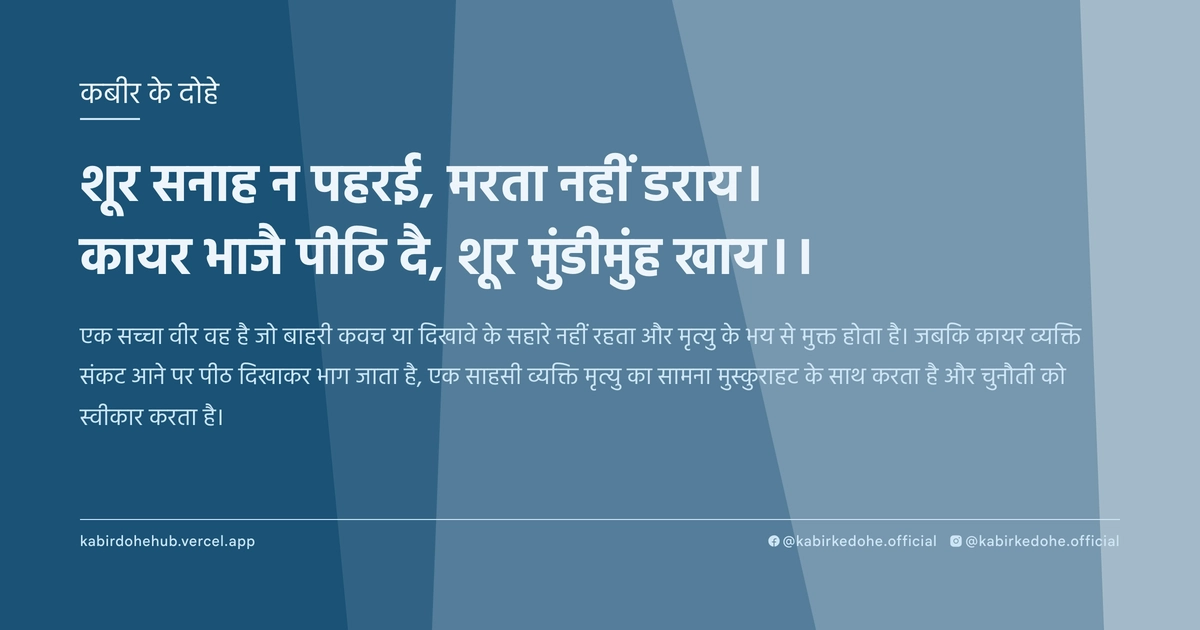
शूर सनाह न पहरई, मरता नहीं डराय।
कायर भाजै पीठि दै, शूर मुंडीमुंह खाय।।
Shur sanah na pahrai, marta nahi daray. Kayar bhajai peethi dai, shur mundimunh khay.
इस पृष्ठ पर इस कबीर दोहे का अर्थ (meaning), हिंदी व्याख्या और अंग्रेज़ी अनुवाद, दार्शनिक विश्लेषण और व्यावहारिक जीवन सीख दी गई है। यह दोहा धैर्य (Patience) विषय से जुड़ा है — Kabir doha meaning and explanation in Hindi and English.
अर्थ (Meaning):
एक सच्चा वीर वह है जो बाहरी कवच या दिखावे के सहारे नहीं रहता और मृत्यु के भय से मुक्त होता है। जबकि कायर व्यक्ति संकट आने पर पीठ दिखाकर भाग जाता है, एक साहसी व्यक्ति मृत्यु का सामना मुस्कुराहट के साथ करता है और चुनौती को स्वीकार करता है।
A true warrior does not rely on external armor or superficial protections, nor does he fear death. While the coward flees by turning his back to the enemy, the brave soul faces the challenge head-on, welcoming even the possibility of annihilation with an open heart.
व्याख्या (Interpretation):
शाब्दिक रूप से यह दोहा युद्ध के मैदान में वीरता की बात करता है, परंतु आध्यात्मिक स्तर पर 'शूर' वह साधक है जिसने अपने अहंकार का त्याग कर दिया है। 'सनाह' या कवच यहाँ सांसारिक मोह-माया और धार्मिक कर्मकांडों का प्रतीक है, जिनका उपयोग मनुष्य अपनी आंतरिक रिक्तता को छिपाने के लिए करता है। निर्गुण भक्ति के संदर्भ में, वास्तविक वीरता है—अपने 'अहं' (Ego) की मृत्यु को स्वीकार करना। जब साधक यह जान लेता है कि आत्मा अजर-अमर है (अद्वैत वेदांत), तब वह मृत्यु के भय से मुक्त हो जाता है। कायर वह है जो माया के मोह में फंसा है और सत्य के साक्षात्कार से डरकर भागता है, जबकि वीर वह है जो शून्य में विलीन होने का साहस रखता है।
Literally, this couplet speaks of bravery on a battlefield, but spiritually, the 'Warrior' is the seeker who has relinquished the ego. The 'armor' (sanah) symbolizes worldly attachments and ritualistic shields that humans use to mask their internal void. In the context of Nirgun Bhakti, true bravery is the willingness to let the 'I' die. When the seeker realizes the non-duality of Atman and Brahman, the fear of death vanishes. The coward is one trapped in Maya, fleeing from the terrifying purity of Truth, whereas the brave soul embraces the paradox of dying to the self to be reborn in the Infinite.
दार्शनिक विश्लेषण (Philosophical Analysis):
कबीर का यह दोहा उस युग की उपज है जहाँ धर्म और जाति के नाम पर बाहरी आडंबर चरम पर थे। कबीर ने 'कवच' के माध्यम से उन सभी धार्मिक पहचानों पर प्रहार किया है जो मनुष्य को लगता है कि उसे सुरक्षित रखती हैं, जबकि वास्तव में वे बंधन हैं। यह विचार सूफीवाद के 'फना' (अहंकार का विनाश) के सिद्धांत से मेल खाता है, जहाँ ईश्वर को पाने के लिए स्वयं को मिटाना आवश्यक है।
अद्वैत वेदांत के अनुसार, भय केवल तब तक रहता है जब तक हम स्वयं को शरीर मानते हैं। जैसे ही यह बोध होता है कि हम शुद्ध चेतना हैं, मृत्यु एक भ्रम बन जाती है। कबीर यहाँ शारीरिक वीरता की नहीं, बल्कि मानसिक और आध्यात्मिक दृढ़ता की बात कर रहे हैं।
ritualism (कर्मकांड) का विरोध करते हुए कबीर कहते हैं कि माला जपने या तीर्थ यात्रा करने से वह सुरक्षा नहीं मिलती जो आत्म-साक्षात्कार से मिलती है। बाहरी दिखावा एक कायर की ढाल है, जबकि आंतरिक सत्य एक वीर का शस्त्र है।
मनोवैज्ञानिक स्तर पर, यह दोहा हमें अपनी छाया (Shadow) का सामना करने के लिए प्रेरित करता है। हम अक्सर अपनी कमजोरियों को सामाजिक प्रतिष्ठा या धार्मिक लेबल के पीछे छिपाते हैं। कबीर हमें उस 'कवच' को उतारकर नग्न सत्य के सामने खड़े होने की चुनौती देते हैं।
अंततः, यह संदेश है कि मुक्ति केवल उनके लिए है जो सत्य की अग्नि में जलने को तैयार हैं। जो डरकर भागते हैं, वे जन्म-मृत्यु के चक्र में फंसे रहते हैं, लेकिन जो साहसपूर्वक अहंकार का विसर्जन करते हैं, वे मोक्ष को प्राप्त करते हैं।
This couplet emerges from an era where external religious markers and caste hierarchies were used as shields of superiority. Kabir uses the metaphor of 'armor' to critique the ritualistic identities that people cling to, believing they provide spiritual security, while in reality, they are mere shackles. This aligns closely with the Sufi concept of 'Fana'—the annihilation of the self—where the ego must be extinguished to realize the Divine.
From the perspective of Advaita Vedanta, fear exists only as long as one identifies with the perishable body. Once the realization dawns that the self is pure, eternal consciousness (Brahman), death becomes an illusion. Kabir is not advocating for physical violence or martial prowess, but for an indomitable spiritual fortitude.
By rejecting ritualism, Kabir asserts that beads, fasts, and pilgrimages are the 'armor' of the spiritual coward. These external acts provide a false sense of safety, whereas the path of the Nirgun seeker requires the courage to face the void without any crutches.
Psychologically, this teaching urges the individual to confront their 'Shadow.' We often hide our insecurities behind social status or religious labels. Kabir challenges us to strip away these masks and stand naked before the absolute truth of existence.
Ultimately, liberation is reserved for those who are willing to be consumed by the fire of Truth. Those who flee in fear remain trapped in the cycle of Samsara, but those who courageously surrender their ego achieve the state of Kaivalya or Moksha.
मूल संदेश (Core Message):
- बाहरी आडंबर केवल आंतरिक भय का पर्दा हैं।
- सच्ची वीरता अहंकार के पूर्ण विसर्जन में निहित है।
- मृत्यु का भय केवल शरीर से जुड़ाव के कारण है।
- सत्य का सामना करने के लिए सभी मुखौटों को त्यागें।
- आत्मा अजेय है, केवल अहंकार ही मरता है।
- निर्भयता ही परमात्मा से मिलन का एकमात्र मार्ग है।
- External rituals are merely veils for internal fear.
- True bravery lies in the complete dissolution of the ego.
- Fear of death stems solely from identification with the body.
- Discard all masks to face the naked Truth.
- The soul is invincible; only the ego perishes.
- Fearlessness is the only bridge to the Divine.
व्यावहारिक उदाहरण (Practical Example):
एक समय की बात है, बनारस के घाटों पर रहने वाली एक वृद्ध विधवा, जानकी, का जीवन अत्यंत कठिन था। समाज ने उन्हें 'अशुभ' मानकर हाशिए पर धकेल दिया था। जानकी ने सालों तक अपनी पीड़ा को छिपाने के लिए धर्म के कठोर नियमों और बाहरी दिखावे का 'कवच' पहना था। वह मानती थी कि केवल कठोर उपवास और निरंतर विलाप ही उन्हें मोक्ष दिलाएगा।
वह हर दिन गंगा किनारे बैठकर दूसरों को उनके पापों के प्रति सचेत करती थी, लेकिन भीतर से वह अपनी अकेलेपन और मृत्यु के भय से कांपती थी। उसका यह धार्मिक अनुशासन वास्तव में उसका 'सनाह' (कवच) था, जिससे वह अपनी आंतरिक रिक्तता को ढक रही थी।
एक दिन उसकी मुलाकात एक घुमक्कड़ फकीर से हुई, जिसने उसकी आँखों में छिपे डर को पहचान लिया। फकीर ने उससे कहा, "माई, तूने धर्म का ऐसा कवच पहना है कि तूने खुद को ही उसमें कैद कर लिया है। तू मृत्यु से नहीं, बल्कि इस डर से भाग रही है कि तेरे जाने के बाद तेरी पहचान क्या होगी।"
जानकी को पहले तो यह बात चुभी, लेकिन फिर उसने गहराई से सोचा। उसने महसूस किया कि वह जिस 'पवित्रता' का ढोंग कर रही थी, वह वास्तव में उसकी कमजोरी थी। वह डरती थी कि यदि उसने नियमों को छोड़ा, तो समाज उसे और अधिक प्रताड़ित करेगा।
उसने तय किया कि वह अब इस दिखावे के कवच को उतार फेंकेगी। उसने उपवास के कठोर नियमों को छोड़कर उन लोगों की सेवा करना शुरू किया जिन्हें समाज ने तिरस्कृत किया था। उसने अपनी पीड़ा को दूसरों के दुख में विलीन करना शुरू किया।
धीरे-धीरे, उसका मृत्यु का भय समाप्त हो गया। उसने पाया कि जब उसने अपनी 'पवित्र विधवा' की पहचान (अहंकार) को त्याग दिया, तो वह वास्तव में स्वतंत्र हो गई। अब वह किसी बाहरी मान्यता की मोहताज नहीं थी।
जब अंततः उसकी मृत्यु का समय आया, तो वह डरी हुई नहीं थी। उसने अपनी आँखें बंद कीं और एक मुस्कान के साथ उस अनंत में विलीन हो गई, जैसे कोई वीर युद्ध जीतकर घर लौटता है।
उसका जीवन अब एक उदाहरण बन गया था कि वास्तविक वीरता नियमों का पालन करने में नहीं, बल्कि स्वयं के झूठे अस्तित्व को मिटाकर सत्य को अपनाने में है।
Once, in the ghats of Varanasi, lived an elderly widow named Janaki. Society had pushed her to the margins, labeling her as 'inauspicious.' For years, Janaki wore a 'shield' of rigid religious adherence and external piety to mask her profound grief and loneliness.
She believed that only extreme fasting and perpetual mourning would grant her salvation. Every day, she sat by the Ganges, warning others of their sins, yet internally she trembled with the fear of death and the void of her existence. Her religious discipline was her 'armor' (sanah), used to hide her internal emptiness.
One day, she encountered a wandering fakir who saw through her facade. The fakir told her, "Mother, you have worn the armor of religion so tightly that you have imprisoned yourself within it. You aren't afraid of death, but of the loss of the identity you've built around your suffering."
Initially, Janaki was offended, but the words took root. She realized that the 'purity' she performed was actually a manifestation of her cowardice. She feared that if she let go of the rules, she would have nothing left to define her in a cruel society.
She decided to strip away this armor. She abandoned the performative austerity and began serving those even more marginalized than herself. She started dissolving her personal pain into the collective suffering of others.
Gradually, her fear of death vanished. She discovered that by relinquishing the identity of the 'holy widow' (the ego), she had found true freedom. She was no longer dependent on external validation or social labels.
When the time for her final breath arrived, she was not afraid. She closed her eyes with a serene smile, merging into the Infinite like a warrior returning home after a victorious battle.
Her life became a testament that true bravery lies not in following the letter of the law, but in the courage to annihilate the false self to embrace the Absolute Truth.
अभ्यास मार्गदर्शन (Practice Guidance):
- दैनिक आत्म-निरीक्षण: प्रतिदिन 15 मिनट मौन बैठें और विचार करें कि आप अपनी किन कमजोरियों को छिपाने के लिए 'सामाजिक मुखौटों' या 'धार्मिक पहचानों' का उपयोग कर रहे हैं।
- अहंकार विसर्जन अभ्यास: दिन में एक बार जानबूझकर ऐसी स्थिति में आएं जहां आपकी प्रशंसा न हो या आपकी पहचान को चुनौती मिले, और बिना रक्षात्मक हुए उसे स्वीकार करें।
- जर्नलिंग प्रॉम्प्ट: "यदि मेरी वर्तमान सामाजिक स्थिति, पद और धार्मिक पहचान छीन ली जाए, तो मेरे भीतर क्या बचेगा? क्या मैं उस 'शून्य' का सामना करने का साहस रखता हूँ?"
- डायग्नोस्टिक चेकलिस्ट: क्या मैं अपनी गलतियों को सही ठहराने के लिए नियमों का सहारा लेता हूँ? क्या मैं मृत्यु या विफलता के विचार से घबराता हूँ? यदि हाँ, तो मैं अभी भी 'कवच' पहने हुए हूँ।
- Daily Self-Inquiry: Sit in silence for 15 minutes and observe which 'social masks' or 'religious identities' you are using to shield your inner vulnerabilities.
- Ego-Dissolution Practice: Once a day, consciously place yourself in a situation where you receive no praise or your identity is challenged, and accept it without becoming defensive.
- Journaling Prompt: "If my current social status, title, and religious identity were stripped away, what would remain within me? Do I have the courage to face that 'void'?"
- Diagnostic Checklist: Do I use rules or traditions to justify my mistakes? Do I panic at the thought of failure or death? If yes, I am still wearing the 'armor' of the coward.
चिंतन प्रश्न (Reflection Questions):
- मेरा वह कौन सा 'कवच' है जिसे मैं दुनिया के सामने सबसे अधिक गर्व से पहनता हूँ, लेकिन वास्तव में वह मेरी कमजोरी को छिपाता है?
- क्या मेरी धार्मिक या नैतिक श्रेष्ठता का दावा वास्तव में मेरी करुणा से उपजा है, या यह दूसरों को छोटा दिखाने का एक तरीका है?
- यदि आज मेरी मृत्यु निश्चित हो, तो क्या मैं अपने वर्तमान व्यक्तित्व के साथ संतुष्ट हूँ, या मैं एक झूठा किरदार निभा रहा हूँ?
- मैं किन परिस्थितियों में 'पीठ दिखाकर भागता' हूँ—मानसिक रूप से, भावनात्मक रूप से या नैतिक रूप से?
- क्या मैं सत्य को सुनने का साहस रखता हूँ, या मैं केवल वही सुनना चाहता हूँ जो मेरे अहंकार को संतुष्ट करे?
- What is the 'armor' I wear most proudly in public, which in reality hides my deepest insecurity?
- Is my claim to religious or moral superiority born of genuine compassion, or is it a tool to diminish others?
- If death were certain today, would I be satisfied with my current persona, or have I been playing a false character?
- In which areas of my life do I 'turn my back and flee'—mentally, emotionally, or ethically?
- Do I possess the courage to hear the Truth, or do I only seek echoes that satisfy my ego?