
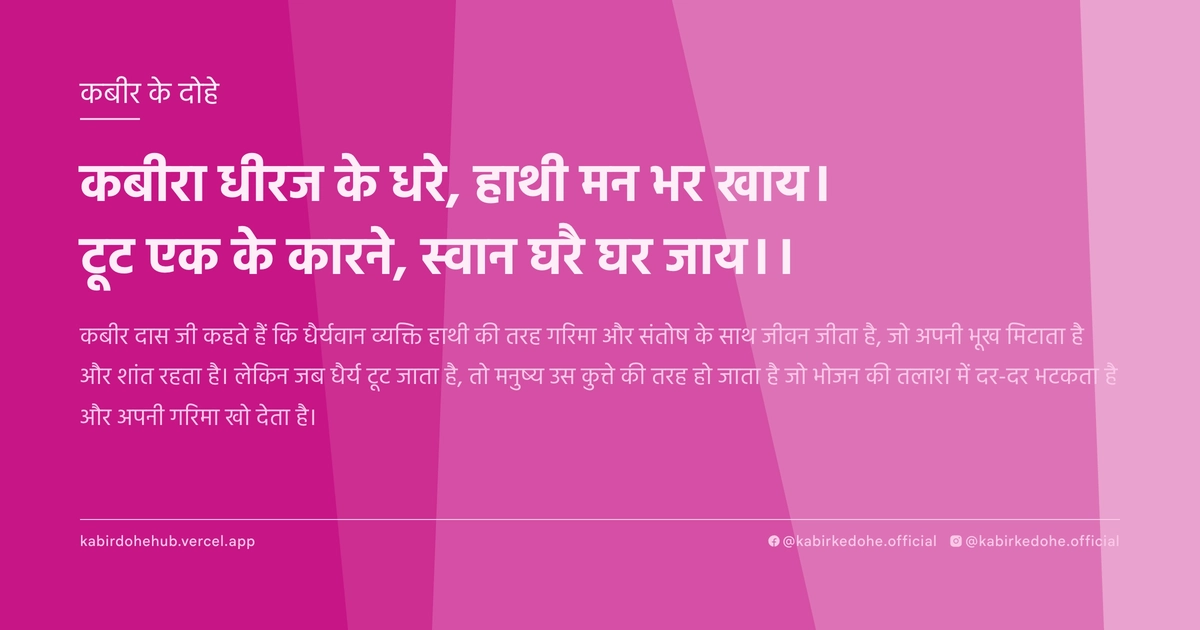
कबीरा धीरज के धरे, हाथी मन भर खाय।
टूट एक के कारने, स्वान घरै घर जाय।।
Kabira dheeraj ke dhare, haathi man bhar khaay. Toot ek ke kaarane, swaan gharai ghar jaaye.
इस पृष्ठ पर इस कबीर दोहे का अर्थ (meaning), हिंदी व्याख्या और अंग्रेज़ी अनुवाद, दार्शनिक विश्लेषण और व्यावहारिक जीवन सीख दी गई है। यह दोहा धैर्य (Patience) विषय से जुड़ा है — Kabir doha meaning and explanation in Hindi and English.
अर्थ (Meaning):
कबीर दास जी कहते हैं कि धैर्यवान व्यक्ति हाथी की तरह गरिमा और संतोष के साथ जीवन जीता है, जो अपनी भूख मिटाता है और शांत रहता है। लेकिन जब धैर्य टूट जाता है, तो मनुष्य उस कुत्ते की तरह हो जाता है जो भोजन की तलाश में दर-दर भटकता है और अपनी गरिमा खो देता है।
Kabir explains that one who possesses patience lives with the dignity and contentment of an elephant, consuming its fill and remaining poised. However, once patience snaps, a person becomes like a stray dog, wandering from door to door in a desperate search for sustenance, losing their inner peace and self-respect.
व्याख्या (Interpretation):
इस दोहे का शाब्दिक अर्थ धैर्य के अभाव में होने वाली मानसिक और सामाजिक गिरावट है। रूपक के स्तर पर, 'हाथी' उस स्थिर आत्मा का प्रतीक है जो अपनी आंतरिक पूर्णता (Samyama) को जानता है, जबकि 'कुत्ता' उस विचलित मन का प्रतीक है जो बाहरी दुनिया की इच्छाओं का गुलाम है। यह निरगुण भक्ति के उस सिद्धांत को दर्शाता है जहाँ साधक को बाहरी शोर के बजाय आंतरिक मौन में टिकना होता है। माया हमें विश्वास दिलाती है कि समाधान बाहर है, लेकिन धैर्य वह सेतु है जो हमें द्वैत (duality) से अद्वैत (non-duality) की ओर ले जाता है। जब हम धैर्य खोते हैं, तो हम अपनी आत्मा (Atman) के साथ संबंध तोड़कर अहंकार (Ego) के अधीन हो जाते हैं। यह विरोधाभास है कि शांति पाने की जल्दबाजी ही शांति को सबसे अधिक नष्ट करती है।
Literally, this couplet addresses the psychological and social decline resulting from a lack of patience. Metaphorically, the 'elephant' symbolizes the stable soul anchored in inner fulfillment (Samyama), while the 'dog' represents the agitated mind enslaved by external desires. This aligns with Nirgun Bhakti, where the seeker must remain anchored in internal silence rather than external noise. Maya deceives us into believing that solutions lie outside, but patience is the bridge leading from duality to non-duality. When patience breaks, we sever our connection with the Atman and succumb to the ego. The central paradox is that the haste to achieve peace is precisely what destroys it most effectively.
दार्शनिक विश्लेषण (Philosophical Analysis):
कबीर का यह दोहा मध्यकालीन भारत के सामाजिक और धार्मिक तनावों के बीच लिखा गया था, जहाँ कर्मकांड और बाहरी दिखावे का बोलबाला था। कबीर ने ritualism का विरोध करते हुए यह सिखाया कि वास्तविक धर्म बाहरी पूजा में नहीं, बल्कि आंतरिक अनुशासन और धैर्य में है। यह विचार अद्वैत वेदांत के करीब है, जहाँ यह माना जाता है कि जब तक व्यक्ति अपनी इच्छाओं और आवेगों पर नियंत्रण नहीं पाता, वह ब्रह्म के साथ अपनी एकता का अनुभव नहीं कर सकता।
सूफीवाद के 'सब्र' (Sabar) के सिद्धांत के साथ इसका गहरा संबंध है, जहाँ धैर्य को ईश्वर की इच्छा के प्रति समर्पण माना जाता है। कबीर यहाँ मनोवैज्ञानिक रूपांतरण की बात कर रहे हैं; वे बताते हैं कि आवेग (impulse) ही वह पर्दा है जो सत्य को ढकता है। जब हम धैर्य खोते हैं, तो हम अपनी चेतना के स्तर को गिरा देते हैं, जिससे हम केवल अपनी इंद्रियों के गुलाम रह जाते हैं।
जाति और वर्ग के भेदभाव को नकारते हुए कबीर यह संदेश देते हैं कि गरिमा किसी जन्म से नहीं, बल्कि मानसिक स्थिरता से आती है। एक राजा भी यदि धैर्यहीन है, तो वह मानसिक रूप से एक भिखारी है। यह विश्लेषण स्पष्ट करता है कि कबीर केवल 'इंतज़ार' की बात नहीं कर रहे, बल्कि 'स्थितप्रज्ञ' होने की बात कर रहे हैं।
अक्सर लोग इस दोहे को केवल आर्थिक अभाव से जोड़ते हैं, लेकिन यह वास्तव में आध्यात्मिक दरिद्रता का वर्णन है। जब साधक अपनी साधना के फल के लिए व्याकुल होता है, तो वह अपनी आध्यात्मिक गरिमा खो देता है।
अंततः, यह दोहा अहंकार के विलीनीकरण की प्रक्रिया है। धैर्य वह अग्नि है जिसमें अहंकार जलकर राख हो जाता है, जिससे केवल शुद्ध चेतना शेष बचती है।
Written amidst the social and religious tensions of medieval India, Kabir's couplet challenges the dominance of ritualism and external displays of piety. He posits that true religion resides not in outward ceremonies but in internal discipline and patience. This resonates with Advaita Vedanta, which suggests that until an individual masters their impulses and desires, they cannot experience their oneness with Brahman.
There is a profound connection here to the Sufi concept of 'Sabar' (patience), where patience is viewed as a total surrender to the Divine Will. Kabir is describing a psychological transformation; he argues that impulse is the veil that obscures the Truth. When we lose patience, we lower our level of consciousness, becoming mere slaves to our sensory urges.
By rejecting caste and class distinctions, Kabir emphasizes that dignity is not a birthright but a result of mental stability. Even a king, if devoid of patience, is mentally a beggar. This analysis clarifies that Kabir is not merely talking about 'waiting,' but about becoming 'Sthitapragya' (one with steady wisdom).
Common literalist misconceptions often link this doha solely to economic deprivation, but it actually describes spiritual poverty. When a seeker becomes anxious for the fruits of their practice, they lose their spiritual poise.
Ultimately, this is a process of ego annihilation. Patience is the fire in which the ego is consumed, leaving behind only pure, unadulterated consciousness.
मूल संदेश (Core Message):
- अधीरता आत्मा की गरिमा को नष्ट कर देती है।
- धैर्य केवल प्रतीक्षा नहीं, बल्कि आंतरिक स्थिरता है।
- बाहरी अभाव तब तक दुख नहीं देता जब तक भीतर संतोष हो।
- इच्छाओं का दास होना मानसिक दरिद्रता का लक्षण है।
- स्थिरता ही वह कुंजी है जो अद्वैत के द्वार खोलती है।
- Impatience erodes the inherent dignity of the soul.
- Patience is not mere waiting, but internal stability.
- External lack does not cause suffering if internal contentment exists.
- Being a slave to desires is a symptom of mental poverty.
- Stability is the key that unlocks the gates of non-duality.
व्यावहारिक उदाहरण (Practical Example):
वाराणसी के घाटों पर रहने वाली एक वृद्ध विधवा, जानकी, का जीवन अत्यंत कठिन था। वह दूसरों के घरों में छोटे-मोटे काम करके अपना गुजारा करती थी। उसके आस-पास के कई लोग अपनी गरीबी के कारण क्रोधित रहते थे और अक्सर दूसरों को दोष देते थे।
जानकी ने अपने जीवन के कई दशक मौन और धैर्य के साथ बिताए थे। वह जानती थी कि परिस्थितियाँ कठिन हैं, लेकिन उसने कभी अपनी गरिमा नहीं खोई। वह शांत भाव से अपना काम करती और जो मिलता, उसमें संतुष्ट रहती।
एक दिन, शहर के एक धनी व्यापारी ने अपनी शक्ति के मद में आकर जानकी का अपमान किया और उसे सार्वजनिक रूप से भला-बुरा कहा। आस-पास के लोग उम्मीद कर रहे थे कि जानकी भी पलटकर जवाब देगी या रोने लगेगी।
लेकिन जानकी शांत रही। उसने न तो क्रोध किया और न ही अपनी स्थिति पर विलाप किया। उसने बस मुस्कुराकर कहा, 'समय सबका आता है, और समय ही सब कुछ सिखाता है।'
व्यापारी को अपनी गलती का अहसास तब हुआ जब उसने देखा कि उसकी अपनी संपत्ति और शक्ति के बावजूद वह अंदर से कितना अशांत और भयभीत था, जबकि जानकी के पास कुछ न होते हुए भी वह एक महारानी की तरह शांत थी।
यह 'कबीर ट्विस्ट' था—जहाँ व्यापारी की बाहरी संपन्नता उसकी आंतरिक दरिद्रता को उजागर कर गई और जानकी की बाहरी दरिद्रता उसकी आंतरिक संपन्नता को।
व्यापारी ने उस दिन महसूस किया कि वह वास्तव में उस 'कुत्ते' की तरह था जो सुख की तलाश में दर-दर भटक रहा था, जबकि जानकी वह 'हाथी' थी जिसने धैर्य के माध्यम से अपनी आंतरिक शांति पा ली थी।
इस घटना के बाद, व्यापारी ने अपना जीवन बदल दिया। उसने अहंकार का त्याग किया और जानकी से धैर्य और संतोष का पाठ सीखना शुरू किया।
जानकी की स्थिरता ने एक अहंकारी व्यक्ति को विनम्र बना दिया, जिससे यह सिद्ध हुआ कि धैर्य केवल सहनशीलता नहीं, बल्कि एक सर्वोच्च शक्ति है।
अंततः, जानकी ने यह दिखाया कि जब हम बाहरी परिणामों से अपनी खुशी को अलग कर लेते हैं, तो हम वास्तव में स्वतंत्र हो जाते हैं।
Janaki, an elderly widow living on the ghats of Varanasi, led a life of extreme hardship. She eked out a living by doing odd jobs in other people's homes. Many around her, driven by poverty, lived in constant anger and spent their days blaming others for their plight.
Janaki, however, had spent decades cultivating silence and patience. She acknowledged the difficulty of her circumstances but never allowed them to erode her dignity. She performed her tasks with a quiet grace, remaining content with whatever she received.
One day, a wealthy merchant of the city, intoxicated by his own power, insulted Janaki and berated her publicly. The onlookers expected Janaki to react with anger or collapse in tears.
Instead, Janaki remained poised. She neither raged nor lamented her state. She simply smiled and said, 'Time comes for everyone, and time is the greatest teacher.'
The merchant realized his mistake when he noticed that despite his immense wealth and power, he was internally turbulent and fearful, while Janaki, possessing nothing, remained as serene as a queen.
This was the 'Kabir Twist'—where the merchant's external abundance highlighted his internal poverty, and Janaki's external poverty revealed her internal abundance.
The merchant realized he was like the 'dog' wandering in search of happiness, while Janaki was the 'elephant' who had found peace through patience.
Following this encounter, the merchant transformed his life. He renounced his arrogance and began learning the art of patience and contentment from Janaki.
Janaki's stability humbled a proud man, proving that patience is not mere endurance, but a supreme spiritual power.
Ultimately, Janaki demonstrated that when we decouple our happiness from external outcomes, we achieve true liberation.
अभ्यास मार्गदर्शन (Practice Guidance):
- दैनिक अभ्यास: प्रतिदिन 20 मिनट 'साक्षी भाव' का अभ्यास करें। जब भी क्रोध या अधीरता महसूस हो, तो उसे रोकने के बजाय केवल देखें कि वह शरीर में कहाँ महसूस हो रहा है।
- आत्म-पूछताछ जर्नल: हर रात लिखें—'आज मैंने कहाँ जल्दबाजी की? क्या उस जल्दबाजी ने मेरी गरिमा को कम किया या मेरी शांति को छीना?'
- व्यवहार परिवर्तन: किसी भी प्रतिक्रिया देने से पहले 10 सेकंड का मौन धारण करें। यह अंतराल आपको 'कुत्ते' की प्रतिक्रिया से 'हाथी' की स्थिरता की ओर ले जाएगा।
- निदान चेकलिस्ट: यदि आप बार-बार दूसरों से उम्मीद कर रहे हैं, छोटी बातों पर विचलित हो रहे हैं, या अपनी स्थिति के लिए दूसरों को दोष दे रहे हैं, तो समझ लें कि आपका धैर्य टूट रहा है।
- Daily Practice: Spend 20 minutes daily practicing 'Sakshi Bhav' (Witness Consciousness). When anger or impatience arises, do not suppress it; simply observe where it manifests in your body.
- Self-Inquiry Journal: Every night, record—'Where did I rush today? Did that haste diminish my dignity or steal my peace?'
- Behavioral Shift: Implement a 10-second silence before responding to any provocation. This gap transitions you from the reactive 'dog' to the stable 'elephant'.
- Diagnostic Checklist: If you find yourself constantly expecting things from others, getting agitated by trivialities, or blaming external factors for your state, recognize that your patience is fracturing.
चिंतन प्रश्न (Reflection Questions):
- क्या मेरी 'सफलता' की दौड़ वास्तव में मेरी आंतरिक शांति की बलि दे रही है?
- जब मैं दूसरों की मदद करता हूँ, तो क्या मैं वास्तव में निस्वार्थ हूँ या मैं अपनी ईगो को संतुष्ट कर रहा हूँ?
- मेरे जीवन का वह कौन सा क्षेत्र है जहाँ मैं 'कुत्ते' की तरह दर-दर भटक रहा हूँ, जबकि समाधान मेरे भीतर है?
- क्या मेरी डिजिटल पहचान (Social Media) मेरी वास्तविक आंतरिक स्थिरता को ढकने का एक मुखौटा है?
- यदि आज मेरे पास सब कुछ छिन जाए, तो क्या मेरे पास वह 'हाथी' जैसा धैर्य बचेगा जो मुझे संभाल सके?
- Is my race for 'success' actually sacrificing my internal peace?
- When I help others, am I truly selfless or am I merely feeding my ego?
- In which area of my life am I wandering like a 'dog', while the solution resides within me?
- Is my digital identity a mask used to conceal a lack of actual internal stability?
- If everything were stripped away from me today, would I possess the 'elephant-like' patience to sustain myself?