
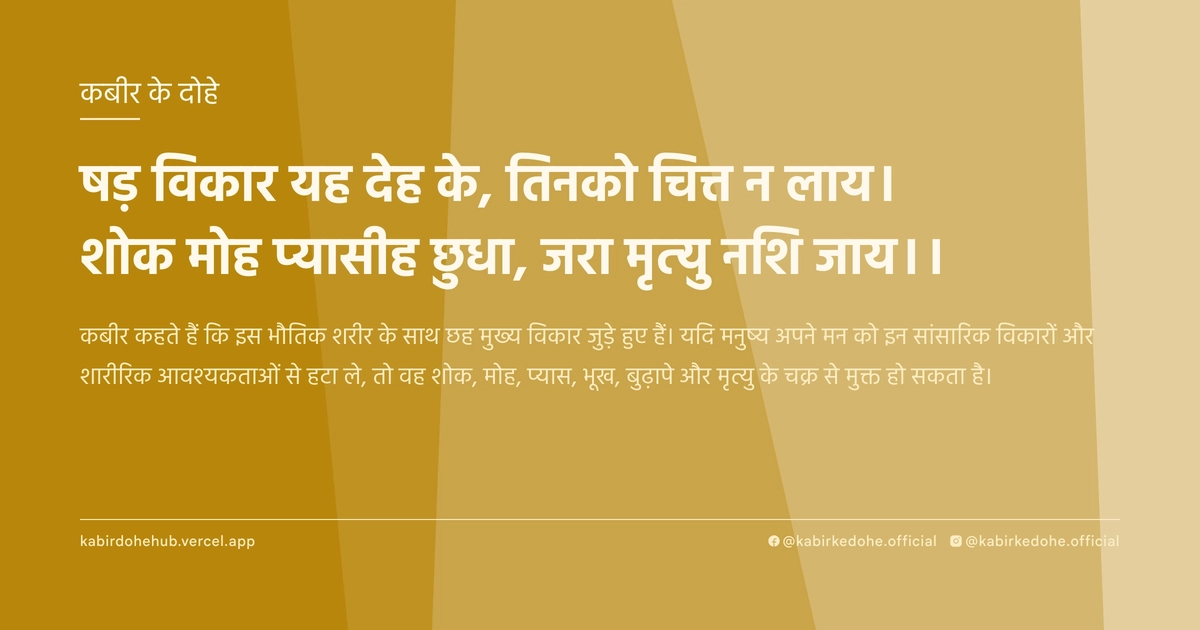
षड़ विकार यह देह के, तिनको चित्त न लाय।
शोक मोह प्यासीह छुधा, जरा मृत्यु नशि जाय।।
Shad vikaar yeh deh ke, tinko chitt na laay. Shok moh pyasih chudha, jara mrityu nashi jaaye.
इस पृष्ठ पर इस कबीर दोहे का अर्थ (meaning), हिंदी व्याख्या और अंग्रेज़ी अनुवाद, दार्शनिक विश्लेषण और व्यावहारिक जीवन सीख दी गई है। यह दोहा वैराग्य (Detachment) विषय से जुड़ा है — Kabir doha meaning and explanation in Hindi and English.
अर्थ (Meaning):
कबीर कहते हैं कि इस भौतिक शरीर के साथ छह मुख्य विकार जुड़े हुए हैं। यदि मनुष्य अपने मन को इन सांसारिक विकारों और शारीरिक आवश्यकताओं से हटा ले, तो वह शोक, मोह, प्यास, भूख, बुढ़ापे और मृत्यु के चक्र से मुक्त हो सकता है।
Kabir asserts that the physical body is entwined with six primary afflictions. If one can detach the consciousness from these somatic impulses and worldly attachments, they can transcend the cycle of grief, delusion, thirst, hunger, decay, and inevitable death.
व्याख्या (Interpretation):
इस दोहे का शाब्दिक अर्थ शरीर की नश्वरता और उसकी सीमाओं को स्वीकार करना है। गहराई में, कबीर 'षड़ विकार' को केवल शारीरिक लक्षणों के रूप में नहीं, बल्कि मानसिक बाधाओं के रूप में देखते हैं। यहाँ 'प्यास' और 'भूख' केवल भोजन और जल की इच्छा नहीं, बल्कि इंद्रिय सुखों की अंतहीन तृष्णा का प्रतीक हैं। यह निरगुण भक्ति का मार्ग है जहाँ साधक यह समझता है कि वह शरीर नहीं, बल्कि अविनाशी आत्मा है। माया हमें विश्वास दिलाती है कि हम यह हाड़-मांस का ढांचा हैं, जिससे दुख का जन्म होता है। जब चित्त इन विकारों से हटकर ब्रह्म में लीन होता है, तब द्वैत समाप्त हो जाता है। अंततः, यह अद्वैत वेदांत की उस स्थिति को दर्शाता है जहाँ जन्म और मृत्यु का भय समाप्त हो जाता है क्योंकि आत्मा का बोध हो जाता है।
Literally, the verse addresses the transience of the physical form and its inherent limitations. Metaphorically, Kabir treats the 'six afflictions' not merely as biological functions but as psychological shackles. 'Thirst' and 'hunger' here symbolize the insatiable craving for sensory pleasures and worldly validation. This aligns with Nirgun Bhakti, where the seeker realizes they are not the perishable body but the imperishable Atman. Maya creates the illusion of somatic identity, which is the root of all suffering. By shifting the consciousness (Chitt) away from these bodily identifications toward the formless Divine, the duality of 'I' and 'Other' dissolves. Ultimately, it mirrors the Advaita Vedanta realization that once the illusion of the body is pierced, the fear of decay and death vanishes, as the soul recognizes its eternal nature.
दार्शनिक विश्लेषण (Philosophical Analysis):
कबीर का यह दोहा उस युग की उपज है जहाँ कर्मकांड और बाहरी आडंबर चरम पर थे। उन्होंने शरीर को एक 'पिंजरा' माना और आत्मा को 'पंछी'। उनका दर्शन सूफीवाद के 'फना' (अहंकार का विनाश) और वेदांत के 'माया' सिद्धांत का एक अनूठा संगम है। कबीर का तर्क है कि जब तक हम स्वयं को शरीर मानते रहेंगे, हम भय और अभाव के गुलाम रहेंगे।
वे जाति और धर्म के भेदभाव को इसलिए नकारते हैं क्योंकि शरीर की बनावट अलग हो सकती है, लेकिन उसके भीतर का विकार और अंततः उसकी मृत्यु एक समान है। यह समानता ही उन्हें सामाजिक समानता की ओर ले जाती है। उनके लिए मोक्ष किसी तीर्थ यात्रा से नहीं, बल्कि आंतरिक शुद्धि और विकारों के त्याग से मिलता है।
मनोवैज्ञानिक स्तर पर, कबीर 'अटैचमेंट' (मोह) को दुख का मूल कारण मानते हैं। जब चित्त शरीर की आवश्यकताओं में उलझा रहता है, तो वह अपनी वास्तविक क्षमता को भूल जाता है। यह मानसिक भटकाव ही हमें जन्म-मरण के चक्र में बांधे रखता है।
सूफी मत की तरह, कबीर भी प्रेम और समर्पण की बात करते हैं, लेकिन उनका प्रेम 'निरुपाधिक' है। वे कहते हैं कि ईश्वर को पाने के लिए पहले उस 'मैं' को मिटाना होगा जो शरीर के साथ जुड़ा है। यह 'अहं' का विसर्जन ही वास्तविक आध्यात्मिक प्रगति है।
अक्सर लोग इस दोहे को वैराग्य या शरीर के प्रति घृणा के रूप में देखते हैं, जो कि एक गलत व्याख्या है। कबीर शरीर को नष्ट करने की बात नहीं कर रहे, बल्कि शरीर के प्रति 'मोह' को नष्ट करने की बात कर रहे हैं। यह शरीर का तिरस्कार नहीं, बल्कि चेतना का विस्तार है।
This couplet emerges from an era dominated by rigid ritualism and external piety. Kabir views the body as a 'cage' and the soul as a 'bird.' His philosophy is a sophisticated synthesis of the Sufi concept of 'Fana' (annihilation of the ego) and the Vedantic doctrine of 'Maya' (illusion). He argues that as long as we identify ourselves with the physical form, we remain prisoners of fear and scarcity.
His rejection of caste and religious dogma stems from the observation that while physical appearances vary, the internal afflictions and the eventual destiny of decay are universal. This biological equality serves as the foundation for his social egalitarianism. For Kabir, liberation is not achieved through pilgrimages but through internal purification and the shedding of somatic attachments.
Psychologically, Kabir identifies 'attachment' (Moha) as the primary catalyst for suffering. When the consciousness is preoccupied with the demands and desires of the body, it loses sight of its transcendental potential. This mental fragmentation keeps the individual tethered to the cycle of Samsara.
Similar to Sufi mysticism, Kabir emphasizes a love that is unconditional and non-dual. He suggests that to encounter the Divine, one must first erase the 'I' that is anchored in the physical shell. The dissolution of this ego is the only true spiritual progression.
Common literalist misconceptions often frame this verse as an advocacy for asceticism or hatred of the body. However, Kabir is not calling for the destruction of the body, but for the destruction of the 'attachment' to it. It is not a rejection of existence, but an expansion of consciousness beyond the limited physical self.
मूल संदेश (Core Message):
- शरीर एक वस्त्र है, आत्मा शाश्वत सत्य है।
- इंद्रिय तृष्णा ही मानसिक दुखों का मूल कारण है।
- चेतना को देह से अलग करना ही वास्तविक मुक्ति है।
- मृत्यु केवल शरीर का अंत है, चेतना का नहीं।
- अहंकार का विसर्जन ही ईश्वर से मिलन का मार्ग है।
- The body is a garment; the soul is the eternal truth.
- Sensory cravings are the root cause of mental suffering.
- Detaching consciousness from the body is true liberation.
- Death is the end of the form, not the end of consciousness.
- Dissolving the ego is the only path to the Divine.
व्यावहारिक उदाहरण (Practical Example):
वाराणसी के एक पुराने घाट पर रहने वाली एक वृद्ध विधवा, जानकी, का जीवन केवल अपनी शारीरिक पीड़ाओं और बीते समय के शोक में बीता था। वह हर दिन मंदिर जाती, लेकिन उसका मन केवल अपनी घुटनों के दर्द और अकेलेपन की भूख में डूबा रहता था।
वह मानती थी कि उसकी पीड़ा उसका भाग्य है और वह शरीर के इस क्षय को ही अपना संपूर्ण अस्तित्व मान चुकी थी। उसकी दुनिया केवल उसकी बीमारियों और यादों तक सीमित थी।
एक दिन उसकी मुलाकात एक घुमंतू साधु से हुई, जिसने उसे कबीर का यह दोहा सुनाया। साधु ने उससे कहा, 'माँ, तुम दर्द को महसूस कर रही हो, लेकिन तुम वह नहीं हो जिसे दर्द हो रहा है। तुम वह साक्षी हो जो इस दर्द को देख रहा है।'
जानकी को पहले यह बात समझ नहीं आई। उसने सोचा कि जब शरीर दुख दे रहा है, तो मैं अलग कैसे हो सकती हूँ?
साधु ने उसे एक प्रयोग दिया: जब भी दर्द उठे, वह यह न कहे कि 'मैं दुखी हूँ', बल्कि यह कहे कि 'शरीर में दुख है, और मैं उसे देख रही हूँ'।
धीरे-धीरे जानकी ने महसूस किया कि उसका 'चित्त' शरीर की पीड़ा से अलग होना शुरू हो गया है। उसने पाया कि भूख और प्यास तो शरीर की ज़रूरतें हैं, लेकिन 'अतृप्ति' मन का विकार है।
उसने अपने शोक को एक दर्शक की तरह देखना शुरू किया। उसने महसूस किया कि वह केवल एक बूढ़ी औरत नहीं है, बल्कि एक अनंत चेतना है जो इस शरीर का उपयोग कर रही है।
इस 'कबीर ट्विस्ट' ने उसकी जीवनशैली बदल दी। उसने अपनी पीड़ाओं के प्रति शिकायत करना छोड़ दिया और घाट पर आने वाले अन्य दुखी लोगों की मदद करना शुरू किया।
उसका शारीरिक दर्द पूरी तरह नहीं गया, लेकिन उसका मानसिक शोक समाप्त हो गया। वह अब मृत्यु से नहीं डरती थी क्योंकि वह जान चुकी थी कि वह शरीर नहीं है।
अंततः, जानकी ने शांति से अपनी आँखें मूँदीं, यह जानते हुए कि वह उस बंधन से मुक्त हो रही है जिसे वह अब तक अपना घर समझती थी।
Janaki, an elderly widow living on the ancient ghats of Varanasi, spent her days consumed by physical agony and the grief of a lost past. Every day she visited the temple, yet her mind remained trapped in the hunger of loneliness and the persistent ache of her joints.
She believed her suffering was her destiny, identifying her entire existence with the decaying physical form she inhabited. Her world had shrunk to the size of her ailments and memories.
One day, she encountered a wandering mystic who recited this specific Doha to her. The mystic told her, 'Mother, you are feeling the pain, but you are not the one who is in pain. You are the witness observing this pain.'
Janaki was initially confused. She wondered how she could be separate from the body when the body was the only thing she felt.
The mystic gave her a practice: whenever pain arose, instead of saying 'I am suffering,' she should say, 'There is suffering in the body, and I am observing it.'
Slowly, Janaki felt her consciousness (Chitt) begin to detach from the somatic distress. She realized that while hunger and thirst were biological needs, the feeling of 'insatiable longing' was a mental affliction.
She began to observe her grief as if it belonged to someone else. She discovered she was not merely an old woman, but an infinite consciousness utilizing a physical vessel.
This 'Kabir Twist' transformed her existence. She stopped complaining about her ailments and began comforting other grieving souls who visited the ghats.
Her physical pain did not vanish entirely, but her mental anguish did. The fear of death evaporated because she no longer identified as the body.
Ultimately, Janaki closed her eyes in profound peace, knowing she was liberating herself from the cage she had mistaken for her home.
अभ्यास मार्गदर्शन (Practice Guidance):
- साक्षी भाव का अभ्यास: दिन में तीन बार 10 मिनट के लिए बैठें और अपने शरीर की संवेदनाओं (दर्द, खुजली, भूख) को बिना किसी प्रतिक्रिया के केवल देखें। यह कहें, 'यह शरीर की अनुभूति है, मैं इसका दृष्टा हूँ'।
- विकार डायरी: उन क्षणों को लिखें जब आप अत्यधिक मोह या शोक महसूस करते हैं। विश्लेषण करें कि क्या यह आपकी आत्मा की आवश्यकता है या केवल शरीर/अहंकार की एक मांग।
- इंद्रिय उपवास: सप्ताह में एक दिन ऐसा निर्धारित करें जहाँ आप अपनी सामान्य सुख-सुविधाओं (पसंदीदा भोजन, मनोरंजन) का त्याग करें, ताकि आप शरीर की निर्भरता को पहचान सकें।
- निदान चेकलिस्ट: क्या आप बीमारी में टूट जाते हैं? क्या आप अपनी पहचान अपनी उम्र या सुंदरता से जोड़ते हैं? क्या मृत्यु का विचार आपको भयभीत करता है? यदि हाँ, तो आपका चित्त अभी भी 'देह' में अटका है।
- Practice of the Witness: Three times a day, sit for 10 minutes and observe bodily sensations (pain, itch, hunger) without reaction. Affirm: 'This is a sensation of the body; I am the observer.'
- Affliction Journaling: Document moments of intense attachment or grief. Analyze whether the craving stems from the soul's need or merely a demand of the ego/body.
- Sensory Fasting: Designate one day a week to forgo habitual comforts (favorite foods, entertainment) to consciously recognize the body's dependencies.
- Diagnostic Checklist: Do you collapse emotionally during illness? Do you tie your identity to your age or appearance? Does the thought of death trigger panic? If yes, your consciousness is still anchored in the 'Deh' (body).
चिंतन प्रश्न (Reflection Questions):
- यदि आज आपका शरीर पूरी तरह बदल जाए, तो आपकी कौन सी पहचान शेष रहेगी?
- आप अपनी डिजिटल छवि (सोशल मीडिया) को कितना 'सत्य' मानते हैं और यह आपके 'देह-मोह' को कैसे बढ़ाता है?
- क्या आप वास्तव में स्वतंत्र हैं, या आपकी इच्छाएं केवल आपकी जैविक प्रवृत्तियों का परिणाम हैं?
- जब आप किसी प्रियजन को खोते हैं, तो आप वास्तव में किसे याद करते हैं—उनके शरीर को या उनके अस्तित्व को?
- आपके भीतर का वह कौन सा हिस्सा है जो कभी बीमार नहीं पड़ता और कभी बूढ़ा नहीं होता?
- If your body were completely replaced today, what part of your identity would remain?
- How much of your digital persona do you perceive as 'real,' and how does this amplify your attachment to form?
- Are you truly autonomous, or are your desires merely the result of biological impulses?
- When you lose a loved one, what do you actually miss—their physical presence or their essence?
- Which part of you never falls ill and never grows old?