
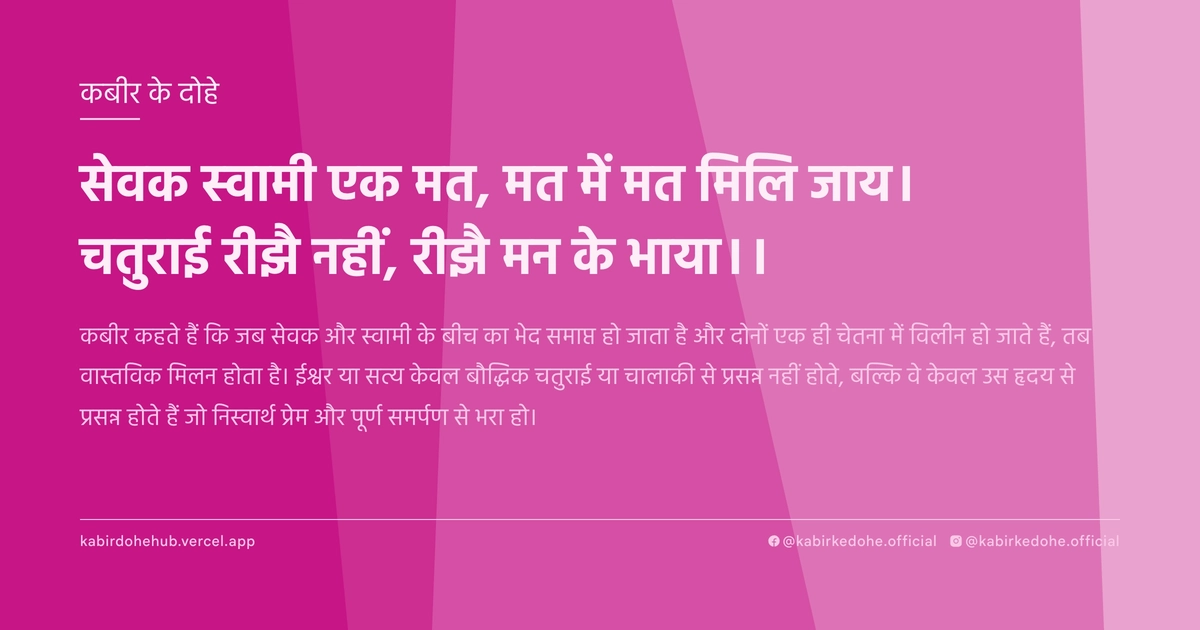
सेवक स्वामी एक मत, मत में मत मिलि जाय।
चतुराई रीझै नहीं, रीझै मन के भाया।।
Sevak swami ek mat, mat mein mat mili jaaye. Chaturai reejhai nahi, reejhai man ke bhaya.
इस पृष्ठ पर इस कबीर दोहे का अर्थ (meaning), हिंदी व्याख्या और अंग्रेज़ी अनुवाद, दार्शनिक विश्लेषण और व्यावहारिक जीवन सीख दी गई है। यह दोहा प्रपत्ति (Surrender) विषय से जुड़ा है — Kabir doha meaning and explanation in Hindi and English.
अर्थ (Meaning):
कबीर कहते हैं कि जब सेवक और स्वामी के बीच का भेद समाप्त हो जाता है और दोनों एक ही चेतना में विलीन हो जाते हैं, तब वास्तविक मिलन होता है। ईश्वर या सत्य केवल बौद्धिक चतुराई या चालाकी से प्रसन्न नहीं होते, बल्कि वे केवल उस हृदय से प्रसन्न होते हैं जो निस्वार्थ प्रेम और पूर्ण समर्पण से भरा हो।
Kabir asserts that true spiritual union occurs when the distinction between the servant (the individual soul) and the master (the Divine) dissolves into a single consciousness. The Divine is not impressed by intellectual cleverness or strategic piety; rather, the Truth is attracted only to a heart characterized by selfless love and absolute surrender.
व्याख्या (Interpretation):
इस दोहे का शाब्दिक अर्थ है कि सेवक और स्वामी का मत एक हो जाना चाहिए। यहाँ 'मत' का अर्थ विचार और अहंकार दोनों से है। जब साधक का व्यक्तिगत अहंकार (जीवात्मा) परमात्मा (ब्रह्म) में विलीन हो जाता है, तो द्वैत समाप्त हो जाता है। यह निर्गुण भक्ति का सार है जहाँ ईश्वर किसी बाहरी रूप में नहीं, बल्कि आंतरिक एकता में पाया जाता है। माया हमें यह विश्वास दिलाती है कि हम और ईश्वर अलग हैं, लेकिन अद्वैत वेदांत के अनुसार यह केवल एक भ्रम है। चतुराई यहाँ उस मानसिक अहंकार को दर्शाती है जो तर्क के माध्यम से ईश्वर को 'पाने' की कोशिश करता है। वास्तविक आध्यात्मिक उपलब्धि तर्क से नहीं, बल्कि 'भाव' या प्रेम से आती है, जो अहंकार के पूर्ण विसर्जन के बाद ही संभव है।
Literally, the verse suggests that the perspective of the servant and the master must become one. Here, 'mat' refers to both opinion and the ego. When the practitioner's individual ego (Jivatma) merges into the Universal Consciousness (Brahman), duality vanishes. This is the essence of Nirgun Bhakti, where the Divine is found not in external forms but in internal oneness. Maya creates the illusion of separation between the self and the Divine, but Advaita Vedanta posits that this separation is a fallacy. 'Chaturayi' or cleverness represents the intellectual ego attempting to 'capture' or 'negotiate' with the Truth through logic. True spiritual realization is not a product of mental gymnastics but of 'Bhava'—pure, unadulterated love that emerges only after the total annihilation of the self.
दार्शनिक विश्लेषण (Philosophical Analysis):
कबीर का यह दोहा उस युग की प्रतिक्रिया है जहाँ धर्म केवल कर्मकांडों और बाहरी दिखावे तक सीमित था। उन्होंने स्पष्ट किया कि ईश्वर किसी विशेष जाति, धर्म या विद्वता का मोहताज नहीं है। यह विचार सूफीवाद के 'फना' (अहंकार का विनाश) के सिद्धांत से गहराई से जुड़ा है, जहाँ प्रेमी अपने अस्तित्व को मिटाकर प्रिय में विलीन हो जाता है।
अद्वैत वेदांत के परिप्रेक्ष्य में, यह 'अहं ब्रह्मास्मि' की स्थिति है। जब तक 'मैं' और 'वह' का भेद है, तब तक दूरी है। कबीर इस दूरी को मिटाने के लिए 'सहज' मार्ग का सुझाव देते हैं, जो न तो कठिन तपस्या है और न ही जटिल शास्त्रार्थ, बल्कि केवल हृदय की सरलता है।
यहाँ 'चतुराई' का खंडन महत्वपूर्ण है। मध्यकालीन समाज में पंडितों और मुल्लाओं का वर्चस्व था जो अपनी भाषाई और तार्किक श्रेष्ठता से ईश्वर तक पहुँचने का दावा करते थे। कबीर इसे एक आध्यात्मिक बाधा मानते हैं क्योंकि तर्क मस्तिष्क का गुण है, जबकि भक्ति आत्मा का।
मनोवैज्ञानिक स्तर पर, यह दोहा 'पहचान के संकट' को संबोधित करता है। हम अक्सर अपनी सामाजिक भूमिकाओं (सेवक या स्वामी) में इतने उलझ जाते हैं कि अपनी मूल प्रकृति को भूल जाते हैं। जब ये भूमिकाएँ गिरती हैं, तब केवल शुद्ध चेतना शेष रहती है।
अंततः, यह शिक्षण हमें सिखाता है कि सत्य कोई ऐसी वस्तु नहीं है जिसे खोजा जाए, बल्कि वह एक अवस्था है जिसमें प्रवेश किया जाता है। यह प्रवेश केवल तभी संभव है जब हम अपनी 'चतुराई' यानी अपनी रणनीतिक सोच को त्याग कर पूर्णतः समर्पित हो जाएँ।
Kabir's couplet is a visceral reaction to an era where religion was reduced to mere ritualism and external displays of piety. He clarifies that the Divine is not beholden to any specific caste, creed, or scholarly achievement. This thought aligns profoundly with the Sufi concept of 'Fana' (annihilation of the self), where the lover dissolves their existence into the Beloved.
From the perspective of Advaita Vedanta, this represents the state of 'Aham Brahmasmi' (I am Brahman). As long as the distinction between 'I' and 'Thou' exists, there is separation. Kabir suggests the 'Sahaj' path—a natural way that is neither rigorous asceticism nor complex theological debate, but simple purity of heart.
The rejection of 'Chaturayi' (cleverness) is pivotal. In the medieval period, the religious elite—Pandits and Mullahs—claimed access to God through linguistic and logical superiority. Kabir identifies this as a spiritual hurdle because logic is a function of the mind, whereas devotion is a function of the soul.
Psychologically, the verse addresses the 'crisis of identity.' We often become so entangled in our social roles (servant or master) that we forget our primordial nature. When these roles collapse, only pure consciousness remains.
Ultimately, this teaching posits that Truth is not an object to be acquired but a state to be entered. This entry is possible only when we abandon our strategic thinking and surrender completely to the flow of existence.
मूल संदेश (Core Message):
- अहंकार की दीवारें गिराकर ही परमात्मा का मिलन संभव है।
- तर्क मस्तिष्क का खेल है, जबकि प्रेम आत्मा की भाषा है।
- श्रेष्ठता का भ्रम ही आध्यात्मिक प्रगति में सबसे बड़ी बाधा है।
- पूर्ण समर्पण ही वह कुंजी है जो द्वैत के द्वार खोलती है।
- जब 'मैं' मिटता है, तभी 'वह' प्रकट होता है।
- Union with the Divine is possible only after dismantling the walls of ego.
- Logic is a game of the mind, while love is the language of the soul.
- The illusion of superiority is the greatest obstacle to spiritual growth.
- Absolute surrender is the key that unlocks the doors of duality.
- Only when the 'I' vanishes does the 'Infinite' manifest.
व्यावहारिक उदाहरण (Practical Example):
वाराणसी के एक पुराने घाट पर माधव नाम का एक वृद्ध नाविक रहता था। वह अपनी नाव चलाने की कला में इतना निपुण था कि शहर के सबसे बड़े विद्वान भी उसकी प्रशंसा करते थे। माधव को अपनी इस 'चतुराई' पर बहुत गर्व था। वह मानता था कि उसकी तकनीक और अनुभव ही उसे दूसरों से श्रेष्ठ बनाते हैं।
एक दिन, एक शांत संन्यासी उसकी नाव पर सवार हुए। माधव ने अपनी कुशलता दिखाने के लिए नाव को बहुत तेज़ी से और जटिल मोड़ों से चलाया, यह सोचकर कि संन्यासी उसकी प्रतिभा से प्रभावित होंगे। वह बार-बार अपनी तकनीक के बारे में बात कर रहा था।
संन्यासी चुपचाप गंगा की लहरों को देख रहे थे। जब वे किनारे पहुँचे, तो उन्होंने माधव से कहा, 'तुम लहरों को नियंत्रित करने की चतुराई में तो माहिर हो, लेकिन क्या तुम लहरों के साथ एक होने का साहस रखते हो?'
माधव हैरान था। संन्यासी ने आगे कहा, 'तुम्हारी चतुराई तुम्हें श्रेष्ठ बनाती है, लेकिन वह तुम्हें शांत नहीं बनाती। तुम नाव के स्वामी बनना चाहते हो, लेकिन क्या तुम इस नदी के सेवक बनने को तैयार हो?'
उस रात माधव सो नहीं सका। उसने महसूस किया कि वह अब तक केवल अपनी श्रेष्ठता सिद्ध करने की कोशिश कर रहा था। उसने अपनी 'स्वामी' वाली छवि को त्यागने का निर्णय लिया।
अगले कुछ महीनों तक, माधव ने अपनी नाव चलाने के तरीके को बदल दिया। अब वह प्रदर्शन के लिए नहीं, बल्कि सेवा के लिए नाव चलाता था। उसने अपनी चतुराई को विनम्रता में बदल दिया।
वह अब यात्रियों से अपनी कुशलता की बातें नहीं करता था, बल्कि उनकी यात्रा को सुखद बनाने के लिए मौन रहकर समर्पित रहता था। उसने पाया कि जब उसने 'श्रेष्ठ' होने का मोह छोड़ा, तो उसे एक अद्भुत आंतरिक शांति मिली।
एक दिन, एक अहंकारी व्यापारी उसकी नाव पर आया और उसे नीचा दिखाने की कोशिश की। पहले का माधव लड़ता, लेकिन अब वह केवल मुस्कुराया। व्यापारी उसकी इस निस्वार्थ शांति को देखकर दंग रह गया और उसने माधव से उसकी शांति का रहस्य पूछा।
माधव ने बस इतना कहा, 'जब मैं स्वामी बनने की कोशिश करता था, तो मैं अकेला था। जब मैं सेवक बन गया, तो पूरा ब्रह्मांड मेरा साथी हो गया।'
यह माधव का 'कबीर ट्विस्ट' था—जहाँ उसकी तकनीकी चतुराई का अंत हुआ और उसकी आत्मा का विस्तार शुरू हुआ।
On an ancient ghat in Varanasi lived an elderly boatman named Madhav. He was so skilled in the art of rowing that even the city's greatest scholars praised him. Madhav took immense pride in this 'cleverness,' believing his technique and experience made him superior to all others.
One day, a serene monk boarded his boat. To impress the monk, Madhav navigated the boat with aggressive speed and complex maneuvers, showcasing his prowess. He spoke incessantly about his technical mastery.
The monk remained silent, gazing at the ripples of the Ganges. Upon reaching the shore, the monk asked, 'You are a master of the cleverness of controlling the waves, but do you have the courage to become one with the waves?'
Madhav was bewildered. The monk continued, 'Your cleverness makes you superior, but it does not make you peaceful. You strive to be the master of the boat, but are you willing to be the servant of this river?'
Madhav could not sleep that night. He realized he had spent his life trying to prove his superiority. He decided to relinquish his identity as the 'master.'
Over the next few months, Madhav changed his approach. He no longer rowed for performance, but for service. He transmuted his cleverness into humility.
He stopped boasting about his skills and instead remained silently dedicated to the comfort of his passengers. He discovered that by letting go of the desire to be 'the best,' he attained an unprecedented inner peace.
One day, an arrogant merchant boarded his boat and tried to belittle him. The old Madhav would have fought back, but the new Madhav simply smiled. The merchant was stunned by this selfless tranquility and asked for the secret of his peace.
Madhav replied, 'When I tried to be the master, I was alone. When I became the servant, the entire universe became my companion.'
This was Madhav's 'Kabir Twist'—where his technical cleverness ended and the expansion of his soul began.
अभ्यास मार्गदर्शन (Practice Guidance):
- प्रतिदिन 20 मिनट मौन ध्यान करें, जहाँ आप स्वयं को किसी भी भूमिका (पिता, पुत्र, कर्मचारी, गुरु) से अलग कर केवल एक 'साक्षी' के रूप में देखें।
- एक जर्नल बनाएँ जिसमें उन क्षणों को लिखें जब आपने अपनी 'चतुराई' या तर्क का उपयोग किसी को नीचा दिखाने या खुद को श्रेष्ठ सिद्ध करने के लिए किया।
- दिन में कम से कम एक ऐसा कार्य करें जिसमें आप पूरी तरह से 'सेवक' की भूमिका में हों, बिना किसी प्रशंसा या फल की इच्छा के।
- डायग्नोस्टिक चेकलिस्ट: क्या मैं बातचीत के दौरान सामने वाले को चुप कराने की कोशिश करता हूँ? क्या मैं अपनी उपलब्धियों का उल्लेख बार-बार करता हूँ? यदि हाँ, तो आप अभी भी 'चतुराई' के जाल में हैं।
- Practice 20 minutes of silent meditation daily, stripping away all roles (parent, child, employee, teacher) and observing yourself solely as a 'witness'.
- Maintain a journal recording moments where you used 'cleverness' or logic to belittle others or prove your own superiority.
- Perform at least one act of service daily where you fully embody the role of a 'servant,' without any desire for praise or reward.
- Diagnostic Checklist: Do I try to silence others during conversations to prove my point? Do I frequently mention my achievements? If yes, you are still trapped in the web of 'cleverness'.
चिंतन प्रश्न (Reflection Questions):
- मेरी वह कौन सी 'चतुराई' है जिसे मैं अपनी बुद्धिमत्ता समझता हूँ, लेकिन वास्तव में वह मेरा अहंकार है?
- यदि मेरी सभी सामाजिक उपलब्धियाँ और पद छीन लिए जाएँ, तो मेरे भीतर क्या बचेगा?
- मैं ईश्वर या सत्य को 'पाने' के लिए कौन सी रणनीतियाँ अपना रहा हूँ, और क्या ये रणनीतियाँ ही मुझे उनसे दूर कर रही हैं?
- मेरे जीवन में 'सेवक' और 'स्वामी' का संघर्ष कहाँ मौजूद है, और मैं इसे कैसे समाप्त कर सकता हूँ?
- क्या मेरा प्रेम वास्तव में निस्वार्थ है, या यह केवल मेरी अपनी छवि को बेहतर बनाने का एक तरीका है?
- What 'cleverness' do I mistake for intelligence, which is actually just my ego in disguise?
- If all my social achievements and titles were stripped away, what would remain of me?
- What strategies am I using to 'attain' Truth, and are these very strategies keeping me distant from it?
- Where does the conflict between 'servant' and 'master' exist in my life, and how can I dissolve it?
- Is my love truly selfless, or is it merely a tool to enhance my own self-image?