
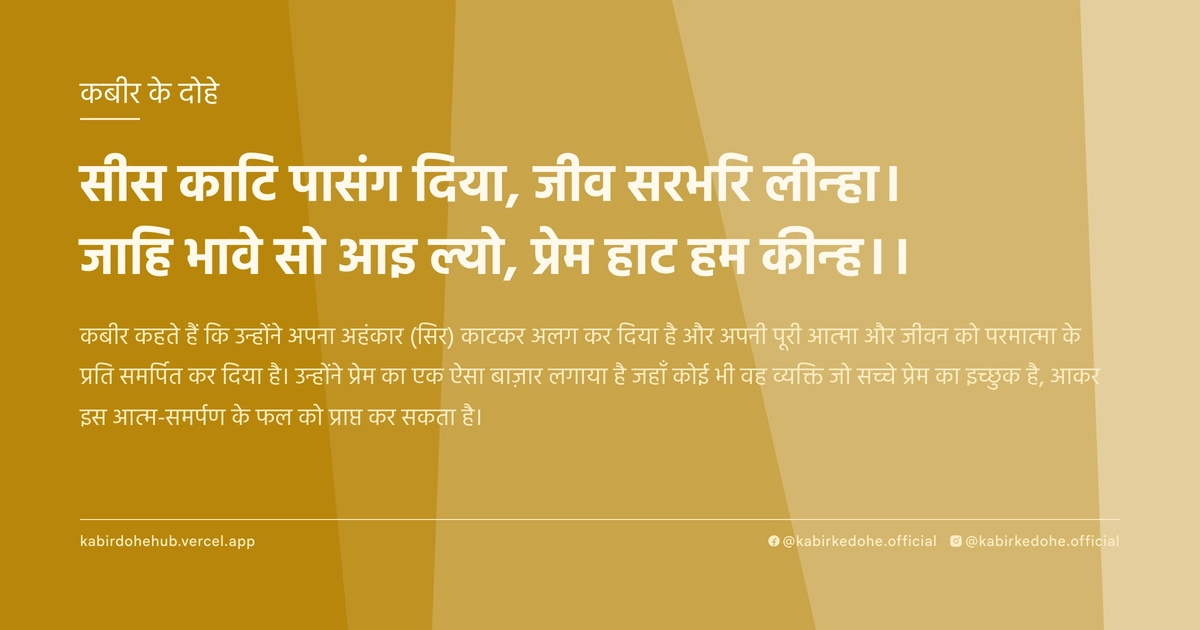
सीस काटि पासंग दिया, जीव सरभरि लीन्हा।
जाहि भावे सो आइ ल्यो, प्रेम हाट हम कीन्ह।।
Sees kaati paasang diya, jeev sarbhari leenha. Jaahi bhaave so aai lyo, prem haat hum keenh.
इस पृष्ठ पर इस कबीर दोहे का अर्थ (meaning), हिंदी व्याख्या और अंग्रेज़ी अनुवाद, दार्शनिक विश्लेषण और व्यावहारिक जीवन सीख दी गई है। यह दोहा प्रपत्ति (Surrender) विषय से जुड़ा है — Kabir doha meaning and explanation in Hindi and English.
अर्थ (Meaning):
कबीर कहते हैं कि उन्होंने अपना अहंकार (सिर) काटकर अलग कर दिया है और अपनी पूरी आत्मा और जीवन को परमात्मा के प्रति समर्पित कर दिया है। उन्होंने प्रेम का एक ऐसा बाज़ार लगाया है जहाँ कोई भी वह व्यक्ति जो सच्चे प्रेम का इच्छुक है, आकर इस आत्म-समर्पण के फल को प्राप्त कर सकता है।
Kabir declares that he has severed the head of his ego and offered it as a sacrifice, fully immersing his soul in the Divine. He has established a marketplace of love, inviting anyone who possesses a genuine longing for spiritual union to come and claim the fruits of this absolute surrender.
व्याख्या (Interpretation):
यहाँ 'सिर काटना' शारीरिक मृत्यु नहीं, बल्कि अहंकार (I-ness) का पूर्ण विनाश है। 'पासंग' का अर्थ है त्याग या समर्पण। कबीर निरगुण भक्ति के उस शिखर की बात कर रहे हैं जहाँ साधक और साध्य के बीच की दूरी समाप्त हो जाती है। यह अद्वैत वेदांत के उस सिद्धांत को दर्शाता है जहाँ जब 'मैं' मिटता है, तब केवल 'ब्रह्म' शेष रहता है। प्रेम हाट एक रूपक है, जो बताता है कि परमात्मा कोई वस्तु नहीं जिसे खरीदा जाए, बल्कि एक अनुभव है जिसे केवल प्रेम के माध्यम से ही प्राप्त किया जा सकता है। यह माया के पर्दे को फाड़ने और आत्मा के वास्तविक स्वरूप को पहचानने की प्रक्रिया है।
The act of 'severing the head' is not a physical sacrifice but a profound metaphor for the annihilation of the ego (Ahamkara). 'Paasang' signifies the total relinquishment of the self. Kabir speaks from the pinnacle of Nirgun Bhakti, where the duality between the seeker and the sought dissolves. This aligns with Advaita Vedanta, suggesting that when the 'I' vanishes, only the Absolute (Brahman) remains. The 'Marketplace of Love' is a mystical allegory; the Divine is not a commodity to be purchased but an experience to be realized through selfless love. It represents the tearing of the veil of Maya to reveal the non-dual nature of the Atman.
दार्शनिक विश्लेषण (Philosophical Analysis):
कबीर का यह दोहा मध्यकालीन भारत के उस सामाजिक और धार्मिक संघर्ष का प्रतिबिंब है जहाँ कर्मकांड और बाहरी दिखावे का बोलबाला था। उन्होंने मंदिर, मस्जिद और जातिगत श्रेष्ठता के दावों को नकारते हुए 'प्रेम' को एकमात्र धर्म घोषित किया। यह दृष्टिकोण सूफी मत के 'फना' (Fana) के करीब है, जहाँ प्रेमी अपने अस्तित्व को मिटाकर ईश्वर में विलीन हो जाता है।
दार्शनिक स्तर पर, कबीर यहाँ 'अहं' के विसर्जन की बात कर रहे हैं। जब तक मनुष्य अपनी पहचान को शरीर, नाम या पद से जोड़ता है, वह सत्य से दूर रहता है। सिर काटना उस मानसिक संरचना को नष्ट करना है जो हमें दूसरों से अलग करती है। यह एक मनोवैज्ञानिक रूपांतरण है जहाँ व्यक्ति 'स्व' से 'सर्व' की ओर बढ़ता है।
अद्वैत वेदांत के अनुसार, अज्ञान (Avidya) ही वह बंधन है जो हमें अलग महसूस कराता है। कबीर का 'प्रेम हाट' इसी अज्ञान को मिटाने का साधन है। वे बताते हैं कि ज्ञान केवल किताबों से नहीं, बल्कि हृदय के समर्पण से आता है। यहाँ प्रेम कोई भावना नहीं, बल्कि एक आध्यात्मिक उपकरण है जो द्वैत को समाप्त करता है।
कबीर ने तत्कालीन समाज की रूढ़ियों पर प्रहार किया। उन्होंने सिखाया कि ईश्वर को पाने के लिए किसी पुरोहित या मध्यस्थ की आवश्यकता नहीं है। यदि हृदय में प्रेम है, तो वह स्वयं में एक मंदिर है। यह क्रांतिकारी विचार था जिसने आम जनमानस को आध्यात्मिक स्वतंत्रता प्रदान की।
अंततः, यह दोहा इस सत्य को स्थापित करता है कि मोक्ष का मार्ग त्याग और प्रेम से होकर जाता है। जब साधक अपना सब कुछ—यहाँ तक कि अपनी पहचान भी—परमात्मा के चरणों में रख देता है, तब वह वास्तव में पूर्ण हो जाता है। यह शून्य में विलीन होकर अनंत होने की यात्रा है।
This couplet reflects the socio-religious turbulence of medieval India, where ritualism and outward displays of piety dominated. Kabir rejected the claims of temple, mosque, and caste superiority, declaring 'Love' as the only true religion. This perspective closely mirrors the Sufi concept of 'Fana' (annihilation), where the lover dissolves their individual existence to merge with the Beloved.
Philosophically, Kabir addresses the dissolution of the ego. As long as a human identifies themselves with the body, a name, or a status, they remain estranged from the Truth. 'Severing the head' symbolizes the destruction of the mental construct that creates separation. It is a psychological transformation from the 'Self' to the 'Universal'.
According to Advaita Vedanta, ignorance (Avidya) is the bond that creates the illusion of duality. Kabir's 'Marketplace of Love' is the instrument to erase this ignorance. He posits that true knowledge is not found in scriptures but in the surrender of the heart. Here, love is not a mere emotion but a spiritual tool that annihilates duality.
Kabir attacked the orthodoxies of his time, teaching that no priest or intermediary is needed to reach the Divine. If the heart is filled with love, it becomes a temple in itself. This was a revolutionary idea that granted spiritual autonomy to the common masses.
Ultimately, the doha establishes that the path to liberation lies through renunciation and love. When the seeker offers everything—including their very identity—at the feet of the Divine, they achieve wholeness. It is the journey of becoming 'Zero' to realize the 'Infinite'.
मूल संदेश (Core Message):
- अहंकार ही वह अंतिम पर्दा है जो आत्मा को परमात्मा से अलग करता है।
- पूर्ण समर्पण ही आध्यात्मिक जागृति की एकमात्र कुंजी है।
- प्रेम कोई भावना नहीं, बल्कि स्वयं के अस्तित्व का विसर्जन है।
- जब 'मैं' समाप्त होता है, तब 'सत्य' का उदय होता है।
- बाहरी कर्मकांड व्यर्थ हैं यदि हृदय में प्रेम और विनम्रता नहीं है।
- परमात्मा को पाने के लिए स्वयं को खोना अनिवार्य है।
- The ego is the final veil separating the soul from the Divine.
- Absolute surrender is the only key to spiritual awakening.
- Love is not an emotion, but the dissolution of one's own existence.
- When the 'I' vanishes, the 'Truth' emerges.
- External rituals are futile if the heart lacks love and humility.
- To find the Divine, one must first lose oneself.
व्यावहारिक उदाहरण (Practical Example):
एक समय की बात है, वाराणसी के घाटों पर माधव नाम का एक वृद्ध बुनकर रहता था। माधव अपनी कला में निपुण था, लेकिन उसका अहंकार उसकी कला से भी बड़ा था। वह मानता था कि उसके द्वारा बुने गए वस्त्र दुनिया में सबसे श्रेष्ठ हैं और वह स्वयं को अन्य बुनकरों से ऊपर समझता था।
उसका जीवन क्रोध और श्रेष्ठता की भावना से भरा था। वह अपने शिष्यों को नीचा दिखाता और हर छोटी बात पर विवाद करता। उसकी प्रसिद्धि तो थी, लेकिन उसके मन में शांति नहीं थी। वह हमेशा इस डर में रहता कि कोई उससे बेहतर बुनकर न आ जाए।
एक दिन, एक फकीर उसके पास आया और उसने माधव के सबसे महंगे वस्त्र को देखा। फकीर ने मुस्कुराते हुए कहा, "माधव, तुम्हारे वस्त्र सुंदर हैं, लेकिन उनमें वह धागा गायब है जो आत्मा को परमात्मा से जोड़ता है। तुमने कपड़े तो बुने, पर अपना अहंकार नहीं काटा।"
माधव को पहले तो यह बात चुभी, लेकिन फकीर की आँखों में एक अजीब सी शांति थी। फकीर ने उसे चुनौती दी कि वह एक ऐसा वस्त्र बुने जिसमें उसकी अपनी कोई पहचान न हो, केवल समर्पण हो। माधव ने कोशिश की, लेकिन वह बार-बार अपनी 'कला' दिखाने लगता।
हफ्तों तक वह संघर्ष करता रहा। अंत में, एक रात उसे अहसास हुआ कि वह वस्त्र नहीं बुन रहा, बल्कि अपनी श्रेष्ठता की दीवार खड़ी कर रहा है। उसने अपनी आँखें बंद कीं और प्रार्थना की कि उसका 'मैं' मिट जाए। उसने महसूस किया कि उसकी कला उसकी नहीं, बल्कि उस ईश्वर की देन है।
उस क्षण, माधव का अहंकार टूट गया। उसने अपनी सारी श्रेष्ठता की भावना को त्याग दिया। उसने अपने सबसे कीमती वस्त्रों को उन गरीबों में बाँट दिया जिनके पास पहनने को कपड़े नहीं थे, बिना किसी उम्मीद या प्रशंसा के।
अब माधव पहले से अधिक कुशलता से बुनता था, लेकिन अब उसके काम में एक दिव्य चमक थी। वह अब खुद को 'महान बुनकर' नहीं, बल्कि 'ईश्वर का एक यंत्र' मानता था। उसके व्यवहार में विनम्रता आ गई और उसके घर में शांति का वास हुआ।
गाँव के लोग हैरान थे कि माधव इतना बदल कैसे गया। माधव ने बस इतना कहा, "मैंने अपना सिर (अहंकार) काटकर प्रेम के बाज़ार में बेच दिया है, और अब मैं वास्तव में स्वतंत्र हूँ।"
माधव की यह कहानी हमें सिखाती है कि जब हम अपनी उपलब्धियों का श्रेय स्वयं लेना बंद कर देते हैं, तब हम वास्तव में उस अनंत प्रेम का हिस्सा बन जाते हैं।
Once, on the ghats of Varanasi, lived an elderly weaver named Madhav. Madhav was a master of his craft, but his ego was even greater than his skill. He believed the fabrics he wove were the finest in the world and considered himself superior to all other weavers.
His life was consumed by anger and a sense of superiority. He belittled his apprentices and clashed with others over the smallest matters. While he had fame, he lacked peace, constantly fearing that someone might surpass his skill.
One day, a wandering dervish visited him and looked at Madhav's most expensive garment. The dervish smiled and said, "Madhav, your cloth is beautiful, but it lacks the thread that binds the soul to the Divine. You have woven fabric, but you have not severed your ego."
Madhav was initially offended, but he noticed a profound peace in the dervish's eyes. The dervish challenged him to weave a garment that held no trace of his own identity, only pure surrender. Madhav tried, but he kept slipping back into showcasing his 'artistry'.
For weeks he struggled. Finally, one night, he realized he wasn't weaving cloth, but building a wall of superiority. He closed his eyes and prayed for his 'I' to vanish. He realized that his skill was not his own, but a gift from the Divine.
In that moment, Madhav's ego shattered. He renounced all feelings of superiority. He distributed his most precious garments to the poor who had nothing to wear, without seeking any reward or praise.
Madhav continued to weave with even greater skill, but now his work possessed a divine radiance. He no longer saw himself as a 'Great Weaver' but as a 'mere instrument of God'. Humility entered his nature, and peace settled in his home.
The villagers were astonished by the change. Madhav simply replied, "I have severed my head (ego) and traded it in the marketplace of love; only now am I truly free."
Madhav's story teaches us that when we stop claiming credit for our achievements, we truly become a part of that infinite, universal love.
अभ्यास मार्गदर्शन (Practice Guidance):
- प्रतिदिन 20 मिनट मौन ध्यान करें, जहाँ आप अपने विचारों को केवल एक साक्षी (Witness) की तरह देखें और उनमें 'मैं' की पहचान को मिटाने का प्रयास करें।
- एक 'अहंकार डायरी' बनाएँ। दिन भर में जब भी आपको महसूस हो कि आप किसी से श्रेष्ठ महसूस कर रहे हैं या अपनी प्रशंसा की इच्छा कर रहे हैं, उसे लिखें और फिर उसे मानसिक रूप से समर्पित कर दें।
- सेवा का अभ्यास करें: सप्ताह में एक बार ऐसा कार्य करें जिसके लिए आपको कोई श्रेय न मिले और जिसके बारे में किसी को पता न चले। यह गुप्त दान या सेवा अहंकार को गलाने में मदद करती है।
- निदान चेकलिस्ट: क्या मैं दूसरों की सफलता से जलता हूँ? क्या मैं अपनी उपलब्धियों का श्रेय केवल स्वयं को देता हूँ? क्या मैं दूसरों को सुधारने की कोशिश में उन्हें नीचा दिखाता हूँ? यदि हाँ, तो अहंकार अभी जीवित है।
- Practice 20 minutes of silent meditation daily, observing your thoughts as a witness and consciously attempting to dissolve the identity of 'I'.
- Maintain an 'Ego Journal'. Whenever you feel superior to others or crave validation throughout the day, record it and then mentally surrender that feeling to the Divine.
- Practice selfless service: Once a week, perform an act of kindness for which you receive no credit and which remains unknown to others. This anonymous service helps erode the ego.
- Diagnostic Checklist: Do I feel resentment toward others' success? Do I claim sole credit for my achievements? Do I belittle others while trying to 'correct' them? If yes, the ego is still active.
चिंतन प्रश्न (Reflection Questions):
- मेरी वह कौन सी उपलब्धि है जिसे मैं अपनी पहचान का आधार मानता हूँ, और यदि वह छिन जाए तो क्या मैं शून्य महसूस करूँगा?
- क्या मेरा 'आध्यात्मिक मार्ग' भी मेरे अहंकार को संतुष्ट करने का एक तरीका बन गया है (जैसे यह सोचना कि मैं दूसरों से अधिक जागरूक हूँ)?
- मेरे जीवन का वह कौन सा क्षेत्र है जहाँ मैं अभी भी 'नियंत्रण' चाहता हूँ, जबकि समर्पण शांति ला सकता है?
- क्या मैं वास्तव में प्रेम करता हूँ, या मैं केवल उस प्रेम की प्रशंसा चाहता हूँ जो मुझे दूसरों से मिलता है?
- यदि मेरी सामाजिक पहचान (नाम, पद, प्रतिष्ठा) पूरी तरह मिटा दी जाए, तो मेरे भीतर क्या शेष रहेगा?
- मेरे भीतर का वह कौन सा 'सिर' है जिसे काटने की सबसे अधिक आवश्यकता है?
- Which achievement do I use as the foundation of my identity, and would I feel like a void if it were taken away?
- Has my 'spiritual path' become another way to feed my ego (e.g., believing I am more conscious than others)?
- In which area of my life am I still clinging to 'control' when surrender could bring peace?
- Do I truly love, or do I merely crave the validation and love that others give me?
- If my social identity (name, rank, reputation) were completely erased, what would remain within me?
- Which 'head' within me is in the most urgent need of being severed?