
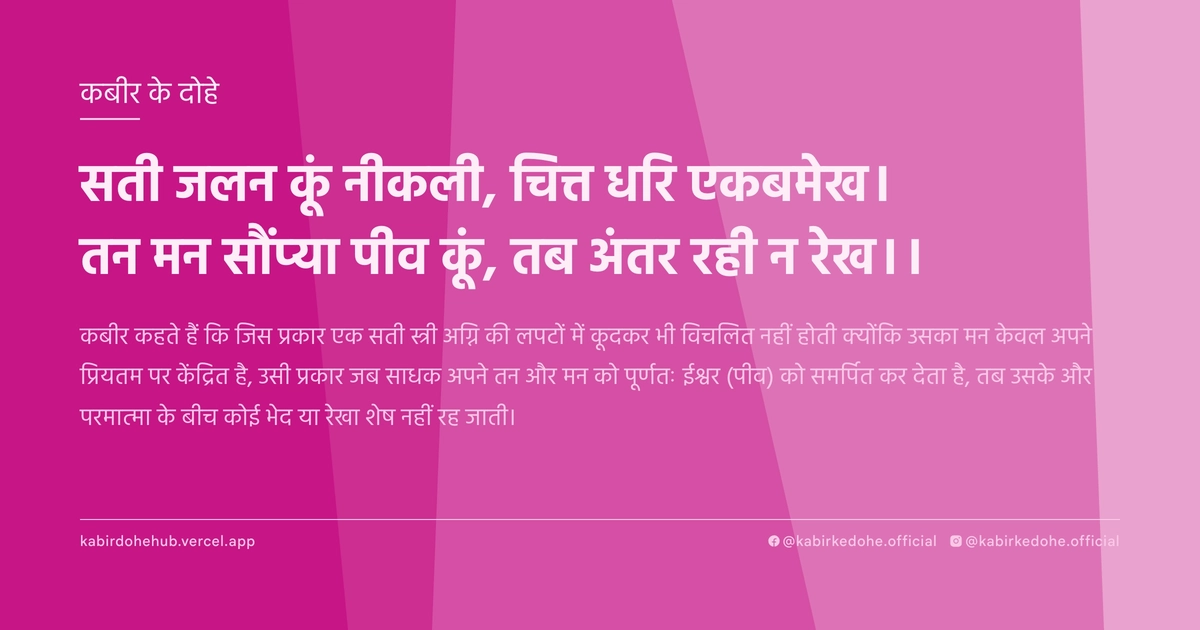
सती जलन कूं नीकली, चित्त धरि एकबमेख।
तन मन सौंप्या पीव कूं, तब अंतर रही न रेख।।
Sati jalan koon neekali, chitt dhari ekbamekh. Tan man saumpya peev koon, tab antar rahi na rekh.
इस पृष्ठ पर इस कबीर दोहे का अर्थ (meaning), हिंदी व्याख्या और अंग्रेज़ी अनुवाद, दार्शनिक विश्लेषण और व्यावहारिक जीवन सीख दी गई है। यह दोहा प्रपत्ति (Surrender) विषय से जुड़ा है — Kabir doha meaning and explanation in Hindi and English.
अर्थ (Meaning):
कबीर कहते हैं कि जिस प्रकार एक सती स्त्री अग्नि की लपटों में कूदकर भी विचलित नहीं होती क्योंकि उसका मन केवल अपने प्रियतम पर केंद्रित है, उसी प्रकार जब साधक अपने तन और मन को पूर्णतः ईश्वर (पीव) को समर्पित कर देता है, तब उसके और परमात्मा के बीच कोई भेद या रेखा शेष नहीं रह जाती।
Kabir explains that just as a devoted wife (Sati) passes through fire without wavering because her mind is fixed solely on her beloved, similarly, when a seeker surrenders their entire physical and mental existence to the Divine Beloved, the boundary or separation between the individual soul and the Supreme Truth vanishes completely.
व्याख्या (Interpretation):
यहाँ 'सती' और 'अग्नि' का प्रयोग भौतिक अर्थ में नहीं, बल्कि आध्यात्मिक रूपांतरण के लिए किया गया है। अग्नि यहाँ 'तप' और 'साधना' की उस तीव्रता का प्रतीक है जो अहंकार को जलाकर भस्म कर देती है। 'एकबमेख' का अर्थ है अनन्य एकाग्रता, जहाँ चित्त की सारी लहरें शांत होकर एक बिंदु पर टिक जाती हैं। यह अवस्था निर्गुण भक्ति की पराकाष्ठा है, जहाँ भक्त और भगवान का द्वैत समाप्त हो जाता है। जब साधक 'तन-मन' का पूर्ण समर्पण करता है, तो वह माया के आवरण को भेद देता है। अंततः, 'रेखा' का मिटना अद्वैत वेदांत की उस स्थिति को दर्शाता है जहाँ आत्मा और ब्रह्म एक हो जाते हैं। यह विरह की अग्नि में तपकर मिलन की प्राप्ति की यात्रा है।
The references to the 'Sati' and 'Fire' are not literal but serve as potent metaphors for spiritual transmutation. Fire symbolizes the intensity of 'Tapas' (austerity) and the burning of the ego's impurities. 'Ekbamekh' refers to an unwavering, singular concentration where the fluctuations of the mind cease, aligning with the essence of Nirgun Bhakti. The surrender of 'body and mind' represents the total dissolution of the individual identity into the Divine Beloved. This process mirrors the Advaita Vedanta concept of non-duality, where the perceived separation between the self and the Absolute is revealed as an illusion (Maya). The 'vanishing line' signifies the collapse of the subject-object duality, leading to a state of absolute oneness. It is the journey of refining the soul through the fire of longing to achieve ultimate union.
दार्शनिक विश्लेषण (Philosophical Analysis):
कबीर का यह दोहा मध्यकालीन भारत के सामाजिक और धार्मिक परिवेश में एक क्रांतिकारी हस्तक्षेप है। उस समय धर्म बाहरी कर्मकांडों, तीर्थों और जातिगत श्रेष्ठता में उलझा हुआ था। कबीर ने इन सबको नकारते हुए 'प्रेम' और 'समर्पण' को ही एकमात्र मार्ग बताया। यह दृष्टिकोण सूफी मत के 'फना' (अहंकार का विनाश) और अद्वैत वेदांत के 'अहं ब्रह्मास्मि' का एक सुंदर संगम है।
यहाँ 'पीव' शब्द का प्रयोग अत्यंत महत्वपूर्ण है। सूफी परंपरा में ईश्वर को 'प्रियतम' माना जाता है, और कबीर इसी शब्दावली का उपयोग कर यह बताते हैं कि ईश्वर कोई डराने वाला न्यायाधीश नहीं, बल्कि वह प्रेम है जिसे पाने के लिए स्वयं को मिटाना पड़ता है। यह समर्पण केवल मानसिक नहीं, बल्कि शारीरिक और भावनात्मक स्तर पर भी है, जो यह दर्शाता है कि जब तक 'मैं' मौजूद है, तब तक 'वह' नहीं मिल सकता।
कबीर ritualism (कर्मकांड) का विरोध करते हुए यह स्पष्ट करते हैं कि मोक्ष किसी बाहरी क्रिया से नहीं, बल्कि आंतरिक एकाग्रता से मिलता है। अग्नि में जलना यहाँ वासनाओं और मोह के जलने का प्रतीक है। जब साधक अपनी समस्त पहचान को ईश्वर में विलीन कर देता है, तो वह सामाजिक मर्यादाओं और जातिगत बंधनों से ऊपर उठ जाता है, क्योंकि अब वह केवल 'एक' है।
मनोवैज्ञानिक स्तर पर, यह दोहा 'संज्ञानात्मक विलोपन' की बात करता है। जब व्यक्ति का लक्ष्य इतना प्रबल हो जाता है कि वह अपने अस्तित्व को भूल जाता है, तब वह उस परम आनंद को प्राप्त करता है जिसे 'समाधि' कहा गया है। यह अहंकार का पूर्ण विसर्जन है, जहाँ ज्ञाता, ज्ञान और ज्ञेय का अंतर समाप्त हो जाता है।
अंततः, यह दोहा हमें सिखाता है कि सत्य की प्राप्ति के लिए 'आंशिक समर्पण' पर्याप्त नहीं है। आधा-अधूरा प्रेम या आधी-अधूरी भक्ति केवल भ्रम पैदा करती है। पूर्णता केवल तभी आती है जब साधक अपनी पूरी सत्ता को उस अनंत में समर्पित कर दे, जिससे वह स्वयं अनंत हो जाए।
This couplet represents a revolutionary intervention in the socio-religious landscape of medieval India. During Kabir's era, spirituality was often reduced to external rituals, pilgrimages, and caste-based hierarchies. Kabir dismantled these structures, proposing 'Love' and 'Total Surrender' as the only authentic paths to liberation. His approach is a profound synthesis of the Sufi concept of 'Fana' (annihilation of the self) and the Advaita Vedanta realization of 'Aham Brahmasmi' (I am Brahman).
The use of the word 'Peev' (Beloved) is strategically significant. In Sufi mysticism, the Divine is envisioned as the Ultimate Beloved. By using this term, Kabir shifts the perception of God from a distant, judging deity to an intimate presence that demands the total dissolution of the lover's ego. This surrender is not merely intellectual but holistic, suggesting that as long as the 'I' persists, the 'Thou' remains elusive.
Kabir’s rejection of ritualism is evident here; he asserts that liberation is not achieved through outward performances but through internal singularity of purpose. The 'fire' is a metaphor for the incineration of worldly desires and attachments. When the seeker merges their identity into the Divine, they transcend social constructs and caste barriers, for in the state of oneness, distinctions cease to exist.
Psychologically, this doha describes a state of 'cognitive dissolution.' When a human's aspiration becomes so singular and intense that the self-concept vanishes, they enter the state of 'Samadhi' or absolute absorption. This is the total erasure of the ego, where the knower, the known, and the process of knowing merge into one.
Ultimately, the teaching emphasizes that 'partial surrender' is insufficient. Half-hearted devotion only creates more illusion. Fulfillment arrives only when the seeker offers their entire existence to the Infinite, thereby becoming the Infinite themselves.
मूल संदेश (Core Message):
- अहंकार की अग्नि में जलना ही वास्तविक शुद्धि है।
- आंशिक समर्पण केवल भ्रम पैदा करता है, पूर्णता ही सत्य है।
- ईश्वर कोई बाहरी लक्ष्य नहीं, बल्कि स्वयं के विसर्जन का परिणाम है।
- जब 'मैं' मिटता है, तभी 'वह' प्रकट होता है।
- प्रेम की पराकाष्ठा द्वैत का पूर्ण विनाश है।
- True purification lies in burning the ego in the fire of longing.
- Partial surrender breeds illusion; only totality leads to Truth.
- The Divine is not an external goal, but the result of self-dissolution.
- Only when the 'I' vanishes does the 'He' manifest.
- The pinnacle of love is the absolute destruction of duality.
व्यावहारिक उदाहरण (Practical Example):
वाराणसी के एक पुराने घाट पर रामदीन नाम का एक वृद्ध नाविक रहता था। वह जीवन भर नाव चलाता रहा, लेकिन उसका मन हमेशा एक अनजानी बेचैनी से भरा रहता था। वह मंदिर जाता, दान देता और शास्त्रों की बातें सुनता, फिर भी उसे लगता कि उसके और ईश्वर के बीच एक गहरी खाई है।
एक दिन उसने कबीर के इस दोहे को सुना। उसे समझ आया कि वह ईश्वर को 'पाने' की कोशिश कर रहा था, जबकि उसे स्वयं को 'खोने' की आवश्यकता थी। उसने तय किया कि वह अब नाव केवल जीविका के लिए नहीं, बल्कि सेवा के लिए चलाएगा।
शुरुआत में यह कठिन था। जब कोई यात्री उसे गाली देता या पैसे कम देता, तो उसका पुराना अहंकार जाग उठता। लेकिन वह तुरंत याद करता—'तन मन सौंप्या पीव कूं'। उसने अपनी नाराजगी को ईश्वर के प्रति प्रेम में बदलना शुरू किया।
धीरे-धीरे, रामदीन के लिए नाव चलाना एक प्रार्थना बन गया। वह अब यह नहीं देखता था कि वह किसे घाट से पार करा रहा है; उसे हर यात्री में वही 'पीव' (प्रियतम) नजर आने लगा।
एक बार एक बहुत अमीर व्यापारी उसकी नाव पर सवार हुआ और उसे नीचा दिखाने लगा। रामदीन ने मुस्कुराकर उसकी सेवा की, बिना किसी शिकायत के। व्यापारी हैरान था कि इस गरीब नाविक में इतनी शांति कैसे है।
जब व्यापारी ने पूछा, तो रामदीन ने कहा, "साहब, जब मैंने यह मान लिया कि मैं कुछ नहीं हूँ और जो कुछ भी है वह वही है, तो फिर मुझे बुरा मानने वाला कोई बचा ही नहीं।"
उस क्षण रामदीन के भीतर की वह 'रेखा' मिट गई जो उसे दुनिया से अलग करती थी। वह अब केवल एक नाविक नहीं था, वह स्वयं उस प्रवाह का हिस्सा बन गया था जिसे वह पार कराता था।
उसकी आँखों में एक ऐसी चमक थी जो किसी शास्त्र के अध्ययन से नहीं, बल्कि पूर्ण समर्पण से आई थी। वह अब घाट पर केवल नाव नहीं चलाता था, बल्कि लोगों के दिलों में शांति का बीज बोता था।
रामदीन का जीवन अब एक जीवित उदाहरण था कि कैसे एक साधारण कार्य, जब पूर्ण समर्पण के साथ किया जाता है, तो वह मोक्ष का मार्ग बन जाता है।
उसने सीखा कि अग्नि (कठिनाइयाँ) उसे जलाती नहीं हैं, बल्कि उसे शुद्ध करती हैं, क्योंकि उसका चित्त अब केवल एक ही दिशा में था।
On an ancient ghat in Varanasi lived an elderly boatman named Ramdeen. He had spent his entire life rowing passengers across the river, yet his heart was perpetually filled with a restless longing. He visited temples, gave alms, and listened to scriptures, but he always felt a profound void—a line separating him from the Divine.
One day, he encountered this specific doha of Kabir. He realized that he had been trying to 'acquire' God, whereas the true path was to 'lose' himself. He decided that from that day forward, his boat would not just be a means of livelihood, but an instrument of selfless service.
Initially, this was grueling. Whenever a passenger insulted him or haggled over the fare, his old ego would flare up. But he would immediately recall—'Tan man saumpya peev kun' (Surrender body and mind to the Beloved).
Slowly, the act of rowing became a living prayer for Ramdeen. He stopped seeing passengers as mere customers; instead, he began to perceive the 'Peev' (the Divine Beloved) in every soul he transported.
Once, a wealthy merchant boarded his boat and spoke to him with utter contempt. Ramdeen continued to serve him with a genuine smile, devoid of any resentment. The merchant was baffled by the profound peace emanating from this poor boatman.
When the merchant asked the secret, Ramdeen replied, "Sir, once I accepted that I am nothing and that everything is Him, there was no one left to be offended."
In that moment, the 'line' that had separated Ramdeen from the rest of existence vanished. He was no longer just a boatman; he had become the very flow of the river he navigated.
There was a luminosity in his eyes that no amount of scholarly study could provide—a light born of total surrender. He no longer just moved bodies across the water; he moved hearts toward peace.
Ramdeen's life became a living testament to the fact that any mundane task, when performed with absolute surrender, transforms into a path of liberation.
He discovered that the 'fire' of life's hardships did not burn him; instead, it purified him, because his consciousness was now anchored in a single, divine point.
अभ्यास मार्गदर्शन (Practice Guidance):
- दैनिक ध्यान: प्रतिदिन 20 मिनट मौन बैठें और कल्पना करें कि आपका अहंकार एक मोमबत्ती की तरह पिघल रहा है और आप उस अनंत प्रकाश में विलीन हो रहे हैं।
- आत्म-पूछताछ जर्नल: हर रात लिखें कि आज दिन भर में किस क्षण आपका 'मैं' (अहंकार) सबसे अधिक हावी रहा और आप उसे 'पीव' (ईश्वर) को कैसे समर्पित कर सकते थे।
- व्यवहार परिवर्तन: दिन में कम से कम एक ऐसा कार्य करें जिसमें आपको कोई श्रेय (credit) न मिले और आप अपनी पहचान को पूरी तरह गुप्त रखें।
- डायग्नोस्टिक चेकलिस्ट: क्या मैं अभी भी 'मेरे' और 'तेरे' के बीच भेद कर रहा हूँ? क्या मैं अपनी उपलब्धियों पर गर्व या अपनी असफलताओं पर शोक कर रहा हूँ? यदि हाँ, तो समर्पण अभी अधूरा है।
- Daily Meditation: Sit in silence for 20 minutes daily, visualizing your ego melting like wax and merging into an infinite, all-encompassing light.
- Self-Inquiry Journaling: Every night, record the specific moments when your 'I' (ego) was most dominant and reflect on how that moment could have been surrendered to the 'Peev' (Divine).
- Behavioral Shift: Perform at least one act of service daily where you receive no credit and keep your identity completely anonymous.
- Diagnostic Checklist: Am I still operating in the duality of 'mine' and 'thine'? Do I feel pride in success or grief in failure? If yes, the surrender is still incomplete.
चिंतन प्रश्न (Reflection Questions):
- मेरे जीवन में वह कौन सी 'रेखा' है जिसे मैं मिटाने से सबसे अधिक डरता हूँ?
- क्या मेरा आध्यात्मिक अभ्यास वास्तव में समर्पण है, या यह केवल एक नया 'आध्यात्मिक अहंकार' बनाने का तरीका है?
- यदि मेरी सामाजिक पहचान (नाम, पद, जाति) आज छीन ली जाए, तो मेरे भीतर क्या बचेगा?
- मैं किन लोगों या स्थितियों के प्रति अपना प्रेम सीमित रखता हूँ, और वह सीमा कहाँ से आती है?
- क्या मैं वास्तव में ईश्वर को चाहता हूँ, या मैं केवल ईश्वर के माध्यम से अपनी इच्छाओं की पूर्ति चाहता हूँ?
- What is the specific 'line' in my life that I am most afraid to erase?
- Is my spiritual practice truly a surrender, or is it merely a way to construct a new 'spiritual ego'?
- If my social identity (name, rank, caste) were stripped away today, what would actually remain within me?
- Toward which people or situations do I limit my love, and where does that boundary originate?
- Do I truly desire the Divine, or do I merely desire the fulfillment of my own wishes through the Divine?