
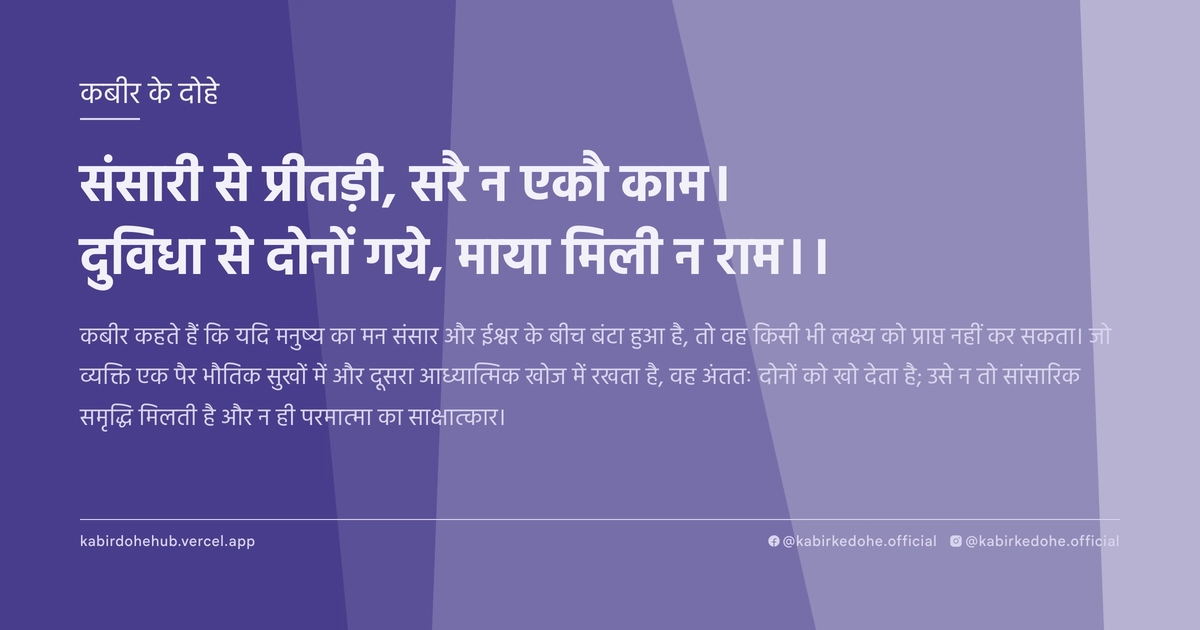
संसारी से प्रीतड़ी, सरै न एकौ काम।
दुविधा से दोनों गये, माया मिली न राम।।
Sansari se preetadi, sarai na ekau kaam. Duvidha se donon gaye, maya mili na raam.
इस पृष्ठ पर इस कबीर दोहे का अर्थ (meaning), हिंदी व्याख्या और अंग्रेज़ी अनुवाद, दार्शनिक विश्लेषण और व्यावहारिक जीवन सीख दी गई है। यह दोहा माया (Maya) विषय से जुड़ा है — Kabir doha meaning and explanation in Hindi and English.
अर्थ (Meaning):
कबीर कहते हैं कि यदि मनुष्य का मन संसार और ईश्वर के बीच बंटा हुआ है, तो वह किसी भी लक्ष्य को प्राप्त नहीं कर सकता। जो व्यक्ति एक पैर भौतिक सुखों में और दूसरा आध्यात्मिक खोज में रखता है, वह अंततः दोनों को खो देता है; उसे न तो सांसारिक समृद्धि मिलती है और न ही परमात्मा का साक्षात्कार।
Kabir asserts that if a person's mind is divided between worldly attachments and spiritual pursuit, they will fail in both endeavors. One who attempts to walk two opposing paths simultaneously—clinging to material desires while pretending to seek the Divine—ends up losing both; they achieve neither worldly success nor spiritual liberation.
व्याख्या (Interpretation):
यह दोहा द्वंद्व और मानसिक विखंडन की स्थिति का वर्णन करता है। 'सारी' यहाँ संसार और उसकी मोह-माया का प्रतीक है। कबीर समझाते हैं कि जब चेतना विभाजित होती है, तो ऊर्जा का क्षय होता है। यह स्थिति 'माया' के प्रभाव को दर्शाती है, जहाँ मनुष्य भ्रमित होकर यह सोचता है कि वह भौतिक विलासिता और निर्गुण भक्ति को एक साथ पूर्णता से जी सकता है। वास्तव में, यह एक विरोधाभास है क्योंकि माया का स्वभाव बंधन है और राम (परमात्मा) का स्वभाव मुक्ति है। जब तक साधक अपने भीतर के इस द्वंद्व को समाप्त नहीं करता, वह शून्य में भटकता रहता है। यह अद्वैत वेदांत के उस सिद्धांत की ओर संकेत है जहाँ पूर्ण समर्पण ही सत्य तक पहुँचने का एकमात्र मार्ग है।
This couplet describes the state of duality and mental fragmentation. 'Sari' symbolizes the world and its clinging attachments. Kabir explains that when consciousness is divided, energy is dissipated. This state reflects the influence of 'Maya,' where the human erroneously believes they can simultaneously embody material luxury and Nirgun Bhakti (formless devotion) with full integrity. In reality, this is a paradox because the nature of Maya is bondage, while the nature of Ram (the Divine) is liberation. Until the seeker resolves this internal conflict, they wander in a void. This points toward the Advaita Vedanta principle where total surrender and singular focus are the only paths to realizing the Truth.
दार्शनिक विश्लेषण (Philosophical Analysis):
कबीर का यह दर्शन उनके युग के धार्मिक पाखंड और आधे-अधूरे समर्पण के विरुद्ध एक कड़ा प्रहार है। उन्होंने देखा कि लोग बाहरी कर्मकांडों में लगे थे लेकिन उनका मन अभी भी सांसारिक लालसाओं में डूबा था। यह 'दो नावों की सवारी' करने जैसा है। कबीर यहाँ 'निर्गुण भक्ति' का समर्थन करते हैं, जो किसी बाहरी मूर्ति या मंदिर की नहीं, बल्कि अंतर्मन की शुद्धि की मांग करती है।
दार्शनिक स्तर पर, यह सूफीवाद के 'फना' (अहंकार का विनाश) के विचार से मिलता-जुलता है। जब तक 'मैं' और 'मेरा' (माया) जीवित है, तब तक 'वह' (राम) प्रकट नहीं हो सकता। यहाँ राम कोई व्यक्ति नहीं, बल्कि वह सार्वभौमिक चेतना है जो केवल तब अनुभव की जा सकती है जब मन पूरी तरह से एकाग्र और शुद्ध हो।
अद्वैत वेदांत के अनुसार, माया वह पर्दा है जो हमें ब्रह्म से अलग करता है। यदि हम माया को पकड़कर ब्रह्म को खोजने की कोशिश करते हैं, तो हम केवल भ्रम को और मजबूत करते हैं। कबीर चेतावनी देते हैं कि आध्यात्मिक यात्रा में 'समझौता' संभव नहीं है। या तो आप संसार के प्रति पूर्णतः समर्पित होकर उसके दुखों को झेलें, या परमात्मा के प्रति समर्पित होकर मुक्त हो जाएं।
मनोवैज्ञानिक रूप से, यह संज्ञानात्मक विसंगति (Cognitive Dissonance) की स्थिति है। जब हमारे मूल्य और हमारे कार्य अलग-अलग दिशाओं में होते हैं, तो मानसिक तनाव पैदा होता है। कबीर इस तनाव का समाधान 'एकतत्व' या एकनिष्ठता में देखते हैं।
अंततः, यह दोहा हमें सिखाता है कि पूर्णता केवल पूर्ण समर्पण से आती है। आधा-अधूरा प्रयास न केवल समय की बर्बादी है, बल्कि यह आत्मा को एक अंतहीन चक्र में फंसा देता है जहाँ वह न तो दुनिया का आनंद ले पाता है और न ही मोक्ष प्राप्त करता है।
Kabir's philosophy here is a sharp critique of the religious hypocrisy and half-hearted surrender prevalent in his era. He observed people engaging in external rituals while their minds remained steeped in worldly cravings. This is akin to 'riding two boats' at once. Kabir advocates for 'Nirgun Bhakti,' which demands internal purification rather than adherence to external idols or temples.
On a philosophical level, this aligns with the Sufi concept of 'Fana' (the annihilation of the ego). As long as the 'I' and 'Mine' (Maya) persist, the 'He' (Ram/Universal Consciousness) cannot manifest. Here, Ram is not a persona but the cosmic consciousness that can only be experienced when the mind is entirely focused and purified.
According to Advaita Vedanta, Maya is the veil that separates the individual from Brahman. If we attempt to seek Brahman while clinging to Maya, we only strengthen the illusion. Kabir warns that there is no 'compromise' in the spiritual journey. One must either be fully immersed in the world and endure its sorrows or be fully surrendered to the Divine and attain liberation.
Psychologically, this describes a state of cognitive dissonance. When our values and actions pull in opposite directions, mental distress ensues. Kabir sees the resolution of this stress in 'Ekattva' or one-pointedness of mind.
Ultimately, this couplet teaches that wholeness comes only through total surrender. A half-hearted effort is not merely a waste of time; it traps the soul in an endless cycle where it can neither enjoy the world nor achieve liberation.
मूल संदेश (Core Message):
- विभाजित मन कभी लक्ष्य प्राप्त नहीं करता।
- माया और मोक्ष एक साथ संभव नहीं हैं।
- पूर्ण समर्पण ही एकमात्र मार्ग है।
- आंतरिक द्वंद्व ऊर्जा का विनाश करता है।
- एकाग्रता ही आध्यात्मिक सफलता की कुंजी है।
- मोह का त्याग ही वास्तविक प्राप्ति है।
- A divided mind never reaches its destination.
- Maya and Moksha cannot be held simultaneously.
- Total surrender is the only viable path.
- Internal conflict dissipates spiritual energy.
- One-pointedness is the key to spiritual success.
- Renouncing attachment is the only true gain.
व्यावहारिक उदाहरण (Practical Example):
एक समय की बात है, बनारस के घाटों पर माधव नाम का एक वृद्ध बुनकर रहता था। माधव अपनी कला में निपुण था, लेकिन उसका मन हमेशा अशांत रहता था। वह चाहता था कि उसके पास बहुत सारा धन हो ताकि वह शहर के सबसे बड़े व्यापारी बन सके, लेकिन साथ ही वह एक महान संत की तरह शांति और मोक्ष भी चाहता था।
वह दिन भर कपड़े बुनता, लेकिन उसका ध्यान इस बात पर रहता कि वह और अधिक मुनाफा कैसे कमाए। रात को वह घंटों ध्यान लगाता, लेकिन ध्यान के दौरान भी उसके मन में नए करघों और रेशमी धागों के व्यापार की योजनाएं चलती रहती थीं।
वह न तो अपने व्यापार में पूरी तरह सफल हो पा रहा था क्योंकि उसकी एकाग्रता कम थी, और न ही वह ध्यान में गहराई तक उतर पा रहा था क्योंकि उसकी इच्छाएं उसे खींच रही थीं। वह एक अजीब सी बेचैनी में जीता था।
एक दिन उसने एक फकीर को देखा जो सड़क किनारे बैठा था। फकीर के पास कुछ नहीं था, फिर भी उसके चेहरे पर एक असीम शांति थी। माधव ने उससे पूछा, 'महाराज, मैं सब कुछ पाना चाहता हूँ—धन भी और ईश्वर भी, फिर भी मैं दुखी क्यों हूँ?'
फकीर ने मुस्कुराते हुए कहा, 'बेटा, तुम एक ही समय में दो विपरीत दिशाओं में दौड़ रहे हो। तुम उस व्यक्ति की तरह हो जो एक पैर से उत्तर की ओर और दूसरे से दक्षिण की ओर जाना चाहता है। परिणाम क्या होगा? तुम वहीं खड़े रहोगे जहाँ तुम हो, लेकिन तुम्हारी थकान दोगुनी होगी।'
माधव को कबीर की यह बात याद आई कि दुविधा में दोनों हाथ खाली रह जाते हैं। उसे समझ आया कि उसकी 'इच्छा' ही उसकी सबसे बड़ी बाधा थी। उसने तय किया कि वह अब अपनी कला को ही अपनी पूजा बनाएगा।
उसने लालच छोड़ दिया और केवल गुणवत्ता पर ध्यान केंद्रित किया। जब उसने धन की लालसा छोड़ी, तो आश्चर्यजनक रूप से उसका काम और बेहतर हो गया और लोग उसके कपड़ों की सराहना करने लगे।
लेकिन असली बदलाव उसके भीतर आया। अब जब वह बुनता था, तो वह धागों में परमात्मा को देखता था। उसकी मेहनत ही उसकी भक्ति बन गई।
अब उसके मन में कोई द्वंद्व नहीं था। उसने संसार को छोड़ा नहीं, बल्कि संसार के प्रति अपने 'मोह' को छोड़ दिया।
अंततः, माधव को वह शांति मिल गई जिसे वह वर्षों से खोज रहा था। उसने जान लिया कि जब मन एक दिशा में स्थिर होता है, तब माया और राम का संघर्ष समाप्त हो जाता है और जीवन एक लय में बहने लगता है।
Once, on the ghats of Varanasi, lived an elderly weaver named Madhav. Madhav was skilled in his craft, but his mind was perpetually restless. He desired immense wealth to become the city's biggest merchant, yet simultaneously, he craved the peace and liberation of a great saint.
All day he wove cloth, but his focus remained on how to maximize profits. At night, he meditated for hours, yet during meditation, plans for new looms and silk thread trades swirled in his mind.
He was neither fully successful in business because his concentration was lacking, nor could he dive deep into meditation because his desires kept pulling him back. He lived in a state of strange, constant agitation.
One day, he saw a fakir sitting by the roadside. The fakir possessed nothing, yet his face radiated an infinite peace. Madhav asked, 'Maharaj, I want everything—wealth and God—yet why am I so miserable?'
The fakir smiled and said, 'Son, you are running in two opposite directions at once. You are like a man who wants one foot to go North and the other to go South. What will be the result? You will remain exactly where you are, but your exhaustion will be doubled.'
Madhav recalled Kabir's wisdom that in duality, both hands remain empty. He realized that his 'craving' was his greatest obstacle. He decided that he would now make his art his worship.
He abandoned greed and focused solely on quality. When he let go of the lust for money, surprisingly, his work improved, and people began to admire his craftsmanship more.
But the real change happened within. Now, as he wove, he saw the Divine in the threads. His hard work became his devotion.
There was no longer any conflict in his mind. He did not abandon the world; rather, he abandoned his 'attachment' to the world.
Ultimately, Madhav found the peace he had been searching for for years. He learned that when the mind is steady in one direction, the struggle between Maya and Ram ceases, and life begins to flow in a divine rhythm.
अभ्यास मार्गदर्शन (Practice Guidance):
- प्रतिदिन 20 मिनट 'साक्षी भाव' का अभ्यास करें: अपने मन में चल रहे परस्पर विरोधी विचारों को बिना किसी निर्णय के देखें।
- आत्म-पूछताछ जर्नल: लिखें कि जीवन के किन क्षेत्रों में आप 'दो नावों की सवारी' कर रहे हैं (जैसे: करियर में सफलता बनाम आंतरिक शांति)।
- एक समय में एक कार्य (Single-tasking): मल्टीटास्किंग का त्याग करें। जिस कार्य को कर रहे हैं, उसमें पूरी तरह डूब जाएं, चाहे वह बर्तन धोना हो या प्रार्थना करना।
- निदान चेकलिस्ट: क्या आप अक्सर निर्णय लेने में असमर्थ रहते हैं? क्या आप आध्यात्मिक होने का दावा करते हैं लेकिन छोटी बातों पर अत्यधिक क्रोधित होते हैं? यदि हाँ, तो आप अभी भी 'दुविधा' में हैं।
- Practice 'Witness Consciousness' for 20 minutes daily: Observe the conflicting thoughts in your mind without judgment.
- Self-Inquiry Journaling: Write down the areas of your life where you are 'riding two boats' (e.g., seeking corporate success while craving inner peace).
- Single-tasking: Abandon multitasking. Immerse yourself completely in the task at hand, whether it is washing dishes or praying.
- Diagnostic Checklist: Do you often find yourself unable to make decisions? Do you claim to be spiritual yet react with extreme anger to trivial matters? If yes, you are still residing in 'Duvidha' (duality).
चिंतन प्रश्न (Reflection Questions):
- क्या मेरा 'आध्यात्मिक व्यक्तित्व' केवल मेरी सामाजिक छवि को सुधारने का एक साधन है?
- मैं किन भौतिक सुखों को छोड़ने से इतना डरता हूँ कि मैं ईश्वर की ओर कदम नहीं बढ़ा पा रहा?
- मेरे जीवन का वह कौन सा क्षेत्र है जहाँ मैं केवल दिखावा कर रहा हूँ, जबकि मेरा मन कहीं और है?
- यदि मुझे आज ही सब कुछ खोना पड़े, तो क्या मेरे भीतर कुछ ऐसा बचेगा जिसे मैं 'शाश्वत' कह सकूँ?
- क्या मेरी प्रार्थनाएँ वास्तव में समर्पण हैं, या वे केवल मेरी इच्छाओं की एक सूची हैं जिसे मैं ईश्वर के सामने रख रहा हूँ?
- मैं अपनी डिजिटल पहचान और वास्तविक आंतरिक शून्य के बीच के अंतर को कैसे भरता हूँ?
- Is my 'spiritual persona' merely a tool to enhance my social image?
- Which material comforts am I so afraid to lose that I cannot take a step toward the Divine?
- In which area of my life am I merely pretending, while my mind is elsewhere?
- If I were to lose everything today, would there be anything left within me that I could call 'eternal'?
- Are my prayers truly acts of surrender, or are they just a shopping list of desires I present to God?
- How do I bridge the gap between my digital identity and my actual internal void?