
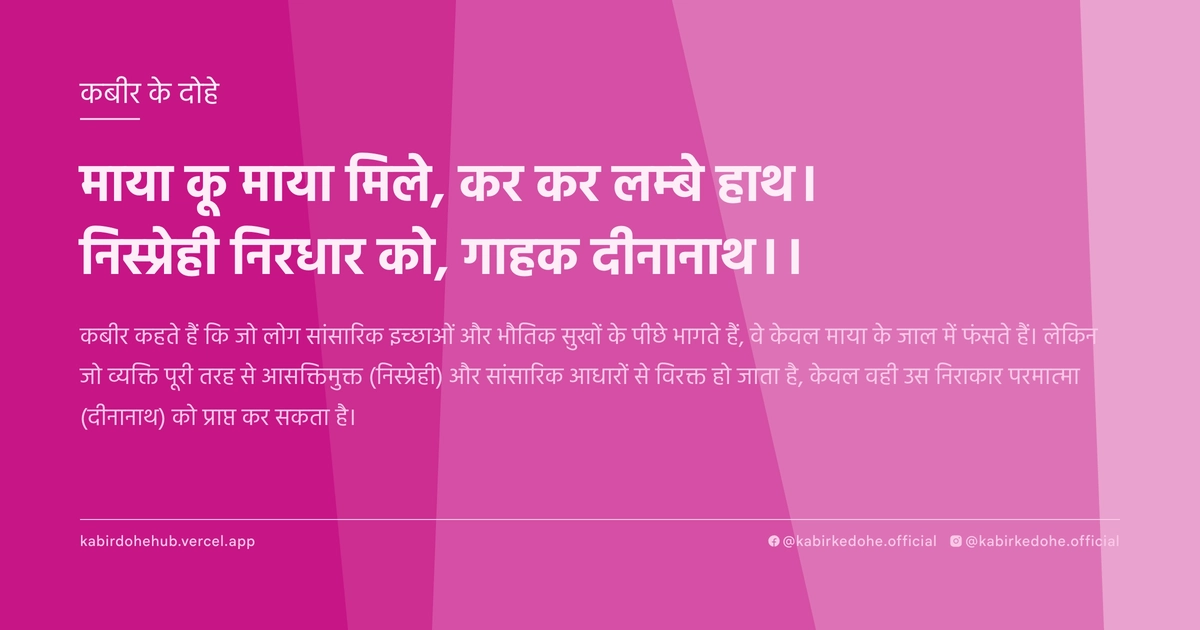
माया कू माया मिले, कर कर लम्बे हाथ।
निस्प्रेही निरधार को, गाहक दीनानाथ।।
Maya ku maya mile, kar kar lambe haath. Nisprehi nirdhaar ko, gaahak deenanath.
इस पृष्ठ पर इस कबीर दोहे का अर्थ (meaning), हिंदी व्याख्या और अंग्रेज़ी अनुवाद, दार्शनिक विश्लेषण और व्यावहारिक जीवन सीख दी गई है। यह दोहा माया (Maya) विषय से जुड़ा है — Kabir doha meaning and explanation in Hindi and English.
अर्थ (Meaning):
कबीर कहते हैं कि जो लोग सांसारिक इच्छाओं और भौतिक सुखों के पीछे भागते हैं, वे केवल माया के जाल में फंसते हैं। लेकिन जो व्यक्ति पूरी तरह से आसक्तिमुक्त (निस्प्रेही) और सांसारिक आधारों से विरक्त हो जाता है, केवल वही उस निराकार परमात्मा (दीनानाथ) को प्राप्त कर सकता है।
Kabir asserts that those who strive greedily for worldly possessions and sensory pleasures only succeed in entangling themselves further in the web of Maya. Conversely, only the one who becomes truly detached (Nisprehi) and relinquishes all reliance on material anchors can truly realize and reach the Formless Divine, the protector of the humble.
व्याख्या (Interpretation):
यहाँ 'लम्बे हाथ' एक रूपक है जो अत्यधिक लालच और भौतिक विस्तार की इच्छा को दर्शाता है। कबीर समझाते हैं कि जब हम बाहरी दुनिया में अपनी पकड़ मजबूत करने की कोशिश करते हैं, तो हम वास्तव में माया के बंधन को और कस लेते हैं। यह निरगुण भक्ति का मूल है जहाँ ईश्वर किसी मूर्ति या कर्मकांड में नहीं, बल्कि अहंकार के विसर्जन में मिलता है। 'निरधार' वह स्थिति है जहाँ मनुष्य ने दुनिया के सभी झूठे सहारे छोड़ दिए हैं। जब आत्मा शून्य हो जाती है, तब वह पूर्ण ब्रह्म से एकाकार होती है। यह विरोधाभास है कि जिसे दुनिया 'अनाथ' या 'अधम' समझती है, वही परमात्मा का प्रिय होता है क्योंकि उसके पास अब खोने के लिए कोई अहंकार नहीं बचा है।
The phrase 'long arms' serves as a potent metaphor for insatiable greed and the desperate reach for material expansion. Kabir explains that in attempting to grasp the external world, we inadvertently tighten the shackles of Maya. This aligns with Nirgun Bhakti, where the Divine is found not in idols or rituals, but in the dissolution of the 'I'. 'Niradhar' refers to the state of having no worldly support, a spiritual vacuum. The central paradox is that only when the soul becomes completely empty of desire does it become full of the Divine. By shedding the illusion of ownership, the seeker transcends the duality of subject and object, realizing the non-dual nature of Atman and Brahman.
दार्शनिक विश्लेषण (Philosophical Analysis):
कबीर का यह दोहा मध्यकालीन भारत के उस सामाजिक परिवेश में रचा गया था जहाँ धर्म के नाम पर बाहरी आडंबर और जातिगत श्रेष्ठता चरम पर थी। कबीर ने स्पष्ट रूप से उन लोगों पर प्रहार किया जो लंबी मालाओं और कठिन तपस्याओं के माध्यम से मोक्ष पाना चाहते थे, जबकि उनके भीतर लालच जीवित था। वे 'माया' को केवल धन नहीं, बल्कि वह मनोवैज्ञानिक पर्दा मानते हैं जो आत्मा को उसके वास्तविक स्वरूप से अलग करता है।
अद्वैत वेदांत के दृष्टिकोण से, यह दोहा 'विवेक' और 'वैराग्य' की बात करता है। जब तक साधक यह मानता है कि वह शरीर या संपत्ति है, वह माया के अधीन है। जैसे ही वह यह पहचानता है कि वह शुद्ध चेतना है, वह 'निस्प्रेही' हो जाता है। यहाँ माया एक सक्रिय शक्ति है जो मनुष्य को भ्रमित रखती है, और इससे निकलने का एकमात्र मार्ग पूर्ण समर्पण है।
सूफीवाद के 'फना' (अहंकार का विनाश) के सिद्धांत के साथ इसका गहरा संबंध है। सूफी संत भी मानते हैं कि जब तक 'मैं' जीवित है, 'वह' (ईश्वर) प्रकट नहीं हो सकता। कबीर का 'दीनानाथ' वही परम सत्य है जो केवल दीनता (विनम्रता) के द्वार से प्रवेश करता है। यह अहंकार का पूर्ण विलोपन है, न कि केवल बाहरी त्याग।
कबीर ritualism (कर्मकांड) का विरोध करते हुए यह तर्क देते हैं कि ईश्वर को पाने के लिए किसी बाहरी माध्यम या 'लम्बे हाथों' (साधनों) की आवश्यकता नहीं है। वास्तव में, ये साधन ही बाधाएं बन जाते हैं। सच्ची भक्ति आंतरिक शुद्धि और मानसिक रिक्तता में निहित है।
अंततः, यह विश्लेषण हमें बताता है कि आध्यात्मिक प्रगति संचय में नहीं, बल्कि विसर्जन में है। मनोवैज्ञानिक रूप से, यह इच्छाओं के निरंतर चक्र से मुक्त होकर आंतरिक शांति प्राप्त करने की प्रक्रिया है। जब हम बाहरी दुनिया की पकड़ छोड़ते हैं, तभी हम आंतरिक अनंतता को पकड़ पाते हैं।
This couplet emerged during a period of intense religious ritualism and caste hierarchy in medieval India. Kabir targeted those who sought liberation through external displays of piety—long prayer beads or rigorous asceticism—while remaining internally consumed by greed. He defines 'Maya' not merely as wealth, but as the psychological veil that obscures the soul's true identity from the Eternal Truth.
From the lens of Advaita Vedanta, this teaching emphasizes 'Viveka' (discernment) and 'Vairagya' (dispassion). As long as the seeker identifies with the body or possessions, they remain a prisoner of Maya. The moment they realize they are pure consciousness, they become 'Nisprehi'. Maya is an active force of illusion; the only escape is the total surrender of the egoic self.
There is a profound resonance here with the Sufi concept of 'Fana' (annihilation of the self). Sufi mysticism teaches that 'He' cannot be realized as long as the 'I' persists. Kabir's 'Deenanath' is the Ultimate Reality that enters only through the door of humility. This is not a call for superficial poverty, but for the complete eradication of the ego.
Kabir rejects ritualism, arguing that the Divine requires no external intermediaries or 'long arms' (means/tools). In fact, these very tools become obstacles. True devotion lies in internal purification and the creation of a mental void, allowing the Divine to fill the space.
Ultimately, this analysis reveals that spiritual evolution is a process of subtraction, not addition. Psychologically, it is the transition from the endless cycle of craving to the stillness of being. By releasing the grip on the transient world, one finally grasps the infinite.
मूल संदेश (Core Message):
- लालच केवल मानसिक बंधन और दुख को जन्म देता है।
- सच्ची स्वतंत्रता इच्छाओं के त्याग में निहित है।
- अहंकार का विसर्जन ही परमात्मा से मिलन का मार्ग है।
- बाहरी साधनों से अधिक आंतरिक रिक्तता महत्वपूर्ण है।
- विनम्रता वह कुंजी है जो ईश्वरीय द्वार खोलती है।
- माया का भ्रम केवल वैराग्य से ही टूट सकता है।
- Greed only breeds psychological bondage and suffering.
- True liberation resides in the relinquishment of cravings.
- The dissolution of ego is the only path to the Divine.
- Internal emptiness is more vital than external means.
- Humility is the key that unlocks the gates of God.
- The illusion of Maya is shattered only through dispassion.
व्यावहारिक उदाहरण (Practical Example):
वाराणसी के घाटों पर रहने वाले एक वृद्ध बुनकर, माधव की कहानी है। माधव अपनी कला में निपुण था, लेकिन उसकी महत्वाकांक्षा उसे अंधा कर रही थी। वह शहर के सबसे अमीर व्यापारियों के लिए सबसे महंगे रेशमी वस्त्र बुनना चाहता था ताकि वह अपनी एक अलग पहचान बना सके। उसने दिन-रात मेहनत की, कर्ज लिया और अपने परिवार की खुशियों को नजरअंदाज किया। वह जितना अधिक धन कमाने की कोशिश करता, उसकी बेचैनी उतनी ही बढ़ती जाती।
एक दिन, उसने देखा कि एक फकीर घाट की सीढ़ियों पर बैठा है, जिसके पास केवल एक फटा हुआ कपड़ा था, फिर भी उसके चेहरे पर ऐसी शांति थी जो माधव ने करोड़ों के सपनों में भी नहीं पाई थी। माधव ने उससे पूछा, 'आप इतने अभाव में भी इतने प्रसन्न कैसे हैं?'
फकीर ने मुस्कुराकर कहा, 'मैं कुछ पाने की कोशिश नहीं कर रहा, इसलिए मैं कुछ खोने से नहीं डरता। तुमने अपने हाथ बहुत लम्बे कर लिए हैं, इसलिए तुम थक गए हो। मैंने अपने हाथ छोड़ दिए हैं, इसलिए मैं मुक्त हूँ।'
यह बात माधव के दिल में चुभ गई। उसने महसूस किया कि उसकी 'लम्बी भुजाएं'—उसका लालच और उसकी सामाजिक प्रतिष्ठा की भूख—उसे मानसिक तनाव और अकेलेपन की ओर ले जा रही थीं। उसने महसूस किया कि वह रेशम के धागों से नहीं, बल्कि अपनी इच्छाओं के धागों से बंधा हुआ है।
अगले कुछ महीनों में, माधव ने अपना नजरिया बदला। उसने महंगे अनुबंधों के पीछे भागना छोड़ दिया और साधारण लोगों के लिए सरल वस्त्र बुनना शुरू किया। उसने अपनी कमाई का एक हिस्सा गरीबों में बांटना शुरू किया।
जैसे-जैसे उसकी पकड़ भौतिक लाभ पर ढीली हुई, उसकी आंतरिक शांति बढ़ने लगी। अब वह केवल पैसे के लिए नहीं, बल्कि आनंद के लिए बुनता था।
उसने पाया कि जब उसने 'सबसे बड़ा' बनने की इच्छा छोड़ दी, तो वह वास्तव में सबके साथ जुड़ गया। उसकी कला में अब एक ऐसी गहराई थी जो पहले कभी नहीं थी, क्योंकि अब वह अहंकार से नहीं, प्रेम से बुन रहा था।
माधव अब 'निरधार' था—उसे अब किसी बाहरी प्रशंसा या धन के सहारे की जरूरत नहीं थी। वह स्वयं में पूर्ण था।
अंत में, माधव ने पाया कि जिस परमात्मा को वह मंदिरों और महंगे अनुष्ठानों में खोज रहा था, वह उसकी अपनी निस्वार्थ सेवा और संतोष में ही निवास करता था।
Consider the story of Madhav, an elderly weaver living on the ghats of Varanasi. Madhav was a master of his craft, yet he was consumed by a relentless ambition. He dreamed of weaving the most expensive silk garments for the city's wealthiest merchants, believing that this would grant him a legacy of prestige and power. He worked sleepless nights, took on debts, and ignored the simple joys of his family. The more he reached for wealth, the more his inner restlessness grew.
One afternoon, he noticed a wandering dervish sitting on the stone steps of the river. The dervish possessed nothing but a tattered cloak, yet his face radiated a serenity that Madhav had never encountered, even in his wildest dreams of success. Intrigued, Madhav asked, 'How can you be so content in such utter deprivation?'
The dervish smiled and replied, 'I am not trying to acquire anything, and therefore, I have nothing to fear losing. You have stretched your arms too far in greed, and so you are exhausted. I have let go of my arms, and thus, I am free.'
These words pierced Madhav's heart. He realized that his 'long arms'—his greed and his hunger for social validation—were the very sources of his anxiety and loneliness. He saw that he was not just weaving silk, but was entangled in the threads of his own endless desires.
Over the following months, Madhav shifted his perspective. He stopped chasing lucrative contracts and began weaving simple, honest clothes for the common folk. He started sharing a portion of his modest earnings with the needy.
As his grip on material gain loosened, his internal peace flourished. He no longer wove for profit, but for the sheer joy of creation. He discovered that by letting go of the desire to be 'the greatest,' he became truly connected to everyone.
His art acquired a depth it had previously lacked, for it was now born of love rather than ego. Madhav had become 'Niradhar'—he no longer needed the crutch of external praise or financial security to feel whole.
Ultimately, Madhav realized that the Divine, whom he had sought through rituals and prestige, resided within his own selfless service and contentment.
अभ्यास मार्गदर्शन (Practice Guidance):
- दैनिक चिंतन: प्रतिदिन 15 मिनट मौन बैठें और विचार करें कि आपकी कौन सी इच्छाएं आपको मानसिक तनाव दे रही हैं।
- आत्म-पूछताछ जर्नल: लिखें कि 'यदि मेरी सारी उपलब्धियां और संपत्ति छीन ली जाए, तो मैं कौन रहूंगा?'
- व्यवहारिक परिवर्तन: सप्ताह में एक बार ऐसी वस्तु या सेवा का दान करें जिसे आप बहुत मूल्यवान मानते हैं, ताकि 'पकड़ने' की आदत छूटे।
- डायग्नोस्टिक चेकलिस्ट: क्या मैं किसी की प्रशंसा पर निर्भर हूँ? क्या मैं भविष्य की चिंता में वर्तमान को खो रहा हूँ? क्या मैं दूसरों की सफलता से ईर्ष्या करता हूँ? (यदि हाँ, तो माया का प्रभाव सक्रिय है)।
- Daily Contemplation: Spend 15 minutes in silence, observing which specific desires are causing you mental agitation and stress.
- Self-Inquiry Journaling: Write a detailed response to the prompt: 'If all my achievements and possessions were stripped away, who would I be?'
- Behavioral Shift: Once a week, give away something you consider highly valuable to break the psychological habit of 'clinging'.
- Diagnostic Checklist: Am I dependent on external validation? Am I sacrificing the present for a future goal? Do I feel envy toward others' success? (If yes, the grip of Maya is active).
चिंतन प्रश्न (Reflection Questions):
- मेरी 'लम्बी भुजाएं' आज के डिजिटल युग में क्या हैं—लाइक्स, फॉलोअर्स या सामाजिक प्रतिष्ठा?
- मैं किन चीजों को 'अपना' कहता हूँ, जबकि वे वास्तव में क्षणभंगुर हैं?
- क्या मेरी धार्मिकता वास्तव में आध्यात्मिक है, या यह केवल एक सामाजिक मुखौटा है?
- मेरे जीवन का वह कौन सा हिस्सा है जहाँ मैं अभी भी नियंत्रण (control) पाने की कोशिश कर रहा हूँ?
- क्या मैं वास्तव में 'निरधार' होने का साहस रखता हूँ, या मैं सुरक्षा के झूठे भ्रमों में जी रहा हूँ?
- मेरे भीतर का 'दीन' (विनम्र हिस्सा) कितना दबा हुआ है?
- What are my 'long arms' in today's digital age—likes, followers, or social status?
- Which things do I claim as 'mine' while knowing they are fundamentally transient?
- Is my religiosity truly spiritual, or is it merely a social mask for my ego?
- In which area of my life am I still desperately trying to maintain absolute control?
- Do I truly have the courage to be 'Niradhar', or am I living in the false illusion of security?
- How deeply buried is the 'humble' part of my being beneath my public identity?