
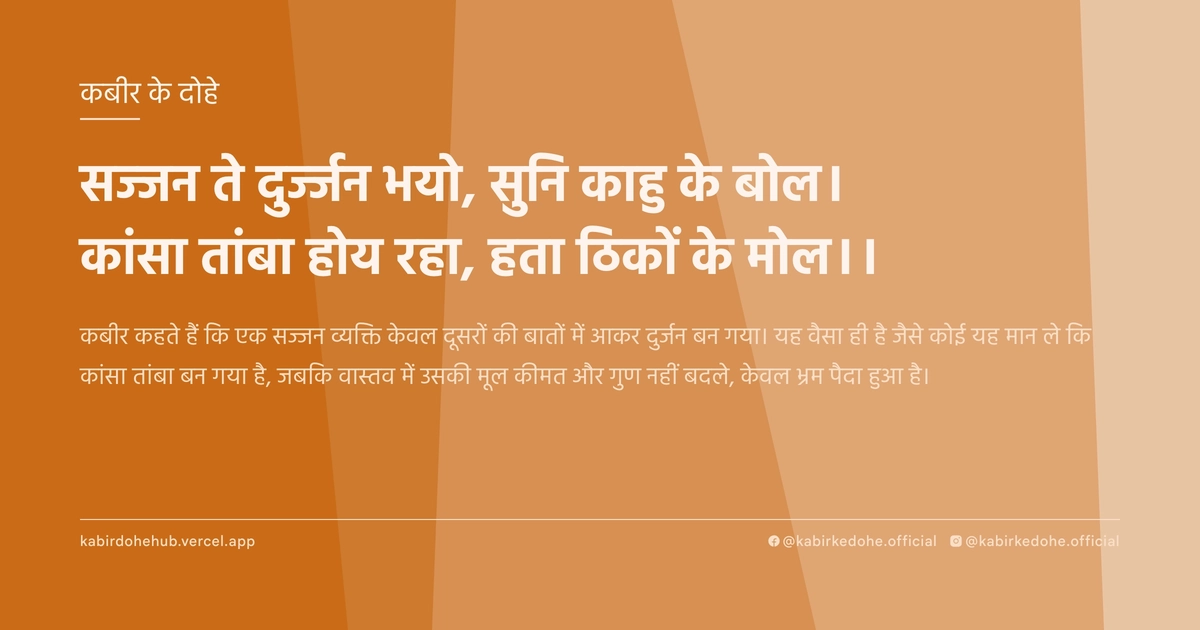
सज्जन ते दुर्ज्जन भयो, सुनि काहु के बोल।
कांसा तांबा होय रहा, हता ठिकों के मोल।।
Sajjan te durjan bhayo, suni kaahu ke bol. Kansa tamba hoye raha, hata thikon ke mol.
इस पृष्ठ पर इस कबीर दोहे का अर्थ (meaning), हिंदी व्याख्या और अंग्रेज़ी अनुवाद, दार्शनिक विश्लेषण और व्यावहारिक जीवन सीख दी गई है। यह दोहा आत्मनिरीक्षण (Self-introspection) विषय से जुड़ा है — Kabir doha meaning and explanation in Hindi and English.
अर्थ (Meaning):
कबीर कहते हैं कि एक सज्जन व्यक्ति केवल दूसरों की बातों में आकर दुर्जन बन गया। यह वैसा ही है जैसे कोई यह मान ले कि कांसा तांबा बन गया है, जबकि वास्तव में उसकी मूल कीमत और गुण नहीं बदले, केवल भ्रम पैदा हुआ है।
Kabir observes that a virtuous person becomes wicked simply by listening to the words of others. He compares this to the illusion that bell-metal has turned into copper; while the appearance or perception might change, the intrinsic value and nature remain unaltered, yet the person loses their way.
व्याख्या (Interpretation):
शाब्दिक अर्थ यह है कि बाहरी प्रभाव हमारे स्वभाव को बदल सकते हैं। गहरा आध्यात्मिक अर्थ यह है कि 'सज्जनता' और 'दुर्जनता' केवल मन के स्तर पर आरोपित लेबल हैं। जब कोई व्यक्ति बाहरी प्रशंसा या आलोचना से प्रभावित होता है, तो वह अपनी मूल आत्मा (Atman) से दूर हो जाता है और माया के जाल में फंस जाता है। यह निर्गुण भक्ति का संकेत है कि सत्य आंतरिक है, बाहरी शोर में नहीं। यहाँ कांसा और तांबा प्रतीकात्मक हैं—एक की चमक दूसरे को भ्रमित कर सकती है, लेकिन तत्व नहीं बदलते। यह अद्वैत वेदांत के उस सिद्धांत को दर्शाता है जहाँ अज्ञानता (Avidya) के कारण हम अपनी वास्तविक पहचान भूलकर बाहरी पहचान को अपना लेते हैं।
Literally, the verse warns against the influence of external opinions. Metaphorically, it explores the fragility of the ego and the deceptive nature of Maya. The transition from 'Sajjan' (virtuous) to 'Durjan' (wicked) is not a change in essence but a shift in consciousness driven by external noise. In the context of Nirgun Bhakti, the true self is formless and untouched by labels; however, the conditioned mind mistakes the 'copper' (false identity) for the 'bell-metal' (true nature). This paradox highlights the human tendency to seek validation externally, thereby drifting away from the non-dual reality of Atman-Brahman, where no such distinctions as virtuous or wicked exist.
दार्शनिक विश्लेषण (Philosophical Analysis):
कबीर का यह दोहा उनके युग के सामाजिक और धार्मिक पाखंड पर एक तीखा प्रहार है। उस समय लोग बाहरी कर्मकांडों और गुरुओं के शब्दों के आधार पर अपनी आध्यात्मिक स्थिति का निर्धारण करते थे। कबीर ने इस बात का खंडन किया कि किसी की संगत या शब्दों से आत्मा का मूल स्वभाव बदल सकता है, लेकिन मन भ्रमित जरूर हो सकता है।
यह विश्लेषण अद्वैत वेदांत के करीब है, जहाँ यह माना जाता है कि ब्रह्म ही एकमात्र सत्य है और बाकी सब माया है। जब व्यक्ति दूसरों के शब्दों को सत्य मान लेता है, तो वह 'अध्यास' (superimposition) की स्थिति में होता है, जैसे अंधेरे में रस्सी को सांप समझ लेना।
सूफीवाद के परिप्रेक्ष्य में, यह 'नफ्स' (अहंकार) के नियंत्रण की बात है। यदि साधक बाहरी प्रशंसा से फूलता है या आलोचना से टूटता है, तो वह अभी भी द्वैत में है। वास्तविक फना (annihilation) तब होता है जब व्यक्ति बाहरी दुनिया के शोर से पूरी तरह मुक्त हो जाता है।
कबीर जाति और वर्ग के भेदभाव को नकारते थे। उनके लिए 'सज्जन' वह नहीं है जो ऊंचे कुल में जन्मा है, बल्कि वह है जिसने अपने अहंकार को जीत लिया है। यहाँ वे चेतावनी दे रहे हैं कि बाहरी प्रभाव हमें अपनी सहज सरलता से दूर ले जा सकते हैं।
मनोवैज्ञानिक स्तर पर, यह 'एक्सटर्नल लोकस ऑफ कंट्रोल' की समस्या है। जब हम अपनी पहचान दूसरों के शब्दों पर आधारित करते हैं, तो हम अपनी मानसिक शांति खो देते हैं। कबीर का समाधान आत्म-साक्षात्कार है, जहाँ व्यक्ति स्वयं का प्रकाश बनता है और बाहरी प्रभावों के प्रति तटस्थ रहता है।
Kabir's couplet is a profound critique of the social and religious conditioning prevalent during his era. People often defined their spiritual worth based on the dictates of orthodox priests or the labels imposed by society. Kabir dismantles this by suggesting that while external influence can alter behavior, it only does so by creating a veil of ignorance over the true self.
From the lens of Advaita Vedanta, this is a study of 'Adhyasa' or superimposition. The person is not actually becoming 'wicked'; rather, they are superimposing a false identity (the copper) over their true nature (the bell-metal). The error lies in the perception, not in the essence. The soul remains pure, but the mind becomes clouded by the noise of the world.
In Sufi philosophy, this relates to the struggle with the 'Nafs' (the ego). A seeker who is swayed by the praise or criticism of others is still trapped in the duality of the self and the other. True liberation, or 'Fana', occurs when the individual transcends the need for external validation and merges with the Divine Truth.
Kabir's rejection of ritualism is evident here. He suggests that virtue is not a status conferred by a title or a ritual, but a state of internal alignment. By equating the change in character to a change in metal, he mocks the superficiality of those who believe they can change their spiritual trajectory simply by following the crowd.
Psychologically, this addresses the fragility of the ego. When an individual's sense of self is contingent upon external feedback, they become volatile. Kabir advocates for an internal anchor—a spiritual stability that allows one to remain unmoved by the fluctuating opinions of society, thereby achieving a state of equanimity.
मूल संदेश (Core Message):
- बाहरी शोर आंतरिक शांति का सबसे बड़ा शत्रु है।
- अपनी मूल सज्जनता को किसी की बातों के लिए न त्यागें।
- पहचान बाहरी शब्दों में नहीं, आंतरिक सत्य में होती है।
- भ्रम में जीना आत्मा की वास्तविक कीमत को कम करना है।
- सत्य वह है जो दूसरों की अनुपस्थिति में भी अपरिवर्तित रहे।
- External noise is the greatest enemy of internal peace.
- Never sacrifice your innate virtue for the sake of another's opinion.
- Identity resides in internal truth, not in external labels.
- Living in delusion is to diminish the true value of the soul.
- Truth is that which remains unchanged even in the absence of others.
व्यावहारिक उदाहरण (Practical Example):
एक समय की बात है, वाराणसी के घाटों पर माधव नाम का एक वृद्ध बुनकर रहता था। माधव अपनी ईमानदारी और शांत स्वभाव के लिए पूरे मोहल्ले में प्रसिद्ध था। वह गरीब था, लेकिन उसका मन संतोष से भरा था और वह सबकी मदद करता था।
एक दिन शहर में एक चतुर व्यापारी आया, जिसने माधव की सरलता को देखा। व्यापारी ने माधव के कान भरने शुरू किए कि वह बहुत कम कीमत पर कपड़े बेचता है और लोग उसका फायदा उठा रहे हैं। उसने कहा, "माधव, तुम सज्जन बनकर मूर्ख बन रहे हो। दुनिया केवल चालाकों का सम्मान करती है।"
धीरे-धीरे माधव के मन में संदेह पैदा हुआ। उसने सोचा कि उसकी दयालुता वास्तव में उसकी कमजोरी थी। उसने अपने व्यवहार में बदलाव किया; वह अब ग्राहकों से बहस करने लगा, अधिक पैसे मांगने लगा और उन लोगों को दुत्कारने लगा जो उससे मदद मांगते थे।
मोहल्ले के लोग हैरान थे कि वह शांत माधव अचानक इतना क्रोधी और लालची कैसे हो गया। वह अब खुद को एक "स्मार्ट व्यापारी" समझने लगा था, जैसा कि उस बाहरी व्यक्ति ने उसे बताया था।
लेकिन इस बदलाव ने उसे मानसिक अशांति दी। उसकी नींद उड़ गई और उसके पुराने मित्र उससे दूर होने लगे। वह अब अमीर तो हो रहा था, लेकिन उसका आंतरिक सुख पूरी तरह समाप्त हो चुका था।
एक शाम, माधव घाट पर बैठा था, तभी उसने एक छोटे बच्चे को देखा जो अपनी रोटी एक भूखे कुत्ते के साथ साझा कर रहा था। उस बच्चे के चेहरे पर वही संतोष था जो कभी माधव के चेहरे पर होता था।
माधव को अचानक कबीर का वह दोहा याद आया कि कैसे वह दूसरों की बातों में आकर अपना मूल स्वभाव खो बैठा। उसे अहसास हुआ कि वह 'कांसा' (सज्जन) था, लेकिन उसने खुद को 'तांबा' (दुर्जन) समझने की गलती की, जबकि तांबा वास्तव में उसके लिए केवल एक बोझ था।
उसने उसी क्षण उस व्यापारी के प्रभाव को त्याग दिया। उसने अपनी पुरानी सरलता को वापस अपनाया और यह समझ लिया कि दुनिया की नजरों में "मूर्ख" होना, अपनी आत्मा की नजरों में "दुष्ट" होने से कहीं बेहतर है।
Once, in the bustling ghats of Varanasi, lived an elderly weaver named Madhav. Madhav was renowned throughout his neighborhood for his unwavering honesty and serene temperament. Though he lived in poverty, his heart was full of contentment, and he spent his spare time helping others.
One day, a cunning merchant arrived in the city and noticed Madhav's simplicity. The merchant began whispering in Madhav's ear, claiming that he was selling his fabrics far too cheaply and that people were taking advantage of his kindness. He told him, "Madhav, by being virtuous, you are merely being a fool. The world only respects the clever and the greedy."
Slowly, seeds of doubt were sown in Madhav's mind. He began to believe that his generosity was actually a sign of weakness. He changed his behavior; he started arguing with customers, demanding exorbitant prices, and dismissing those who came to him for help.
The community was shocked. The once-peaceful Madhav had become irritable and avaricious. He now identified as a "shrewd businessman," exactly as the external voice had conditioned him to be.
However, this transformation brought him profound mental unrest. He lost his sleep, and his lifelong friends began to distance themselves from him. While his purse grew heavier, his inner peace vanished completely.
One evening, while sitting by the Ganges, Madhav saw a small child sharing his meager piece of bread with a stray dog. The look of pure contentment on the child's face mirrored the expression Madhav used to wear years ago.
In that moment, Kabir's wisdom flashed through his mind. He realized that he had allowed the words of another to distort his essence. He had been 'bell-metal' (virtuous), but in a fit of delusion, he tried to become 'copper' (wicked), only to find that the copper was a heavy burden on his soul.
He immediately discarded the merchant's influence. He reclaimed his innate simplicity and understood that it is far better to be perceived as a "fool" by the world than to be a "villain" in the eyes of one's own soul.
अभ्यास मार्गदर्शन (Practice Guidance):
- प्रतिदिन 15 मिनट मौन अभ्यास करें, जहाँ आप बाहरी दुनिया के सभी शब्दों और विचारों को केवल एक दर्शक की तरह देखें, बिना उनसे जुड़े।
- एक डायरी लिखें जिसमें उन क्षणों को दर्ज करें जब आपने किसी की प्रशंसा या आलोचना के कारण अपना व्यवहार बदला। विश्लेषण करें कि क्या वह बदलाव आपकी आत्मा के अनुरूप था।
- जब भी कोई आपको कुछ ऐसा करने के लिए प्रेरित करे जो आपके मूल मूल्यों के खिलाफ हो, तो स्वयं से पूछें: "क्या यह मेरी अपनी आवाज है या किसी और की प्रतिध्वनि?"
- निदान चेकलिस्ट: यदि आप दूसरों की राय के कारण अपनी खुशी खो रहे हैं, या अपनी पहचान को बाहरी लेबल (सफल, असफल, अच्छा, बुरा) से जोड़ रहे हैं, तो आप 'तांबा' बनने के भ्रम में हैं।
- Practice 15 minutes of daily silence, observing external words and opinions as a detached witness without allowing them to penetrate your core identity.
- Maintain a journal to record instances where you altered your behavior due to someone's praise or criticism. Analyze whether that change aligned with your authentic self.
- Whenever you feel pressured to act against your core values, ask yourself: "Is this my own inner voice, or is it merely an echo of someone else's expectation?"
- Diagnostic Checklist: If you find your happiness fluctuating based on others' opinions, or if you identify yourself through external labels (successful, failure, good, bad), you are currently under the illusion of 'becoming copper'.
चिंतन प्रश्न (Reflection Questions):
- मेरे व्यक्तित्व का वह कौन सा हिस्सा है जो केवल दूसरों को खुश करने के लिए बनाया गया है?
- क्या मैं वास्तव में 'सज्जन' हूँ, या मैं केवल इसलिए सज्जन दिखता हूँ क्योंकि मुझे समाज से इसकी अपेक्षा है?
- जब कोई मेरी आलोचना करता है, तो मुझे गुस्सा क्यों आता है? क्या वह मेरा अहंकार है जो चोटिल हुआ है, या मेरा सत्य?
- डिजिटल युग में, सोशल मीडिया की 'लाइक' और 'कमेंट' मेरे वास्तविक स्वभाव को कैसे बदल रहे हैं?
- यदि दुनिया के सभी लोग मेरे बारे में अपनी राय बदल लें, तो मेरे भीतर क्या बचेगा?
- Which part of my personality is a curated mask designed solely to please others?
- Am I truly 'virtuous,' or do I only appear so because society expects this behavior from me?
- Why does criticism provoke anger in me? Is it my ego that is wounded, or is it my truth?
- In the digital age, how are social media 'likes' and 'comments' subtly altering my authentic nature?
- If every person in the world changed their opinion of me tomorrow, what would remain of my essence?