
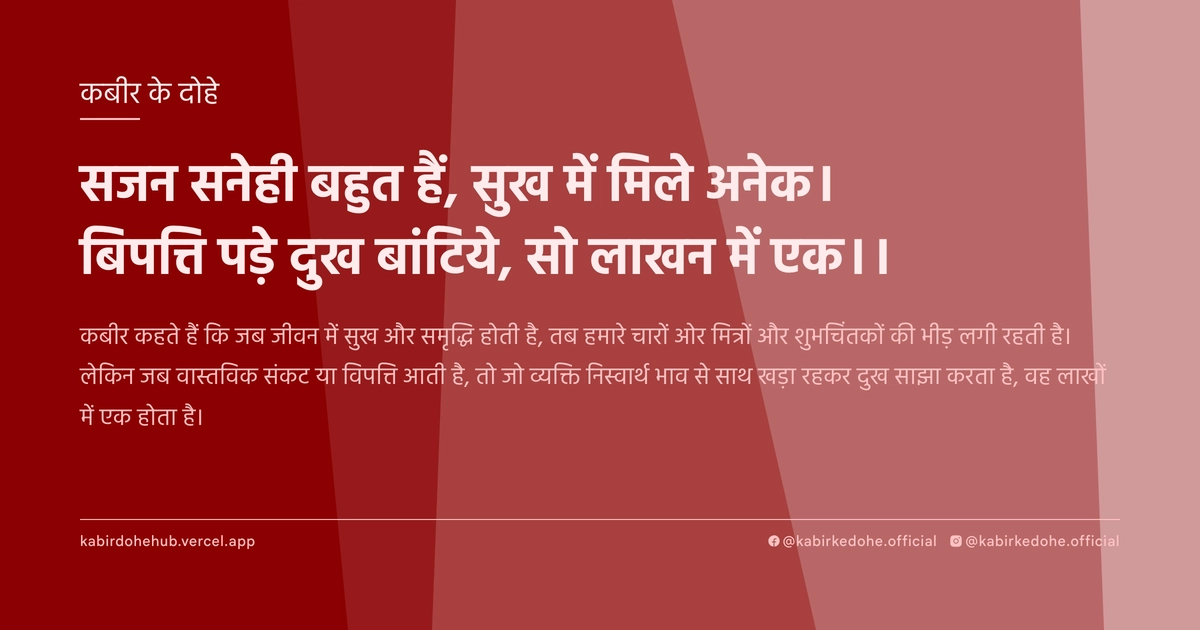
सजन सनेही बहुत हैं, सुख में मिले अनेक।
बिपत्ति पड़े दुख बांटिये, सो लाखन में एक।।
Sajan sanehi bahut hain, sukh me mile anek. Bipatti pade dukh baantiye, so lakhan me ek.
इस पृष्ठ पर इस कबीर दोहे का अर्थ (meaning), हिंदी व्याख्या और अंग्रेज़ी अनुवाद, दार्शनिक विश्लेषण और व्यावहारिक जीवन सीख दी गई है। यह दोहा दुख और सुख (Sorrow and Joy) विषय से जुड़ा है — Kabir doha meaning and explanation in Hindi and English.
अर्थ (Meaning):
कबीर कहते हैं कि जब जीवन में सुख और समृद्धि होती है, तब हमारे चारों ओर मित्रों और शुभचिंतकों की भीड़ लगी रहती है। लेकिन जब वास्तविक संकट या विपत्ति आती है, तो जो व्यक्ति निस्वार्थ भाव से साथ खड़ा रहकर दुख साझा करता है, वह लाखों में एक होता है।
Kabir observes that during times of prosperity and joy, one is surrounded by countless friends and well-wishers. However, when true adversity strikes, the person who remains steadfast and shares the burden of sorrow is a rare soul, found perhaps only once in a million.
व्याख्या (Interpretation):
इसका शाब्दिक अर्थ सामाजिक संबंधों की क्षणभंगता है, लेकिन आध्यात्मिक स्तर पर यह 'माया' के प्रभाव को दर्शाता है। सुख में मिलने वाले साथी अक्सर अहंकार और बाहरी आकर्षण से प्रेरित होते हैं, जो केवल प्रतिबिंब हैं। वास्तविक सनेही वह है जो द्वैत (दो होने का भाव) को मिटाकर दूसरे के दुख को अपना मानता है। यह निर्गुण भक्ति का सार है जहाँ 'स्व' का विसर्जन होता है। जब व्यक्ति अपनी पहचान को केवल शरीर या पद तक सीमित नहीं रखता, तब वह उस 'एक' में बदल जाता है जो निस्वार्थ प्रेम का प्रतीक है। यह दोहा हमें सिखाता है कि बाहरी शोर के बीच आंतरिक सत्य की पहचान कैसे करें।
Literally, this speaks to the fragility of social bonds, but spiritually, it illustrates the influence of Maya (illusion). Those who flock to us in prosperity are often driven by ego and external attraction, acting as mere reflections of our own status. A true companion is one who transcends duality, perceiving another's suffering as their own. This is the essence of Nirgun Bhakti, where the 'I' is dissolved. When a person ceases to limit their identity to the body or social rank, they become that 'one in a million' who embodies selfless love. The verse guides us to distinguish the eternal truth from the transient noise of worldly validation.
दार्शनिक विश्लेषण (Philosophical Analysis):
कबीर का यह दोहा तत्कालीन समाज में व्याप्त पाखंड और दिखावे पर एक गहरा प्रहार है। उन्होंने देखा कि कैसे धार्मिक और सामाजिक अनुष्ठान केवल बाहरी चमक-धमक तक सीमित थे, जबकि वास्तविक करुणा का अभाव था। यह विचार अद्वैत वेदांत के करीब है, जहाँ यह माना जाता है कि जब तक मनुष्य स्वयं को दूसरों से अलग देखता है, वह केवल स्वार्थ के संबंधों में बंधा रहता है।
सूफी मत के 'इश्क-ए-हकीकी' (ईश्वरीय प्रेम) के संदर्भ में, यह दोहा सिखाता है कि सच्चा प्रेम वह है जो परीक्षा की घड़ी में परखा जाए। सुख के समय का प्रेम 'इश्क-ए-मजाजी' (सांसारिक प्रेम) है, जो अस्थिर है। कबीर यहाँ यह स्पष्ट करते हैं कि अहंकार (Ego) केवल लाभ की स्थिति में सक्रिय होता है, जबकि आत्मा (Atman) केवल त्याग और सहानुभूति में प्रकट होती है।
कबीर ने जाति और कर्मकांडों का विरोध इसलिए किया क्योंकि ये चीजें मनुष्य के बीच कृत्रिम दीवारें खड़ी करती हैं। जब कोई व्यक्ति इन दीवारों को गिरा देता है, तभी वह दूसरे के दुख को महसूस कर पाता है। यह मनोवैज्ञानिक रूपांतरण की प्रक्रिया है जहाँ व्यक्ति 'मैं' से 'हम' की ओर बढ़ता है।
अक्सर लोग इस दोहे को केवल सामाजिक शिकायत के रूप में देखते हैं, लेकिन यह वास्तव में एक दर्पण है। यह हमें यह सोचने पर मजबूर करता है कि क्या हम स्वयं उन 'लाखों' में से एक हैं जो केवल सुख के साथी हैं, या हम उस 'एक' बनने का साहस रखते हैं जो अंधेरे में रोशनी बनता है।
अंततः, यह दोहा हमें सिखाता है कि आध्यात्मिक परिपक्वता बाहरी भीड़ में नहीं, बल्कि उस एकांत सत्य में है जहाँ निस्वार्थ सेवा और करुणा का वास होता है। यह भौतिकता के मोह से मुक्त होकर मानवता के वास्तविक स्वरूप को पहचानने का आह्वान है।
Kabir's couplet is a profound critique of the hypocrisy and superficiality prevalent in his era. He observed how religious and social rituals were limited to external displays, while genuine compassion was absent. This aligns with Advaita Vedanta, which posits that as long as a human perceives themselves as separate from others, they remain bound by selfish attachments.
In the context of the Sufi concept of 'Ishq-e-Haqiqi' (Divine Love), this verse teaches that true love is validated only through trial. Love during prosperity is 'Ishq-e-Majazi' (worldly love), which is inherently unstable. Kabir clarifies that the ego is active only in conditions of gain, whereas the Atman (Soul) manifests only through sacrifice and empathy.
Kabir opposed caste and ritualism because these constructs create artificial barriers between humans. Only when these walls are demolished can one truly feel the pain of another. This is a process of psychological transformation, moving from the narrow 'I' to the expansive 'We'.
Common literalist interpretations view this as a mere social complaint, but it is actually a spiritual mirror. It forces the reader to question whether they are among the 'millions' who only accompany others in joy, or if they possess the courage to be the 'one' who becomes a light in the darkness.
Ultimately, the verse teaches that spiritual maturity is not found in the crowd, but in the solitary truth of selfless service and compassion. It is a call to liberate oneself from the attachment to materiality and recognize the authentic form of humanity.
मूल संदेश (Core Message):
- सुख की भीड़ अक्सर एक भ्रम होती है।
- सच्चा प्रेम केवल त्याग और सहानुभूति में जीवित रहता है।
- अहंकार लाभ में बढ़ता है, करुणा दुख में जागती है।
- बाहरी संबंधों से ऊपर उठकर आत्मिक एकता को पहचानें।
- निस्वार्थ सेवा ही मनुष्य को 'लाखों में एक' बनाती है।
- The crowd of prosperity is often a mirage.
- True love survives only in sacrifice and empathy.
- Ego grows in gain; compassion awakens in pain.
- Rise above external bonds to recognize spiritual unity.
- Selfless service is what makes one 'one in a million'.
व्यावहारिक उदाहरण (Practical Example):
एक समय की बात है, वाराणसी के घाटों पर माधव नाम का एक बूढ़ा बुनकर रहता था। माधव अपनी सादगी और ईमानदारी के लिए जाना जाता था, लेकिन उसके पास धन की कमी थी। उसके मोहल्ले में कई लोग थे जो उसके साथ बैठकर हँसते-खेलते और उत्सवों में उसके साथ नाचते थे। वे उसे 'मित्र' कहते थे और उसकी प्रशंसा करते थे।
एक वर्ष, शहर में भीषण बाढ़ आई। गंगा का जलस्तर इतना बढ़ गया कि माधव की छोटी सी झोपड़ी और उसके करघे, जो उसकी आजीविका का एकमात्र साधन थे, पानी में बह गए। माधव सड़क पर आ गया और उसके पास खाने तक के पैसे नहीं बचे।
उस संकट की घड़ी में, वे सभी 'सनेही' जो सुख के दिनों में उसके साथ थे, अचानक गायब हो गए। किसी ने यह नहीं पूछा कि वह कहाँ सो रहा है या क्या उसने कुछ खाया है। माधव ने महसूस किया कि उसकी लोकप्रियता केवल उसकी उपयोगिता और सुखद स्वभाव तक सीमित थी।
तभी, एक व्यक्ति सामने आया जिसे माधव ने सालों पहले एक मामूली मदद दी थी—एक गरीब मजदूर, जिसे माधव ने अपनी पुरानी चादर दी थी। वह मजदूर, जिसके पास खुद बहुत कम था, माधव के पास आया और उसे अपने छोटे से घर में शरण दी।
उस मजदूर ने न केवल माधव को छत दी, बल्कि अपनी आधी रोटी उसके साथ साझा की। उसने माधव को फिर से करघा खरीदने के लिए अपने छोटे से जमापूंजी के पैसे दिए।
माधव की आँखों में आँसू थे। उसने महसूस किया कि जिस भीड़ को वह अपना 'सनेह' समझ रहा था, वह केवल माया का एक भ्रम था। असली मित्र वह था जिसने उसके दुख को अपना समझा और बिना किसी स्वार्थ के उसकी मदद की।
इस घटना ने माधव के जीवन के प्रति दृष्टिकोण को बदल दिया। उसने अब बाहरी प्रशंसा की चाहत छोड़ दी और अपना पूरा जीवन दूसरों की निस्वार्थ सेवा में लगाने का संकल्प लिया।
उसने सीखा कि रिश्तों की असली पहचान सुख की महफिलों में नहीं, बल्कि दुख की तन्हाइयों में होती है। माधव अब उस 'लाखों में एक' व्यक्ति की श्रेणी में आ गया, जो दूसरों के आँसू पोंछने का साहस रखता था।
Once, on the ghats of Varanasi, lived an elderly weaver named Madhav. Madhav was known for his simplicity and honesty, though he possessed very little wealth. In his neighborhood, many people spent their days laughing and celebrating with him. They called him 'friend' and praised his gentle nature.
One year, a devastating flood hit the city. The waters of the Ganges rose so high that Madhav's small hut and his looms—his only means of livelihood—were swept away. Madhav found himself homeless and without a single coin for food.
In that hour of crisis, all those 'dear ones' who had been his companions in prosperity suddenly vanished. No one asked where he was sleeping or if he had eaten. Madhav realized that his popularity was limited to his utility and his pleasant demeanor.
Then, a man appeared whom Madhav had helped years ago with a small gesture—a poor laborer to whom Madhav had once given an old blanket. This laborer, who had very little himself, came to Madhav and offered him shelter in his tiny dwelling.
The laborer not only provided a roof but shared half of his own meager meal. He even gave Madhav his small life savings to help him buy a new loom.
Tears welled in Madhav's eyes. He realized that the crowd he had mistaken for 'affection' was merely an illusion of Maya. The true friend was the one who perceived his suffering as his own and helped without any expectation of reward.
This event transformed Madhav's outlook on life. He ceased craving external validation and resolved to spend the rest of his days in selfless service to others.
He learned that the true identity of a relationship is not found in the gatherings of joy, but in the solitude of sorrow. Madhav now entered the ranks of that 'one in a million' who possesses the courage to wipe away another's tears.
अभ्यास मार्गदर्शन (Practice Guidance):
- प्रतिदिन 15 मिनट मौन ध्यान करें और विचार करें कि आपके जीवन में कौन से संबंध केवल लाभ पर आधारित हैं और कौन से निस्वार्थ प्रेम पर।
- एक 'करुणा डायरी' लिखें: हर सप्ताह किसी ऐसे व्यक्ति की मदद करें जो आपको कुछ वापस नहीं दे सकता, और अनुभव करें कि अहंकार कैसे घटता है।
- आत्म-पूछताछ: जब आप किसी की मदद करते हैं, तो क्या आप मन ही मन प्रशंसा या भविष्य में मदद की उम्मीद कर रहे हैं? यदि हाँ, तो उस विचार को पहचानें और मुक्त करें।
- निदान चेकलिस्ट: क्या आप केवल उन लोगों से मिलते हैं जो आपके स्तर के हैं? क्या आप संकट में पड़े व्यक्ति को देखकर असहज महसूस करते हैं? यदि हाँ, तो आप अभी भी माया के प्रभाव में हैं।
- Practice 15 minutes of silent meditation daily, contemplating which relationships in your life are based on utility and which are based on selfless love.
- Maintain a 'Compassion Journal': Every week, help someone who cannot possibly repay you, and observe how this act diminishes the ego.
- Self-Inquiry: When helping others, ask yourself if you are secretly craving praise or expecting a future favor. If so, acknowledge the thought and let it go.
- Diagnostic Checklist: Do you only associate with people of your own social status? Do you feel uncomfortable when encountering someone in deep distress? If yes, you are still under the influence of Maya.
चिंतन प्रश्न (Reflection Questions):
- यदि आज आपकी सारी सामाजिक प्रतिष्ठा और संपत्ति छीन ली जाए, तो आपके पास कौन बचेगा?
- क्या आप वास्तव में दूसरों के दुख को महसूस करते हैं, या आप केवल अपनी छवि सुधारने के लिए सहानुभूति दिखाते हैं?
- आपके जीवन का वह कौन सा 'अंधेरा क्षण' था जिसने आपको आपके असली मित्रों से परिचित कराया?
- क्या आप स्वयं उस 'एक' व्यक्ति के रूप में विकसित हुए हैं जिसे आप दूसरों में खोजना चाहते हैं?
- डिजिटल युग में, जहाँ 'फॉलोअर्स' की भीड़ है, क्या आपके पास एक भी ऐसा व्यक्ति है जो आपके मौन दुख को समझ सके?
- If all your social prestige and wealth were stripped away today, who would truly remain by your side?
- Do you genuinely feel the pain of others, or do you perform empathy to maintain a positive self-image?
- What was the 'darkest hour' of your life that introduced you to your authentic friends?
- Have you evolved into that 'one' person whom you seek in others?
- In a digital age of countless 'followers,' do you have a single soul who can understand your silent suffering?