
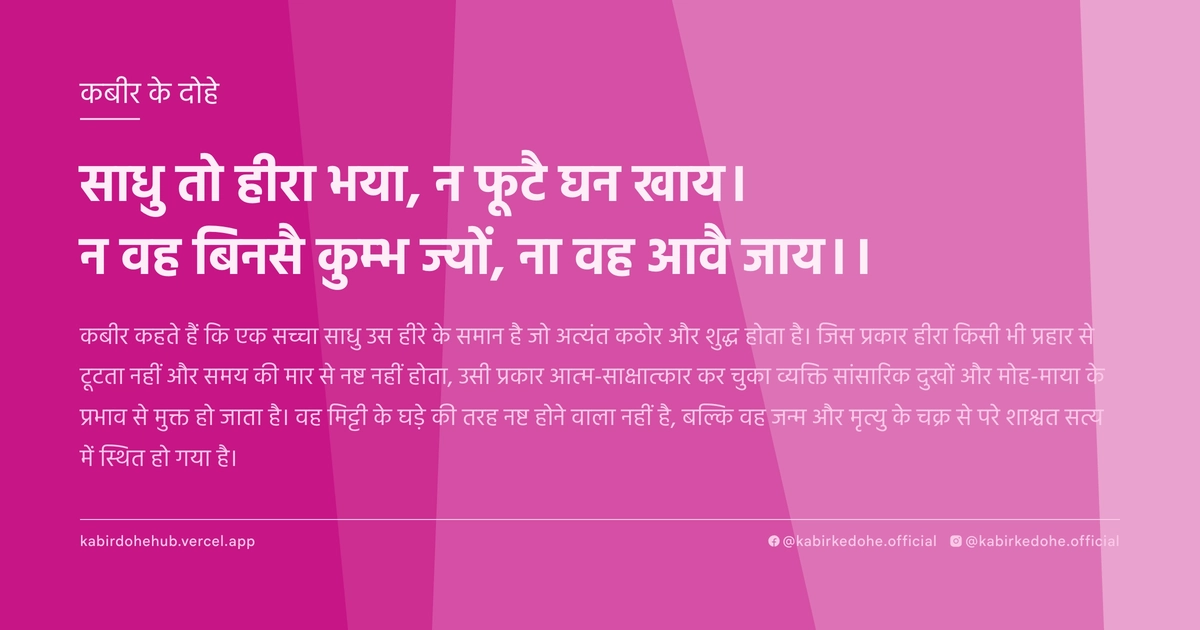
साधु तो हीरा भया, न फूटै घन खाय।
न वह बिनसै कुम्भ ज्यों, ना वह आवै जाय।।
Sadhu to heera bhaya, na phoote ghan khaay. Na vah binsai kumbh jyon, na vah aave jaaye.
इस पृष्ठ पर इस कबीर दोहे का अर्थ (meaning), हिंदी व्याख्या और अंग्रेज़ी अनुवाद, दार्शनिक विश्लेषण और व्यावहारिक जीवन सीख दी गई है। यह दोहा निर्गुण ब्रह्म (Nirguna Brahman) विषय से जुड़ा है — Kabir doha meaning and explanation in Hindi and English.
अर्थ (Meaning):
कबीर कहते हैं कि एक सच्चा साधु उस हीरे के समान है जो अत्यंत कठोर और शुद्ध होता है। जिस प्रकार हीरा किसी भी प्रहार से टूटता नहीं और समय की मार से नष्ट नहीं होता, उसी प्रकार आत्म-साक्षात्कार कर चुका व्यक्ति सांसारिक दुखों और मोह-माया के प्रभाव से मुक्त हो जाता है। वह मिट्टी के घड़े की तरह नष्ट होने वाला नहीं है, बल्कि वह जन्म और मृत्यु के चक्र से परे शाश्वत सत्य में स्थित हो गया है।
Kabir asserts that a true seeker or realized soul is like a diamond—indestructible and pure. Just as a diamond remains unbroken despite the heaviest pressure and resists decay, the enlightened being remains unaffected by the turbulence of the material world. Unlike a clay pot that shatters easily, the realized soul transcends the fragile cycle of birth and death, merging into the eternal, unchanging Absolute.
व्याख्या (Interpretation):
इस दोहे में 'हीरा' और 'कुम्भ' (घड़ा) के माध्यम से दो विपरीत अवस्थाओं का वर्णन है। घड़ा मानव शरीर और अहंकार का प्रतीक है, जो क्षणभंगुर है और एक छोटे से आघात से बिखर जाता है। इसके विपरीत, हीरा उस 'अविनाशी आत्मा' का प्रतीक है जिसने माया के आवरण को हटा दिया है। यहाँ 'न फूटै घन खाय' का अर्थ है कि जब साधक अपनी पहचान शरीर से हटाकर शुद्ध चेतना (Nirgun Brahman) में कर लेता है, तो संसार की कोई भी विपरीत परिस्थिति उसे विचलित नहीं कर सकती। यह अद्वैत वेदांत के उस सिद्धांत को दर्शाता है जहाँ जीव और ब्रह्म की एकता स्थापित हो जाती है। साधु वह है जिसने द्वैत को मिटाकर उस शून्य में प्रवेश किया है जहाँ न कुछ आता है और न कुछ जाता है। यह स्थिति पूर्ण स्थिरता और मोक्ष की है।
Through the metaphors of the 'diamond' and the 'clay pot,' Kabir contrasts the ephemeral nature of the ego with the eternal nature of the soul. The pot represents the physical body and the conditioned mind—fragile, temporary, and prone to shattering under the weight of worldly suffering. The diamond symbolizes the 'Indestructible Self' (Atman) that has been polished through the fire of spiritual discipline. 'Not breaking under pressure' signifies the state of Equanimity (Samatvam), where the seeker is no longer swayed by pleasure or pain. This aligns with Nirgun Bhakti, where the devotee seeks the formless Absolute rather than a physical deity. The phrase 'neither comes nor goes' points to the realization of non-duality (Advaita), where the illusion of separation vanishes, and the soul recognizes itself as the timeless Brahman, existing beyond the linear constraints of time and space.
दार्शनिक विश्लेषण (Philosophical Analysis):
कबीर का यह दर्शन उस समय के कट्टरपंथ और बाहरी कर्मकांडों के विरुद्ध एक सशक्त प्रहार था। उन्होंने यह स्पष्ट किया कि मोक्ष किसी तीर्थ यात्रा या बाहरी अनुष्ठान से नहीं, बल्कि आंतरिक रूपांतरण से मिलता है। यह विचार सूफी मत के 'फना' (अहंकार का विनाश) और वेदांत के 'अहं ब्रह्मास्मि' का संगम है। कबीर का 'साधु' कोई ऐसा व्यक्ति नहीं है जिसने गेरुआ वस्त्र धारण किया हो, बल्कि वह है जिसने अपने भीतर के 'कुम्भ' यानी अहंकार को तोड़ दिया है।
ऐतिहासिक रूप से, कबीर ने जाति और धर्म की सीमाओं को चुनौती दी। उनका मानना था कि सत्य सार्वभौमिक है और वह किसी विशेष वर्ग की बपौती नहीं है। इस दोहे में वे मनोवैज्ञानिक परिवर्तन की बात कर रहे हैं—कैसे एक व्यक्ति अपनी पहचान को 'नश्वर' से बदलकर 'शाश्वत' कर सकता है। जब तक हम स्वयं को शरीर (मिट्टी का घड़ा) मानते हैं, हम भय और असुरक्षा में जीते हैं।
दार्शनिक स्तर पर, यह 'माया' के पर्दें को हटाने की प्रक्रिया है। माया हमें विश्वास दिलाती है कि हम अलग-अलग और सीमित हैं। लेकिन जब ज्ञान की अग्नि इस भ्रम को जला देती है, तब केवल वह 'हीरा' बचता है जो वास्तव में हम हैं। यह अवस्था 'सहज समाधि' की है, जहाँ व्यक्ति संसार में रहते हुए भी उससे अछूता रहता है।
सूफीवाद के प्रभाव में, यह 'इश्क-ए-हकीकी' (ईश्वरीय प्रेम) की पराकाष्ठा है, जहाँ प्रेमी और प्रियतम एक हो जाते हैं। यहाँ 'न वह आवै जाय' का अर्थ है कि वह द्वैत की दुनिया से बाहर निकल चुका है, जहाँ जन्म और मृत्यु केवल एक खेल की तरह प्रतीत होते हैं।
अंततः, कबीर हमें यह समझाते हैं कि आध्यात्मिक विकास का अर्थ है अपनी कमजोरी (मिट्टी) को अपनी शक्ति (हीरे) में बदलना। यह केवल बौद्धिक ज्ञान नहीं, बल्कि एक अनुभवजन्य सत्य है जिसे केवल गहन साधना और आत्म-निरीक्षण के माध्यम से ही प्राप्त किया जा सकता है।
Kabir’s philosophy serves as a radical critique of the ritualistic orthodoxy of his era. He posits that liberation is not achieved through external pilgrimages or rigid religious dogmas, but through a profound internal alchemy. This teaching is a synthesis of the Sufi concept of 'Fana' (the annihilation of the ego) and the Vedantic realization of 'Aham Brahmasmi' (I am the Absolute). For Kabir, a 'Sadhu' is not defined by saffron robes, but by the internal collapse of the 'pot'—the egoic identity.
Historically, Kabir challenged the caste hierarchy and religious silos. He argued that Truth is universal and accessible to all, regardless of social standing. In this couplet, he addresses a psychological shift: the transition from identifying with the perishable (the body) to identifying with the imperishable (the consciousness). As long as we perceive ourselves as the 'clay pot,' we are governed by fear, anxiety, and the dread of extinction.
On a metaphysical level, this is the process of piercing through 'Maya' (the cosmic illusion). Maya convinces the individual that they are fragmented and limited. However, when the fire of spiritual inquiry consumes this delusion, only the 'diamond' remains—the pure, unadulterated awareness. This is the state of 'Sahaja Samadhi,' where one exists in the world but is not of the world, remaining untouched by its turbulence.
Influenced by Sufism, this represents the pinnacle of 'Ishq-e-Haqiqi' (Divine Love), where the distinction between the lover and the Beloved dissolves. The phrase 'neither comes nor goes' signifies the exit from the duality of existence and non-existence, viewing the cycle of birth and death as a mere play of shadows.
Ultimately, Kabir suggests that spiritual evolution is the act of transforming one's fragility into strength. It is not a theoretical exercise but an experiential truth. The 'diamond' is not something acquired from outside; it is the original state of the soul, uncovered once the debris of conditioned beliefs is cleared away.
मूल संदेश (Core Message):
- अहंकार एक मिट्टी का घड़ा है, जो अंततः टूटना ही है।
- शुद्ध चेतना एक हीरे की तरह अविनाशी और अटल है।
- बाहरी पहचान का त्याग ही वास्तविक आंतरिक शक्ति है।
- द्वैत से ऊपर उठकर अद्वैत में स्थित होना ही मोक्ष है।
- सत्य वह है जो समय और परिस्थिति से परे अपरिवर्तित रहे।
- The ego is a clay pot, destined to shatter eventually.
- Pure consciousness is like a diamond—indestructible and steady.
- Relinquishing external identity is the path to true inner strength.
- Transcending duality to reside in non-duality is liberation.
- Truth is that which remains unchanged beyond time and circumstance.
व्यावहारिक उदाहरण (Practical Example):
वाराणसी के एक पुराने मोहल्ले में माधव नाम का एक कुम्हार रहता था। वह बहुत कुशल था, लेकिन उसका स्वभाव अत्यंत क्रोधी और अहंकारी था। वह मानता था कि उसके बनाए घड़े शहर में सबसे श्रेष्ठ हैं और दूसरों को नीचा दिखाता था। उसका जीवन तनाव और कलह से भरा था क्योंकि वह अपनी पहचान अपने काम और अपनी प्रसिद्धि से जोड़ चुका था।
एक दिन उसकी मुलाकात एक घुमक्कड़ फकीर से हुई। फकीर ने माधव के सबसे सुंदर घड़े को देखा और अचानक उसे पत्थर मारकर तोड़ दिया। माधव क्रोध से लाल हो गया और फकीर को भला-बुरा कहने लगा। फकीर शांत रहा और मुस्कुराते हुए बोला, 'माधव, तू इस मिट्टी के टुकड़े के लिए इतना दुखी है, जबकि तेरे भीतर एक हीरा छिपा है जिसे तूने कभी देखा ही नहीं।'
माधव ने हैरान होकर पूछा, 'मेरे भीतर हीरा कहाँ है?' फकीर ने उत्तर दिया, 'यह अहंकार, यह क्रोध, यह मोह—ये सब मिट्टी के घड़े की तरह हैं। एक दिन ये सब टूट जाएंगे। लेकिन जो सत्य है, जो कभी नहीं मरता, वह तेरे भीतर की वह चेतना है जिसे तूने भुला दिया है। तू घड़ा बनकर जी रहा है, इसलिए टूट रहा है। हीरा बनकर जी, फिर देख दुनिया तुझे तोड़ नहीं पाएगी।'
माधव को पहली बार अपनी स्थिति का अहसास हुआ। उसने महसूस किया कि उसकी खुशी बाहरी प्रशंसा पर टिकी थी, जो कि मिट्टी के घड़े जैसी नाजुक थी। उसने अगले कुछ महीनों तक फकीर के सानिध्य में मौन और आत्म-चिंतन का अभ्यास किया। उसने अपने भीतर के क्रोध और श्रेष्ठता के भाव को धीरे-धीरे विसर्जित करना शुरू किया।
समय बीतने के साथ, माधव का व्यवहार बदल गया। अब वह अपने काम को अहंकार के लिए नहीं, बल्कि सेवा के भाव से करता था। जब लोग उसके घड़ों की आलोचना करते, तो वह विचलित नहीं होता। उसने जान लिया था कि उसकी असली पहचान वह नहीं है जो वह बनाता है, बल्कि वह है जो वह वास्तव में है।
एक बार शहर में भीषण बाढ़ आई और माधव की पूरी कार्यशाला बह गई। उसके सारे घड़े नष्ट हो गए। उसके पड़ोसी विलाप कर रहे थे, लेकिन माधव शांत था। उसके चेहरे पर एक अलौकिक मुस्कान थी।
उसके पड़ोसियों ने पूछा, 'माधव, तू पागल हो गया है? तेरा सब कुछ खत्म हो गया, फिर भी तू खुश है?' माधव ने शांति से जवाब दिया, 'मिट्टी का घड़ा तो टूटना ही था, लेकिन मेरा हीरा अभी भी सुरक्षित है। जो मेरा वास्तव में है, उसे कोई बाढ़ नहीं बहा सकती।'
इस प्रकार, माधव ने बाहरी पहचान के मोह को त्याग कर आंतरिक शाश्वत सत्य को पा लिया। वह अब एक साधारण कुम्हार नहीं, बल्कि एक 'साधु' बन चुका था, जिसे संसार की कोई भी परिस्थिति विचलित नहीं कर सकती थी।
In an ancient alley of Varanasi lived a potter named Madhav. He was exceptionally skilled, but his nature was volatile and arrogant. He believed his pots were the finest in the city and frequently belittled other artisans. His life was a storm of stress and conflict because he had tethered his entire identity to his craft and the fame it brought him.
One day, he encountered a wandering dervish. The dervish looked at Madhav's most exquisite pot and, without warning, shattered it with a stone. Madhav turned crimson with rage and began hurling insults at the dervish. The dervish remained serene, smiling as he said, 'Madhav, you grieve so deeply for a piece of clay, yet you are blind to the diamond hidden within you.'
Confused and angry, Madhav asked, 'Where is this diamond?' The dervish replied, 'This ego, this rage, this attachment—these are all like clay pots. One day, they will all shatter. But the Truth, that which never dies, is the consciousness within you that you have forgotten. You are living as a pot, and thus you break. Live as a diamond, and the world will find no way to shatter you.'
For the first time, Madhav felt the hollowness of his existence. He realized his happiness was dependent on external validation, which was as fragile as the clay he worked with. For the next few months, he stayed under the dervish's guidance, practicing silence and deep self-inquiry. He began to consciously dissolve his feelings of superiority and anger.
As time passed, Madhav's demeanor transformed. He no longer worked for the sake of pride, but as a form of service. When people criticized his work, he remained unperturbed. He had realized that his true identity was not what he created, but who he essentially was.
One year, a devastating flood hit the city, sweeping away Madhav's entire workshop. Every single pot he had crafted was destroyed. While his neighbors wailed in despair, Madhav remained profoundly calm, a celestial smile gracing his lips.
His neighbors asked, 'Madhav, have you lost your mind? Everything you owned is gone, yet you are happy?' Madhav replied softly, 'The clay pot was destined to break, but my diamond remains intact. That which is truly mine cannot be swept away by any flood.'
Thus, by relinquishing the attachment to his external persona, Madhav discovered the eternal truth within. He was no longer just a potter; he had become a 'Sadhu'—a realized soul whom the fluctuations of the world could no longer disturb.
अभ्यास मार्गदर्शन (Practice Guidance):
- प्रतिदिन 20 मिनट 'साक्षी भाव' का अभ्यास करें: अपने विचारों और भावनाओं को ऐसे देखें जैसे आप किसी दूसरे व्यक्ति को देख रहे हों, यह महसूस करते हुए कि आप वह विचार नहीं, बल्कि उसे देखने वाले 'हीरे' (चेतना) हैं।
- आत्म-पूछताछ जर्नल: प्रतिदिन एक ऐसी घटना लिखें जिसने आपको विचलित किया। फिर विश्लेषण करें कि आपके भीतर का कौन सा 'मिट्टी का घड़ा' (अहंकार, अपेक्षा, डर) टूटा है, और यह याद करें कि आपकी मूल चेतना अभी भी अक्षुण्ण है।
- व्यवहारिक परिवर्तन: जब भी कोई आपकी आलोचना करे या आपको अपमानित करे, तो तुरंत प्रतिक्रिया देने के बजाय 10 सेकंड रुकें और स्वयं से कहें, 'यह प्रहार घड़े पर है, हीरे पर नहीं।'
- निदान चेकलिस्ट: आप जान सकते हैं कि आप इस ज्ञान को जी रहे हैं यदि: (1) आपकी खुशी बाहरी परिस्थितियों पर निर्भर नहीं है, (2) आप दूसरों की सफलता से ईर्ष्या नहीं करते, (3) आप नुकसान होने पर भी आंतरिक शांति बनाए रखते हैं।
- Practice 'Witness Consciousness' for 20 minutes daily: Observe your thoughts and emotions as if you are watching a stranger, realizing that you are not the thought, but the 'diamond' (the awareness) observing it.
- Self-Inquiry Journaling: Record one event daily that disturbed your peace. Analyze which 'clay pot' (ego, expectation, or fear) was shattered, and reaffirm that your core consciousness remains untouched.
- Behavioral Shift: Whenever you face criticism or insult, pause for 10 seconds before reacting and tell yourself, 'This blow is hitting the pot, not the diamond.'
- Diagnostic Checklist: You are living this wisdom if: (1) Your happiness is not contingent on external circumstances, (2) You feel no envy toward others' success, (3) You maintain internal stillness even during significant loss.
चिंतन प्रश्न (Reflection Questions):
- मेरे जीवन का वह 'मिट्टी का घड़ा' क्या है जिसे मैं टूटने से बचाने के लिए सबसे अधिक संघर्ष कर रहा हूँ?
- क्या मेरी पहचान मेरे पद, संपत्ति या सामाजिक प्रतिष्ठा से जुड़ी है? यदि ये सब कल छिन जाएं, तो मेरे भीतर क्या बचेगा?
- मैं अपनी डिजिटल पहचान (सोशल मीडिया) को कितना महत्व देता हूँ, और यह मेरे वास्तविक 'स्व' को कैसे ढक रहा है?
- जब मैं दूसरों की मदद करता हूँ, तो क्या वह वास्तव में निस्वार्थ है, या यह मेरे 'परोपकारी' होने के अहंकार को संतुष्ट करने का एक तरीका है?
- क्या मैं वास्तव में शांति चाहता हूँ, या मैं केवल अपनी इच्छाओं की पूर्ति के बाद मिलने वाले अस्थायी सुख को शांति समझ रहा हूँ?
- What is the 'clay pot' in my life that I am struggling most to protect from shattering?
- Is my identity tied to my title, wealth, or social status? If these were gone tomorrow, what would remain within me?
- How much value do I place on my digital persona, and how is it obscuring my authentic 'Self'?
- When I help others, is it truly selfless, or is it a way to feed the ego of being a 'benevolent person'?
- Do I truly seek inner peace, or am I mistaking the temporary pleasure following the fulfillment of desires for peace?