
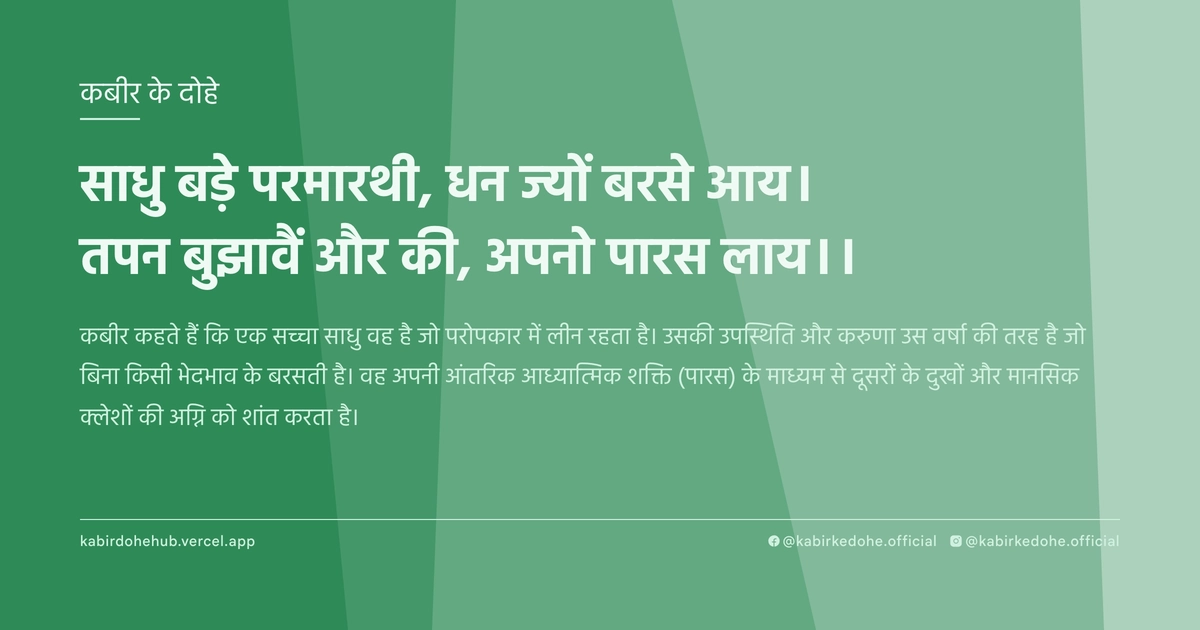
साधु बड़े परमारथी, धन ज्यों बरसे आय।
तपन बुझावैं और की, अपनो पारस लाय।।
Sadhu bade parmarthi, dhan jyon barse aay. Tapan bujhavain aur ki, apno paras laay.
इस पृष्ठ पर इस कबीर दोहे का अर्थ (meaning), हिंदी व्याख्या और अंग्रेज़ी अनुवाद, दार्शनिक विश्लेषण और व्यावहारिक जीवन सीख दी गई है। यह दोहा करुणा (Compassion) विषय से जुड़ा है — Kabir doha meaning and explanation in Hindi and English.
अर्थ (Meaning):
कबीर कहते हैं कि एक सच्चा साधु वह है जो परोपकार में लीन रहता है। उसकी उपस्थिति और करुणा उस वर्षा की तरह है जो बिना किसी भेदभाव के बरसती है। वह अपनी आंतरिक आध्यात्मिक शक्ति (पारस) के माध्यम से दूसरों के दुखों और मानसिक क्लेशों की अग्नि को शांत करता है।
Kabir asserts that a true seeker or saint is one whose existence is dedicated to the welfare of others. Their compassion is likened to a sudden, refreshing rain that falls indiscriminately. By applying the 'Paras' (the philosopher's stone) of their realized consciousness, they extinguish the fires of suffering and mental anguish in others.
व्याख्या (Interpretation):
इस दोहे में 'साधु' शब्द केवल गेरुआ वस्त्र पहनने वाले के लिए नहीं, बल्कि उस जागृत आत्मा के लिए है जिसने अहंकार का त्याग कर दिया है। 'परमारथी' का अर्थ है वह जिसकी चेतना व्यक्तिगत स्वार्थ से ऊपर उठकर सार्वभौमिक कल्याण में स्थित है। 'तपन' यहाँ सांसारिक दुखों, क्रोध और अज्ञान की जलन का प्रतीक है। 'पारस' वह आध्यात्मिक स्पर्श है जो लोहे को सोने में बदल देता है; यहाँ यह साधु की वह करुणा है जो अज्ञानी को ज्ञान की ओर ले जाती है। यह निर्गुण भक्ति का सार है जहाँ ईश्वर किसी मंदिर में नहीं, बल्कि मानवता की सेवा और निस्वार्थ प्रेम में पाया जाता है। यह अद्वैत वेदांत के उस सत्य को दर्शाता है जहाँ 'तू' और 'मैं' का भेद समाप्त हो जाता है और केवल एक ही चेतना शेष रहती है।
In this couplet, 'Sadhu' does not refer to a mere ascetic in saffron robes, but to an awakened soul who has transcended the ego. 'Parmarthi' denotes one whose consciousness is anchored in universal welfare rather than personal gain. 'Tapan' (heat) symbolizes the burning agony of worldly suffering, anger, and ignorance. 'Paras' refers to the mythical philosopher's stone that turns iron into gold; here, it represents the transformative compassion of the realized master that transmutes ignorance into wisdom. This embodies the essence of Nirgun Bhakti, where the Divine is found not in temples, but in the selfless service of humanity. It mirrors the Advaita Vedanta truth where the duality of 'I' and 'Thou' dissolves, leaving only the singular, non-dual consciousness.
दार्शनिक विश्लेषण (Philosophical Analysis):
कबीर का यह दृष्टिकोण तत्कालीन समाज में व्याप्त कर्मकांडीय धर्म और बाहरी आडंबरों पर एक गहरा प्रहार है। उनके समय में साधुत्व को अक्सर केवल वैराग्य या जंगलों में भटकने से जोड़ा जाता था, लेकिन कबीर ने साधुत्व की परिभाषा को 'परोपकार' से जोड़ा। यह विचार सूफीवाद के 'इन्सान-ए-कामिल' (पूर्ण मानव) के सिद्धांत से मेल खाता है, जहाँ व्यक्ति का आध्यात्मिक विकास उसकी क्षमता से मापा जाता है कि वह दूसरों के जीवन में कितना प्रकाश ला सकता है।
दार्शनिक स्तर पर, यह दोहा 'अहं' (Ego) के विसर्जन की बात करता है। जब तक व्यक्ति स्वयं को दूसरों से अलग मानता है, वह 'तपन' या जलन का अनुभव करता है। लेकिन जब वह अद्वैत की स्थिति में पहुँचता है, तो उसे दूसरे का दुख अपना दुख प्रतीत होता है। यहाँ 'पारस' वास्तव में वह शून्य या समाधि की अवस्था है, जहाँ से साधु कार्य करता है।
कबीर जाति और वर्ण व्यवस्था को नकारते हुए यह संदेश देते हैं कि आध्यात्मिक पात्रता जन्म से नहीं, बल्कि कर्म और करुणा से आती है। एक व्यक्ति चाहे किसी भी कुल का हो, यदि वह दूसरों के कष्ट हरने की क्षमता रखता है, तो वही वास्तविक साधु है। यह सामाजिक समानता का एक क्रांतिकारी आह्वान था।
मनोवैज्ञानिक रूप से, यह दोहा 'सहानुभूति' (Empathy) और 'करुणा' (Compassion) के बीच के अंतर को स्पष्ट करता है। सहानुभूति केवल दुख को महसूस करना है, लेकिन करुणा (पारस) उस दुख को मिटाने का सक्रिय प्रयास है। साधु केवल सहानुभूति नहीं दिखाता, बल्कि वह अपनी शांति से दूसरे की अशांति को सोख लेता है।
अंततः, यह शिक्षण हमें यह समझाता है कि वास्तविक मोक्ष व्यक्तिगत शांति में नहीं, बल्कि सामूहिक शांति के सृजन में है। जो स्वयं को मिटाकर दूसरों के लिए उपलब्ध हो जाता है, वही वास्तव में अमर हो जाता है। यह भौतिक संचय के विपरीत 'आध्यात्मिक वितरण' का मार्ग है।
Kabir's perspective is a profound critique of the ritualistic religion and outward ostentation prevalent in his era. During his time, sainthood was often equated with mere renunciation or wandering in forests, but Kabir redefined it through the lens of 'altruism.' This aligns with the Sufi concept of 'Insan-e-Kamil' (the Perfect Human), where spiritual evolution is measured by one's ability to bring light into the lives of others.
On a philosophical level, this doha speaks of the dissolution of the 'Aham' (Ego). As long as an individual perceives themselves as separate from others, they experience 'Tapan' or the burning of desire and anger. However, upon reaching the state of Advaita (non-duality), the suffering of another is felt as one's own. The 'Paras' is, in reality, that state of void or Samadhi from which the saint operates.
Rejecting caste and varna hierarchies, Kabir messages that spiritual eligibility is not born of lineage but of action and compassion. Regardless of birth, anyone capable of alleviating the distress of others is a true Sadhu. This was a revolutionary call for social equality in a deeply stratified society.
Psychologically, this verse distinguishes between empathy and compassion. Empathy is merely feeling the pain of another, but compassion (the Paras) is the active effort to extinguish that pain. The saint does not merely sympathize; they absorb the turbulence of another into their own profound stillness.
Ultimately, this teaching suggests that true liberation is not found in individual peace, but in the creation of collective peace. He who erases the self to become available for others becomes truly immortal. It is a path of 'spiritual distribution' as opposed to material accumulation.
मूल संदेश (Core Message):
- अहंकार की अग्नि केवल निस्वार्थ प्रेम से शांत होती है।
- सच्ची आध्यात्मिकता बाहरी वेशभूषा में नहीं, बल्कि परोपकार में है।
- जब आप दूसरों के दुख को अपना मानते हैं, तब आप साधु बन जाते हैं।
- करुणा वह पारस है जो साधारण मनुष्य को दिव्य बनाता है।
- शांति का वितरण ही शांति की वास्तविक प्राप्ति है।
- The fire of ego is extinguished only by the water of selfless love.
- True spirituality lies not in outward attire, but in altruism.
- When you perceive another's pain as your own, you become a Sadhu.
- Compassion is the philosopher's stone that transmutes the human into the divine.
- The distribution of peace is the only true way to attain it.
व्यावहारिक उदाहरण (Practical Example):
वाराणसी के एक पुराने मोहल्ले में रामदीन नाम का एक बुनकर रहता था। वह स्वभाव से अत्यंत शांत था और दिन भर करघे पर काम करता, लेकिन उसकी असली पहचान उसकी करुणा थी। उस मोहल्ले में एक व्यक्ति था, जिसे लोग 'क्रोधी काका' कहते थे, जो छोटी-छोटी बातों पर चिल्लाता और सबको कोसता था। उसकी कड़वाहट ने उसे समाज से अलग कर दिया था, और वह अपने ही गुस्से की आग में जल रहा था।
रामदीन ने कभी उसे उपदेश नहीं दिया, न ही उसे सुधारने की कोशिश की। वह बस हर सुबह काका के पास जाता, उनके साथ बैठकर चुपचाप उनकी बातें सुनता, और कभी-कभी उनके लिए एक छोटा सा मीठा टुकड़ा या ताज़ा फल ले जाता। जब काका चिल्लाते, रामदीन बस एक मंद मुस्कान के साथ उनकी ओर देखता, जैसे वह उनके क्रोध को नहीं, बल्कि उनके भीतर छिपे अकेलेपन को देख रहा हो।
महीनों तक यह सिलसिला चलता रहा। रामदीन की निस्वार्थ उपस्थिति ने काका के भीतर के रक्षा-कवच को तोड़ दिया। एक दिन काका फूट-फूट कर रो पड़े और अपनी बरसों की कुंठा रामदीन के सामने उड़ेल दी। रामदीन ने बस उनका हाथ थामा और कहा, "काका, यह आग आपको जला रही है, इसे बह जाने दीजिए।"
उस दिन रामदीन का 'पारस' काम कर गया। काका ने महसूस किया कि जिस शांति की तलाश में वे पूरी दुनिया से लड़ रहे थे, वह तो रामदीन की मौन स्वीकृति में मौजूद थी। धीरे-धीरे काका का व्यवहार बदलने लगा। वे अब मोहल्ले के बच्चों को कहानियाँ सुनाते और दूसरों की मदद करते।
रामदीन ने कोई चमत्कार नहीं किया, उसने बस अपनी आंतरिक शांति को एक उपकरण की तरह इस्तेमाल किया। उसने यह साबित किया कि एक साधारण बुनकर भी अपनी करुणा से किसी के जीवन की तपन बुझा सकता है।
मोहल्ले के लोग हैरान थे कि बिना किसी तर्क-वितर्क के काका कैसे बदल गए। रामदीन ने उन्हें समझाया कि जब हम किसी के क्रोध का उत्तर क्रोध से नहीं, बल्कि प्रेम से देते हैं, तो हम उनके भीतर के अंधेरे को रोशनी में बदल देते हैं।
यह बदलाव केवल काका तक सीमित नहीं रहा। रामदीन की इस पद्धति को देखकर अन्य लोग भी एक-दूसरे के प्रति अधिक सहनशील होने लगे। पूरा मोहल्ला एक छोटे से आध्यात्मिक समुदाय में बदल गया।
रामदीन का जीवन यह दर्शाता है कि साधु वह नहीं जो दुनिया छोड़ दे, बल्कि वह है जो दुनिया में रहकर दूसरों के दुखों को हर ले। उसका करघा केवल कपड़ा नहीं बुन रहा था, बल्कि वह टूटे हुए दिलों को जोड़ रहा था।
In an old neighborhood of Varanasi lived a weaver named Ramdeen. He was inherently calm, spending his days at the loom, but his true identity lay in his compassion. In that same neighborhood lived a man known as 'Angry Kaka,' who screamed at the slightest provocation and cursed everyone. His bitterness had isolated him, and he was burning in the fire of his own rage.
Ramdeen never lectured him, nor did he try to 'fix' him. He simply visited Kaka every morning, sat with him in silence, listened to his ramblings, and occasionally brought a small sweet or a fresh fruit. When Kaka screamed, Ramdeen would simply look at him with a gentle smile, as if he were seeing not the anger, but the profound loneliness hidden beneath it.
This continued for months. Ramdeen's selfless presence eventually broke through Kaka's defensive walls. One day, Kaka broke down in tears, pouring out years of accumulated frustration in front of Ramdeen. Ramdeen simply held his hand and said, 'Kaka, this fire is burning you; let it flow away.'
On that day, Ramdeen's 'Paras' worked. Kaka realized that the peace he had been fighting the world to find was present in Ramdeen's silent acceptance. Gradually, Kaka's behavior shifted. He began telling stories to the neighborhood children and helping others.
Ramdeen performed no miracle; he simply used his inner peace as a tool. He proved that a simple weaver could extinguish the burning agony of another's life through sheer compassion.
The neighbors were astonished that Kaka had changed without any argument or debate. Ramdeen explained to them that when we respond to anger not with more anger, but with love, we transform the darkness within another into light.
This transformation wasn't limited to Kaka. Seeing Ramdeen's approach, others in the neighborhood became more tolerant of one another. The entire street evolved into a small spiritual community.
Ramdeen's life demonstrates that a Sadhu is not one who leaves the world, but one who remains in the world to alleviate the suffering of others. His loom was not just weaving cloth; it was weaving together broken hearts.
अभ्यास मार्गदर्शन (Practice Guidance):
- दैनिक मौन अभ्यास: प्रतिदिन 20 मिनट पूर्ण मौन में बैठें और महसूस करें कि आपकी आंतरिक शांति एक ठंडी वर्षा की तरह है जो आपके आस-पास के तनाव को सोख रही है।
- करुणा का संकल्प: दिन भर में कम से कम एक व्यक्ति ऐसा खोजें जो मानसिक तनाव या क्रोध में हो, और बिना उसे सही ठहराए या गलत साबित किए, बस उसकी बात धैर्यपूर्वक सुनें।
- आत्म-पूछताछ जर्नल: हर रात लिखें कि आज आपने अपनी 'तपन' (क्रोध/ईर्ष्या) को कैसे संभाला और क्या आप किसी और के लिए 'पारस' बन पाए?
- निदान चेकलिस्ट: क्या मैं दूसरों की मदद इसलिए कर रहा हूँ ताकि मुझे प्रशंसा मिले (अहंकार), या इसलिए क्योंकि मैं उनके दुख को अपना दुख महसूस कर रहा हूँ (साधुत्व)?
- Daily Silence Practice: Sit in complete silence for 20 minutes daily, visualizing your inner peace as a cooling rain that absorbs the stress and tension of your surroundings.
- Vow of Compassion: Each day, identify at least one person experiencing mental distress or anger. Listen to them with patience, without attempting to validate or invalidate their feelings.
- Self-Inquiry Journaling: Every night, record how you managed your own 'Tapan' (anger/jealousy) and whether you were able to act as a 'Paras' for someone else.
- Diagnostic Checklist: Am I helping others to receive praise (Ego), or because I genuinely feel their suffering as my own (Sainthood)?
चिंतन प्रश्न (Reflection Questions):
- क्या मेरी मदद करने की इच्छा वास्तव में निस्वार्थ है, या यह मेरी 'अच्छे व्यक्ति' होने की छवि को पुष्ट करने का एक तरीका है?
- मेरे जीवन में वह कौन सा 'तपन' (क्रोध या द्वेष) है जिसे मैं दूसरों पर थोपता हूँ, जबकि मैं चाहता हूँ कि दूसरे मेरे प्रति शांत रहें?
- यदि मैं अपनी सभी उपलब्धियों और पहचान को हटा दूँ, तो क्या मेरे पास देने के लिए केवल करुणा शेष रहेगी?
- मैं अक्सर दूसरों को 'सुधारने' की कोशिश करता हूँ, लेकिन क्या मैं उन्हें वैसे ही स्वीकार करने का साहस रखता हूँ जैसे वे हैं?
- क्या मेरा आध्यात्मिक अभ्यास मुझे समाज से काट रहा है या मुझे समाज के दुखों के प्रति अधिक संवेदनशील बना रहा है?
- Is my desire to help truly selfless, or is it a way to reinforce my image of being a 'good person'?
- What is the 'Tapan' (anger or malice) in my life that I project onto others, while expecting them to remain calm with me?
- If I stripped away all my achievements and identities, would compassion be the only thing left for me to give?
- I often try to 'fix' others, but do I have the courage to accept them exactly as they are?
- Is my spiritual practice isolating me from society, or is it making me more sensitive to the collective suffering of humanity?