
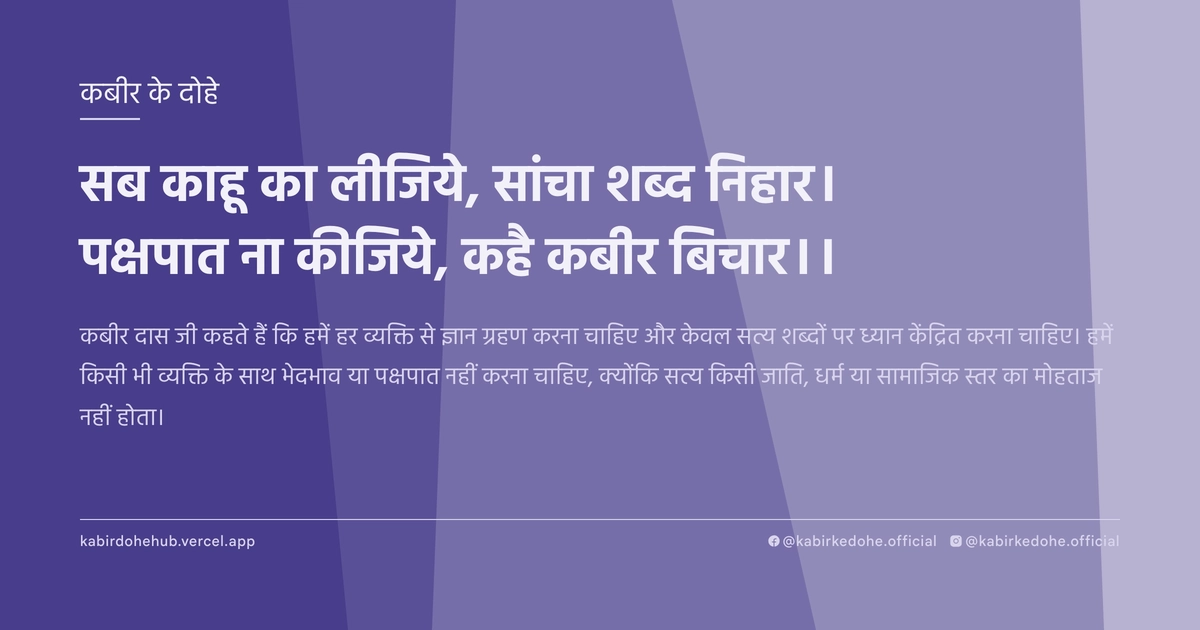
सब काहू का लीजिये, सांचा शब्द निहार।
पक्षपात ना कीजिये, कहै कबीर बिचार।।
Sab kahu ka leeje, sancha shabd nihaar. Pakshpaat na kariye, kahe Kabir bichaar.
इस पृष्ठ पर इस कबीर दोहे का अर्थ (meaning), हिंदी व्याख्या और अंग्रेज़ी अनुवाद, दार्शनिक विश्लेषण और व्यावहारिक जीवन सीख दी गई है। यह दोहा विश्व-दर्शन (Universalism) विषय से जुड़ा है — Kabir doha meaning and explanation in Hindi and English.
अर्थ (Meaning):
कबीर दास जी कहते हैं कि हमें हर व्यक्ति से ज्ञान ग्रहण करना चाहिए और केवल सत्य शब्दों पर ध्यान केंद्रित करना चाहिए। हमें किसी भी व्यक्ति के साथ भेदभाव या पक्षपात नहीं करना चाहिए, क्योंकि सत्य किसी जाति, धर्म या सामाजिक स्तर का मोहताज नहीं होता।
Kabir suggests that one should be open to receiving wisdom from everyone and focus solely on the truth of the words spoken. He urges against prejudice or partiality, asserting that truth transcends social hierarchies, castes, and religious affiliations.
व्याख्या (Interpretation):
इस दोहे का शाब्दिक अर्थ है कि सत्य कहीं भी मिल सकता है, इसलिए हर किसी को सुनने की पात्रता रखें। रूपक के तौर पर, यह 'अहंकार' के विनाश की बात करता है, क्योंकि पक्षपात अहंकार की ही उपज है। निर्गुण भक्ति के संदर्भ में, ईश्वर किसी विशेष संप्रदाय में नहीं बल्कि सार्वभौमिक सत्य में निवास करता है। जब हम पक्षपात छोड़ते हैं, तब हम माया के उस पर्दे को हटाते हैं जो हमें दूसरों में स्वयं के ही स्वरूप (ब्रह्म) को देखने से रोकता है। यह अद्वैत वेदांत के उस सिद्धांत को पुष्ट करता है जहाँ आत्मा और परमात्मा एक हैं। अंततः, यह दोहा हमें बाहरी पहचानों से ऊपर उठकर आंतरिक सत्य की खोज करने का आह्वान करता है।
Literally, the verse advises openness to wisdom from all sources. Metaphorically, it addresses the annihilation of the ego, as prejudice is a byproduct of the 'I-consciousness'. In the context of Nirgun Bhakti, the Divine does not reside in a specific sect but in universal truth. By abandoning partiality, we lift the veil of Maya that prevents us from seeing the Atman in others. This aligns with Advaita Vedanta's non-duality, where the individual soul and the universal Brahman are one. Ultimately, the doha calls for a transcendence of external identities to realize the singular, internal Truth.
दार्शनिक विश्लेषण (Philosophical Analysis):
कबीर का यह विचार उनके युग के गहरे सामाजिक और धार्मिक संघर्षों की प्रतिक्रिया है। 15वीं शताब्दी में भारत जाति व्यवस्था और धार्मिक कट्टरता में जकड़ा हुआ था। कबीर ने इस व्यवस्था पर प्रहार करते हुए कहा कि सत्य का कोई 'विशेष अधिकार' नहीं होता। उन्होंने कर्मकांडों और बाहरी आडंबरों को नकारते हुए 'शब्द' की पवित्रता पर जोर दिया।
दार्शनिक स्तर पर, यह सूफीवाद के 'इंसान-ए-कामिल' (पूर्ण मानव) की अवधारणा से मिलता-जुलता है, जहाँ सत्य की खोज के लिए विनम्रता अनिवार्य है। जब हम किसी के प्रति पक्षपात करते हैं, तो हम वास्तव में सत्य को नहीं, बल्कि अपनी पूर्वधारणाओं को देख रहे होते हैं। यह मनोवैज्ञानिक अवरोध हमें वास्तविक ज्ञान से दूर रखता है।
अद्वैत वेदांत के अनुसार, यदि सब कुछ एक ही चेतना का विस्तार है, तो पक्षपात करना स्वयं के ही एक हिस्से से घृणा करने जैसा है। कबीर यहाँ 'सांचा शब्द' (सत्य शब्द) को एक उपकरण के रूप में प्रस्तुत करते हैं जो व्यक्ति को उसके सीमित व्यक्तित्व से मुक्त कर उसे वैश्विक चेतना से जोड़ता है।
कबीर की यह दृष्टि केवल सामाजिक समानता की बात नहीं करती, बल्कि यह एक आध्यात्मिक सर्जरी है। वे चाहते हैं कि साधक अपनी पहचान के सारे खोल उतार फेंके। जब 'मैं' और 'तू' का भेद मिट जाता है, तभी सत्य का साक्षात्कार संभव होता है।
अक्सर लोग इस दोहे को केवल 'सबकी मदद करो' के रूप में देखते हैं, लेकिन यह उससे कहीं अधिक गहरा है। यह 'ज्ञानमीमांसा' (Epistemology) का प्रश्न है—कि ज्ञान कहाँ से आता है? कबीर कहते हैं कि ज्ञान किसी पद या प्रतिष्ठा का उत्पाद नहीं, बल्कि सत्य की गूँज है जो किसी भी साधारण व्यक्ति के माध्यम से आ सकती है।
Kabir's insight is a direct response to the profound social and religious conflicts of the 15th century, where India was gripped by rigid caste hierarchies and sectarian dogma. He challenged the notion that truth was the exclusive property of a priestly class or a specific religion, asserting that the 'Word' (Shabd) is the only true authority.
Philosophically, this resonates with the Sufi concept of 'Al-Insan al-Kamil' (the Perfect Human), where humility is a prerequisite for divine realization. Prejudice is not merely a social flaw but a psychological barrier; when we are partial, we perceive our preconceptions rather than the objective Truth.
From the lens of Advaita Vedanta, if all existence is an extension of a single Consciousness, then partiality is an act of self-fragmentation. To despise another based on their identity is to despise a reflection of one's own essence. Kabir uses the 'Sancha Shabd' as a tool to dissolve the limited ego and merge it with the universal whole.
This vision is not just about social equality but is a form of spiritual surgery. Kabir demands that the seeker strip away all layers of identity. Only when the duality of 'I' and 'Thou' vanishes can the ultimate reality be experienced.
Common literalist interpretations often reduce this to a simple call for kindness. However, it is fundamentally an epistemological claim: truth is not a product of status or prestige, but a resonance that can emanate from the most humble of sources.
मूल संदेश (Core Message):
- अहंकार सत्य के मार्ग में सबसे बड़ी बाधा है।
- सत्य किसी विशेष व्यक्ति या वर्ग की बपौती नहीं है।
- विनम्रता ही वह कुंजी है जो ज्ञान के द्वार खोलती है।
- पक्षपात करना स्वयं की आत्मा को सीमित करना है।
- सार्वभौमिक सत्य हर साधारण अनुभव में छिपा होता है।
- Ego is the primary obstacle on the path to Truth.
- Truth is not the monopoly of any specific person or class.
- Humility is the key that unlocks the doors of wisdom.
- To be partial is to limit one's own soul.
- Universal Truth is hidden within every ordinary experience.
व्यावहारिक उदाहरण (Practical Example):
एक समय की बात है, वाराणसी के घाटों पर माधव नाम का एक वृद्ध बुनकर रहता था। माधव अपनी कला में निपुण था, लेकिन वह बहुत अहंकारी था। वह मानता था कि केवल उच्च कुल के विद्वान ही उसे आध्यात्मिक ज्ञान दे सकते हैं। वह अक्सर अपने आस-पास के अनपढ़ मजदूरों और सफाईकर्मियों को तुच्छ समझकर उनसे बात तक नहीं करता था।
एक दिन माधव के शहर में एक महान पंडित आए। माधव उनके चरणों में गिर पड़ा और उनसे मोक्ष का मार्ग पूछा। पंडित जी ने उसे बहुत कठिन संस्कृत श्लोक सुनाए, लेकिन माधव को कुछ समझ नहीं आया। वह उलझन में था और उसे लगा कि शायद वह पर्याप्त बुद्धिमान नहीं है।
उसी शाम, जब माधव अपने करघे पर काम कर रहा था, एक छोटा बच्चा, जो गलियों में कचरा बीनता था, उसके पास आया। उस बच्चे ने बड़ी मासूमियत से कहा, "काका, आप धागों को इतना कसकर क्यों खींच रहे हैं? अगर धागा बहुत ज्यादा खिंचेगा, तो वह टूट जाएगा। जीवन भी ऐसा ही है, जब हम बहुत ज्यादा पकड़ कर रखते हैं, तो दुख बढ़ जाता है। बस ढीला छोड़ दो, सब ठीक हो जाएगा।"
माधव पहले तो चिढ़ गया कि एक मामूली बच्चा उसे जीवन का पाठ पढ़ा रहा है। लेकिन जैसे ही उसने अपनी आँखें बंद कीं, उसे महसूस हुआ कि इस बच्चे की बात में वही सत्य था जिसे वह बड़े-बड़े ग्रंथों में ढूँढ रहा था। उसे अहसास हुआ कि वह 'पंडित' होने के अहंकार में सत्य को देख ही नहीं पा रहा था।
उस बच्चे के सरल शब्दों ने माधव के भीतर के अहंकार को तोड़ दिया। उसे समझ आया कि सत्य किसी की डिग्री या जाति में नहीं, बल्कि उसकी सादगी और अनुभव में होता है।
अगले दिन से माधव का व्यवहार बदल गया। उसने उन लोगों से बात करना शुरू किया जिन्हें वह अब तक अनदेखा करता था। उसने पाया कि एक मोची उसे धैर्य के बारे में सिखा सकता है और एक भिखारी उसे संतोष के बारे में।
उसने महसूस किया कि जब उसने पक्षपात छोड़ा, तो पूरी दुनिया उसकी गुरु बन गई। अब वह केवल रेशमी धागों से कपड़े नहीं बुनता था, बल्कि वह मानवीय संबंधों के प्रेमपूर्ण धागों को जोड़ रहा था।
माधव की इस आंतरिक क्रांति ने उसके काम में भी निखार ला दिया। उसके द्वारा बुने गए वस्त्रों में अब एक ऐसी शांति और गहराई थी जो पहले कभी नहीं थी, क्योंकि वे अब अहंकार से नहीं, बल्कि विनम्रता से रचे गए थे।
अंततः, माधव ने जान लिया कि 'सांचा शब्द' किसी भी मुख से निकल सकता है, बस सुनने वाले का हृदय खुला होना चाहिए।
Once, in the ghats of Varanasi, lived an elderly weaver named Madhav. Madhav was a master of his craft but deeply arrogant. He believed that spiritual wisdom could only be dispensed by high-born scholars and treated the illiterate laborers and sweepers around him with utter disdain.
One day, a renowned scholar visited the city. Madhav fell at his feet, begging for the path to liberation. The scholar recited complex Sanskrit verses, but Madhav found himself confused and overwhelmed, feeling that he lacked the intellect to grasp such heights.
That evening, while Madhav was working at his loom, a small child who collected scrap from the streets approached him. With innocent clarity, the child asked, "Uncle, why are you pulling the threads so tight? If you pull too hard, the thread will snap. Life is like this; when we cling too tightly, pain increases. Just let go, and everything will be fine."
Initially, Madhav was irritated that a mere street child dared to teach him about life. But as he closed his eyes, he realized that this child's simple observation held the very truth he had been searching for in massive volumes of scripture.
The child's words acted as a catalyst, shattering Madhav's ego. He realized that truth does not reside in a degree or a caste, but in simplicity and direct experience.
From the next day, Madhav's behavior transformed. He began engaging with those he had previously ignored. He discovered that a cobbler could teach him about patience and a beggar could teach him about contentment.
He realized that once he abandoned partiality, the entire world became his guru. He was no longer just weaving silk threads; he was weaving bonds of love and human connection.
This internal revolution reflected in his work. The fabrics he wove now possessed a serenity and depth that were absent before, for they were created from humility rather than pride.
Ultimately, Madhav understood that the 'True Word' can emerge from any mouth, provided the listener's heart is open.
अभ्यास मार्गदर्शन (Practice Guidance):
- दैनिक अभ्यास: हर दिन कम से कम एक ऐसे व्यक्ति से बात करें जिससे आप आमतौर पर बात नहीं करते या जिसे आप अपने से 'नीचा' या 'अलग' समझते हैं। उनकी कहानी सुनें बिना किसी निर्णय के।
- आत्म-पूछताछ जर्नल: जब भी आप किसी के प्रति पूर्वाग्रह महसूस करें, तो लिखें: "मैं इस व्यक्ति के बारे में क्या मान रहा हूँ और यह धारणा मेरे किस अहंकार से उपजी है?"
- मौन श्रवण: दिन में 15 मिनट केवल सुनने का अभ्यास करें। सामने वाले की बात को काटने या उत्तर देने की योजना बनाने के बजाय, केवल उनके शब्दों के पीछे छिपे सत्य को महसूस करें।
- निदान चेकलिस्ट: यदि आप किसी की बात सुनकर तुरंत उसकी सामाजिक स्थिति या शिक्षा का आकलन कर रहे हैं, तो समझ लें कि आप अभी भी पक्षपात के जाल में हैं। यदि आप केवल 'सत्य' को पकड़ रहे हैं, तो आप जागृत हैं।
- Daily Practice: Engage in a conversation with at least one person you typically avoid or perceive as 'inferior' or 'different'. Listen to their story without any judgment.
- Self-Inquiry Journal: Whenever you feel a prejudice, write down: "What assumption am I making about this person, and from which part of my ego does this bias stem?"
- Silent Listening: Practice 15 minutes of pure listening daily. Instead of planning a response or interrupting, focus entirely on the truth residing behind the speaker's words.
- Diagnostic Checklist: If you find yourself assessing a person's social status or education before absorbing their words, you are still trapped in partiality. If you seek only the 'Truth', you are awakening.
चिंतन प्रश्न (Reflection Questions):
- क्या मैं वास्तव में लोगों को सुनता हूँ, या मैं केवल अपनी मान्यताओं की पुष्टि करने वाले शब्दों की तलाश करता हूँ?
- मेरे जीवन में वह कौन सा व्यक्ति है जिसे मैं 'अयोग्य' मानता हूँ, और क्या वह अयोग्यता मेरी अपनी धारणा है?
- यदि मेरा सामाजिक पद और पहचान छीन ली जाए, तो क्या मैं अभी भी सत्य को पहचानने की क्षमता रखूँगा?
- मेरी डिजिटल पहचान (सोशल मीडिया) मुझे किन लोगों के प्रति पक्षपाती बना रही है?
- क्या मैं सत्य को स्वीकार करने के लिए तैयार हूँ यदि वह मेरे सबसे नापसंद व्यक्ति के मुख से आए?
- Do I truly listen to people, or am I merely searching for words that confirm my existing beliefs?
- Who is the person in my life I consider 'unqualified', and is that disqualification merely my own projection?
- If my social status and identity were stripped away, would I still possess the capacity to recognize Truth?
- How is my digital identity (social media) fueling my partiality toward certain groups of people?
- Am I prepared to accept the Truth even if it is spoken by the person I dislike the most?