
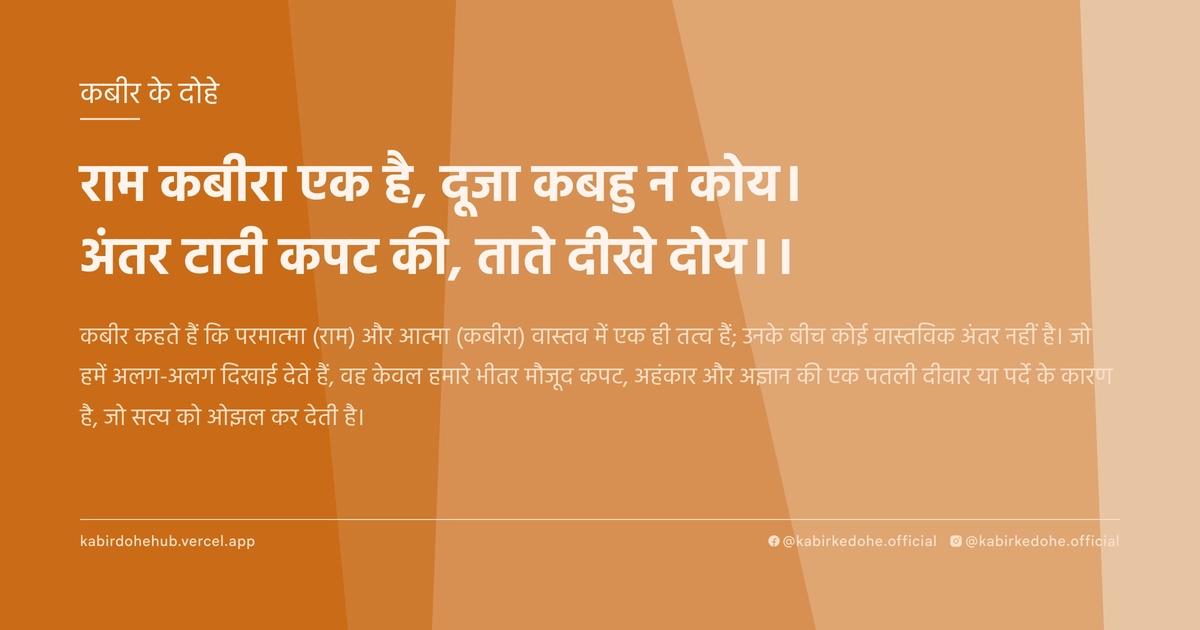
राम कबीरा एक है, दूजा कबहु न कोय।
अंतर टाटी कपट की, ताते दीखे दोय।।
Ram Kabira ek hai, dooja kabhu na koy. Antar taati kapat ki, taate deekhe doy.
इस पृष्ठ पर इस कबीर दोहे का अर्थ (meaning), हिंदी व्याख्या और अंग्रेज़ी अनुवाद, दार्शनिक विश्लेषण और व्यावहारिक जीवन सीख दी गई है। यह दोहा निर्गुण ब्रह्म (Nirguna Brahman) विषय से जुड़ा है — Kabir doha meaning and explanation in Hindi and English.
अर्थ (Meaning):
कबीर कहते हैं कि परमात्मा (राम) और आत्मा (कबीरा) वास्तव में एक ही तत्व हैं; उनके बीच कोई वास्तविक अंतर नहीं है। जो हमें अलग-अलग दिखाई देते हैं, वह केवल हमारे भीतर मौजूद कपट, अहंकार और अज्ञान की एक पतली दीवार या पर्दे के कारण है, जो सत्य को ओझल कर देती है।
Kabir asserts that the Divine (Ram) and the individual soul (Kabira) are essentially one and the same; there is no second entity. The perceived separation is merely an illusion created by a thin veil of deceit, ego, and ignorance residing within the human heart, which obscures the singular truth of existence.
व्याख्या (Interpretation):
इस दोहे का शाब्दिक अर्थ है कि ईश्वर और मनुष्य अलग नहीं हैं। रूपकात्मक रूप से, 'टाटी' (बांस की चटाई या पर्दा) उस मानसिक और भावनात्मक अवरोध का प्रतीक है जिसे हम 'अहंकार' कहते हैं। यह निरगुण भक्ति का सार है, जहाँ ईश्वर किसी मूर्ति में नहीं बल्कि स्वयं के भीतर स्थित है। जब तक माया का पर्दा है, हमें द्वैत (दो) दिखाई देता है, लेकिन जैसे ही कपट मिटता है, अद्वैत (एकता) का अनुभव होता है। यह आत्मा और ब्रह्म की गैर-द्वैतता को दर्शाता है। यहाँ 'राम' शब्द किसी व्यक्ति विशेष के लिए नहीं, बल्कि उस सर्वव्यापी चेतना के लिए है जो कण-कण में व्याप्त है।
Literally, the verse claims that God and man are not distinct. Metaphorically, the 'taati' (a bamboo screen or veil) symbolizes the psychological and emotional barrier of the ego. This is the essence of Nirgun Bhakti, where the Divine is not found in idols but within the self. As long as the veil of Maya persists, we perceive duality; once the deceit of the ego vanishes, the experience of non-duality (Advaita) emerges. It highlights the non-dual nature of Atman and Brahman. Here, 'Ram' does not refer to a mythological figure but to the omnipresent consciousness pervading every atom of existence.
दार्शनिक विश्लेषण (Philosophical Analysis):
कबीर का यह दोहा मध्यकालीन भारत के सामाजिक और धार्मिक संघर्षों के बीच एक क्रांतिकारी घोषणा थी। उस समय समाज कर्मकांडों और बाहरी आडंबरों में उलझा था, जहाँ हिंदू और मुस्लिम अलग-अलग रास्तों पर चलते थे। कबीर ने इस द्वैत को चुनौती देते हुए घोषणा की कि सत्य एक है। उनका दृष्टिकोण अद्वैत वेदांत के 'अहं ब्रह्मास्मि' (मैं ही ब्रह्म हूँ) और सूफी मत के 'फना' (अहंकार का विलीनीकरण) का एक अद्भुत संगम है।
वे ritualism (कर्मकांड) का विरोध करते हैं क्योंकि बाहरी पूजा अक्सर अहंकार को बढ़ाती है, जबकि आंतरिक शुद्धि उसे मिटाती है। कबीर के अनुसार, मंदिर या मस्जिद जाने से अधिक महत्वपूर्ण है अपने भीतर के 'कपट' को पहचानना। यह कपट केवल झूठ बोलना नहीं है, बल्कि वह सूक्ष्म भ्रम है कि 'मैं' इस ब्रह्मांड से अलग हूँ।
दार्शनिक स्तर पर, यह दोहा 'माया' की अवधारणा को स्पष्ट करता है। माया वह शक्ति है जो एक को दो के रूप में दिखाती है। जब साधक अपनी वासनाओं और मानसिक विकृतियों को त्याग देता है, तो वह पाता है कि जिसे वह बाहर खोज रहा था, वह उसके अपने अस्तित्व का मूल आधार था।
मनोवैज्ञानिक रूप से, यह अहंकार के विलीनीकरण की प्रक्रिया है। जब व्यक्ति अपनी पहचान को केवल शरीर या नाम तक सीमित नहीं रखता, तो वह सामूहिक चेतना से जुड़ जाता है। यह 'स्व' से 'सर्व' की यात्रा है।
अंततः, कबीर यह समझाते हैं कि ईश्वर और भक्त के बीच कोई दूरी नहीं है। दूरी केवल हमारी धारणा में है। यह ज्ञान ही मुक्ति का मार्ग है, जहाँ भक्त और भगवान के बीच का भेद समाप्त हो जाता है और केवल शुद्ध अस्तित्व शेष रहता है।
This couplet was a revolutionary proclamation amidst the social and religious conflicts of medieval India. At a time when society was entangled in rituals and outward displays, with Hindus and Muslims walking divergent paths, Kabir challenged this duality by declaring that Truth is One. His perspective is a sublime synthesis of Advaita Vedanta's 'Aham Brahmasmi' (I am Brahman) and the Sufi concept of 'Fana' (the annihilation of the ego).
He rejects ritualism because external worship often inflates the ego, whereas internal purification diminishes it. According to Kabir, recognizing the 'kapat' (deceit) within is far more vital than visiting temples or mosques. This deceit is not merely lying, but the subtle delusion that 'I' am separate from the universe.
Philosophically, the verse elucidates the concept of 'Maya'. Maya is the cosmic illusion that makes the One appear as Two. When a seeker renounces desires and mental distortions, they discover that what they were searching for externally was the very foundation of their own existence.
Psychologically, this is the process of ego-dissolution. When an individual stops limiting their identity to the body or a name, they merge with the collective consciousness. It is a journey from the 'Self' to the 'All'.
Ultimately, Kabir explains that there is no distance between the Divine and the devotee. The distance exists only in our perception. This realization is the path to liberation, where the distinction between the seeker and the sought vanishes, leaving only pure existence.
मूल संदेश (Core Message):
- द्वैत एक मानसिक भ्रम है, एकता ही एकमात्र सत्य है।
- अहंकार वह पर्दा है जो हमें परमात्मा से अलग करता है।
- ईश्वर बाहर खोजने की वस्तु नहीं, भीतर अनुभव करने वाली स्थिति है।
- जब 'मैं' मिटता है, तब केवल 'वह' शेष रहता है।
- शुद्ध प्रेम ही वह साधन है जो कपट की दीवार को गिराता है।
- Duality is a mental illusion; unity is the only absolute truth.
- The ego is the veil that separates the soul from the Divine.
- God is not an object to be sought externally, but a state to be experienced internally.
- When the 'I' dissolves, only the 'One' remains.
- Pure love is the only instrument capable of tearing down the wall of deceit.
व्यावहारिक उदाहरण (Practical Example):
वाराणसी के घाटों पर रहने वाले एक वृद्ध विधवा, जानकी, का जीवन अत्यंत कठिन था। वह दूसरों के घरों में छोटे-मोटे काम करती और दिन भर मंदिर की सीढ़ियों पर बैठकर लोगों को देखते हुए यह सोचती कि ईश्वर केवल उन अमीर लोगों के लिए है जो सोने के गहने पहनकर पूजा करते हैं। वह स्वयं को तुच्छ और ईश्वर से दूर मानती थी।
एक दिन उसकी मुलाकात एक घुमंतू साधु से हुई, जिसने उसे कबीर का यह दोहा सुनाया। जानकी ने पूछा, "मैं तो इतनी अछूत और गरीब हूँ, ईश्वर मुझसे कैसे एक हो सकते हैं?"
साधु ने मुस्कुराते हुए कहा, "माता, तुम जिसे अपनी गरीबी और अछूत होने का दुख मान रही हो, वही वह 'टाटी' या पर्दा है। तुम यह मान चुकी हो कि तुम अलग हो, इसलिए तुम्हें ईश्वर अलग दिख रहे हैं।"
जानकी ने इस बात पर विचार करना शुरू किया। उसने महसूस किया कि उसका दुख वास्तव में उसकी इस धारणा से था कि वह 'अपूर्ण' है। उसने अपनी सेवा को पूजा बनाना शुरू किया। जब वह किसी बीमार पड़ोसी की सेवा करती, तो वह यह नहीं सोचती कि वह एक 'गरीब विधवा' है जो मदद कर रही है, बल्कि वह महसूस करती कि वह उसी दिव्य चेतना की सेवा कर रही है जो उसके भीतर है।
धीरे-धीरे उसका आंतरिक द्वंद्व समाप्त हो गया। उसे अब मंदिर की भीड़ में ईश्वर खोजने की जरूरत नहीं पड़ी। उसे महसूस हुआ कि जब वह शांत बैठती है, तो वह और वह अनंत शांति एक ही हैं।
उसका व्यवहार बदल गया। वह अब दूसरों की आलोचना नहीं करती थी, क्योंकि उसे हर व्यक्ति में वही 'राम' दिखाई देने लगा था जो उसके अपने भीतर था।
उसकी गरीबी अब उसके लिए बंधन नहीं, बल्कि एक सादगी बन गई। उसने पाया कि अहंकार का त्याग ही सबसे बड़ी संपत्ति है।
जानकी का जीवन अब एक जीवित प्रार्थना बन गया था। उसने जान लिया कि ईश्वर कोई बाहरी गंतव्य नहीं, बल्कि एक आंतरिक अनुभूति है।
अंत में, वह उस शांति की प्रतिमूर्ति बन गई जिसे लोग बड़े-बड़े आश्रमों में खोजते थे, जबकि वह केवल अपने भीतर के पर्दे को हटाकर पा लिया था।
Janaki, an elderly widow living on the ghats of Varanasi, led a life of extreme hardship. She performed menial tasks in other people's homes and spent her days sitting on temple steps, believing that God belonged only to the wealthy who wore gold ornaments for prayer. She viewed herself as insignificant and distant from the Divine.
One day, she met a wandering monk who recited this specific Doha by Kabir. Janaki asked, "I am so untouchable and poor; how can God and I be one?"
The monk smiled and replied, "Mother, the grief you feel over your poverty and status is the very 'taati' or veil. Because you believe you are separate, God appears separate to you."
Janaki began to contemplate this. She realized that her suffering stemmed from the belief that she was 'incomplete'. She started transforming her service into worship. When she cared for a sick neighbor, she no longer thought of herself as a 'poor widow' helping another, but felt she was serving the same divine consciousness that resided within her.
Gradually, her internal conflict vanished. She no longer felt the need to seek God in the crowds of the temple. She realized that in moments of stillness, she and that infinite peace were one.
Her behavior transformed. She stopped criticizing others because she began to see the same 'Ram' in everyone that she found within herself.
Her poverty was no longer a burden but a form of simplicity. She discovered that the renunciation of ego is the greatest wealth of all.
Janaki's life became a living prayer. She understood that God is not an external destination, but an internal realization.
Ultimately, she became an embodiment of the peace that people seek in great ashrams, having found it simply by removing the veil from her own heart.
अभ्यास मार्गदर्शन (Practice Guidance):
- प्रतिदिन 20 मिनट मौन ध्यान करें, जहाँ आप अपने विचारों को केवल साक्षी भाव से देखें और यह अनुभव करें कि विचार आप नहीं हैं, बल्कि आप वह चेतना हैं जिसमें विचार उठते हैं।
- स्व-पूछताछ जर्नल (Self-Inquiry Journal) बनाएँ: प्रतिदिन लिखें कि आज किस समय आपने खुद को दूसरों से श्रेष्ठ या निम्न महसूस किया? वह कौन सा 'कपट' या पर्दा था जिसने आपको एकता के अनुभव से दूर किया?
- व्यवहार परिवर्तन: दिन में कम से कम तीन बार ऐसे लोगों की मदद करें जिनसे आप असहमत हैं, यह सोचते हुए कि आप वास्तव में स्वयं की ही सेवा कर रहे हैं।
- निदान चेकलिस्ट (Diagnostic Checklist): क्या मैं अभी भी 'मैं' और 'वे' के बीच भेद कर रहा हूँ? क्या मेरी प्रार्थनाएँ केवल माँगने के लिए हैं या समर्पण के लिए? क्या मैं दूसरों के दोषों में अपना ही प्रतिबिंब देख पा रहा हूँ?
- Practice 20 minutes of silent meditation daily, observing your thoughts as a witness and realizing that you are not the thoughts, but the consciousness in which they arise.
- Maintain a Self-Inquiry Journal: Record moments throughout the day when you felt superior or inferior to others. Identify the 'kapat' or veil that obstructed your experience of unity.
- Behavioral Shift: Help at least three people daily with whom you disagree, consciously reminding yourself that you are serving the same divine essence within them.
- Diagnostic Checklist: Am I still operating in the binary of 'I' and 'They'? Are my prayers merely requests or acts of surrender? Can I see my own reflections in the flaws of others?
चिंतन प्रश्न (Reflection Questions):
- मेरे जीवन में वह 'टाटी' या पर्दा क्या है—मेरा पद, मेरा धर्म, या मेरी बौद्धिक श्रेष्ठता का अहंकार?
- यदि मैं अपनी सभी सामाजिक पहचान (नाम, पेशा, जाति) खो दूँ, तो जो बचेगा, क्या वह वास्तव में मुझसे अलग है?
- मैं जिन लोगों को अपना 'शत्रु' मानता हूँ, उनके भीतर मैं उस एक ही चेतना को कैसे देख सकता हूँ?
- क्या मेरी आध्यात्मिकता मुझे दूसरों से अलग कर रही है, या मुझे सबके साथ जोड़ रही है?
- मेरे भीतर का वह कौन सा गुप्त कपट है जो मुझे यह विश्वास दिलाता है कि मैं अधूरा हूँ और मुझे बाहर से कुछ पाने की आवश्यकता है?
- What is the 'taati' or veil in my life—my status, my religion, or the ego of my intellectual superiority?
- If I were to lose all my social identities (name, profession, caste), would what remains truly be separate from the Divine?
- How can I perceive the same single consciousness within those I consider my 'enemies'?
- Is my spirituality distancing me from others, or is it weaving me into the fabric of all existence?
- What is the hidden deceit within me that convinces me I am incomplete and in need of something from the outside?