
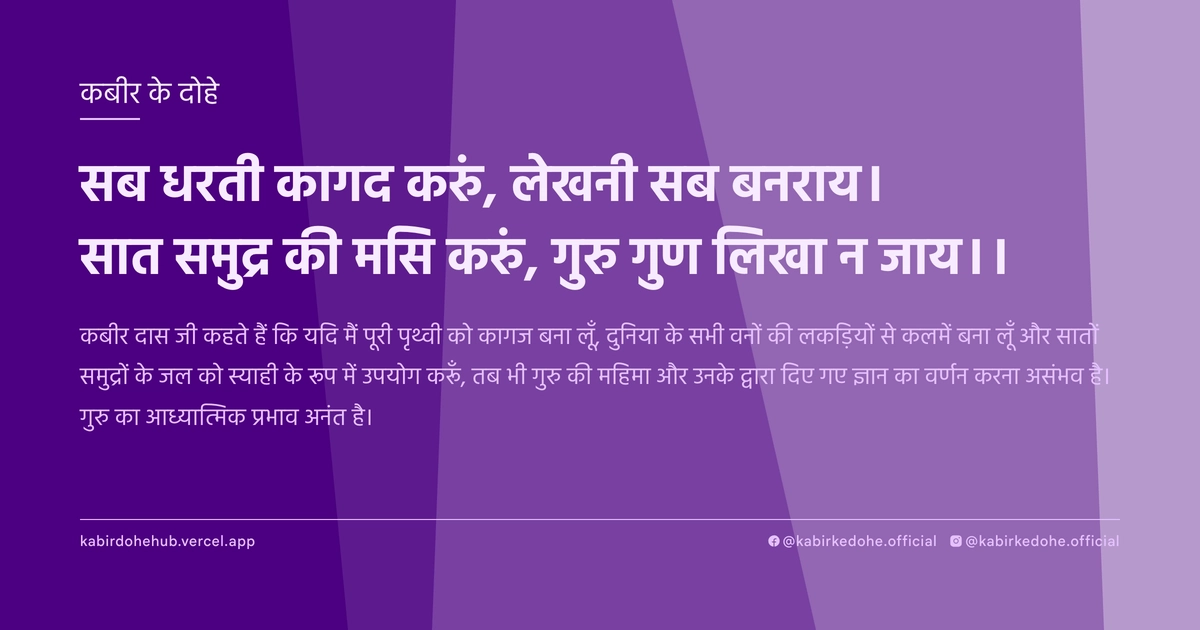
सब धरती कागद करुं, लेखनी सब बनराय।
सात समुद्र की मसि करुं, गुरु गुण लिखा न जाय।।
Sab dharti kagad karun, lekhani sab banray. Saat samudra ki masi karun, guru gun likha na jaaye.
इस पृष्ठ पर इस कबीर दोहे का अर्थ (meaning), हिंदी व्याख्या और अंग्रेज़ी अनुवाद, दार्शनिक विश्लेषण और व्यावहारिक जीवन सीख दी गई है। यह दोहा गुरु महत्व (The Guru's Importance) विषय से जुड़ा है — Kabir doha meaning and explanation in Hindi and English.
अर्थ (Meaning):
कबीर दास जी कहते हैं कि यदि मैं पूरी पृथ्वी को कागज बना लूँ, दुनिया के सभी वनों की लकड़ियों से कलमें बना लूँ और सातों समुद्रों के जल को स्याही के रूप में उपयोग करूँ, तब भी गुरु की महिमा और उनके द्वारा दिए गए ज्ञान का वर्णन करना असंभव है। गुरु का आध्यात्मिक प्रभाव अनंत है।
Kabir suggests that even if the entire earth were turned into paper, every forest into a writing quill, and the waters of the seven seas into ink, the boundless virtues and spiritual grace of the Guru could never be fully documented. The Guru's essence transcends the limits of physical expression.
व्याख्या (Interpretation):
यह दोहा गुरु की असीमित कृपा का वर्णन करता है। शाब्दिक रूप से यह अतिशयोक्ति का प्रयोग करता है, लेकिन आध्यात्मिक स्तर पर यह 'सगुण' (रूप) और 'निर्गुण' (निराकार) के बीच के सेतु के रूप में गुरु की स्थिति को दर्शाता है। यहाँ गुरु केवल एक व्यक्ति नहीं, बल्कि वह चैतन्य शक्ति है जो शिष्य के भीतर के अज्ञान के पर्दे को हटाती है। यह अद्वैत वेदांत के उस सत्य की ओर संकेत करता है जहाँ गुरु वह माध्यम है जो जीव को यह अहसास कराता है कि वह स्वयं ब्रह्म है। माया के प्रभाव में हम सीमितता को देखते हैं, लेकिन गुरु हमें उस अनंतता से परिचित कराते हैं जिसे शब्दों में नहीं बांधा जा सकता। यह विरोधाभास है कि जो अनंत है, उसे व्यक्त करने के लिए हम सीमित शब्दों का सहारा लेते हैं, जो अंततः विफल हो जाता है।
This couplet celebrates the immeasurable grace of the Guru. While literally employing hyperbole, spiritually it positions the Guru as the bridge between the 'Saguna' (manifest) and 'Nirgun' (unmanifest). The Guru is not merely a human teacher but the awakened consciousness that dissolves the veil of ignorance (Maya). Linking to Advaita Vedanta, the Guru is the catalyst who reveals the non-duality of the Atman and Brahman. We perceive limitations due to the illusion of duality, but the Guru introduces us to the Infinite. The central paradox lies in the attempt to capture the boundless essence of spiritual liberation using the finite tools of language and logic, which inevitably fail to encompass the totality of the experience.
दार्शनिक विश्लेषण (Philosophical Analysis):
कबीर का यह दोहा उस कालखंड का है जब समाज कर्मकांडों और बाहरी दिखावे में उलझा था। कबीर ने मंदिर, मस्जिद और शास्त्रोचित ज्ञान के बजाय 'अनुभव' और 'गुरु' की महत्ता पर जोर दिया। उनके लिए गुरु वह नहीं जो केवल पोथियाँ पढ़ाए, बल्कि वह है जो साधक को उसके भीतर के 'सहज' से मिला दे। यह दृष्टिकोण सूफी मत के 'पीर' और वेदांत के 'गुरु' के समन्वय जैसा है, जहाँ समर्पण (Surrender) ही ज्ञान का एकमात्र द्वार है।
यहाँ गुरु की महिमा का वर्णन वास्तव में 'अहंकार' के विसर्जन की प्रक्रिया है। जब शिष्य यह स्वीकार करता है कि गुरु का गुण अनंत है, तो उसका अपना छोटा 'मैं' समाप्त होने लगता है। यह मनोवैज्ञानिक रूपांतरण है जहाँ व्यक्ति अपनी बौद्धिक श्रेष्ठता का त्याग कर पूर्णता के प्रति समर्पित होता है।
कबीर ने जाति और धर्म की सीमाओं को तोड़कर ज्ञान को सार्वभौमिक बनाया। उनके अनुसार, गुरु वह प्रकाश है जो अंधकार को मिटाता है, चाहे वह अंधकार किसी भी धर्म या जाति के व्यक्ति का हो। यह सामाजिक समानता का एक गहरा आध्यात्मिक आधार प्रदान करता है।
दार्शनिक रूप से, यह दोहा 'शब्द' और 'अर्थ' के बीच के अंतर को स्पष्ट करता है। शास्त्र (लिखा हुआ ज्ञान) सीमित है, जबकि अनुभव (गुरु का ज्ञान) असीम है। कबीर चेतावनी देते हैं कि केवल पढ़ने से मोक्ष नहीं मिलता; मोक्ष उस जीवंत परंपरा से मिलता है जो गुरु के माध्यम से प्रवाहित होती है।
अंततः, यह निर्गुण भक्ति का सार है। गुरु वह दर्पण है जिसमें शिष्य अपनी वास्तविक स्वरूप को देखता है। जब शिष्य और गुरु एक हो जाते हैं, तब लिखने या वर्णन करने की आवश्यकता ही समाप्त हो जाती है, क्योंकि सत्य स्वयं अनुभव बन जाता है।
Kabir's verse emerges from an era dominated by rigid ritualism and scriptural dogmatism. He pivots away from the external trappings of temples and mosques, emphasizing 'Anubhav' (direct experience) and the role of the Guru. For Kabir, the Guru is not a mere lecturer of texts but a spiritual catalyst who awakens the 'Sahaj' (innate spontaneity) within the seeker. This aligns with the Sufi concept of the 'Pir' and the Vedantic 'Guru', where absolute surrender is the gateway to enlightenment.
The exaltation of the Guru is, in reality, a process of ego-annihilation. By acknowledging the infinite nature of the Guru's grace, the seeker's limited 'I' begins to dissolve. This is a psychological shift from intellectual pride to spiritual humility, allowing the seeker to move from the fragmented self to the universal whole.
Kabir dismantled caste and religious hierarchies by making spiritual knowledge universal. He posits that the light of the Guru eradicates ignorance regardless of one's social standing. This provides a profound spiritual foundation for social equality, suggesting that the soul's liberation is independent of earthly identity.
Philosophically, the verse distinguishes between 'Shabd' (the word) and 'Arth' (the meaning/essence). Scriptural knowledge is finite and static, whereas the Guru's guidance is dynamic and infinite. Kabir warns that liberation cannot be achieved through rote learning; it requires a living transmission of wisdom.
Ultimately, this reflects the core of Nirgun Bhakti. The Guru acts as a mirror reflecting the seeker's true nature. When the duality between the teacher and the taught vanishes, the need for description disappears, as truth is no longer an object of study but a lived reality.
मूल संदेश (Core Message):
- बौद्धिक ज्ञान की सीमाएं हैं, लेकिन अनुभव की कोई सीमा नहीं है।
- अहंकार का विसर्जन ही वास्तविक ज्ञान का प्रारंभ है।
- गुरु व्यक्ति नहीं, बल्कि वह चेतना है जो अज्ञान को मिटाती है।
- सत्य शब्दों में नहीं, बल्कि मौन और अनुभव में बसता है।
- समर्पण वह कुंजी है जो अनंत के द्वार खोलती है।
- Intellectual knowledge is finite; direct experience is boundless.
- The dissolution of ego is the true beginning of wisdom.
- The Guru is not a person, but the consciousness that erases ignorance.
- Truth resides not in words, but in silence and lived experience.
- Surrender is the key that unlocks the gates of the Infinite.
व्यावहारिक उदाहरण (Practical Example):
वाराणसी के घाटों पर रहने वाले एक वृद्ध बुनकर, माधव, का जीवन केवल धागों और करघे के इर्द-गिर्द सिमटा था। वह अपनी कला में निपुण था, लेकिन मन में एक गहरी अशांति थी। उसे लगता था कि जीवन केवल पेट भरने और वस्त्र बुनने का एक अंतहीन चक्र है। वह अक्सर बड़े-बड़े पंडितों के पास जाता, कठिन ग्रंथों के श्लोक सुनता, लेकिन उसका मन कभी शांत नहीं हुआ। उसे लगता था कि ज्ञान केवल किताबों और कठिन शब्दों में छिपा है।
एक दिन उसकी मुलाकात एक फकीर से हुई, जो घाट की सीढ़ियों पर चुपचाप बैठा रहता था। फकीर ने माधव को कोई ग्रंथ नहीं दिया, न ही कोई मंत्र सिखाया। उसने बस माधव से कहा, 'जिस तरह तुम धागों के बीच के खाली स्थान को देखते हो ताकि कपड़ा बन सके, वैसे ही अपने जीवन के शोर के बीच उस मौन को खोजो जो तुम स्वयं हो।'
माधव को पहले यह बात बहुत साधारण लगी। उसने सोचा कि इतने सालों से वह बड़े विद्वानों से सीख रहा था, और यह फकीर उसे केवल 'मौन' की बात कर रहा है। लेकिन जैसे-जैसे उसने उस निर्देश का पालन किया, उसे महसूस हुआ कि उसकी सारी बौद्धिक खोजें व्यर्थ थीं।
उसने पाया कि जिस शांति को वह किताबों में खोज रहा था, वह उसके भीतर ही थी, बस उसे पहचानने के लिए एक सही दिशा की आवश्यकता थी। फकीर ने उसे वह दिशा दी थी।
धीरे-धीरे माधव का व्यवहार बदलने लगा। वह अब केवल कपड़ा नहीं बुनता था, बल्कि हर धागे में उस अनंत शांति का अनुभव करता था। उसकी कला में एक नई गहराई आ गई, क्योंकि अब वह अहंकार से नहीं, बल्कि समर्पण से काम कर रहा था।
उसके आस-पड़ोस के लोग हैरान थे कि माधव अब विवादों से दूर रहता था और उसके चेहरे पर एक अलौकिक तेज था। जब लोग उससे पूछते कि उसने कौन सी किताब पढ़ी है, तो वह बस मुस्कुरा देता।
उसे समझ आया कि फकीर का वह एक छोटा सा वाक्य दुनिया की सारी लाइब्रेरी की किताबों से अधिक शक्तिशाली था। वह ज्ञान शब्दों में नहीं, बल्कि उस अनुभव में था जिसने उसे बदल दिया था।
माधव ने महसूस किया कि गुरु वह नहीं जो आपको जानकारी दे, बल्कि वह है जो आपकी दृष्टि बदल दे। उसने अपनी पूरी संपत्ति और सम्मान उस फकीर के चरणों में समर्पित कर दिया, यह जानते हुए कि असली धन वह आंतरिक शांति है जो उसे मिली है।
अब वह अपनी बुनाई को ही अपनी प्रार्थना मानता था। उसने सीखा कि जब गुरु का हाथ सिर पर होता है, तो साधारण जीवन भी एक महान साधना बन जाता है।
यह माधव का 'कबीर ट्विस्ट' था—किताबों के बोझ से मुक्त होकर, एक जीवित गुरु के मौन शब्द के माध्यम से उसने उस अनंत सत्य को पा लिया जिसे दुनिया की सारी स्याही भी नहीं लिख सकती थी।
Madhav, an elderly weaver living on the ghats of Varanasi, spent his life confined to the rhythm of threads and looms. Though a master of his craft, a deep restlessness plagued him. He viewed life as an endless cycle of survival and labor. He frequently visited learned pundits, listening to complex scriptural verses, yet his mind remained turbulent. He believed wisdom was hidden only within heavy books and arcane terminology.
One day, he encountered a wandering dervish who sat in silence on the stone steps of the river. The dervish gave Madhav no scriptures and taught him no mantras. He simply said, 'Just as you observe the empty spaces between the threads to create a fabric, find the silence within the noise of your life; for that silence is who you truly are.'
Initially, Madhav found this advice too simple. He thought, 'I have studied under great scholars, and this man speaks only of silence.' However, as he began to practice this observation, he realized that his lifelong intellectual pursuit had been a detour.
He discovered that the peace he sought in libraries existed within him all along; he simply lacked the correct lens to perceive it. The dervish had provided that lens.
Gradually, Madhav's behavior transformed. He no longer wove just for sustenance, but experienced a profound serenity in every thread. His art gained a new dimension because he worked from a place of surrender rather than ego.
Neighbors were amazed that Madhav, once irritable, now avoided all conflicts and carried a celestial glow. When asked which scripture had changed him, he would only smile.
He understood that the dervish's simple sentence was more powerful than all the libraries in the world. The wisdom was not in the words, but in the experience the words triggered.
Madhav realized that a true Guru is not one who provides information, but one who transforms your vision. He surrendered his pride and material attachments at the dervish's feet, knowing the real wealth was his inner stillness.
He began to treat his weaving as a form of prayer. He learned that under the guidance of a true master, an ordinary life becomes a supreme spiritual practice.
This was Madhav's 'Kabir Twist'—by shedding the burden of books and embracing the living word of a master, he touched a truth that all the ink in the seven seas could never document.
अभ्यास मार्गदर्शन (Practice Guidance):
- प्रतिदिन 20 मिनट 'साक्षी भाव' का अभ्यास करें: अपने विचारों को बिना किसी निर्णय के देखें, जैसे आप किसी और को देख रहे हों।
- आत्म-पूछताछ जर्नल: प्रतिदिन लिखें कि आज आपने कहाँ अपने 'अहंकार' को ज्ञान के पीछे भागते देखा और कहाँ आपने 'सहज' अनुभव किया।
- व्यवहारिक परिवर्तन: किसी ऐसे व्यक्ति की मदद करें जिससे आप असहमत हैं, यह मानते हुए कि उनके भीतर भी वही अनंत चेतना है जो आपके भीतर है।
- डायग्नोस्टिक चेकलिस्ट: क्या आप अभी भी सत्य को केवल किताबों या दूसरों के प्रमाणों में खोज रहे हैं? यदि हाँ, तो आप अभी भी 'माया' के प्रभाव में हैं। क्या आप मौन में सहज महसूस करते हैं? यदि हाँ, तो आप गुरु-तत्व के करीब हैं।
- Practice 'Witness Consciousness' for 20 minutes daily: Observe your thoughts without judgment, as if you are watching a stranger.
- Self-Inquiry Journaling: Record instances where you noticed your ego chasing intellectual validation versus moments where you felt 'Sahaj' (spontaneous presence).
- Behavioral Shift: Perform an act of service for someone you fundamentally disagree with, acknowledging that the same infinite consciousness resides in them as in you.
- Diagnostic Checklist: Are you still seeking truth exclusively in books or external validations? If so, you are still under the influence of Maya. Do you feel at home in silence? If yes, you are aligning with the Guru-principle.
चिंतन प्रश्न (Reflection Questions):
- क्या मेरी आध्यात्मिक खोज वास्तव में सत्य को जानने के लिए है, या यह मेरे बौद्धिक अहंकार को संतुष्ट करने का एक तरीका है?
- मैं अपनी पहचान को अपनी डिग्री, पद या ज्ञान से कितना जोड़ता हूँ, और यदि ये सब छीन लिए जाएं, तो मेरा 'मैं' क्या बचेगा?
- क्या मैं वास्तव में किसी के मार्गदर्शन के लिए तैयार हूँ, या मैं केवल उन्हीं गुरुओं को पसंद करता हूँ जो मेरी मौजूदा मान्यताओं की पुष्टि करते हैं?
- मेरे जीवन का वह कौन सा 'मौन' है जिसे मैं शोर से भरने की कोशिश करता रहता हूँ?
- यदि सत्य को शब्दों में नहीं लिखा जा सकता, तो मैं अपनी पूरी जिंदगी किन शब्दों के पीछे भाग रहा हूँ?
- Is my spiritual quest truly about seeking truth, or is it a sophisticated way to feed my intellectual ego?
- To what extent do I tie my identity to my degrees, status, or knowledge, and if these were stripped away, what would remain of 'I'?
- Am I truly open to guidance, or do I only gravitate toward teachers who validate my existing biases?
- What is the specific 'silence' in my life that I constantly try to drown out with noise?
- If truth cannot be captured in words, which illusions have I been chasing in the form of language?